Antibiotic-free poultry means birds raised without antibiotics for growth promotion or routine disease prevention — animals kept healthy by good management, vaccination and biosecurity rather than by drugs in the water tank, with medicines reserved for genuinely sick birds and always followed by the correct withdrawal period. It is not the same as never treating a sick bird, and it is not achieved by simply stopping antibiotics on a badly run farm. Done properly it protects your flock, protects the people who eat your chicken, and increasingly opens a premium market. This guide explains what antibiotic-free really means for a Ghanaian farm, why it matters for antimicrobial resistance and food safety, and exactly how to get there without losing birds.
Written by the Agro Prime Ghana poultry team and reviewed against current health references (World Health Organization guidance and peer-reviewed research on Ghana's poultry sector). Last updated September 2026.
Key takeaways
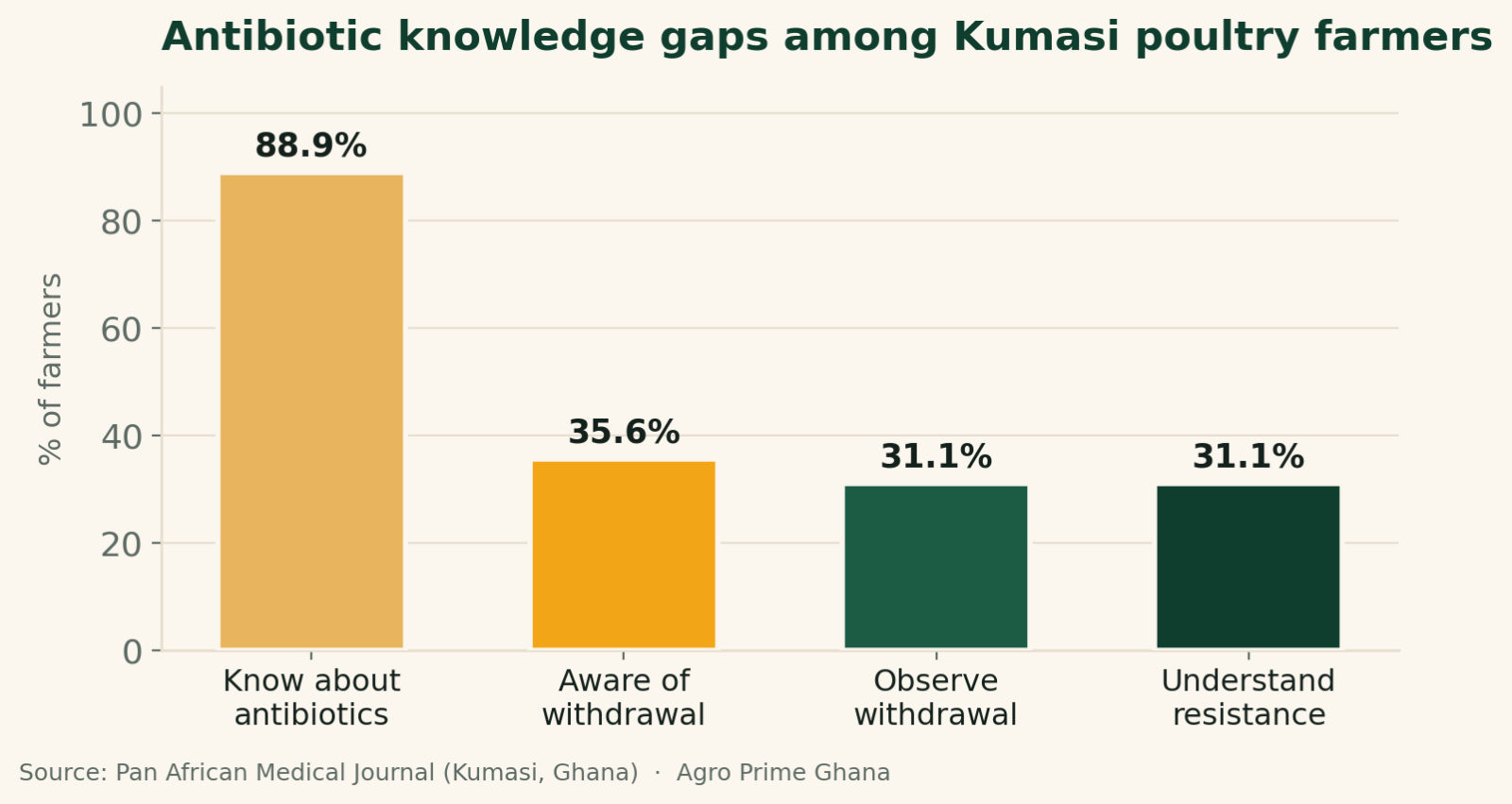
"Antibiotic-free" poultry is raised without antibiotics for growth promotion or routine prevention; sick birds are still treated, then held through a proper withdrawal period. This matters because antimicrobial resistance (AMR) was associated with more than 4.7 million deaths globally in 2021, and in some countries about 80% of medically important antibiotics are used in animals. In 2017 the WHO recommended farmers stop using antibiotics for growth promotion and for disease prevention without a diagnosis. Ghana has real gaps: in one Kumasi study only 35.6% of poultry farmers were aware of withdrawal periods and just 31.1% observed them. You cut antibiotics by leaning on biosecurity, vaccination, clean water, good brooding, probiotics, prebiotics and organic acids — and treating illness responsibly when it strikes. Meat withdrawal periods run roughly 3–7 days for common drugs.
What does "antibiotic-free" poultry actually mean?
Antibiotic-free poultry is meat or eggs produced from birds that were not given antibiotics to make them grow faster or to blanket-prevent disease in a healthy flock. The phrase is widely used — and widely muddled — so it helps to be precise about what it does and does not mean. It does not mean a farm that lets sick birds suffer untreated; responsible antibiotic-free systems still treat individual sick birds or a diagnosed outbreak, but those birds are then either removed from the antibiotic-free label or held long enough that no residue remains. What it rules out is the two habits that drive most antibiotic overuse in poultry: routinely dosing the water "to be safe," and using antibiotics as a crutch for poor hygiene, crowding or weak chicks. In practice, a true antibiotic-free programme replaces those crutches with better management — the birds stay well because the system keeps them well, not because a drug is masking the problems. This is a meaningful distinction for Ghanaian farmers, because the goal is not to abandon medicine but to stop using it as a substitute for husbandry.
Why antibiotic-free production matters — AMR and Ghana
The reason this has moved from a niche concern to a global priority is antimicrobial resistance: the process by which bacteria, exposed again and again to antibiotics, evolve to survive them, so that the drugs stop working in animals and in people. The World Health Organization reports that bacterial AMR "was estimated to be associated with more than 4.7 million deaths globally in 2021." A large share of the world's antibiotics never goes near a hospital — in some countries, WHO notes, "approximately 80% of total consumption of medically important antibiotics is in the animal sector, largely for growth promotion in healthy animals." Because resistant bacteria and resistance genes move between animals, people, food and the environment, overusing antibiotics on the farm directly undermines the medicines doctors rely on. That is why, in 2017, the WHO issued a clear recommendation to stop using antibiotics in healthy animals: no antibiotics for growth promotion, and none for disease prevention unless disease "has been diagnosed in other animals in the same flock, herd, or fish population."
Ghana is squarely part of this picture. Research on poultry farms in the Kumasi metropolitan area found that while 88.9% of farmers were knowledgeable about antibiotics, only 31.1% understood antibiotic resistance, only 35.6% were aware of residues and withdrawal periods, and just 31.1% actually observed withdrawal periods — with 100% adding antibiotics to drinking water. That study found residues in market chicken liver and gizzard were below accepted limits, but the knowledge gaps are a warning sign. Ghana has taken the problem seriously nationally, with a National Action Plan on Antimicrobial Resistance. For the individual farmer the message is simple: using fewer antibiotics, correctly, is not just good ethics — it is good business.
Withdrawal periods: the bridge to residue-free meat
A withdrawal period is the time that must pass between the last dose of a drug and the day a bird is slaughtered (or its eggs eaten), so that residues fall below safe limits. It is the single most important rule for anyone who does use antibiotics, because it is the difference between safe chicken and chicken carrying drug residues. Observing it is not optional cosmetic caution — residues in meat can trigger allergic reactions and help drive antibiotic resistance in people. The exact period depends on the drug; the figures below are typical published pre-slaughter withdrawal times for chickens and illustrate the principle. Always follow the specific period printed on the product you use, and if a label is missing or unclear, ask a veterinary or extension officer rather than guessing.
| Antibiotic (example) | Typical meat withdrawal before slaughter | Note |
|---|---|---|
| Amoxicillin | ~3 days | A penicillin; residues can cause allergy in sensitive people |
| Oxytetracycline | ~5 days | Tetracycline group; very widely used in Ghana |
| Tylosin | ~5 days | Macrolide used for respiratory disease |
| Sulfa drugs (e.g. sulfadimidine) | ~5 days | Longer for some sulphonamides; check the label |
| Ciprofloxacin / fluoroquinolones | ~6 days | Medically critical for humans — use sparingly |
Indicative published withdrawal times (source: SR Publications review of drug withdrawal periods). Always follow the withdrawal period stated on the specific product.
The pillars of raising poultry without routine antibiotics
If antibiotics are the crutch, these are the legs that let a flock stand without them. Antibiotic-free production is not one clever product but a stack of solid basics, each removing a reason birds get sick in the first place:
- Biosecurity first. Most flock infections are brought in — on shoes, vehicles, crates, wild birds, rodents and new stock. Tight biosecurity (foot dips, restricted visitors, all-in-all-out, pest control) keeps pathogens out so you never need to medicate them out.
- Vaccination. The diseases that most often trigger panic antibiotic use in Ghana — Newcastle, Gumboro, fowl typhoid — are largely vaccine-preventable. A disciplined programme (see our layer vaccination schedule) prevents the outbreaks that drive drug use.
- Clean water and good brooding. Contaminated water is a direct route to gut disease; strong early brooding builds robust chicks. Getting the first weeks right sharply reduces later illness.
- Coccidiosis control without antibiotics. Coccidiosis is a leading reason keepers reach for medication. A coccidiosis vaccine or an ionophore coccidiostat (not a medically important human antibiotic), plus dry litter, controls it without touching your antibiotic-free status.
Notice the theme: every pillar prevents a problem rather than treating one. That is the whole logic of antibiotic-free — you spend your effort upstream, on keeping birds well, instead of downstream, on rescuing sick ones.
Field note: the water tank is where most antibiotics get wasted
In our experience the habit that undermines antibiotic-free intentions most is routine, "just-in-case" dosing of the drinking water — a splash of tetracycline every few weeks whether or not anything is wrong. It feels like insurance, but it does three harmful things: it breeds resistance, it can leave residues if the birds are near market, and it hides the management faults that are the real cause of illness. When a keeper tells us their birds "always need antibiotics," the answer is almost never a stronger drug — it is cleaner water lines, better brooding, tighter biosecurity and the right vaccines. Take the routine dosing out of the water and you are forced to fix the things that actually keep birds well.
Start antibiotic-free from day one with strong, vaccinated chicks
Raising poultry without routine antibiotics is far easier when you begin with robust, well-hatched chicks and a clear vaccination plan — because most drug use is a reaction to weak starts and preventable disease. Agro Prime Ghana supplies healthy day-old broiler and layer chicks from our Kasoa hatchery, and we can help you build a brooding, biosecurity and vaccination programme designed to keep antibiotic use to genuine treatment only. If you are aiming at the antibiotic-free or "no routine antibiotics" market, we can talk through what your buyers will expect. Message us on WhatsApp (+233 24 915 1503) or book a visit to plan a healthier batch.
Alternatives to antibiotics that actually work
Cutting routine antibiotics does not mean cutting the tools that support gut health and immunity — it means swapping drugs for approaches that do not breed resistance. Several are well established in modern poultry production and increasingly available in Ghana:
- Probiotics and prebiotics. Beneficial bacteria (probiotics) and the fibres that feed them (prebiotics) help build a healthy gut flora that crowds out pathogens like Salmonella and E. coli. Our guide to probiotics in poultry covers how to use them.
- Organic acids. Adding acids to feed or water lowers gut pH, discouraging harmful bacteria and supporting digestion — a common antibiotic-free strategy.
- Phytogenics and botanicals. Plant extracts and herbs (including locally familiar ones) are used to support gut health and appetite; evidence varies by product, so treat them as support, not miracle cures.
- Coccidiosis vaccines and ionophores. Because coccidiosis drives so much medication, controlling it without medically important antibiotics is a cornerstone of any antibiotic-free plan.
- Good nutrition and clean feed. A balanced ration and mould-free, residue-free ingredients keep the gut and immune system strong, so birds resist challenges that would otherwise need treating.
None of these replaces the basics of biosecurity and vaccination — they layer on top of them. Think of the whole approach as building resilience, so that when a challenge comes, the flock shrugs it off instead of collapsing into an outbreak.
When a bird is sick: responsible treatment still matters
Antibiotic-free must never become an excuse to let animals suffer. The WHO guidance is explicit that "sick animals should be tested to determine the most effective and prudent antibiotic to treat their specific infection," and that healthy animals may receive preventive antibiotics only when disease has actually been diagnosed in the flock. The responsible position is straightforward: prevent hard, but when a genuine disease is diagnosed, treat it properly — the right drug, at the right dose, for the right duration, ideally on veterinary advice, and never the "highest priority critically important" human antibiotics unless there is no alternative. Then observe the withdrawal period to the day, and if you are marketing under an antibiotic-free label, divert those treated birds out of that stream. This is what separates a credible antibiotic-free programme from an irresponsible one: it reduces antibiotics by making them rarely necessary, not by refusing to use them when an animal truly needs help. Our guides to responsible antibiotic use and water medication walk through doing it correctly.
Field note: keep records, and you will use fewer drugs
The farms that use the least antibiotics are almost always the ones that keep the best records. When you write down every treatment — what, when, which birds, and the withdrawal date — three things happen: you stop treating out of habit, you can prove to a buyer that your birds are clean at slaughter, and you start to see the patterns that tell you which management fault keeps causing the same illness. A simple treatment logbook is one of the cheapest antibiotic-reduction tools there is, and it doubles as your evidence when a premium buyer asks how your birds were raised.
The market angle: is antibiotic-free worth it in Ghana?
Increasingly, yes. As Ghanaian consumers, hotels, restaurants and export buyers grow more conscious of food safety and antibiotic resistance, "raised without routine antibiotics" and "residue-free" are becoming genuine selling points rather than abstract ideals. A farm that can honestly say its birds were kept healthy through good management, and that every treated bird was held through its withdrawal period, has a story that discerning buyers will pay for. The commercial logic also runs the other way: routine antibiotic use is a cost — the drugs plus the resistance and residue risks — while the antibiotic-free approach reinvests that money in prevention that lowers mortality. You do not need a formal certification to benefit; simply running a genuinely low-antibiotic, withdrawal-compliant operation gives you a cleaner, safer, more marketable product. For farms supplying schools, hospitals, hotels or premium retail, it is fast becoming the expectation rather than the exception — worth weighing in any poultry marketing plan.
The bottom line on antibiotic-free poultry
Raising antibiotic-free poultry in Ghana is not about denying sick birds medicine — it is about building a farm so well-managed that antibiotics are rarely needed, and using them properly (with full withdrawal periods) when they genuinely are. The stakes are real: antimicrobial resistance is a global killer, animals account for a large share of antibiotic use, and Ghana's own farms show wide gaps in withdrawal-period knowledge. The path forward is prevention stacked on prevention — biosecurity, vaccination, clean water, strong brooding, coccidiosis control, probiotics, organic acids and good nutrition — so that the water tank stops being a routine drug dispenser. Treat responsibly when you must, observe every withdrawal period to the day, keep records, and you produce chicken that is safer for your customers, kinder to the medicines we all depend on, and increasingly worth a premium. That is a business advantage as much as an ethical one.
Frequently asked questions
What does antibiotic-free poultry mean?
Why is reducing antibiotics in poultry important?
What is a withdrawal period and why does it matter?
How can I raise chickens without routine antibiotics?
Are there proven alternatives to antibiotics in poultry?
Do Ghanaian farmers follow withdrawal periods?
Is antibiotic-free poultry more profitable in Ghana?
Should I stop treating sick birds to stay antibiotic-free?
Sources & further reading
- World Health Organization — Stop using antibiotics in healthy animals (2017 recommendations; 80% animal-sector figure) and the Antimicrobial resistance fact sheet (4.7 million deaths, 2021).
- Pan African Medical Journal — Antibiotic usage and prevalence of antibiotic residue in broiler chicken, Kumasi (farmer awareness and withdrawal-period practice in Ghana).
- SR Publications — Drug Withdrawal Periods for Animal-Derived Products (withdrawal definition and typical days; public-health effects).
- Ministry of Health, Ghana — National Action Plan on Antimicrobial Resistance.
- Agro Prime Ghana guides: responsible antibiotic use, poultry biosecurity, probiotics in poultry and coccidiosis.
About Agro Prime Ghana
Agro Prime Ghana Limited runs a poultry hatchery and mixed agribusiness in Kasoa, supplying day-old chicks and supporting poultry keepers nationwide. These guides combine hands-on hatchery and farm experience with current health and veterinary references. This article is general educational information, not a substitute for professional veterinary advice — if your flock is sick, have it seen and treated properly, and always observe withdrawal periods. We supply healthy day-old chicks (broilers & layers), point-of-lay pullets, quality feed and hands-on farm support. Ready to build a healthier, lower-antibiotic flock? Book a visit or message us on WhatsApp (+233 24 915 1503) to order chicks, feed or advice.