Most poultry medicines in Ghana go into the flock through the drinking water, and for good reason: sick birds go off their feed long before they stop drinking, so water reaches them when medicated feed no longer would. But water medication is also where a lot of treatments quietly fail. The bag says the drug works, yet the flock does not recover — not because the medicine is bad, but because half the birds never got a proper dose. Too much water in the trough and the dose is diluted to nothing; a header tank topped up all afternoon and the concentration drifts down hour by hour. Getting water medication right is a skill worth learning properly. This guide covers correct dosing, stock solutions, and the mistakes that waste medicine and money.
Written by the Agro Prime Ghana poultry team and reviewed against current veterinary references (MSD Veterinary Manual and industry water-medication guidance). Last updated September 2026.
Key takeaways
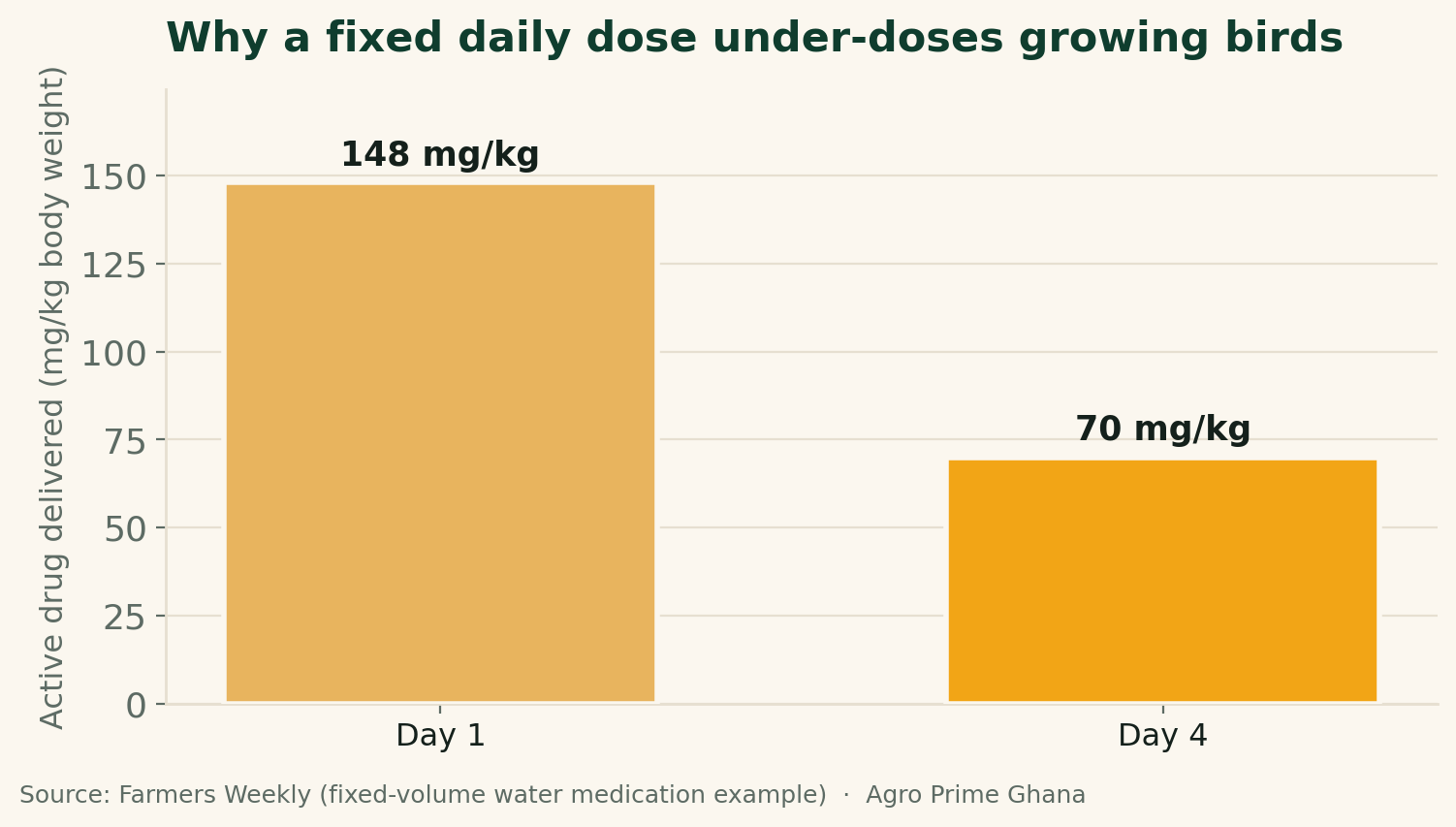
Dose by the birds, not the trough: most poultry drugs are dosed per kilogram of body weight, so you work out the total flock weight, calculate the total drug needed, and then dissolve that into only as much water as the flock will actually drink in the treatment window. Birds drink roughly twice as much water as feed by weight (more in heat), and intake rises daily as they grow — so a fixed daily amount of drug under-doses birds as they grow, dropping in one industry example from 148 to 70 mg per kg over four days. Make a concentrated stock solution and meter it in with a dosing pump (commonly a 1–2% ratio), or dose a measured header tank and turn off the top-up so it is not continually diluted. Most water treatments run 3–5 days. Withhold water briefly first so thirsty birds drink promptly, mix only what will be used within the day, clean lines before and after, and never combine drugs with vitamins, electrolytes or heavy chlorine unless the label allows it.
Why water is the main route in Ghana
Water medication dominates for practical reasons. Appetite fails before thirst: a bird fighting coccidiosis, fowl typhoid or a respiratory infection stops eating days before it stops drinking, so a water-soluble drug still reaches it when medicated feed sits untouched. Water dosing is also fast to start and lets you adjust the dose daily as the flock grows. The trade-off is that it is only as accurate as your arithmetic and water management: unlike a bag of feed mixed to a fixed rate, the concentration in the water depends entirely on how much the birds drink and how much water you put the drug into. That is the whole game.
Dose by the bird, not by the bucket
The commonest conceptual error is to think in terms of "how much drug per litre of water." Almost all poultry medicines are prescribed as a dose per kilogram of body weight per day. So the honest calculation runs in this order: estimate the average body weight of your birds and multiply by the number of birds to get total flock weight; multiply that by the label's mg/kg dose to get the total drug the flock needs that day; then dissolve that total into the amount of water the flock will drink in your treatment window. The water volume is just the carrier — you size it to what the birds will actually consume, not the other way round.
How much will they drink? A reliable rule of thumb is that poultry drink roughly twice as much water as they eat feed, by weight, and considerably more in Ghana's heat. Intake also rises every day as birds grow — from a few tens of millilitres in day-old chicks up to around 300 mL a day in larger birds depending on type and temperature. The safest approach is to measure your own flock's actual daily water use from the meter or tank for a day or two before you medicate, because your birds, your weather and your equipment give a real number instead of a guess.
The trap of the fixed daily dose
Here is the mistake that catches even experienced keepers. You add the same amount of drug to the tank every day of a course. It feels consistent — but the birds are growing and drinking more each day, so the same drug spread through more water and more body weight means the dose per bird falls day by day. Industry figures put real numbers on it: under a fixed-volume approach the active delivered dropped from about 148 mg per kg on day one to about 70 mg per kg by day four — less than half the intended dose by the end, exactly when you need the drug to finish the job. The fix is to recalculate every day so the per-bird dose stays steady, as summarised below. A dose that drifts to half-strength breeds resistance and relapses.
| Dosing approach | What you do | What happens to the dose |
|---|---|---|
| Same amount daily (avoid) | Add a fixed weight of drug to the water each day of the course | Dose per bird falls as birds grow and drink more — e.g. 148 → 70 mg/kg over four days |
| Recalculate daily (best) | Work out flock weight and drug needed fresh each day | Per-bird dose held steady; total product rises (e.g. 100 → 216 g/day) |
| Stock solution + pump | Concentrate metered in at ~1–2%, container emptied over 24 h | Concentration stays constant however fast birds drink |
Stock solutions and dosing pumps
For anything but the smallest flock, the professional method is a stock (concentrated) solution metered into the water line by a dosing pump (proportioner/medicator). You dissolve the full day's drug into a small, concentrated volume, and the pump injects it into the drinking water at a fixed ratio — commonly around 1 or 2% (one part concentrate to about 100 or 50 parts water). The concentration then stays constant however the birds' drinking speeds up or slows, and you simply size the concentrate container to empty over 24 hours, which keeps dosing even. Two things make or break it: the drug must be fully dissolved (undissolved powder settles, clogs and doses unevenly), and the pump must be correctly calibrated, because a proportioner at the wrong ratio silently over- or under-doses the whole flock.
Field note: make the stock solution properly, or don't bother
The stock solution is where small farms lose their treatments. We dissolve the powder in a little clean, lukewarm water first and stir it to a smooth mix before making it up to volume — never tip dry powder into a full tank, where it clumps, sinks and coats the bottom. We use clean, non-metal containers, mix only what will be used that day, and stir the tank if the drug tends to settle. If the water is heavily chlorinated or very hard, some drugs bind or break down, so we use the plainest clean water we have for medicating. A cloudy, sludgy tank is a sign the dose in the birds is nothing like the dose on the label.
Dosing a header tank without over-diluting
Plenty of Ghanaian houses run off a simple header tank rather than an in-line pump, and this works well if you respect one rule: stop the automatic top-up while the medicated water is being drunk. If the float valve keeps refilling the tank with plain water as the birds drink, the medicine gets more and more dilute through the day and the last birds to drink get almost nothing. Instead, calculate the drug for a measured tank volume the flock will drink in the window, turn off the incoming supply, let the birds empty that water, and only then refill. Bleed and prime the lines first, too: in long drinker lines it can take several hours for freshly medicated water to reach the far nipples, so birds at the end of the house are dosed last unless you account for it.
Get the birds to drink it — the thirst window
A dose only works if the birds actually take it, and take it together. The standard trick is a short thirst window: withhold water for a brief period (judged by weather and age, and never so long that it stresses birds, especially in heat) so that when the medicated water goes on, the whole flock drinks promptly and evenly. This concentrates consumption into the period when the drug is at full strength, instead of slow drinkers dribbling it in over hours. Put medicated water on in the cool of early morning where you can, because in the afternoon heat birds drink erratically — and mixing water dosing with heat-stress management needs care (see our guide to heat stress in poultry). Make sure there is enough drinker space for every bird to reach the water in that window; a crowded line means the timid birds — often the sickest — miss out.
Timing, duration and finishing the course
Most water medications are given for a defined course, commonly 3–5 days depending on the drug and disease, and the course is set for a reason. Stopping early because the birds "look better" is a classic route to relapse and resistance, particularly with antibiotics — finish the full course at the correct daily dose. Mix fresh medicated water every day: many drugs lose potency once dissolved and standing, and a tank of yesterday's solution left warm in the sun is both weaker and a contamination risk. If there is no response in the expected time, reconsider the diagnosis rather than simply dosing longer. For antiparasitics the same discipline applies — our guide to deworming poultry covers dosing and withdrawal for those products.
Field note: the withdrawal period is not optional
Whatever goes into the water, the egg and meat withdrawal period on the label is a legal and food-safety line, not a suggestion. Antibiotics and some other drugs leave residues in eggs and meat for a set number of days after treatment, and selling within that window puts residues into the food chain and your reputation on the line. We write the treatment date and the earliest safe sale date on the pen card the day we start dosing, so nobody has to guess later. If you supply eggs or dressed birds to schools, hotels or the public, treat withdrawal as seriously as the dose itself.
The mistakes that waste medicine
The failures that most often turn a good drug into a wasted one:
- Dosing by volume of water instead of body weight, so the dose per bird is anyone's guess.
- Adding a fixed amount daily while birds grow and drink more, so the dose falls to half-strength by the end of the course.
- Letting a header tank keep topping up with plain water, diluting the medicine through the day.
- Not dissolving the drug fully, so powder settles, dosing is uneven and lines clog; or running an uncalibrated pump at the wrong ratio.
- Medicating in the heat with no thirst window, so intake is erratic and the sickest birds miss out.
- Mixing drugs with vitamins, electrolytes or heavy chlorine that inactivate them, unless the label allows it.
- Stopping early or reusing yesterday's solution, and ignoring the withdrawal period.
Every one of these is free to fix — they are about method and arithmetic, not money. Clean drinker lines and good water quality sit underneath all of it, part of the wider husbandry covered in our poultry biosecurity guide.
The bottom line on water medication
Water is the right route for most poultry treatment because sick birds keep drinking after they stop eating — but the medicine only works if the dose that reaches each bird matches the label. Dose by body weight, not the volume of the trough; recalculate every day as the flock grows so the dose does not drift to half-strength; deliver it through a properly made stock solution and a calibrated pump, or a measured header tank with the top-up switched off; and get the whole flock drinking it together with a short thirst window in the cool of the morning. Finish the course, mix fresh each day, respect the withdrawal period, and keep the water clean. Do that, and the drug on your shelf actually does the job it was bought for — instead of running down the lines at a strength that treats nothing and breeds resistance.
Frequently asked questions
How do I calculate the right dose of medicine for water?
What is a stock solution and why use one?
Why do my water treatments seem not to work?
How much water do chickens drink?
Should I withhold water before medicating?
Can I mix medicine with vitamins or electrolytes in the water?
How long should a water medication course last?
Do I need to worry about withdrawal periods with water medication?
Sources & further reading
- MSD Veterinary Manual — general guidance on drug administration to poultry via drinking water, dosing by body weight, and residue/withdrawal considerations.
- Farmers Weekly — New tips on water medicating broiler chicks (fixed vs increasing dose drift, header-tank management, line bleeding, dosing pumps).
- Dosatron / industry water-medication guidance — Poultry medication via drinking water (water intake, stock solutions, mixing and system hygiene).
- Agro Prime Ghana guides: deworming poultry, heat stress in poultry, and poultry biosecurity.
About Agro Prime Ghana
Agro Prime Ghana Limited runs a poultry hatchery and mixed agribusiness in Kasoa, supplying day-old chicks and supporting poultry keepers nationwide. These guides combine hands-on hatchery and farm experience with current veterinary references. This article is general educational information, not a substitute for veterinary advice — always follow the specific product label for dose, mixing and withdrawal, and involve a veterinary or extension officer when treating disease. Need chicks, feed advice or farm support? Book a visit or message us on WhatsApp (+233 24 915 1503).