Responsible antibiotic use in poultry means giving antibiotics only to treat a diagnosed bacterial disease, at the correct dose, for the correct length of time, on veterinary advice, and always observing the withdrawal period before the birds or their eggs are eaten — and never routinely dumping them in the drinking water to make birds grow or to stop disease in a flock that is not sick. On too many Ghanaian farms the opposite has become normal: a scoop of tetracycline goes into the water "to be safe" every few weeks, a new batch of chicks is started on antibiotics as a matter of habit, and birds are sold to market days after their last dose. It feels cheap and protective. In reality it wastes money, breeds drug-resistant bacteria that can no longer be treated in either birds or people, and leaves antibiotic residues in the eggs and meat you sell. This guide explains what responsible antibiotic use looks like on a working Ghanaian poultry farm, and how to protect your flock with far less reliance on drugs.
Written by the Agro Prime Ghana poultry team and reviewed against current references (WHO and FAO on antimicrobial resistance, and the MSD Veterinary Manual). Last updated September 2026.
Key takeaways
Antibiotics treat bacterial diseases only — they do nothing for viruses (Newcastle, Gumboro), coccidiosis or worms. Use them just to treat a diagnosed infection, ideally after a vet or extension officer has confirmed the cause, at the full labelled dose for the full course. Never use them for growth promotion or as routine prevention in healthy birds — the FAO and EU (which banned growth-promoter antibiotics on 1 January 2006) both reject that practice. Always keep the withdrawal period: the days after the last dose when meat and eggs must not be eaten, because of drug residues. Overuse drives antimicrobial resistance (AMR), which the WHO links to more than 4.7 million deaths worldwide in 2021, with about 1 in 6 bacterial infections already resistant. The real protection for your flock is vaccination, biosecurity, clean dry housing, good feed and healthy chicks — not the water-soluble antibiotic bottle.
What "responsible antibiotic use" actually means
Responsible antibiotic use — the vets call it antimicrobial stewardship — is simply using these drugs in a way that keeps them working, both for your birds and for the people who eat them. It rests on a few plain rules. Antibiotics are for treating a real bacterial infection, not for insurance. You should know, or have good reason to believe, which disease you are treating, because the wrong antibiotic for the wrong bug is money poured on the ground. You give the full dose for the full number of days on the label — under-dosing or stopping early leaves the toughest bacteria alive to multiply. And you respect the withdrawal period so that no drug residue reaches the plate. Antibiotics also do nothing at all against the diseases that actually kill most Ghanaian poultry: Newcastle disease and Gumboro are viruses, coccidiosis is a protozoan parasite, and worms are, well, worms. Pouring antibiotics on those is both useless and harmful.
Why antibiotic resistance should worry every poultry keeper
Every time a bacterium is exposed to an antibiotic and survives, it can pass on the trick of surviving — that is antimicrobial resistance, and it is one of the biggest threats in both human and animal medicine. The World Health Organization defines AMR as bacteria, viruses, fungi and parasites no longer responding to the medicines meant to kill them, so that ordinary infections become hard or impossible to treat. The scale is sobering: the WHO reports that bacterial AMR was associated with more than 4.7 million deaths globally in 2021, that roughly one in six laboratory-confirmed bacterial infections in 2023 was already resistant to the antibiotics used against it, and that resistance rose in over 40% of the drug–bug combinations it monitors between 2018 and 2023. Crucially, the WHO and the Food and Agriculture Organization (FAO) treat this as a "One Health" problem — resistance driven by careless antibiotic use in farm animals does not stay on the farm. Resistant bacteria and resistance genes move to people through food, water, manure and direct contact. When a poultry keeper in Kasoa tips antibiotics into the drinker every week, they are, without meaning to, helping to make the antibiotics in the local clinic stop working. That is the honest, uncomfortable link, and it is why this is not just a technical farming issue.
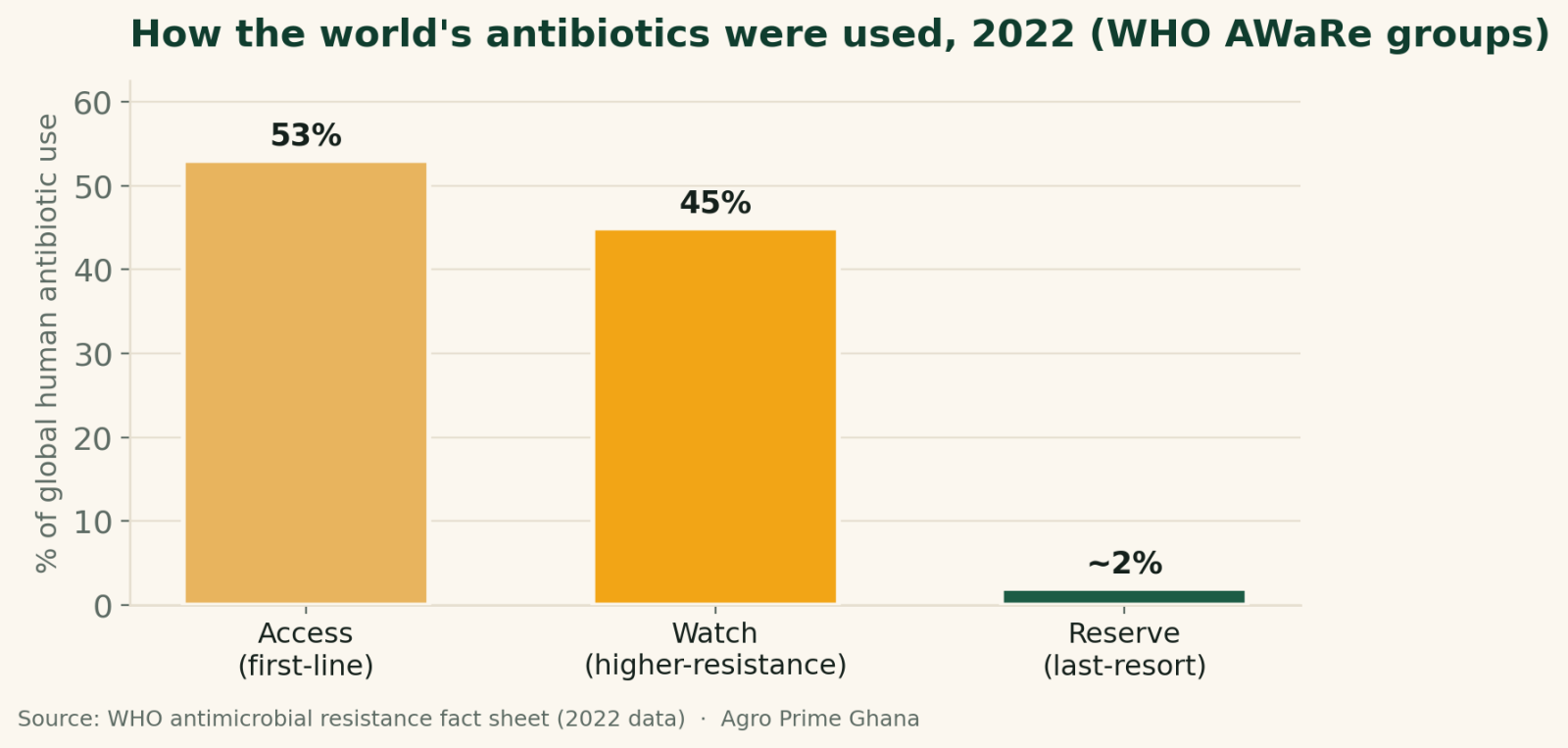
The chart above is about human medicine, but it makes the farm point sharply. The WHO's AWaRe framework sorts antibiotics into Access (safe first-line drugs), Watch (drugs that drive resistance and should be used more carefully) and Reserve (last-resort drugs for when nothing else works). The whole global effort is to shift use towards the Access group and protect the Reserve group. On the farm the parallel is exact: the antibiotics most casually dumped into poultry water are often the very ones human medicine most needs to protect. The clearest example is the fluoroquinolone group (enrofloxacin, the familiar "Enro" bottles) — so important for treating life-threatening infections in people that many countries prohibit its use in poultry altogether.
Why you should never use antibiotics for growth or routine prevention
Two of the most common uses of antibiotics on Ghanaian farms are exactly the two the world's agencies now reject: growth promotion and routine prophylaxis (dosing healthy birds "to prevent" disease). The FAO describes antimicrobial growth promoters as antibiotics given "at a low, sub-therapeutic dose in pursuit of growth rather than on health grounds," and notes that the European Union banned this practice from 1 January 2006. The FAO's position is blunt: antibiotics should not be used in feed for growth-promoting purposes without a public-health safety assessment. The problem with both growth promotion and blanket prevention is the same — they expose huge numbers of bacteria to a constant low level of drug, which is the ideal recipe for breeding resistance, while doing nothing that good management could not do better. Low-dose, long-term antibiotic exposure is resistance training for bacteria. If a flock is genuinely at high risk of a specific bacterial disease, the answer is to fix the risk (the litter, the water, the crowding, the stress) and, where relevant, to vaccinate — not to paper over it with a drug the birds are not even sick enough to need.
Field note: the water-bottle habit is usually treating the wrong thing
On our own floor, the commonest scenario behind a "let's put antibiotics in the water" reflex is a flock that is doing poorly for reasons antibiotics cannot touch — chilled or overheated brooding, wet litter driving coccidiosis, a virus moving through unvaccinated birds, or plain bad feed. The antibiotic gets the credit if the birds happen to recover (they were going to anyway once conditions improved) and the blame escapes when they do not. What we have learned is to stop and ask, before reaching for any drug: what is the actual diagnosis, and is it even bacterial? More often than not the real fix is a dry brooder, a repaired drinker, a vaccine that was skipped, or a better feed — not an antibiotic at all.
What is a withdrawal period, and why it is non-negotiable
A withdrawal period is the time that must pass between a bird's last dose of a medicine and the day its meat or eggs can safely be eaten, so that drug residues fall to a safe level. Penn State Extension defines it as the period after giving a medication "during which the meat and/or eggs should not be used for human consumption due to possibility of drug residues." This is where a great deal of casual antibiotic use in Ghana becomes a direct food-safety problem: birds are treated and then sold, or their eggs collected and marketed, within days — while the antibiotic is still in the tissue and the egg. Those residues can trigger allergic reactions, and, more slowly and invisibly, contribute to the resistance problem in the people who eat them. A point worth remembering even for backyard keepers who "would never eat a treated bird": control of birds is easily lost — they are sold, given away, or stolen — so the withdrawal period protects whoever ends up eating them, not just you. If you cannot say with confidence what a drug's withdrawal period is, that alone is a reason not to be using it without advice.
| Practice | Irresponsible use | Responsible use |
|---|---|---|
| Reason for giving | "To be safe," for growth, or routine every-batch dosing | Only to treat a diagnosed bacterial disease |
| Choice of drug | Whatever is on the agrovet shelf, guessed | Chosen for the specific bug, ideally on vet/extension advice |
| Dose & duration | Rough scoop; stopped when birds look better | Full labelled dose for the full course |
| Withdrawal period | Ignored — birds and eggs sold immediately | Strictly observed before any meat or eggs are eaten/sold |
| Critical human drugs | Fluoroquinolones ("Enro") used freely | Reserved for human medicine; avoided in poultry |
| Main disease strategy | Antibiotics as the first and only line | Vaccination, biosecurity, hygiene first; antibiotics last |
Prescription-only, and why a vet should be in the loop
The global direction of travel is that the important antibiotics should only be used through a veterinarian who knows the flock. In the United States, the FDA moved medically important antimicrobials to prescription-only — a restriction that began in 2017 and became complete in June 2023, so that these drugs now require a veterinarian's prescription. The reasoning applies just as well in Ghana even where the rules are looser: a vet or trained extension officer can work out why a flock is sick, can advise a culture or post-mortem to identify the actual organism, can pick a drug that will work rather than one that will not, and can tell you the correct dose and the withdrawal period. That is the difference between treating a disease and treating a symptom. Some products remain sensibly available over the counter because they are not medically important for humans — Penn State lists examples like amprolium (an anticoccidial, for coccidiosis) and fenbendazole (a dewormer) — but note that neither of those is an antibiotic in the antibacterial sense at all. The genuinely important antibacterials are exactly the ones that deserve professional oversight.
Field note: keep a simple treatment record — it changes how you use drugs
One habit we would urge on any farm is a plain notebook or phone note recording every antibiotic given: which house, which drug, what dose, the dates started and finished, and the withdrawal date before those birds or eggs can be sold. It sounds bureaucratic, but writing it down does two useful things. First, it forces you to honour the withdrawal period, because the "safe to sell" date is staring at you. Second, when you can see on paper how often you have reached for antibiotics — and for what — you quickly notice the pattern of "just-in-case" dosing that never actually diagnosed anything, and you start asking better questions before opening the bottle. A farm that keeps records almost always ends up using fewer drugs.
The better protection: how to need antibiotics far less
The farms that use the fewest antibiotics are not reckless — they are the best managed. They have simply removed the reasons birds get sick in the first place. This is precisely what the FAO recommends in place of routine drugs: good husbandry and hygiene, disease control through vaccination, lower stocking density and stress, and feed additives that support gut health. In Ghanaian practice that comes down to a handful of things you already know how to do:
- Vaccinate against the real killers. The diseases that devastate Ghanaian flocks — Newcastle disease above all, plus Gumboro and fowl pox — are viruses that no antibiotic can touch, but that vaccines prevent. A sound vaccination programme, with the vaccines kept cold and given correctly, does more to keep a flock alive than any drug. See our guide to the poultry vaccine cold chain.
- Practise real biosecurity. Most bacterial trouble walks in on boots, hands, wild birds, rodents and shared equipment. Controlling who and what enters your birds' space is free and hugely effective — our poultry biosecurity guide covers the practical steps.
- Control coccidiosis and worms directly. These are not bacterial, so they need the right tools: a coccidiostat or coccidiosis vaccine plus dry litter, and a sensible deworming routine — not antibiotics.
- Start with strong, healthy chicks. A robust, well-started chick from a clean hatchery mounts its own defence against bacteria far better than a weak, stressed one. Choosing well at the start saves drugs later — see how to choose healthy day-old chicks.
- Get the basics right. Clean water in clean drinkers, dry friable litter, correct brooding temperature, uncrowded houses, good ventilation and quality, mould-free feed prevent the very conditions — chilling, dirty water, damp litter — that let bacteria such as E. coli take hold.
- Consider gut-health additives, not antibiotics, as support. The FAO points to probiotics, prebiotics, organic acids and similar feed additives as legitimate ways to support performance and gut health. These are tools to reduce antibiotic need, not to replace good management.
Start with birds that need fewer drugs — talk to Agro Prime Ghana
The cheapest antibiotic is the one you never have to buy because your birds stayed well. At Agro Prime Ghana we supply strong, healthy day-old chicks (broilers and layers) and point-of-lay pullets from clean stock, and we help you build the vaccination and biosecurity plan that keeps antibiotic use to a genuine minimum — the plan that prevents Newcastle, controls coccidiosis, and keeps your litter and water right from day one. If you are tempted to reach for the water-soluble bottle, message us first and let us help you work out what is actually wrong. Order chicks, feed or a flock-health consult on WhatsApp (+233 24 915 1503) or book a visit.
When antibiotics ARE the right answer — using them well
None of this means antibiotics are the enemy. When a flock has a genuine, diagnosed bacterial disease — colibacillosis, fowl typhoid, infectious coryza and the like — the right antibiotic, used properly, is a valuable and sometimes life-saving tool, and withholding it would be cruel and costly. Responsible use in that situation means: get the best diagnosis you can (ideally a vet or a post-mortem, not a guess); choose the drug on advice rather than on what is nearest to hand; give the full labelled dose to the whole affected group for the full number of days, even after the birds start to look better, so you do not leave the hardiest bacteria alive; treat the water and dose carefully so weak birds still get enough; fix the underlying management fault that let the disease in, so it does not simply come back; and then observe the withdrawal period to the day before any bird or egg from that flock is eaten or sold. Keep a simple written record of what you gave, to which house, on what dates — that record is what lets you honour the withdrawal period and learn from the episode.
The bottom line on antibiotics in poultry
Antibiotics are a precious, finite resource, and on the modern Ghanaian farm they are too often the first thing reached for and the last thing needed. Used responsibly, they treat diagnosed bacterial disease at the correct dose for the correct time, on advice, with the withdrawal period honoured — and they are never poured into healthy birds for growth or "just in case." Used carelessly, they waste your money, breed resistant bacteria that threaten both your flock and your family, and leave residues in the food you sell. The genuinely protective investments are the unglamorous ones: vaccination, biosecurity, clean dry housing, good water, quality feed and strong chicks to begin with. Get those right and you will find, as the best-run farms do, that you barely reach for the antibiotic bottle at all — which is exactly the point.
Frequently asked questions
What does responsible antibiotic use in poultry mean?
Why shouldn't I put antibiotics in the water to prevent disease?
What is a withdrawal period and why does it matter?
Do antibiotics treat Newcastle disease or coccidiosis?
How does antibiotic misuse in poultry affect people?
Which antibiotics should never be used in poultry?
When is it actually right to use antibiotics on my flock?
What can I do to reduce how many antibiotics my farm needs?
Sources & further reading
- World Health Organization — Antimicrobial resistance (fact sheet) (AMR definition, global burden, AWaRe framework, One Health).
- Food and Agriculture Organization of the UN — Antimicrobial resistance: animal feeding (growth promoters, EU 2006 ban, husbandry and feed-additive alternatives).
- Penn State Extension — Understanding Poultry Medication Regulations (withdrawal periods, prescription requirements, drugs restricted in poultry).
- MSD Veterinary Manual — Antimicrobial Drug Factors for Animals.
- Agro Prime Ghana guides: Newcastle disease, poultry biosecurity, coccidiosis and deworming.
About Agro Prime Ghana
Agro Prime Ghana Limited runs a poultry hatchery and mixed agribusiness in Kasoa, supplying day-old chicks and supporting poultry keepers across the country. These guides combine hands-on hatchery and farm experience with current veterinary and public-health references. This article is general educational information, not a substitute for professional veterinary advice — if your flock is sick, get a proper diagnosis before reaching for any drug. We supply healthy day-old chicks (broilers and layers), point-of-lay pullets, quality feed and hands-on farm support. Want birds that stay well and need fewer antibiotics? Book a visit or message us on WhatsApp (+233 24 915 1503).