A practical layer vaccination schedule for Ghana runs from day-old to point of lay and, at a minimum, must cover Marek's disease at the hatchery, Gumboro (infectious bursal disease) in the first weeks, repeated Newcastle disease and infectious bronchitis through rearing, fowl pox, and a killed booster before the birds come into lay. In our climate the single most important line of that programme is Newcastle disease, which can wipe out an unprotected flock almost overnight. Every year we meet Ghanaian farmers who did everything else right — good pullets, clean water, a tidy house — and still lost the flock to a disease that a few cedis of vaccine, given on time and given properly, would have stopped. A layer represents 17 or 18 weeks of feed and care before she lays her first sellable egg; losing her at 12 weeks, or watching production collapse at 30 weeks because a booster was skipped, is one of the most expensive mistakes in poultry. This guide sets out a real, workable programme and, just as important, how to give the vaccines so they actually work.
Written by the Agro Prime Ghana poultry team and reviewed against current veterinary references (Merck/MSD Veterinary Manual and the Hy-Line commercial layer vaccination recommendations). Last updated September 2026.
Key takeaways
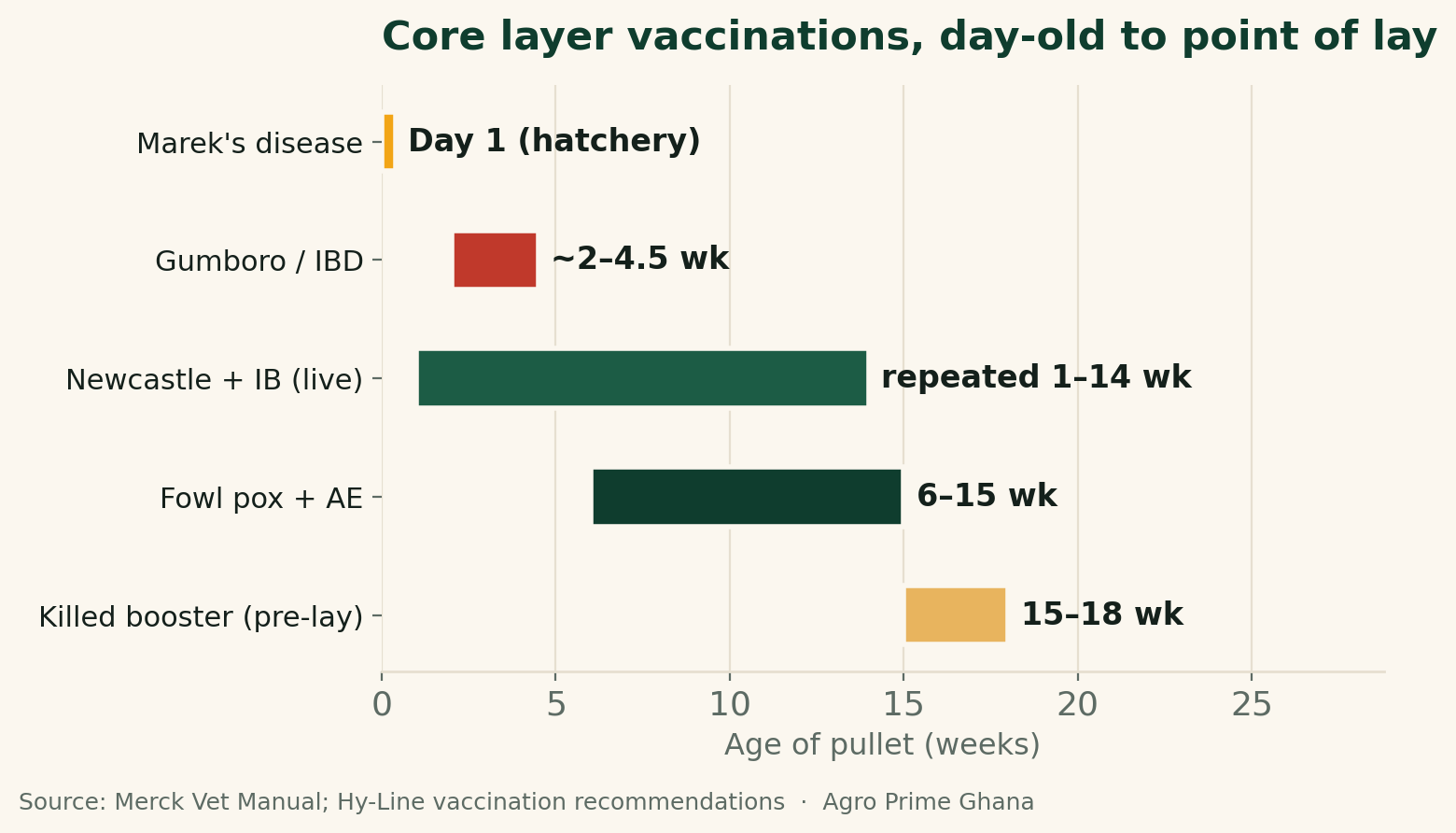
A commercial layer must be protected against Marek's disease (given once at the hatchery, day-old, by injection), Gumboro/IBD (usually two doses between about 2 and 4–5 weeks), Newcastle disease and infectious bronchitis (a live vaccine repeated several times from around 2 weeks through to 16 weeks), fowl pox and avian encephalomyelitis (once, between 6 and 15 weeks), and a final inactivated ("killed") booster before lay. Newcastle is the priority in Ghana: in a naïve, unvaccinated flock it can cause up to 100% mortality, and there is no treatment — only prevention. Vaccines only work if the cold chain is unbroken and the technique is correct. Leave 4–6 weeks between the last live vaccine and the killed pre-lay booster so the two do not interfere.
Why a vaccination schedule matters more for layers than for broilers
A layer has to stay healthy for a very long time. A broiler is on the farm for six weeks; a commercial layer is expected to lay well past 70 weeks and often to 80 or beyond, which means her immune protection has to hold for well over a year. That long life is the whole reason a layer needs a fuller vaccination programme than a broiler — she will be exposed to more disease challenges over her lifetime, and a gap in protection that a broiler would never live long enough to meet becomes a real threat to a layer. The programme is built in two halves: live vaccines during rearing that prime the immune system and give early protection, and a killed (inactivated) booster before lay that lifts antibody levels high and holds them steady through the laying period. Get the rearing programme right but skip the booster, and a flock can be laying beautifully at 25 weeks and then be hit by a Newcastle or infectious-bronchitis break at 35 weeks that craters production for months.
Why Newcastle disease is the vaccine you never skip in Ghana
Of every disease on the schedule, Newcastle disease (ND) is the one that decides whether many Ghanaian flocks live or die. It is a viral disease, it is extremely contagious, and in its worst (velogenic) form it is devastating. The Merck Veterinary Manual records "up to 100% morbidity and mortality rates, especially in naïve populations," with signs appearing as early as two days after exposure. Crucially, the manual is blunt that "no medication has been shown to affect the course" of a virulent infection — once it is in an unprotected flock, there is nothing to buy that will save the birds. The virus spreads on the movement of birds, on people, and on contaminated equipment and litter, which the manual calls "the main mode of virus transmission between poultry flocks and farms." Newcastle is endemic across Africa, and in Ghana the constant movement of birds through live markets, the mixing of backyard and commercial flocks, and shared transport all keep the challenge high. This is why ND is not a single jab but a repeated vaccination through rearing, topped by a killed booster — it is the backbone of the whole programme. If you take nothing else from this guide, take this: never let a layer flock come into lay without a complete Newcastle programme behind it. Our fuller notes on the disease itself are in the guide to Newcastle disease in poultry.
A practical layer vaccination schedule, day-old to point of lay
The table below is a sound, mainstream programme for commercial brown layers (Lohmann Brown, ISA Brown, Hy-Line Brown and similar) under Ghanaian conditions, built from the commercial-layer programmes in the Merck Veterinary Manual and the Hy-Line vaccination recommendations. Treat it as a template, not gospel: the exact ages, the number of Newcastle repeats and whether you include extras like infectious coryza or fowl typhoid should be set with a local veterinarian who knows the disease pressure in your area and the specific vaccines you can buy. What must not change is the logic — Marek's at day-old, Gumboro in the early weeks, Newcastle and IB repeated through rearing, and a killed booster before lay.
| Age | Vaccinate against | Route (typical) | Notes |
|---|---|---|---|
| Day 1 (hatchery) | Marek's disease | Subcutaneous injection | Given once, at the hatchery, before the chick meets the world. Cannot be given later. |
| ~7 days | Newcastle + infectious bronchitis (live) | Eye drop or coarse spray | First ND/IB priming dose (some programmes give a milder ND at day-old in high-challenge areas). |
| ~14 days | Gumboro / IBD (live) | Drinking water | Timed to the maternal-antibody window; often a second dose follows. |
| ~21 days | Newcastle + IB (live), 2nd | Drinking water or spray | Second ND/IB dose keeps immunity climbing. |
| ~24–28 days | Gumboro / IBD (live), 2nd | Drinking water | Completes early bursal protection. |
| 5–6 weeks | Newcastle + IB (live), 3rd | Drinking water or spray | Merck lists an ND/IB dose around 5 weeks. |
| 6–8 weeks | Fowl pox and avian encephalomyelitis (AE) | Wing-web stab | Given once, 6–15 weeks. Hy-Line notes it is given "to prevent egg drops." |
| 8–10 weeks | Newcastle + IB (live), 4th | Drinking water or spray | Maintains protection through the grower phase. |
| 10–12 weeks | Fowl pox / AE / ILT (region-dependent) | Wing-web / eye drop | Merck groups pox, AE and laryngotracheitis here where ILT is a risk. |
| ~12–14 weeks | Newcastle + IB (live), 5th | Drinking water or spray | Last live ND/IB before the killed booster. |
| 15–18 weeks | Killed (inactivated) ND+IB (± EDS) booster | Intramuscular / subcutaneous injection | The pre-lay booster. Leave 4–6 weeks after the last live ND vaccine. |
Two design points are worth understanding rather than just copying. First, Gumboro timing is a balancing act. Chicks are born with maternal antibodies passed down from the hen; those antibodies protect the chick early but also neutralise a vaccine given too soon. Give the IBD vaccine too early and the maternal antibody "eats" it; give it too late and the field virus gets in first. That is why IBD is usually given as two doses in the first few weeks, and why the exact days should match your chicks' maternal-antibody status. Second, the Newcastle programme is deliberately repeated. The Merck programme recommends repeating the live vaccine "every 60–90 days, or a single dose at 18 weeks with inactivated vaccine" — in a high-challenge country like Ghana, most serious layer operations do both: repeat live doses through rearing and a killed booster before lay.
Why the killed booster before lay is non-negotiable
The inactivated (killed) vaccine given around 15–18 weeks is the step small farms most often skip — and it is the one that protects the entire laying period. Live vaccines give quick, broad protection but the antibody level they produce fades; an injected killed vaccine produces a high, durable antibody level that carries the hen through a year or more of lay. The Hy-Line recommendations are specific about the timing: "allow 4–6 weeks between the last live vaccination and the injected inactivated vaccine." That gap matters because a live vaccine and a killed vaccine given too close together interfere with each other, and you end up with weaker protection than either alone. In practice this means your last live Newcastle/IB dose should be in around week 12–13, and the killed booster at week 16–18, before the first eggs appear. Many killed products combine Newcastle, infectious bronchitis and egg-drop syndrome (EDS) in one injection, so a single dose covers three of the diseases most likely to knock out egg production mid-lay.
Field note: the schedule on the wall is only half the job
The most common reason a "fully vaccinated" flock still breaks with disease is not a missing vaccine — it is a vaccine that was given but never actually worked. We have seen ND vaccine mixed into chlorinated tap water that killed the live virus before a single bird drank it; vials left sitting warm on a bench in the Kasoa sun; and drinking-water vaccination given to birds that had free water all morning and were not thirsty, so half the flock never got a dose. A vaccine is a living thing until the moment the bird takes it. Keep it cold from the shop to the bird, use clean cool water with no disinfectant or chlorine (a pinch of skimmed-milk powder helps protect the virus), thirst the birds for an hour or two first so they drink the medicated water quickly, and use it all within a couple of hours of mixing. The paperwork says "vaccinated"; the birds only count it if it was alive when it reached them.
Routes: getting the vaccine into the bird correctly
Each vaccine has a route for a reason, and using the wrong one — or the right one badly — is a common cause of failure. Marek's is injected under the skin of the neck at the hatchery on the day of hatch; it cannot be given usefully later, which is one reason buying already-Marek's-vaccinated day-old chicks or point-of-lay pullets matters. Newcastle and infectious bronchitis live vaccines are given by eye drop (the most reliable for individual birds), coarse spray, or drinking water (the most practical for larger flocks, but the least forgiving of poor technique). Gumboro is usually given in drinking water. Fowl pox and AE are given by the wing-web method — a two-pronged applicator dipped in vaccine and stabbed through the skin of the wing web; a good "take" shows as a small scab at the site a week later, which is how you check it worked. For any water-based vaccine, the rules are the same and they are strict: cool, clean, chlorine-free water; the right volume so birds finish it in 1–2 hours; birds thirsted beforehand; and the whole batch used quickly. We cover the mechanics in detail in our guides to poultry vaccination technique and the vaccine cold chain.
Ready-vaccinated pullets and a schedule built for your farm
Getting a full layer vaccination programme right — the correct vaccines, the correct ages, an unbroken cold chain and clean technique — is a lot to manage on a small farm, and the cost of one gap is an entire flock. Agro Prime supplies point-of-lay (POL) pullets that have already been through a complete rearing vaccination programme, including the pre-lay killed booster, so they are ready to start laying safely. We also supply layer feed, replacement stock, and can help you draw up a vaccination schedule matched to your area's disease pressure and the vaccines available to you. If you are starting or restocking a layer flock, message us on WhatsApp at +233 24 915 1503 or book a visit — it is far cheaper to start with well-vaccinated birds than to gamble on an incomplete programme.
Field note: check that the vaccine actually "took"
One of the few vaccines that tells you whether it worked is fowl pox, and we always use it. Give the wing-web stab correctly and, about a week later, turn the wing over and look for a small scab or swelling at the puncture site — that "take" is proof the vaccine reproduced and the bird responded. If you check a sample of the flock a week after wing-webbing and find few or no takes, something went wrong — bad vaccine, a broken cold chain, or poor technique — and it is worth revaccinating rather than assuming the flock is protected. We treat that scab check as a free quality-control test on our whole vaccination discipline: if the pox took cleanly, the odds are good that the water-based vaccines given the same week were handled well too.
Handling, storing and recording your vaccines
Vaccines are biological products and they die if mistreated. Nearly all poultry vaccines must be kept refrigerated at roughly 2–8°C — never frozen for most, and never allowed to warm up. In Ghana that means thinking about the cold chain the moment you buy: an insulated box with ice packs for the journey home, straight into a working fridge, and out only when you are ready to use them. Reconstituted (mixed) live vaccine has a shelf life of a couple of hours at most, and less in the heat, so mix only what you will use immediately and keep the mixing container out of direct sun. Just as important is record-keeping: write down every vaccine given, the date, the age of the birds, the batch/expiry number and the route. When something goes wrong months later, those records are how you and your vet work out whether a vaccine was missed, given at the wrong age, or possibly a bad batch. Good records are also simply good business — see our guide to record keeping on the poultry farm. Vaccination does not replace hygiene, either: it works alongside strong biosecurity, because keeping the disease challenge low is what lets the vaccines cope.
Common mistakes that undo a good schedule
Most vaccine "failures" are management failures, and they repeat themselves on farm after farm. The big ones: breaking the cold chain (warm or frozen vaccine is dead vaccine); mixing live vaccine with chlorinated or disinfected water, which kills the virus before the birds drink it; not thirsting birds first, so they take the medicated water slowly and unevenly and many miss out; using expired or partly-used vials; giving Gumboro at the wrong age relative to maternal antibodies; and, above all, skipping the pre-lay killed booster to save money. Another quiet killer is stress at vaccination — vaccinating birds that are already sick, heat-stressed, or being moved. A vaccine asks the immune system to do work; a bird under heavy heat stress or fighting another disease responds poorly, so time vaccinations for the cooler parts of the day and never vaccinate a visibly unwell flock without veterinary advice. None of these mistakes cost much to avoid, and every one of them can cost you the flock.
The bottom line on layer vaccination in Ghana
A layer is a long-term investment, and her vaccination programme is the insurance policy that protects it. The programme has a clear shape: Marek's at the hatchery on day one; Gumboro in the early weeks, timed to maternal antibodies; Newcastle and infectious bronchitis repeated through rearing; fowl pox and AE once in mid-rearing; and a killed booster before lay. In Ghana, Newcastle disease sits at the centre of it all — endemic, up to 100% fatal in unprotected flocks, and untreatable — so it is vaccinated repeatedly and never skipped. But the schedule on paper is only half the work. Vaccines are living products that must be kept cold, mixed with clean chlorine-free water, given by the correct route to thirsted, healthy birds, and used quickly. Get both halves right — the right vaccines at the right ages, given so they actually work — and you turn the biggest killers of Ghanaian layers into background risks you have under control.
Frequently asked questions
What vaccines does a commercial layer need in Ghana?
When is Marek's disease vaccine given?
Why is Newcastle disease vaccination so important in Ghana?
What is the killed (inactivated) booster and when is it given?
Can I give Newcastle vaccine in drinking water?
Why do vaccinated flocks still get sick?
How should I store poultry vaccines in Ghana's heat?
Do point-of-lay pullets still need vaccinating?
Sources & further reading
- Merck (MSD) Veterinary Manual — Vaccination Programs for Poultry (commercial-layer schedule, ages, routes and the repeat-live/single-inactivated recommendation).
- Merck (MSD) Veterinary Manual — Newcastle Disease in Poultry (mortality in naïve flocks, transmission, no effective treatment).
- Hy-Line International — Vaccination Recommendations for commercial layers (Marek's at hatchery, ND/IB/IBD/pox/AE ages, and the 4–6 week gap before the inactivated booster).
- Agro Prime Ghana guides: Newcastle disease in poultry, poultry vaccination technique, the vaccine cold chain, poultry biosecurity and record keeping.
About Agro Prime Ghana
Agro Prime Ghana Limited runs a poultry hatchery and mixed agribusiness in Kasoa, supplying day-old chicks (broilers and layers), point-of-lay pullets, quality feed and hands-on farm support to keepers across the country. These guides combine that practical hatchery and farm experience with current veterinary references. This article is general educational information, not a substitute for a vaccination programme designed and supervised by a qualified veterinary or extension officer for your specific farm and area. Starting or restocking a layer flock? Book a visit or message us on WhatsApp (+233 24 915 1503) to order fully vaccinated point-of-lay pullets, chicks, feed or advice.