A spent hen is a layer that has reached the end of her profitable laying life — usually somewhere between about 70 and 90 weeks of age — and in Ghana she is far more than a leftover: spent layers supply more than 90% of all the chicken meat the country actually produces. That single fact reframes the whole question. For most Ghanaian layer farmers the flock earns money twice: once from eighteen months of eggs, and again on the day the birds are sold for meat. Yet many keepers plan the first income carefully and improvise the second, selling in a panic when lay collapses, taking whatever a middleman offers at the gate, and losing birds to bruising and death on the way to market. This guide explains when to sell, how to sell live or dressed, how to protect welfare and value in the process, and how to turn end-of-lay from an afterthought into a planned harvest.
Written by the Agro Prime Ghana poultry team and reviewed against current industry references (USDA FAS GAIN Ghana Poultry reports and published layer-welfare research). Last updated September 2026.
Key takeaways
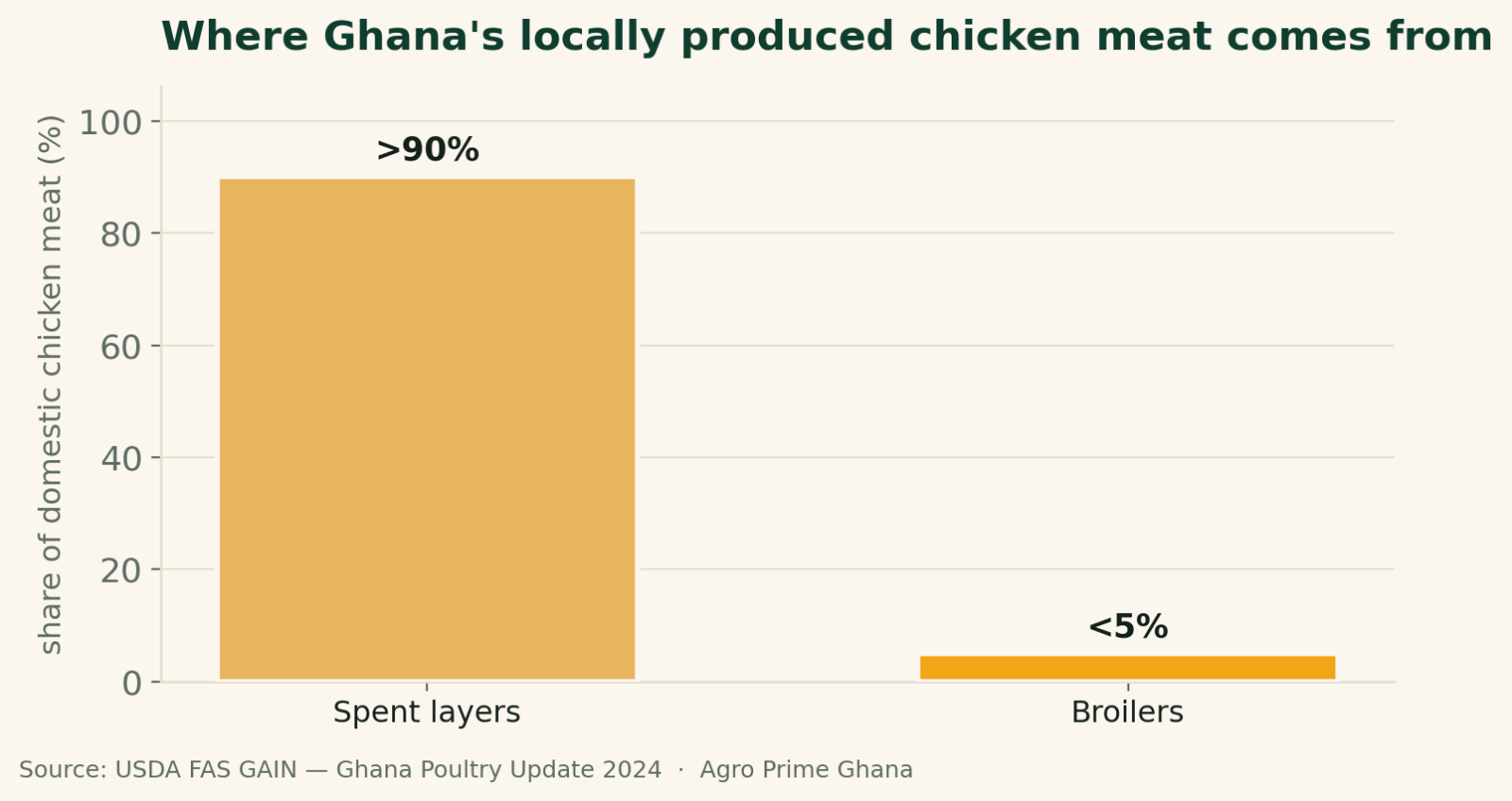
In Ghana, spent layers make up more than 90% of domestically produced chicken meat, while local broilers are under 5% — so old hens are a genuine meat product, not waste (USDA FAS). A hen becomes "spent" when lay drops below the point of profit, typically around 70–90 weeks, and the decision should be driven by lay percentage, egg price and feed cost — not by a fixed date. Sell birds while they still have flesh and value: a laying hen that keeps eating feed after production falls is losing you money daily. You can sell live at the farm gate (simplest, lowest price) or dressed (more work, higher margin, needs hygiene and cold handling). Spent-hen meat is leaner, darker and stronger-flavoured than broiler — ideal for the light soup, stews and stock Ghanaian kitchens prize. Old hens have fragile, osteoporotic bones, so catch, crate and transport gently and in the cool of the day to avoid fractures, bruising and death losses that destroy value.
What "spent hen" means — and why it matters so much in Ghana
A spent hen (or end-of-lay hen) is a commercial layer whose egg production has fallen far enough that she now costs more in feed than she returns in eggs. She is not sick and not old by nature's clock — a hen can live many years — but as a business unit she has finished her job. In most of the world spent hens are treated as a low-value by-product of the egg industry, ground into meal or pet food. Ghana is different, and the difference is the whole point of this article. Because commercial broiler farming here is tiny and imported frozen chicken dominates the frozen trade, the fresh, locally raised chicken most Ghanaians actually buy is overwhelmingly old layers. According to the USDA Foreign Agricultural Service, "spent layers constitute a large proportion (more than 90 percent) of the domestically produced chicken meat, with broilers believed to be less than five percent of the total." That means the retired birds coming off your layer house are not scraps — they are the backbone of Ghana's home-grown chicken meat, with a real and reliable market.
How much is that market worth to your farm?
End-of-lay is a second harvest, and on a layer enterprise it is a meaningful one. Every bird you started as a point-of-lay pullet has value left in her body at the end: two-year-old Lohmann- or ISA-type hens weigh roughly 1.9–2.0 kg live, and Ghanaian buyers actively seek out this mature "hard" chicken for its flavour. The imported picture explains why: Ghana imports on the order of 270,000 metric tonnes of chicken a year, mostly frozen, which supplies the bulk of total consumption — but that frozen product does not compete for the fresh, live, flavour-first market that spent hens serve. The USDA data shows domestic broiler meat sits below 5% of production precisely because feed cost makes fresh broiler expensive; spent hens sidestep that because their feed was already paid for by eggs. The practical lesson: budget your flock's economics over its whole life, egg income plus terminal meat value, and you will make better decisions about when to replace a flock and how hard to push it. For the full replacement calculation, see our guides to when to cull layers and broiler vs layer profit.
| Selling route | Effort & kit needed | Price / margin | Best for |
|---|---|---|---|
| Live at farm gate | Lowest — buyer catches and hauls; you just weigh/count | Lowest per bird, but zero processing cost and instant cash | Whole-flock clear-out, festive rush, farms far from town |
| Live to market / aggregator | You transport; need crates and a vehicle | Middle — you capture the trader's transport margin | Farms near Kasoa/Accra markets with steady buyers |
| Dressed (fresh, whole) | Highest — slaughter, defeather, eviscerate, chill, hygiene | Highest per bird if you have clean buyers | Selling to households, chop bars, hotels, restaurants |
| Value-added (cut / packaged / frozen) | Highest + cold chain and packaging | Highest, but needs volume and reliable cold storage | Established farms with steady institutional demand |
When exactly should you sell? Reading the numbers, not the calendar
The right time to sell is when the hen stops paying her way, and that is a moving target set by three numbers: her lay percentage, the price of eggs, and the cost of feed. A healthy modern brown layer holds a good rate of lay through her first year and then declines; commercially, many flocks are cleared somewhere around 72–80 weeks, but in Ghana farmers often push productive flocks further when eggs are dear. The discipline is simple: once daily lay falls to a level where the value of the eggs a hen produces no longer covers what she eats, every extra day you keep her is a loss stacked on top of her fixed feed bill. Watch the whole-flock hen-day percentage weekly, and when it slides into that break-even zone and keeps falling, plan the sale rather than drifting. Two practical Ghana-specific timing tricks matter. First, aim your clear-out at a demand peak — Christmas, Easter, Eid and Homowo all pull live-bird prices up, and a flock sold into that rush is worth noticeably more than the same flock sold in a quiet week (see selling live birds in the festive season). Second, do not starve a declining flock of feed to save money — a hen that loses flesh and condition loses meat value and welfare at the same time, wiping out the very second income you are trying to protect. A moulting flock is a separate case: sometimes an induced rest and second lay cycle beats selling, which we cover in moulting management.
Field note: sell the flock, not just the "empties"
A trap we see often is a farmer who keeps a whole house running for the sake of a handful of persistent layers while the rest of the flock eats feed and lays little. The feed bill is charged to every bird in the house, not just the good ones. When the flock average drops into the loss zone, it is almost always better to clear the house in one or two planned lots — timed to a market peak and to your restocking of point-of-lay pullets — than to trickle out a few birds at a time and carry the deadweight for months. Plan the exit the same way you planned the intake.
Selling live: the simplest route, done well
Selling live birds at the farm gate is the default in Ghana for good reason — it needs no slaughter facility, no cold chain and no food-hygiene risk on your side, and it turns the flock into cash in a single transaction. The buyer, whether a market woman, an aggregator or a household, takes on the processing. Your job is to protect two things: the weight and condition of the birds, and your reputation for fair, healthy stock. Sell birds in good flesh; present them clean and lively; be honest about age and health. Where you can, sell by weighed weight rather than by eye, because mature layers vary and eyeballing consistently undervalues a well-grown flock. If you are hauling live birds yourself to a market or aggregator, you capture the trader's transport margin — but you also take on the welfare and death-loss risks in the next section, which is exactly where careless handling quietly eats the profit you gained. For the mechanics of moving birds safely, our guidance on poultry marketing is a useful companion.
Selling dressed: more work, more margin, more responsibility
Dressing birds — slaughtering, defeathering, eviscerating, chilling and selling as fresh whole chicken — captures the biggest margin per bird, because you are selling a finished food rather than a live animal. It is how many small Ghanaian layer farms build a loyal base of household, chop-bar and restaurant customers who prefer fresh local hen to frozen imports. But dressing turns you into a food processor, and that carries real duties. You need a clean slaughter and dressing area, potable water, prompt chilling, and scrupulous hygiene, because dressed chicken held warm is a food-safety hazard. Spent-hen meat also behaves differently from broiler on the cutting board and in the pot, and setting customer expectations is part of the sale: it is leaner, darker and firmer, with a stronger, richer flavour, and it rewards slow, moist cooking — the light soups, groundnut soups and long-simmered stews where Ghanaian cooks actually prize "hard" chicken over soft broiler. Sell that character as a feature, not a defect. If you move into holding or transporting dressed birds, get the cold handling right first — see dressed-chicken cold chain.
Ready to plan your next flock — and its second income?
End-of-lay is easiest to profit from when the next flock is already lined up, so the house never sits empty and idle feed is never wasted on unproductive birds. Agro Prime Ghana supplies strong, well-reared point-of-lay (POL) pullets and balanced layer feed, and we help farmers map out flock economics from day-old to end-of-lay — including timing your clear-out to a market peak and restocking to match. Message us on WhatsApp (+233 24 915 1503) or book a visit to talk pullets, feed and a replacement plan that captures both harvests.
Welfare and value in catching and transport — where profit leaks away
This is the part most farmers underestimate, and it is where the money quietly disappears. Old laying hens have fragile, osteoporotic bones after eighteen months of pulling calcium out of the skeleton to make eggshells, which makes them far more prone to fractures than a young broiler when handled roughly. Rough catching, cramming too many birds into a crate, and hauling in the heat of the day cause broken wings and legs, deep bruising, suffocation and outright deaths — every one of which is either an unsaleable bird or a downgraded one. Published welfare research on spent hens repeatedly flags bone fragility, temperature stress and bruising from excessive wing-flapping as the core risks of the end-of-lay journey. The fixes are cheap and entirely within your control:
- Catch calmly and carry properly. Work in dim light or early morning when birds are quiet, catch by the body rather than dragging by a single leg or wing, and never hang birds by one leg while you catch more.
- Don't overload crates. Give birds room to sit without piling; overcrowding causes suffocation and crushing, especially in the heat.
- Travel in the cool of the day. Ghana's midday heat is a killer in a packed crate — move birds early morning or evening, keep air moving, and never leave loaded crates standing in the sun.
- Keep journeys short and unhurried loading gentle. Most death and bruising losses happen at catching and loading, not on the road.
Handled this way, a spent flock arrives alive, unbruised and worth full price. Handled carelessly, you can lose several percent of the flock's value between the house and the buyer — a self-inflicted tax on the very income you set out to earn.
Field note: the cool-hour rule pays for itself
The single change that saves the most birds at clear-out is timing the catch and the haul for the cool hours. Loaded crates of mature hens generate a lot of heat, and Ghana's midday sun turns a full vehicle into an oven within minutes; birds at the bottom and centre go down first. We plan spent-hen movement for early morning, keep the load ventilated, and never let crates sit in direct sun while a sale is being negotiated. It costs nothing but a little scheduling, and it is the difference between delivering a healthy flock and delivering losses.
Getting more from the whole bird
Because spent-hen meat is lean and flavourful, it lends itself to products beyond the whole fresh bird. In several countries end-of-lay meat is turned into sausages, stock, soup bases and processed products, and consumer taste panels have often rated its flavour highly — some studies even find buyers willing to pay a premium for the taste. In the Ghanaian context, the most accessible value-adds are the ones your customers already want: cleanly dressed and jointed birds ready for the pot, and the "hard chicken" reputation that lets you charge a fair fresh-local price against bland frozen imports. Larger farms with steady institutional buyers can go further into portioning, packaging and frozen storage, but only with a reliable cold chain behind them. The principle is the same at every scale: the more finished and reliable the product you hand the customer, the more of the bird's value you keep instead of surrendering it to a middleman.
The bottom line on spent hens
In Ghana, retiring a layer flock is not disposal — it is a harvest, and a big one, since spent layers are the source of over 90% of the chicken meat the country produces. Treat it that way. Decide the timing on lay percentage, egg price and feed cost rather than a fixed date, and aim the clear-out at a demand peak. Choose your route deliberately: live at the gate for simplicity, dressed for margin, value-added only with the hygiene and cold chain to back it. And guard the value you have already grown by catching, crating and transporting old hens gently in the cool of the day, because their fragile bones make careless handling expensive. Plan the exit as carefully as the intake — ideally with the next flock of pullets already lined up — and the end of one laying cycle becomes the profitable, seamless start of the next.
Frequently asked questions
What is a spent hen?
Why are spent layers so important in Ghana's chicken market?
At what age should I sell my laying hens?
Is it better to sell spent hens live or dressed?
Why does spent-hen meat taste and cook differently from broiler?
How do I avoid losing birds during catching and transport?
Can I make extra products from spent hens?
Should I cut feed to a low-laying flock to save money before selling?
Sources & further reading
- USDA Foreign Agricultural Service (GAIN) — Ghana Poultry Voluntary Update 2024 (spent layers as >90% of domestic chicken meat, broilers <5%, import volumes).
- The Poultry Site — Finding the value in processing spent laying hens (meat quality, welfare in catching and transport, value-added uses).
- Agro Prime Ghana guides: when to cull layers, selling live birds in the festive season, and poultry marketing.
About Agro Prime Ghana
Agro Prime Ghana Limited runs a poultry hatchery and mixed agribusiness in Kasoa, supplying day-old chicks and working alongside poultry keepers across the country. We supply healthy day-old chicks (broilers & layers), point-of-lay pullets, quality feed and hands-on farm support across Ghana. This article is general educational information, not a substitute for professional veterinary or business advice. Ready to start or expand — or to plan your flock's second income? Book a visit or message us on WhatsApp (+233 24 915 1503) to order chicks, feed or advice.