There comes a point in most layer flocks — usually somewhere past the first year of lay — when the egg tray starts telling a story the keeper does not want to hear. Numbers drift down, a few birds look ragged and half-bald, feathers appear all over the litter, and the temptation is to assume disease or bad feed. Often it is neither. It is moulting: the natural, annual shedding and regrowth of feathers, during which a hen almost always stops laying. Understanding the moult — when it comes, why it happens, how to feed birds through it, and whether it is ever worth deliberately triggering — is one of the things that separates a keeper who panics from one who plans. This guide covers both the natural moult and the controversial practice of induced moulting, grounded in Ghanaian conditions.
Written by the Agro Prime Ghana poultry team and reviewed against current references (Mississippi State University Extension and MSD/industry poultry references). Last updated September 2026.
Key takeaways
Moulting is the yearly shedding and regrowth of feathers, and most hens stop laying until it is finished because the body diverts protein and energy from egg-making to feather-making. Feathers are lost in a set order — head, neck, breast, body, wings, then tail. Good layers moult late (after 12–14 months of production) and fast (2–3 months), losing primary feathers in groups; poor layers moult early and slowly, taking 4–6 months. Through a natural moult, feed a higher-protein ration, keep water and shade constant, and be patient. Induced (forced) moulting — deliberately resting a flock to trigger a second laying cycle — can restore egg quality and shell strength and extend a flock's useful life, but the old feed-withdrawal method (starving birds to lose 30–35% of body weight) raises serious welfare concerns and is being replaced by gentler low-nutrient-diet methods. For most small Ghanaian keepers, managing the natural moult well matters far more than inducing one.
What moulting is, and why the eggs stop
Feathers are not permanent. As Mississippi State University Extension explains, "each year chickens molt, or lose the older feathers, and grow new ones," and during this renewal "most hens stop producing eggs until after the molt is completed." That link between feathers and eggs is the key to understanding the whole business. A feather is mostly protein (keratin), and growing a full new coat is a heavy metabolic demand. A hen's body cannot pour protein and energy into both a fresh set of feathers and a daily egg at the same time, so it prioritises the feathers — the coat that keeps her insulated and protected — and shuts the reproductive tract down to rest. In evolutionary terms this is sensible: the moult is the bird's built-in "off season," a period to renew the plumage and give the laying machinery a break before the next cycle. What looks to a worried keeper like a flock falling apart is usually a flock doing exactly what its biology intends.
Reading the moult: good layers versus poor layers
One of the most useful things a keeper can learn is that how and when a hen moults tells you what kind of layer she is. The pattern is consistent and worth knowing. According to Mississippi State Extension, the best layers are typically late moulters: they stay in production for 12 to 14 months before moulting, then get the whole thing over with quickly, completing the moult in 2 to 3 months. Because they are working so hard at lay, these good birds often look the worse for it — a "ragged and tattered covering of feathers" — and they shed their wing (primary) feathers in groups of two or more at a time, which is why their moult is fast. Poor layers do the opposite. They are early moulters, going into moult "after only a few months in production," and they drag it out — as long as 4 to 6 months — losing feathers one at a time and keeping a "smoother, better-groomed appearance" throughout. The lesson for culling is direct: the sleek, tidy hen that stopped laying early is usually your worst producer, while the scruffy, half-bald one that laid right through to a late, fast moult is your best.
The feathers also come off in a predictable sequence, which helps you gauge where a bird is in the process. Loss begins at the head, then moves to the neck, the breast, the body, the wings, and finally the tail. A hen just starting to look bare around the head and neck is at the beginning; one regrowing wing and tail feathers is near the end and, all being well, close to coming back into lay.
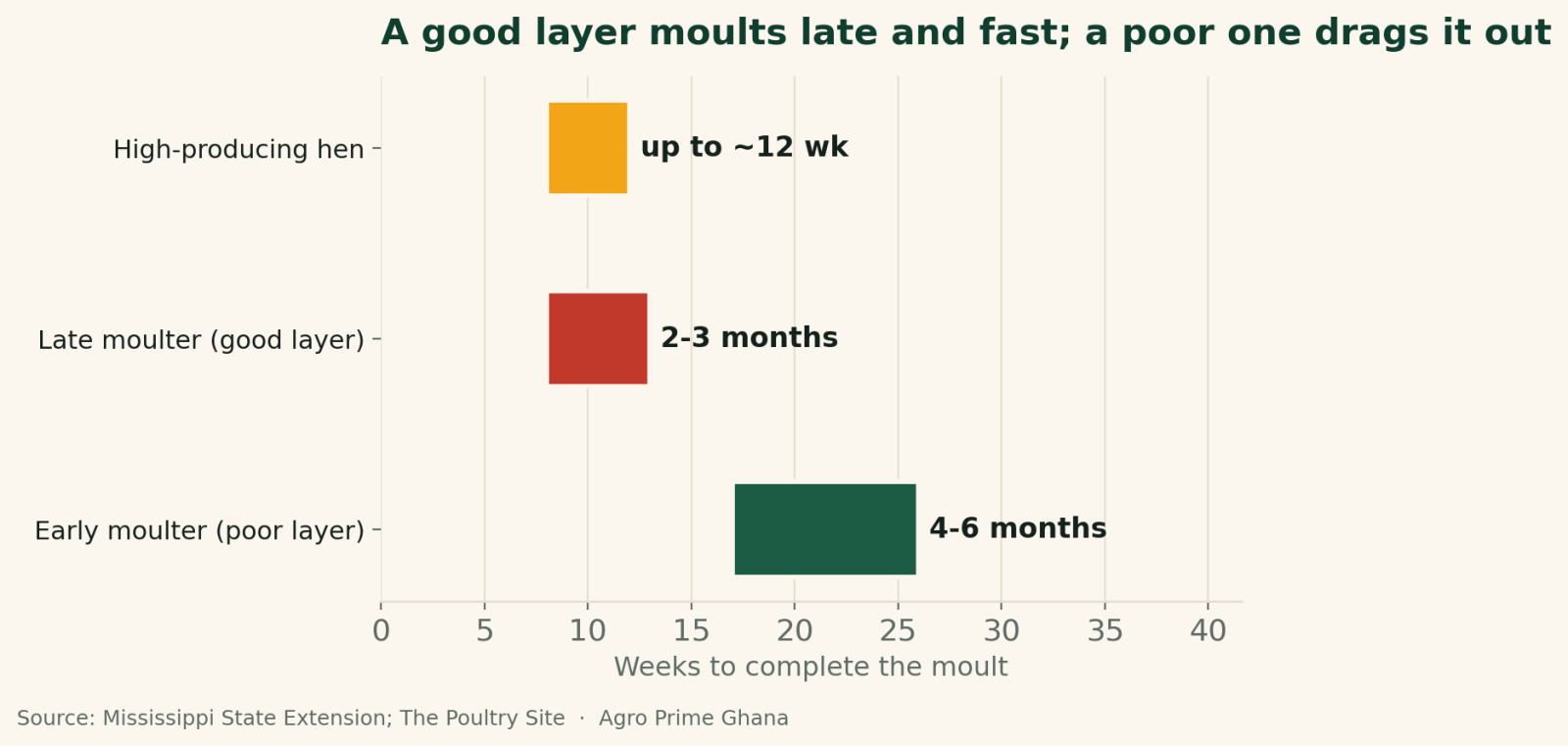
The contrast between good and poor layers at moulting time is consistent enough to use as a culling guide. The table below summarises it, drawn from Mississippi State Extension's description of early versus late moulters.
| What you see | Good layer (late moulter) | Poor layer (early moulter) |
|---|---|---|
| When she moults | After ~12–14 months of steady lay | After only a few months in production |
| How long the moult takes | Fast — about 2–3 months | Slow — 4–6 months |
| Feather appearance | Ragged, tattered (worked hard at lay) | Smooth, neat, well-groomed |
| Wing (primary) feather loss | In groups of two or more at once | One feather at a time |
| What it usually means | A keeper — worth holding on to | A candidate for culling |
Why productivity naturally falls with age
Moulting is tied up with the bigger reality of a layer flock: hens do not lay at the same rate forever. Egg output is highest in the first laying cycle and steps down with each subsequent one. Industry references put the second year of lay at roughly 10–30% below the first year, and a third year lower still — on the order of 70–80% of the second year, or roughly 60% of the original first-year output. Alongside the falling number of eggs, older hens tend to lay larger eggs with progressively thinner, weaker shells, which means more cracks, more waste and more rejects. This decline is exactly why commercial operations face a recurring decision at the end of the first laying year: sell the flock and start again with new pullets, or rest the existing flock through a controlled moult to buy a second, cheaper laying cycle. That second option is induced moulting, and it is worth understanding even if you decide against it.
Feeding and managing birds through a natural moult
For most Ghanaian keepers, the practical priority is not inducing a moult but handling the natural one well, so birds come through it healthy and return to lay promptly. The guiding principle follows directly from the biology: since the bird is spending protein to build feathers, support that demand with the diet. Through the moult it helps to keep birds on a good-quality ration with adequate protein — some keepers lift dietary protein slightly during heavy moult to feed feather regrowth — and to make sure the amino acids that build both feathers and eggs (methionine in particular) are not short. Our layer feeding guide covers hitting those protein and calcium targets. Beyond feed, the moulting flock needs the same steady care as any other: constant clean water, unbroken access to shade, and minimal stress. Ghana's heat is a real factor here — a moulting bird that is also heat-stressed is under a double load, so the ventilation, shade and cool-water measures in our guide to managing heat stress in poultry apply with extra force during a moult. Do not mistake the moult for illness and start dosing birds unnecessarily; do watch for the real problems a run-down flock is prone to, and keep the house clean and calm while the birds renew.
Field note: don't cull the scruffy hen too fast
The instinct on many farms is to look down the pen, spot the raggedy, half-feathered birds, and mark them as the sickly poor-doers to get rid of — while the smooth, well-dressed hens look like the keepers. The moult turns that judgement on its head. What we watch for at moulting time is exactly the opposite: the hardest-working layers are usually the ones that look worst, because they poured everything into eggs and moulted late and fast, while the neat, tidy birds that stopped early are often the freeloaders. Before culling on appearance, we check the vent, the pubic bone spacing and the recent laying record, not just the feathers. The bald hen is frequently the one to keep.
What induced (forced) moulting is
Induced moulting — also called forced moulting — is the deliberate use of management stress to make a whole flock moult together and quickly, so that after a rest the birds re-enter a fresh laying cycle in unison. The commercial logic is straightforward: a flock that has finished its first productive year still has laying capacity left, and resting it to trigger a second cycle is cheaper than raising a brand-new set of pullets from day-old. Done well, the payoff is not just more eggs but better ones. As industry references note, after a moult the hen's production "usually peaks slightly lower than the previous peak, but egg quality is improved" — meaning the second cycle brings back the shell strength and internal quality that had deteriorated in the ageing first-cycle flock. The practice has been widespread in commercial egg production: by 2003, more than 75% of all laying flocks in the United States were being moulted. It is, however, a commercial tool, not a backyard one — as one poultry reference puts it plainly, force moulting is "not normally applicable to the household situation."
How it is done — and why the method matters
Historically, induced moulting was achieved by abruptly withdrawing feed (sometimes water too) and cutting day-length, forcing the birds to stop laying and moult. The traditional target was severe: hens were taken down until they lost roughly 30 to 35% of their body weight, a level associated with full regression and recovery of the reproductive tract, with feed withheld for anywhere from about 7 to 14 days (some programmes ran longer). This is the method that has made forced moulting so controversial. Prolonged feed withdrawal is a serious welfare stressor, it can push flock mortality up, and it is increasingly viewed as unacceptable — the accepted safeguard even in the old model was that mortality during the withdrawal should not exceed about 1.25%, against a normal well-managed monthly mortality of only 0.5–1%, which tells you how much extra stress the birds are under.
Because of these concerns, the industry has shifted decisively toward non-feed-withdrawal methods. Instead of starving birds, these use low-nutrient, high-fibre or low-density diets — high-fibre feeds such as wheat middlings, high-corn or alfalfa-based rations, or low-sodium and altered-mineral diets — together with reduced day-length, to bring the flock out of lay and into a moult without the acute suffering of a total fast. The birds still stop laying and rest — typically ceasing production for at least a couple of weeks before the new cycle begins — but they continue to eat. For any keeper considering an induced moult, this is the responsible route: a managed, fed rest, not a starvation, and always with close attention to the welfare and mortality of the flock.
Field note: for most small farms here, replacement beats forced moulting
We are honest with keepers who ask about forcing a moult to squeeze a second year out of a tired flock: on a small Ghanaian farm it is usually the wrong tool. Getting an induced moult right takes precise feed and light control and careful daily monitoring, and the old feed-withdrawal shortcut is both a welfare problem and a real risk of losing weak birds in our heat. For most small and medium keepers, the cleaner decision at the end of a productive first year is to sell the spent hens and bring in fresh point-of-lay pullets, so you go into a new cycle with strong, uniform birds. Induced moulting earns its place in larger, well-controlled commercial units — not as a backyard money-saver.
The welfare debate you should be aware of
It is worth knowing that induced moulting, especially by feed withdrawal, is genuinely contested on animal-welfare grounds. Animal-welfare bodies and a number of veterinary organisations object to fasting birds to force a moult, and some markets and assurance schemes have moved away from or banned feed-withdrawal moulting entirely. Whatever your own view, the practical takeaways are the same: if you moult a flock, do not do it by starvation; use a fed, low-nutrient method; keep the rest period no longer than necessary; monitor mortality and condition daily; and stop if birds are suffering. A natural moult, by contrast, raises none of these concerns — it is the bird's own process, and your job is simply to support it.
Common mistakes around moulting
A few errors recur. The first is panic: treating a normal moult as a disease outbreak and reaching for medicines the birds do not need, which wastes money and stresses the flock further. The second is culling on looks: getting rid of the ragged birds that are actually your best layers. The third is under-feeding through the moult: cutting feed quality just when the bird needs protein to rebuild its coat, which slows regrowth and delays the return to lay. The fourth is expecting instant eggs: a moult takes time — weeks to a few months depending on the bird — and rushing or stressing the flock does not speed it up. And the fifth, for those tempted by induced moulting, is reaching for the crude feed-withdrawal method instead of a managed, fed approach. Avoid these and the moult becomes a manageable, predictable phase rather than a crisis.
The bottom line on moulting
Moulting is a normal, annual event, not a disease: hens shed and regrow their feathers in a set order and, because feather-building competes with egg-building for protein, they stop laying until it is done. Learn to read it — good layers moult late and fast and look rough, poor layers moult early and slowly and look neat — and use that to guide culling rather than being fooled by appearances. Feed birds well through the natural moult, keep water, shade and calm constant in our heat, and be patient; they will return to lay. Induced moulting is a real commercial tool for winning a second, better-quality laying cycle, but the old starvation method is a welfare problem best left behind in favour of gentler fed methods — and for most small Ghanaian keepers, replacing a spent flock with fresh pullets is the simpler and kinder choice. Handle the moult with understanding, and it stops being a mystery and becomes just another season in the flock's year.
Frequently asked questions
Why have my hens stopped laying and started losing feathers?
How long does a moult last?
My raggedy hens look sick — should I cull them?
What should I feed hens during a moult?
What is induced or forced moulting?
Is forced moulting cruel?
Should a small farmer force a moult or just buy new hens?
Do older hens lay fewer and worse eggs?
Sources & further reading
- Mississippi State University Extension — Molting of Laying Hens (feather-loss sequence, early vs late moulters, moult duration, egg production during moult).
- The Poultry Site — Moulting — a natural process (natural moult timing, induced moulting purpose, cross-cycle production decline).
- Wikipedia (with cited veterinary sources) — Forced molting (feed-withdrawal duration, 30–35% body-weight-loss target, mortality thresholds, post-moult egg quality).
- Agro Prime Ghana guides: layer feeding guide and managing heat stress in poultry.
About Agro Prime Ghana
Agro Prime Ghana Limited runs a poultry hatchery and mixed agribusiness in Kasoa, supplying day-old chicks and point-of-lay pullets and supporting poultry keepers nationwide. These guides combine hands-on hatchery and farm experience with current poultry references. This article is general educational information, not a substitute for professional veterinary or welfare advice — if you are unsure whether your flock is moulting or genuinely sick, have it seen. Need chicks, pullets, feed advice or farm support? Book a visit or message us on WhatsApp (+233 24 915 1503).