You cull layers in Ghana at two points: throughout the laying cycle, when you remove individual hens that have stopped laying but keep eating (the "boarders" quietly draining your feed budget), and at the end of the cycle, when the whole flock's production has fallen far enough that it is no longer profitable to keep feeding them — commonly around 72 to 80 weeks of age, once fewer than about 65% of the hens are still laying. Both decisions come down to one honest question: is this bird, or this flock, still earning more than she costs to feed? A layer that has stopped laying is not resting — she is a pure loss, eating the same 110-plus grams a day as her productive sisters and returning nothing. Knowing how to tell a layer from a non-layer by handling her, and knowing when the whole flock has reached the end of its economic life, is one of the most direct ways to protect the profit of a poultry business. This guide shows you exactly what to look for on the bird and how to time the flock's exit.
Written by the Agro Prime Ghana poultry team and reviewed against current references (Mississippi State University Extension "Culling Hens" and FAO egg-production guidance). Last updated September 2026.
Key takeaways
A laying hen has a large, red, glossy comb; a large, moist, bleached vent; a soft, pliable abdomen; and flexible pelvic (pubic) bones two or more finger-widths apart. A non-layer has a small, dull, shrivelled comb; a small, dry, puckered, yellow vent; and stiff pelvic bones only one finger-width apart or less. In yellow-skinned breeds, laying bleaches the yellow pigment in a set order — vent first (4–7 days of lay), then eye ring, ear lobes, beak and finally shanks — so a fully yellow beak means she has not laid for at least four weeks. At flock level, a laying cycle runs to about 72 weeks, and once fewer than ~65% of hens are laying (around 71 weeks) it usually stops paying to keep them, though a good egg price can justify holding to ~78 weeks. Cull individuals at night, handle birds gently, and always weigh the value of feed saved against eggs and cull-bird income.
Why culling is one of the most profitable habits on a layer farm
Culling feels like a loss — you are removing a bird you raised — but it is one of the clearest ways to make a layer flock more profitable, because feed is by far the largest cost of egg production and a non-laying hen converts that feed into nothing. Every hen in the house eats roughly the same amount each day whether she lays or not, so a bird that has quietly stopped laying is pure expense: she takes up feeder and drinker space, adds to the manure and disease load, and returns zero eggs. On a small flock a handful of these "boarders" can be the difference between a house that pays and one that doesn't. Removing them does three things at once: it cuts your feed bill immediately, it frees resources for the productive birds, and — if the culled hen is healthy — it turns a liability into cash through the spent-hen market, which in Ghana is strong. The skill is being able to walk your flock and reliably tell which hens are earning their feed and which are not. That skill is entirely learnable, because a laying hen and a non-laying hen feel and look genuinely different in the hand.
How to tell a laying hen from a non-layer
The most reliable way to judge a hen is to handle her, not just look at her, and to read several signs together. According to the Mississippi State University Extension guide to culling hens, the key differences between a bird in lay and one that has stopped are consistent and easy to check:
- Comb and wattles. A layer's are large, bright red, glossy and full — the working, hormone-driven look of a bird in production. A non-layer's comb is small, dull, dry and shrivelled, sometimes with a whitish scale.
- The vent. This is one of the best single signs. A laying hen has a large, moist, oval, bleached vent that looks and feels soft. A non-layer's vent is small, dry, round, puckered and yellow.
- The pelvic (pubic) bones. These are the two thin bones either side of the vent. In a layer they are flexible and spread wide apart — at least two finger-widths (a finger-width is about ¾ inch) — to let the egg pass. In a non-layer they are stiff and close together, one finger-width or less apart.
- The abdomen. A layer's abdomen is deep, soft and pliable, measuring three or four finger-widths (about 2½–3 inches) between the pelvic bones and the tip of the keel. A non-layer's is shallow and firm, about two finger-widths (1½ inches).
Read together, the picture is unmistakable: a hen in full lay is "open," soft and moist behind, with a bright working comb; a hen that has stopped is tight, dry, hard and dull. With a little practice you can assess a bird in a few seconds. None of these signs alone is proof, but when three or four agree, they are reliable.
| What you check | Good layer | Non-layer (cull candidate) |
|---|---|---|
| Comb & wattles | Large, bright red, glossy | Small, dull, shrivelled |
| Vent | Large, moist, oval, bleached | Small, dry, puckered, yellow |
| Pelvic (pubic) bones | Flexible, ≥ 2 finger-widths apart | Stiff, ≤ 1 finger-width apart |
| Abdomen | Deep, soft, pliable (2½–3 in) | Shallow, firm (~1½ in) |
| Beak / shank colour (yellow breeds) | Bleached, pale | Full yellow pigment |
Reading pigment: the yellow that fades as she lays
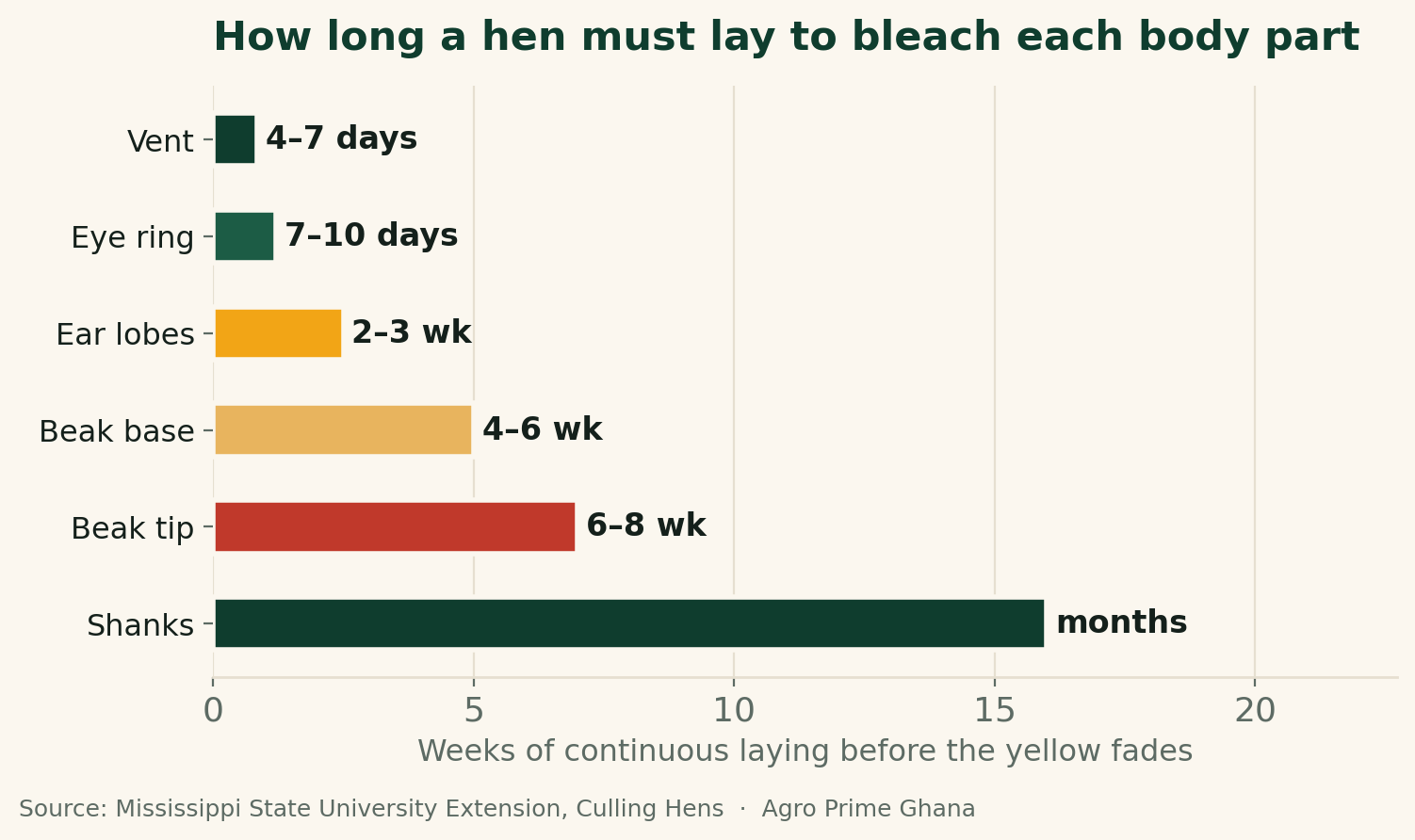
In yellow-skinned breeds there is a second, remarkably precise tool: pigment bleaching. The yellow colour in a hen's skin, vent, beak and shanks comes from carotenoid pigment in her feed. When she lays, that pigment is diverted into egg yolks instead of her body, so laying gradually bleaches the yellow out of her — and it does so in a fixed order, from the parts nearest the vent outward. This means the pigment on a hen's body is effectively a record of how long and how heavily she has been laying. The Mississippi State Extension guide gives the sequence and rough timing: the vent bleaches after about 4–7 days of lay, the eye ring after 7–10 days, the ear lobes (in white-eared breeds) after 2–3 weeks, the base of the beak after 4–6 weeks, the beak tip after 6–8 weeks, and the shanks only after months of steady lay. The practical rule is powerful: because pigment returns to a bird when she stops laying, and returns in the reverse order, "a hen whose beak is fully pigmented has not laid for at least four weeks." So on a yellow-skinned flock, a quick look at beak and shank colour tells you at once which hens have been laying well (pale, bleached) and which have quit (bright yellow) — a fast first screen before you even pick the bird up.
Field note: cull at night, and let your hands do the judging
Two things make on-farm culling far easier and less stressful for the flock. First, do it at night or very early, in low light — birds are calm on the perch, easy to lift, and far less likely to panic and pile up. A torch dimmed with blue cellophane lets you see without stirring the whole house, and handling birds gently and briefly keeps the rest laying normally rather than being frightened off. Second, trust the handling more than the look. A hen can have a slightly faded comb and still be laying well, or look bright and have quit — but the pelvic-bone spread and the soft, moist, open vent rarely lie. We teach new farm hands to check three things on every suspect bird in one motion: two fingers across the pelvic bones, a look at the vent, and a feel of the abdomen. Three "non-layer" signs together, and she goes.
Watch out for the hen who is between eggs — and the moulter
Culling is judgment, not just a checklist, and there are two honest traps. The first is the hen who is simply having an off day — even a good layer does not lay every single day, and a bird caught between clutches can show a slightly less "open" vent. This is why you judge on several signs together and, ideally, over more than one check, rather than condemning a bird on a single ambiguous sign. The second is moulting. A hen that stops laying to moult (replace her feathers) is not a spent hen — she will usually come back into lay. Interestingly, the way a hen moults tells you about her quality: the Extension work notes that late moulters, which are the better layers, keep laying for 12–14 months before moulting and then moult quickly, often looking ragged, while early moulters, the poorer layers, stop sooner and moult slowly. So a hen that moults early and slowly is a genuine cull candidate; one that has laid hard all year and is now moulting fast is worth keeping. Understanding this properly is a topic on its own — see our guide to moulting management in layers. If a whole flock's production has dropped and you are not sure whether it is culling, moult, disease or management, our guide to why hens stop laying works through the causes.
Field note: mark, don't kill, on the first pass
Snap-culling a bird the moment she looks "off" is how good layers get thrown away. On our own farm, when we do a culling walk we carry a stock of coloured leg rings or a livestock marker, and on the first pass we mark the suspect birds rather than removing them — the ones with tight vents, close pelvic bones and yellowing beaks. We come back and check the marked birds a few days later, at night. A genuine non-layer will still show every sign; a hen that was simply between clutches or starting a fast moult will often have "opened up" again and can stay. This two-pass habit costs a little time but stops the most expensive culling mistake there is: killing a productive hen on one ambiguous day. When in doubt, mark and recheck — the bird isn't going anywhere.
When to cull the whole flock: end-of-lay economics
Individual culling runs all through the cycle; the bigger decision is when to depopulate the entire flock and bring in replacements. This is purely an economic call, and it turns on a simple comparison: as long as the eggs a flock lays are worth more than the feed and running costs to keep it, you keep it; once they are not, it is time to sell out. The FAO frames a standard cycle as running to about 72 weeks (roughly 17 months), with production peaking around 31 weeks and then declining. It gives a useful rule of thumb: "when less than 65 percent of the flock are laying eggs (71 weeks of age), it may become uneconomical to retain birds" — but if egg prices are strong, it can pay to keep them until only about 45% are laying (around 78 weeks). The exact tipping point moves with three things: the price of eggs (high prices justify keeping older, lower-producing hens longer), the price of feed (expensive feed brings the cull-out forward), and the value of spent hens and the cost of replacement pullets. There is no single "correct" week — the right answer is the one your own figures give, which is exactly why good record-keeping matters so much: without knowing your flock's current lay percentage and your real feed cost per egg, you are guessing.
Timing the exit in the Ghanaian market
End-of-lay culling in Ghana has a commercial angle beyond the pure production sums: spent hens sell well, and when you sell them matters. Ghanaian consumers value the firmer meat of a mature laying hen, and demand and prices for live birds rise sharply around festive periods — Christmas, Easter, Eid and Homowo among them. A flock drifting into its uneconomic end weeks in, say, November can often be held a little longer and sold into the strong December market at a much better per-bird price, turning the flock's exit into a meaningful lump of income rather than a distress sale. The craft is to line up three things: the flock reaching the end of its profitable lay, the spent-hen market being strong, and your next batch of point-of-lay pullets being ready so the house is not standing empty and earning nothing for long. Planning that hand-over — culling the old flock into a good market while the replacement pullets are coming into lay — is how well-run farms keep the house productive continuously. Our guide to selling live birds into the festive market covers the timing in more detail.
Replacement point-of-lay pullets, ready when your old flock goes
The most expensive part of flock replacement is an empty house — every week the shed stands idle after you sell the old flock is a week of rent, labour and overhead earning nothing. Agro Prime supplies point-of-lay (POL) pullets, reared to target weight and fully vaccinated, so you can bring the new flock into lay just as the old one is culled and keep the house continuously productive. We can help you plan the timing so your replacements are ready to lay as your spent hens go to market. If you are approaching the end of a laying cycle and thinking about restocking, message us on WhatsApp at +233 24 915 1503 or book a visit to line up your next flock.
Is a second cycle (forced moult) worth it?
Some farms, instead of selling out at end of lay, put the flock through a controlled moult to trigger a second laying cycle from the same birds — the idea being to save the cost of new pullets. It can be done, but be clear-eyed about the economics: the second cycle peaks lower than the first, egg numbers and often shell quality are reduced, and analyses of the question generally find that under ordinary conditions moulting does not improve profit per hen place once figures are put on an annual basis, and is really only justified when replacement-pullet prices are unusually high or large eggs command a strong premium. For most Ghanaian small and medium producers, a single cycle followed by clean depopulation and fresh point-of-lay pullets is the simpler, lower-risk and usually more profitable path — and it also lets you empty, clean and rest the house properly between flocks, which is good disease control. If you are weighing a second cycle, run the numbers on your own farm rather than assuming it saves money.
The bottom line on culling layers
Culling is not about getting rid of birds — it is about making sure every hen and every flock is still earning more than it costs to feed. Through the cycle, walk your flock and remove the non-layers: the hens with small, dull combs, small dry puckered vents, stiff pelvic bones a finger-width apart, firm shallow abdomens, and (in yellow breeds) full yellow beaks and shanks that betray weeks without an egg. Judge by handling, read several signs together, and don't confuse a moulting good layer with a spent one. At flock level, watch your lay percentage and your real cost per egg, and plan to sell out when production falls past the point of profit — often around 72–80 weeks, once fewer than about 65% of hens are laying — timing the exit into a strong spent-hen market with fresh point-of-lay pullets ready to take over. Done consistently, culling keeps your feed working, your house full of productive birds, and your layer enterprise honestly profitable.
Frequently asked questions
How can I tell if a hen is still laying?
What do the pelvic (pubic) bones tell me?
How does beak and skin colour show whether a hen is laying?
When should I cull the whole flock and replace it?
Could a hen that stopped laying just be moulting?
What is the best time of day to cull hens?
Can I sell culled and spent hens in Ghana?
Is forcing a second laying cycle (moulting) worth it?
Sources & further reading
- Mississippi State University Extension — Culling Hens (physical signs of laying vs non-laying hens, pelvic-bone spacing, pigment bleaching sequence, moulting and handling).
- FAO — Egg production (Chapter 1) (laying cycle length, the ~65% and 45%-of-flock economic culling thresholds, and end-of-lay replacement).
- The Poultry Site — Determining the optimum replacement schedule for commercial layers (economics of single-cycle depletion vs moulting for a second cycle).
- Agro Prime Ghana guides: why hens stop laying, moulting management in layers, selling live birds into the festive market and record keeping on the poultry farm.
About Agro Prime Ghana
Agro Prime Ghana Limited runs a poultry hatchery and mixed agribusiness in Kasoa, supplying day-old chicks (broilers and layers), point-of-lay pullets, quality feed and hands-on farm support to keepers across the country. These guides combine that practical hatchery and farm experience with current extension and industry references. This article is general educational information, not a substitute for professional veterinary or business advice for your specific farm. Reaching the end of a laying cycle or planning your next flock? Book a visit or message us on WhatsApp (+233 24 915 1503) to line up replacement point-of-lay pullets, feed or advice.


