You can absolutely sell eggs online in Ghana, and for most small and medium layer farms the fastest, cheapest route is a simple stack: a WhatsApp Business catalogue to show and take orders, mobile money to get paid, and a reliable way to deliver crates without breaking them. You do not need a fancy website or an app. What you need is to be reachable, to look trustworthy, and to make ordering as easy as sending one message. Picture the layer keeper in Kasoa with 300 birds coming into peak lay, suddenly holding forty crates a week and watching the local market price get squeezed by the woman who buys in bulk. Selling online is how she stops being a price-taker at the farm gate and starts building her own customers who message her directly, pay before pickup, and come back every week. This guide shows exactly how to do that in the Ghanaian market as it works today.
Written by the Agro Prime Ghana poultry team and reviewed against current market and digital references (DataReportal Digital 2026 Ghana and Bank of Ghana mobile money data). Last updated September 2026.
Key takeaways
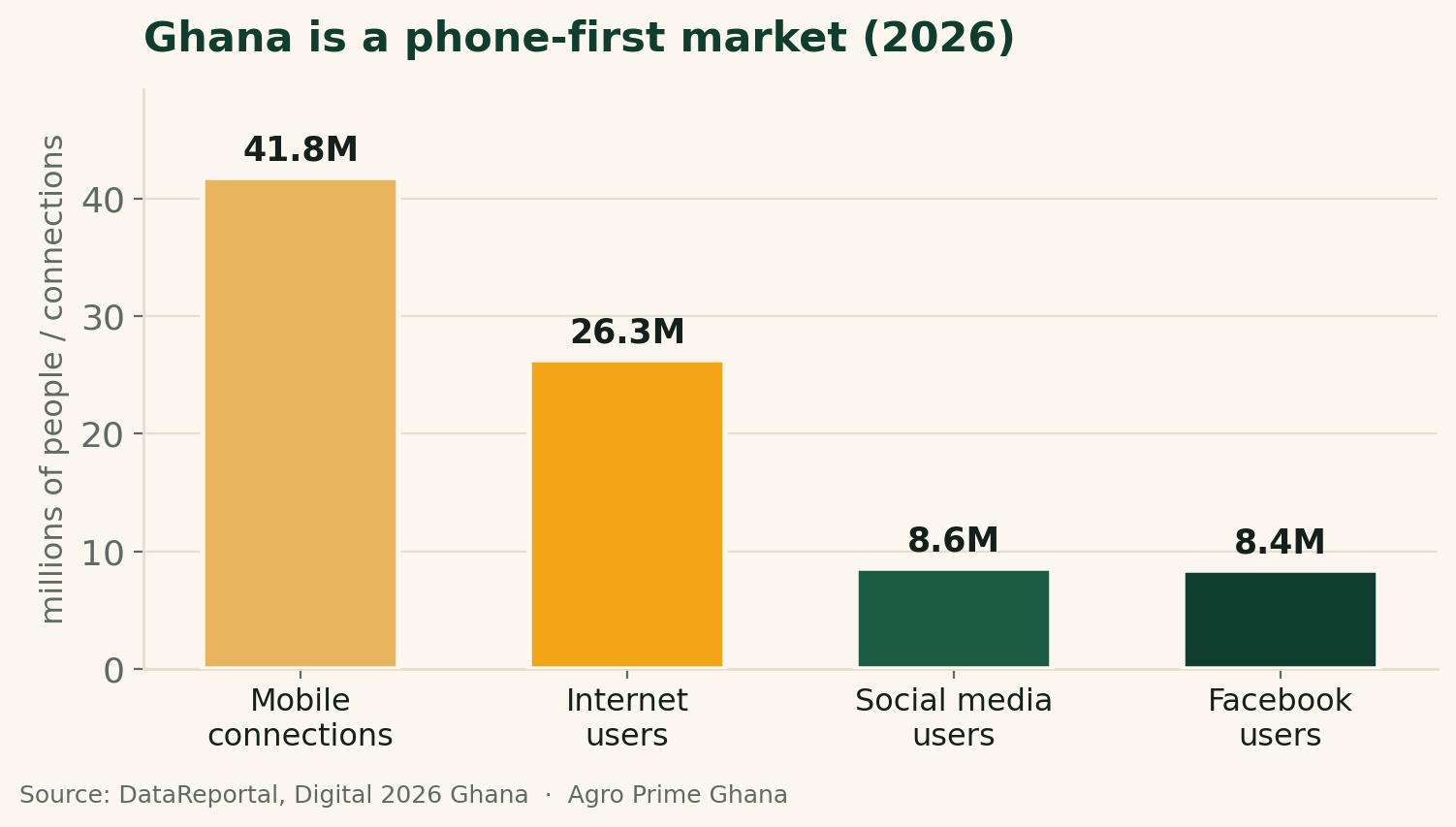
Ghana now has around 26.3 million internet users (about 74.6% of the population) and roughly 8.6 million active social media identities, per DataReportal's Digital 2026 Ghana report — and WhatsApp is the platform Ghanaians use most, with about 93% of online users on it regularly. That makes WhatsApp the single most important place to sell eggs. Get paid with mobile money: MoMo transactions reached about GH¢3.0 trillion in 2024 according to the Bank of Ghana, so nearly every customer can pay you instantly. Sell by the crate of 30, grade and clean your eggs, price a little above farm-gate but below shop retail, and treat breakage in transit as your number-one enemy — it is the single biggest constraint egg marketers report. Win on repeat orders, not one-off sales: a hundred customers who reorder weekly beat a thousand strangers.
Can you really sell eggs online in Ghana?
Yes — and the numbers explain why it now works where it barely did ten years ago. According to DataReportal's Digital 2026 Ghana report, Ghana had about 26.3 million internet users at the end of 2025, equal to roughly 74.6% of the population, alongside some 41.8 million mobile connections — more than one per person. Three-quarters of the country is now reachable through a phone. Just as importantly, the way people pay has changed completely: the Bank of Ghana reported mobile money transactions of about GH¢3.0 trillion in 2024. A customer in Accra can see your eggs, order them and pay for them in under a minute without either of you touching cash. That is the foundation of online selling, and Ghana already has it. "Online" here does not mean building a shop on the internet — it means using the phone, the apps and the payment rails your customers already carry every day.
Which online channels actually work for eggs?
For eggs specifically, the winning channel is almost always WhatsApp, supported by Facebook and Instagram for reach and by neighbourhood delivery for fulfilment. The reason is that eggs are a low-value, high-frequency, fragile, perishable product bought by ordinary households and small food businesses. That profile rules out slow, formal marketplaces and rules in fast, personal, local messaging. DataReportal's Digital 2026 figures show why WhatsApp dominates: while Facebook reaches about 8.4 million Ghanaians and YouTube about 8.6 million, surveys quoted in the Digital reports find WhatsApp is the platform the overwhelming majority use most — around 93% of online Ghanaians. People do not browse a marketplace to buy eggs; they message someone they trust and expect a reply. Your job is to be that trusted "someone" — visible on the platforms below, but closing every sale in a WhatsApp chat.
| Channel | Best for | Strength | Watch out for |
|---|---|---|---|
| WhatsApp Business | Taking and closing every order | Reach (~93% of online users), catalogue, broadcast, instant MoMo | You must reply fast; it is one-to-one work |
| Facebook / Instagram | Being discovered by new buyers nearby | Millions of users; local buy-and-sell groups; visual proof | Move serious buyers to WhatsApp to actually sell |
| TikTok | Showing the farm, building a following | Fast-growing; great for "behind the scenes" trust | Weak for direct egg orders; use it for awareness |
| Marketplaces (Jiji, Tonaton) | Reaching strangers actively searching | Buyers with intent; free listings | Price haggling, no-shows, less repeat business |
| Food-delivery apps | Selling to households wanting doorstep delivery | Built-in logistics and payment | Commissions and packaging rules eat thin egg margins |
Setting up WhatsApp Business to sell eggs
WhatsApp Business is a free, separate app from ordinary WhatsApp, and it is the most valuable tool an egg seller in Ghana can set up in an afternoon. Start with a complete business profile: your farm name, location (be specific — "Kasoa, near…"), opening hours, and a clear photo. Then build a catalogue, which can hold up to 500 items; for eggs you might list "Crate of 30 — large brown," "Half-crate — 15," "Tray of medium," each with a clean photo and a price. Keep your catalogue price and your chat price identical so you are not renegotiating with every customer. Use quick replies for the questions you answer twenty times a day ("Yes, we deliver to Kasoa and Weija; delivery is added to the total"), labels to tag customers (New, Regular, Wholesale, Owing), and a greeting message so a first-time messenger is welcomed even when you are in the layer house. The single most powerful feature for repeat egg sales is the broadcast list: add every customer who has bought, and each time you have fresh crates you send one message that lands as a private chat in each of their phones — not a group, so nobody sees the others. That one habit turns a phone full of contacts into a weekly order book.
How to price eggs for online selling
Price online eggs to sit above the farm-gate wholesale price but below what a shop charges retail — that gap is exactly the value you are capturing by selling direct. In Ghana eggs are traded by the crate of 30, and price moves with size grade, feed costs and season, so avoid quoting a fixed cedi figure that goes stale; instead price each grade clearly and update it as your input costs move. A few principles keep you profitable:
- Grade honestly and charge for it. Sort into small, medium, large and extra-large. Buyers pay more for big, uniform, clean eggs, and grading is one of the easiest ways to lift your average price — see our guide to egg grading and sizing.
- Sell clean eggs. Dirty, cracked or stained eggs cost you trust and repeat orders. Producing and presenting clean eggs is a pricing strategy, not just hygiene.
- Build delivery into the number. Decide whether delivery is included, added, or free above a minimum order (say, "free delivery for two crates or more"). Never let a small order's transport cost quietly wipe out its margin.
- Reward bulk and loyalty. A modest discount for regular multi-crate buyers costs you little and locks in the customers who make the business.
For a fuller treatment of pricing and margins, read our note on egg crate pricing and marketing.
Getting paid: mobile money is your cash register
The safest way to get paid for online egg sales in Ghana is mobile money before delivery. With MoMo now moving trillions of cedis a year, almost every customer already has MTN MoMo, Telecel Cash or AirtelTigo Money, and can pay you the moment they order. Insisting on payment (or at least a deposit for larger orders) before you load the crates protects you from the two classic online-selling losses: the no-show and the "I'll pay on delivery" that becomes an argument at the gate. Keep it simple and trustworthy: state your MoMo name and number clearly, confirm each payment with a short "Received, thank you — your two crates will reach you by 4pm," and keep a running record of who has paid and who is owing. If you want to look more established, payment links through a processor like Paystack let customers pay by card or MoMo from a single link, but for most egg sellers a clean MoMo number and disciplined confirmation is all you need. Whatever you use, write it into your farm records — online selling only stays profitable if you know your true margin per crate.
Field note: turn every buyer into a saved contact and a broadcast subscriber
The mistake we see most often is treating each sale as a one-off. Someone messages, buys two crates, and then vanishes because the seller never saved them. On our own selling side the discipline is simple: the moment anyone buys, their number goes into the phone with a clear name and a label — "Ama Weija regular," "Chop bar Kasoa wholesale" — and onto the weekly broadcast list. When fresh crates are ready, one broadcast quietly reaches all of them as private messages. It costs nothing, it does not spam a group, and it is the difference between hunting for buyers every week and having buyers who expect your message. Guard that contact list like stock; it is worth more than any single crate.
Delivery and packaging: beating breakage
Breakage in transit is the biggest single problem in Ghanaian egg marketing, so your delivery method is not a detail — it is the business. A study of egg marketing in Ghana found that losses from breakage were cited as a constraint by 99% of marketers and high transport costs by 98% (Scientific African, 2023). Every cracked egg is a sale you already made and then destroyed. Protect against it deliberately: use proper egg crates and trays, never loose bags; do not over-stack; cushion the load in the car or on the motorbike; and hand over on trays rather than pouring eggs between containers. Plan delivery zones so a single trip serves several nearby customers and keeps transport cost per crate low — this is why clustering your buyers in Kasoa, Weija, Ngleshie Amanfro and along the Accra road matters. For longer runs, our guide to transporting eggs covers loading, routing and handling in detail. Set a clear promise ("delivered same day if you order before noon") and keep it; reliability is what turns a first delivery into a standing order.
Ready to sell eggs but not producing enough steady, quality crates yet?
Consistent online selling depends on a consistent supply of clean, well-graded eggs — which starts with the right layers, well reared and well fed. Agro Prime Ghana supplies point-of-lay pullets and healthy day-old layer chicks (Lohmann, ISA and similar), plus layer feed and hands-on advice on flock size, lay rate and grading so your production matches the orders you are building online. If you are planning how many birds to keep for a target number of crates a week, we can help you size it properly. Message us on WhatsApp (+233 24 915 1503) or book a visit to the Kasoa farm to talk it through.
Building repeat orders instead of chasing strangers
The real money in selling eggs online is in repeat customers, not viral posts. Eggs are bought weekly, so a customer who reorders is worth fifty of them a year; a customer who buys once is worth one crate. Structure your whole approach around loyalty. Offer a light subscription: "Tell me your standing weekly order and I'll deliver every Friday — you only message me if you want to change it." Keep the relationship warm with useful, occasional messages, not constant selling — a note that fresh large crates are in, a simple egg recipe, a reminder before a festive rush. Ask happy buyers to refer a neighbour, and thank them when they do. The most valuable customers are small food businesses — chop bars, waakye and koko sellers, cake bakers, cold stores and provision shops — who buy several crates every week and rarely change supplier once you prove reliable; going after those, and locking them in, is covered in our guides to selling table eggs and supplying eggs to shops. Handle every complaint fast and fairly — replace broken eggs without argument — because in a market that runs on word of mouth, one well-handled problem buys you ten referrals.
Field note: photos and honesty do the selling for you
Online, your customer cannot pick up the egg, so your photo is the egg. We keep it plain and true: real crates in daylight, clean shells, the actual size the buyer will get — never a borrowed picture of perfect imported-looking eggs you cannot supply. When a batch runs smaller that week, we say so and price it as medium rather than passing it off as large. That honesty feels slower, but it is what stops the "these are not what you showed me" message that kills repeat business. Show exactly what you sell, sell exactly what you showed, and the photos quietly build the trust that closes every future order.
The bottom line on selling eggs online in Ghana
Selling eggs online in Ghana is not a distant idea — the reach and the payment rails are already here, with about 26 million internet users, near-universal WhatsApp use, and mobile money moving trillions of cedis a year. The playbook is unglamorous but reliable: set up WhatsApp Business properly, show clean graded crates in honest photos, take payment by MoMo before you deliver, protect ruthlessly against breakage, and turn every buyer into a saved contact on a weekly broadcast list. Do that consistently and you stop being a price-taker at the farm gate and become a small brand with your own customers, your own prices and your own order book. The farms that win at this are not the ones with the most followers — they are the ones whose regulars know that a crate ordered by noon arrives clean and unbroken by evening, every single week.
Frequently asked questions
What is the best platform to sell eggs online in Ghana?
How do I get paid for eggs sold online?
How should I package and deliver eggs to avoid breakage?
How do I price eggs for online sale?
Do I need a website to sell eggs online in Ghana?
How do I get repeat egg customers instead of one-off sales?
Can I sell eggs on marketplaces like Jiji or on delivery apps?
How many layers do I need to sell eggs online consistently?
Sources & further reading
- DataReportal — Digital 2026: Ghana (internet users, mobile connections, social platform reach, WhatsApp usage).
- Bank of Ghana, via GBC — mobile money transactions reaching about GH¢3.0 trillion in 2024.
- Scientific African (2023) — Organization and performance of chicken egg marketing in Ghana (channels, crate trade, breakage and transport constraints).
- Agro Prime Ghana guides: selling table eggs, egg grading and sizing, transporting eggs, and producing clean eggs.
About Agro Prime Ghana
Agro Prime Ghana Limited runs a poultry hatchery and mixed agribusiness in Kasoa, supplying day-old chicks, point-of-lay pullets, feed and hands-on farm support to keepers across the country. These guides combine practical hatchery and farm experience with current market and industry references. This article is general business information, not financial or legal advice — figures move with season and cost, so check current prices before you commit. Building an egg business and want steady, quality layers to supply it? Book a visit or message us on WhatsApp (+233 24 915 1503) to order chicks, pullets, feed or advice.