
A good setting egg is a clean, sound-shelled, normally-shaped egg of average weight — roughly 50 to 65 grams for a standard chicken — laid by a healthy, fertile flock and set while it is still fresh. Everything you do inside the incubator is limited by what you set: no machine, however good, can hatch a strong chick out of a cracked, dirty, oversized or stale egg. That is why the most profitable half-hour in a small hatchery is often spent before the eggs ever go in — sorting the tray, candling doubtful shells, and setting aside the eggs that were never going to make it. On our own hatchery floor in Kasoa, culling hard at selection is the single cheapest way we know to lift hatchability and chick quality. This guide explains exactly what makes a good hatching egg, egg by egg, and why ruthless selection pays.
Written by the Agro Prime Ghana hatchery team and reviewed against current industry references (Mississippi State University Extension and H&N International). Last updated September 2026.
Key takeaways
A good hatching egg is average-sized (about 50–65 g, with many guides putting the optimum near 58–61 g), normally shaped (a clear oval, not round, long or misshapen), with a sound, clean, uncracked shell of good texture, and it is fresh — ideally set within 7 days of laying. Reject cracked or thin-shelled eggs (they lose the moisture the embryo needs and let in bacteria), dirty eggs (they spread infection and should not be washed), very large or very small eggs (large eggs hatch poorly; small eggs give small, weak chicks), oddly shaped eggs, and eggs with a loose or bubbly air cell on candling. Culling these before setting lifts hatchability, tightens the hatch window and gives stronger day-old chicks — at no cost.
Why selecting eggs before setting matters so much
Egg selection matters because hatchability is decided as much before the incubator as inside it. A cracked shell cannot hold the moisture an embryo needs and is an open door to bacteria; a dirty shell carries that bacteria straight into a warm, moist machine where it multiplies; an oversized or misshapen egg carries a structural problem the machine cannot correct. Mississippi State University Extension is direct about this: incubate only eggs of average size, because "excessively large eggs hatch poorly" and "small eggs hatch into small, unthrifty chicks"; discard all cracked or thin-shelled eggs because "these eggs do not keep the moisture needed for proper chick development"; do not incubate abnormally shaped eggs, which "probably will not hatch"; and never save dirty eggs, because "they can spread disease to other eggs and chicks." Each culled egg is one you were unlikely to hatch anyway — and, worse, a bad egg does not just fail on its own. A dirty or cracked egg that rots or explodes in the machine contaminates the good eggs around it. So culling is not only about the individual egg; it protects the whole set.
There is a commercial edge to this too. A hatchery, or a farmer hatching his own replacements, is paying to run the machine for 21 days regardless of how many eggs hatch. Filling trays with eggs that were never going to make a strong chick wastes that energy and space and drags down your average. Grading hard concentrates your capacity on the eggs that can actually deliver. This is the front end of the same discipline that decides why eggs don't hatch in the first place.
Size and weight: aim for the average
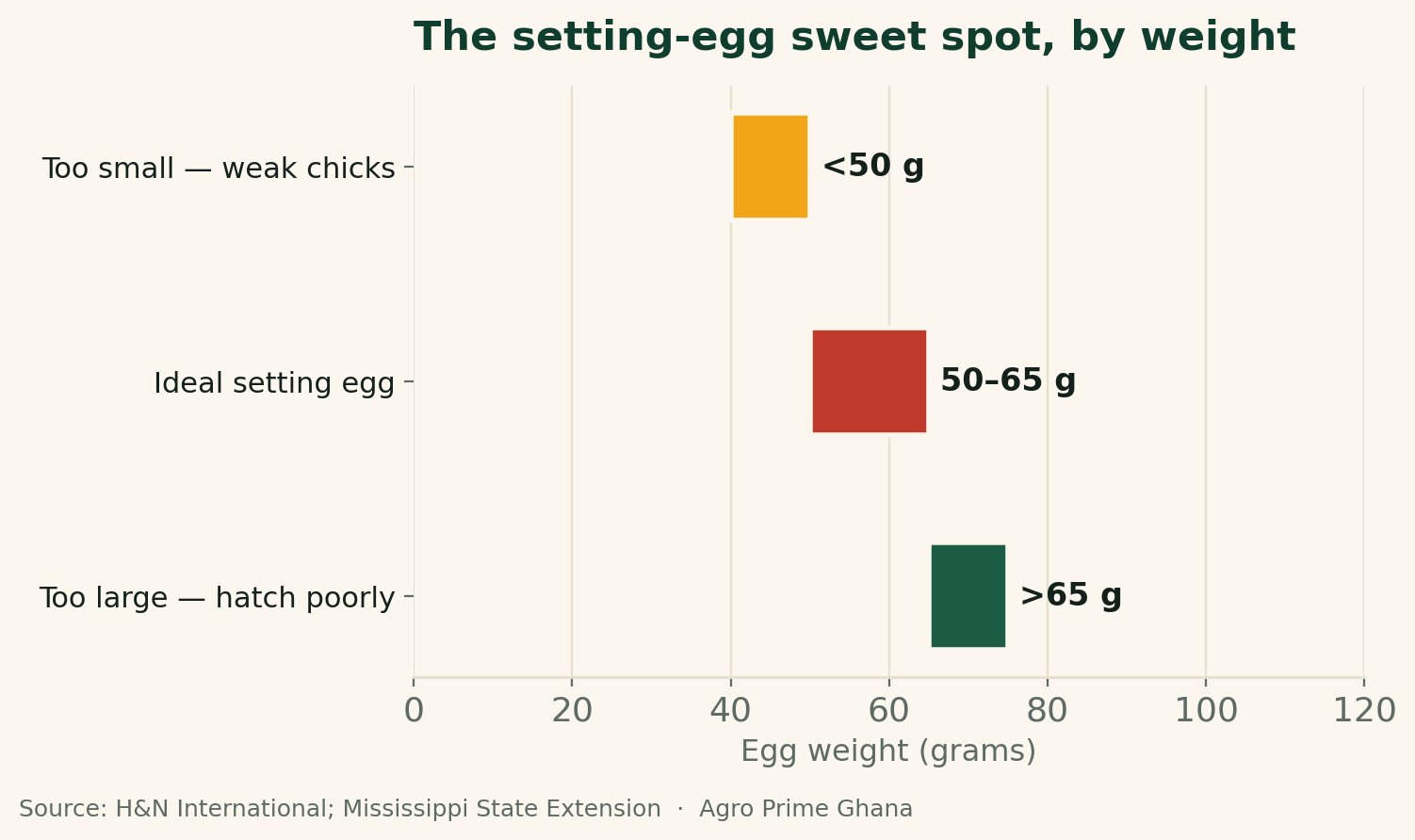
The first thing to judge is weight, and the rule is to aim for the middle, not the extremes. For a standard laying or dual-purpose chicken, a good setting egg falls in roughly the 50 to 65 gram range, and several breeder guides put the sweet spot tighter still — H&N International cites an optimal hatching-egg weight of about 58 to 61 g. Both the very small and the very large should go. Small eggs — typically the first eggs from young pullets just coming into lay — hatch into correspondingly small, weak chicks that start life behind. Very large eggs, often doubles or the big eggs of an older flock, hatch poorly: they take longer, are more prone to malposition, and are more likely to carry two yolks (which almost never hatch a live chick). Setting a mix of sizes also widens your hatch window, because different-sized eggs finish at different times. Consistency is the aim: an even tray of average eggs hatches together and hatches better than a jumble of tiny and giant ones.
| Egg feature | Set it | Cull it |
|---|---|---|
| Weight / size | Average — about 50–65 g (optimum ~58–61 g) | Very small (young-pullet eggs) or very large / double-yolk |
| Shape | Clean, even oval | Round, very long, flat-sided, ridged or lopsided |
| Shell soundness | Intact, no cracks or hairlines | Cracked, star-cracked or thin, chalky, translucent shells |
| Shell texture | Smooth, even, good "grain" | Rough, sandy, pimpled, banded or wrinkled shells |
| Cleanliness | Clean from the nest | Dirty, faecal- or yolk-smeared, or heavily stained (do not wash) |
| Air cell (on candling) | Small, firm air cell at the wide end | Loose, tilted or bubbly air cell |
Shape: a good egg is a proper oval
Shape is quick to judge and worth a hard eye. A good hatching egg has the classic egg outline: one broad end, one slightly pointed end, a smooth even taper. Reject the oddities — eggs that are almost round, unusually long and torpedo-shaped, flat-sided, ridged, or lopsided. Mississippi State Extension notes plainly that abnormally shaped eggs "probably will not hatch." Beyond hatchability, shape carries information about the hen: a flock producing a lot of misshapen eggs may be young, stressed, crowded, or fighting a respiratory disease that shows up in the shell gland, so a rash of odd shapes is worth investigating in the breeder flock rather than just culling at the tray. Set the clean ovals and leave the rest for the kitchen.
Shell quality: sound, clean and well-textured
The shell is the embryo's life-support housing, so its condition is decisive. Three faults send an egg to the cull tray. First, cracks — including fine hairline cracks you can only see by candling. A crack lets moisture escape and bacteria in, and Mississippi State Extension is clear that cracked or thin-shelled eggs "do not keep the moisture needed for proper chick development." Candling in a dark room is the reliable way to catch hairlines: a cracked shell shows a bright line or star against the light. Second, thin, chalky or translucent shells, which are fragile and porous and lose water too fast during incubation; these often point to a calcium or age issue in the flock. Third, rough, sandy, pimpled, banded or wrinkled texture — bumpy or uneven shells hatch worse and, like odd shapes, can flag a flock health or nutrition problem. H&N International recommends incubating only clean eggs and discarding those with hairline cracks, and treats a hairline-crack rate above about 2% as a signal to investigate the flock rather than an acceptable normal. Good shell texture is not fussiness; it is the difference between an egg that holds its moisture on schedule and one that dries out or leaks.
Field note: candle the doubtful ones, don't guess
Most eggs sort themselves at a glance — obviously clean, sound and average go on the tray; obviously cracked, dirty or misshapen go to the kitchen. It is the in-between eggs that cost you, and for those we candle rather than guess. A quick pass with a candling light in a dark room reveals hairline cracks as bright lines, shows thin patches as over-bright areas, and lets you check the air cell. Two minutes over the doubtful eggs at selection saves a rotten egg contaminating a tray three weeks later. Candling is a skill worth building early — see our note on running your incubator and checking eggs through the set.
Cleanliness: set clean eggs, and never wash
Cleanliness is where many small hatcheries quietly lose hatchability, and the rule has two halves. First, set only clean eggs. A shell smeared with droppings or broken-egg yolk is coated in bacteria, and the warm, humid incubator is an ideal culture chamber — a dirty egg can rot, contaminate its neighbours, and hatch (if it hatches at all) a weak, infected chick prone to navel infection. Mississippi State Extension warns that dirty eggs "can spread disease to other eggs and chicks." Second, and crucially, do not wash dirty eggs to save them. Washing, especially in cool or dirty water, drives bacteria through the thousands of pores in the shell and strips the natural protective cuticle, often making a dirty egg more dangerous, not less. The real fix is upstream: collect eggs frequently, keep nest boxes clean and well-bedded, and provide enough nests so hens are not laying and treading on the floor. Clean eggs come from clean nests — which is why hatchery results start in the breeder house and its hygiene routine, not at the incubator door.
Skip the guesswork — get graded hatching eggs or ready day-old chicks
Sourcing fertile eggs of the right size, shell quality and freshness — from a healthy, well-managed breeder flock — is half the battle, and it is exactly what a working hatchery does for a living. Agro Prime Ghana supplies quality hatching eggs selected to these standards, and healthy broiler and layer day-old chicks if you would rather skip incubation entirely, along with practical advice on setting and hatching your own. If you are choosing between hatching eggs and day-old chicks for your operation, we will talk it through with you. Message us on WhatsApp at +233 24 915 1503 or book a visit to the Kasoa hatchery.
Freshness and the air cell: set them while they're young
Even a perfect egg goes stale. Fertile hatching eggs are at their best when set within about 7 days of laying, and hatchability falls steadily the longer they wait — a subject worth a section of its own, covered in our guide to storing hatching eggs before setting. At selection, the age of an egg shows in its air cell, the pocket of air at the broad end. A fresh egg has a small, firm air cell; as an egg ages and loses water, the air cell grows and can become loose or "bubbly," moving around when the egg is tilted. On candling, discard eggs with a loose or bubbly air cell — Mississippi State Extension lists these among the eggs to reject. A large, wobbly air cell tells you the egg is old, has been stored poorly, or has lost too much moisture, all of which cut its chance of hatching a strong chick. So freshness is both a rule (set within a week) and something you can verify by eye at the tray.
Fertility and the flock behind the egg
One thing selection cannot see is fertility. A shell can be flawless and the egg still infertile — no cockerel, too few cockerels, an old or unwell breeder flock, or heat stress suppressing mating. You only confirm fertility by candling at around day 7 to 10 of incubation, when a fertile, developing egg shows a spidery network of blood vessels while a "clear" (infertile) egg or an early-dead one does not. That is too late to affect the current set, but a consistently high proportion of clears tells you to look at the breeding flock, not the incubator. Practically, this means the surest way to set good eggs is to source them from a healthy, correctly-mated breeder flock — the right ratio of cockerels to hens, good body condition, sound nutrition and shade against the heat. Selection culls the eggs that clearly won't hatch; a good breeder flock ensures the ones you do set are actually fertile.
The bottom line on choosing setting eggs
A good setting egg is an average-sized (about 50–65 g), cleanly-shaped, sound-shelled, clean and fresh egg from a healthy fertile flock — and the fastest, cheapest way to lift your hatch is to set only those and cull the rest. Reject cracked and thin shells, dirty eggs (and never wash them), very large and very small eggs, misshapen and rough-shelled eggs, and eggs with a loose air cell on candling. Set within about a week of laying while the air cell is still small and firm. None of this costs anything but a careful half-hour and the discipline to send doubtful eggs to the kitchen rather than the machine. Get selection right and you tighten your hatch window, cut rotten-egg contamination, and hatch a batch of stronger, more uniform chicks — because in incubation, you can only hatch as well as the eggs you chose to set.
Frequently asked questions
What size egg is best for hatching?
Can I incubate cracked eggs?
Should I wash dirty hatching eggs before setting?
How fresh should hatching eggs be?
What shape should a hatching egg be?
Does culling eggs before setting really improve hatchability?
How can I tell if a hatching egg is fertile before setting?
What is wrong with a rough or thin eggshell for hatching?
Sources & further reading
- Mississippi State University Extension — Hatching Quality Chicks (average size, discard cracked/thin/abnormal/dirty eggs, loose air cell, do not wash).
- H&N International — Hatching Egg Management (optimal ~58–61 g egg weight, incubate only clean eggs, hairline-crack rate below ~2%).
- The Poultry Site — A Guide to Egg Quality (shell quality and egg-quality assessment).
- Agro Prime Ghana guides: storing hatching eggs, why eggs don't hatch, and hatchery hygiene & fumigation.
About Agro Prime Ghana
Agro Prime Ghana Limited runs a poultry hatchery and mixed agribusiness in Kasoa, hatching and supplying day-old chicks and supporting poultry keepers nationwide. These guides combine hands-on hatchery experience with current industry references. We supply healthy day-old chicks (broilers & layers), point-of-lay pullets, quality feed, selected hatching eggs and hands-on farm support across Ghana. This article is general educational information, not a substitute for professional veterinary or hatchery advice. Ready to start or expand? Book a visit or message us on WhatsApp (+233 24 915 1503) to order chicks, hatching eggs or advice.