To scale a poultry farm in Ghana without collapsing, grow only when your current flock is already profitable and your systems run without you — then add capacity in deliberate steps (a doubling, not a ten-fold jump), fund the growth with working capital rather than debt on the birds, and tighten biosecurity and management before the extra birds arrive, not after. Most Ghanaian farms that fail do not fail because they were too small; they fail because they grew faster than their cash, their disease control and their market could carry. A keeper doing well on 500 broilers borrows heavily, jumps to 5,000, hits one disease break or one glut at Christmas, and the whole thing comes down. This guide explains when to grow, how to finance growth safely, and how biosecurity, records and management must change as the numbers climb.
Written by the Agro Prime Ghana poultry team and reviewed against current industry references (USDA FAS Ghana Poultry reports and peer-reviewed comparative studies of Ghanaian broiler farms). Last updated September 2026.
Key takeaways
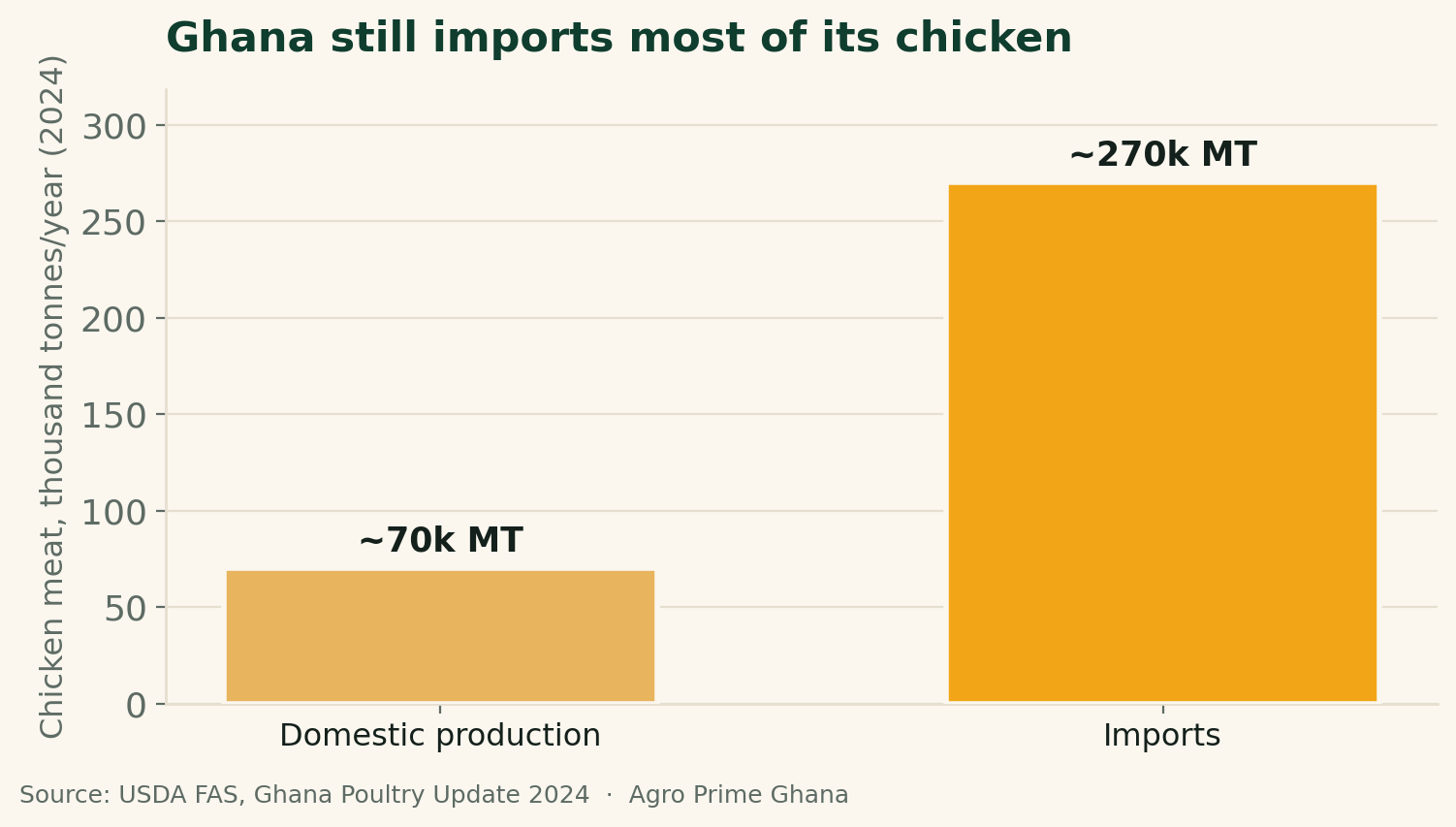
Ghana imports the overwhelming majority of its chicken meat — around 270,000 tonnes of imports against roughly 70,000 tonnes of domestic production in 2024, costing the country over US$375 million a year — so the market for locally-grown birds is real and large. But scaling is where farms die: feed alone is 48–59% of a Ghanaian broiler's production cost, so a small drop in feed efficiency or a spike in mortality multiplies fast at volume. Grow only when your flock is consistently profitable, your records are clean, and your mortality is under control (good farms run around 3–5%; poor chick sourcing and management push it to 5–10% or worse). Scale in steps, keep 3–6 months of working capital, adopt strict all-in/all-out and biosecurity, and secure your market before you expand — not after the birds hatch.
Why the opportunity to scale is real in Ghana
The case for expanding a Ghanaian poultry farm rests on one stubborn fact: the country does not grow enough chicken to feed itself. According to the USDA Foreign Agricultural Service, total chicken-meat consumption ran at about 340,000 tonnes in 2024, of which roughly 270,000 tonnes were imported and only about 70,000 tonnes produced domestically. Imported chicken makes up over 80% of Ghana's meat imports and costs the nation more than US$375 million each year. Domestically, broilers are a tiny sliver — under 5% of local chicken-meat production — because most local chicken meat comes from spent layers. That gap is the opportunity: every kilo of fresh, local broiler or every crate of local eggs displaces an import. Demand is not the constraint. The constraint is producing at a cost, quality and reliability that let you win that market and keep winning it as you get bigger.
When is a poultry farm actually ready to scale?
A farm is ready to scale when the current operation is already profitable, predictable and largely self-running — not when the owner simply wants to be bigger. Wanting to grow is not the same as being ready to grow. Before you add a single extra bird, you should be able to answer yes to all of these:
- Is the current flock consistently profitable? Not once, by luck at Christmas — but batch after batch, with the numbers written down. If you cannot show a profit on your present scale, doubling it only doubles the loss. This is why honest record keeping is the real precondition for scaling.
- Is mortality under control? Well-run Ghanaian broiler flocks lose around 3–5% from chick to market; poor chick sourcing and weak management push losses to 5–10% or higher. At 500 birds a bad batch stings; at 5,000 it can wipe out a season's profit.
- Do you have a reliable market for the extra output? More birds are only more money if you can sell them. Selling 200 broilers to neighbours is different from moving 2,000 every cycle without dumping them at a loss.
- Can the farm run without you standing over it? At scale you cannot personally brood, feed, medicate and sell every bird. If there are no systems and no trained hands, scale simply multiplies the number of things that can go wrong while you sleep.
If you are still getting the fundamentals right, your effort is better spent perfecting them at your current size — see our guide to starting a poultry farm in Ghana — because scaling amplifies whatever you already are. A tight, profitable small farm becomes a tight, profitable bigger farm; a leaky one becomes a bigger disaster.
Why the economics get harder, not easier, as you grow
The dangerous myth of scaling is that bigger automatically means cheaper per bird. In Ghana it often does not, because the single largest cost travels with every bird you add. A 2024 comparative study of Ghanaian broiler farms published in Agriculture & Food Security found that feed represents 48–59% of total broiler production cost, and that Ghanaian farms convert feed far less efficiently than European ones — a feed conversion ratio (FCR) of roughly 2.08–2.18 kg of feed per kg of gain, against about 1.55–1.60 in Germany and the Netherlands. The same study found Ghanaian production costs run 144% to 219% higher than comparable European farms, driven heavily by expensive feed and fewer production cycles per year (about 3, versus 7–8 abroad). The lesson for anyone scaling: because feed dominates, your margin lives or dies on feed efficiency and feed price. Doubling your flock without improving FCR or feed sourcing simply doubles your exposure to the one cost that can sink you. Before you expand volume, squeeze the cost — our guide to reducing poultry feed cost is where the real savings are.
| Growth stage | Typical flock | What must be in place before you move up |
|---|---|---|
| Backyard / trial | 50–300 birds | Basic brooding skill, a working house, a small local market, honest records started |
| Small commercial | 500–1,500 birds | Consistent profit per batch, mortality under 5%, reliable feed and chick supply, repeat buyers |
| Mid commercial | 2,000–10,000 birds | All-in/all-out system, trained staff, biosecurity fence & footbath, working capital buffer, contracts or firm off-takers |
| Large / integrated | 10,000+ birds | Separate brooding & grow-out sites, cold-chain or processing links, formal financing, veterinary programme, professional management |
Illustrative growth stages for Ghanaian conditions; the numbers are typical bands, not rigid rules.
How to finance growth without mortgaging the farm
Finance growth from a mix of retained profit and short-term working capital, and never borrow so much that a single bad batch cannot be survived. The most common way to kill a growing poultry farm in Ghana is to fund a big jump with expensive debt secured on birds that have not yet been raised or sold. Chickens are a biological asset: they can die, and the market can turn against you at exactly the wrong moment. The safer sequence looks like this:
- Grow first from your own profit. Reinvesting margin from profitable batches is the cheapest, safest capital there is, because it carries no interest and no repayment date that ignores whether your birds are healthy.
- Borrow for infrastructure, not for live birds. A loan that builds a house, a store or a borehole buys a durable asset that keeps working across many batches. A loan used to buy this batch's chicks and feed must be repaid on this batch's luck — a much riskier bet.
- Match the loan term to the cash cycle. Broilers turn cash in roughly 6–8 weeks; layers tie money up for months before the first egg. Short, seasonal borrowing suits broilers; long, patient finance suits layers and buildings. Read our guides to poultry farm financing and agricultural loans in Ghana before you sign anything.
- Keep a working-capital buffer. Aim to hold enough cash to feed and run the farm for several batches even if one goes badly. Feed is 48–59% of cost and it must be bought before the birds earn — running out of feed money mid-cycle is how growing farms stall and lose flocks.
Field note: the jump that breaks farms
The pattern we see most often is the "ten-times leap." A keeper does well on a few hundred broilers, borrows against the excitement, and jumps straight to several thousand in one new, unfamiliar house — new litter, new water system, new staff, new disease pressure, all at once. When something goes wrong (and at that jump, something usually does), there is no experience and no cash to absorb it. The farms that grow and survive almost always double rather than leap: 500 to 1,000, then 1,000 to 2,000, learning the new problems of each size while the losses are still small enough to recover from. Slower is not weaker. Slower is what is still standing in five years.
How biosecurity must change as you scale
Biosecurity stops being optional the moment you scale, because at volume a single disease break can destroy in days what took months to build. A backyard flock of fifty can sometimes survive sloppy hygiene; a house of five thousand cannot. The denser the birds and the more traffic your farm attracts — feed deliveries, chick supplies, buyers, workers — the more routes a pathogen has to get in and the faster it spreads once inside. As you grow, the non-negotiables are:
- All-in/all-out by site. Fill a house or site with one age group, raise them together, sell them together, then clean, disinfect and rest the empty house before the next batch. Mixing ages is the classic way disease becomes permanent on a farm — our guide to all-in/all-out management explains why.
- Control who and what enters. A perimeter, a single controlled entrance, footbaths with fresh disinfectant, dedicated farm boots and coveralls, and a rule that outside vehicles stay outside. Most disease walks in on shoes, tyres and shared crates.
- Separate the vulnerable. As you scale, brooding young chicks well away from older grow-out birds — ideally on a separate site — protects the animals most likely to die and least able to fight infection.
- A written vaccination and health programme. At scale you cannot rely on memory. Newcastle disease and Gumboro schedules, coccidiosis control and a relationship with a veterinarian become structural, not occasional.
Biosecurity is cheap relative to what it prevents. At small scale a break is a setback; at large scale, on borrowed money, it is often the end.
Management and people: the part owners underestimate
Scaling is mostly a management problem, not a poultry problem — the birds are the same, but you can no longer do everything yourself. The owner who personally checks every drinker at 300 birds physically cannot at 3,000, and the moment tasks are delegated, the quality of your systems and your staff decides your results. What changes:
- Records become the nervous system of the farm. You cannot see 5,000 birds the way you saw 300, so daily feed intake, water, mortality and — for layers — production must be written down and read every day. A rising mortality trend or a dropping feed intake is often the first sign of trouble, visible in the numbers days before it is obvious in the pen.
- Weighing and uniformity replace eyeballing. Regular sample weighing tells you whether the flock is on target and whether feeding is working — see weighing and flock uniformity. Guessing does not scale.
- Staff must be trained and accountable. Clear routines, someone responsible for each house, and simple checks stop small lapses — a footbath left dry, a leaking drinker, a missed vaccination — from becoming flock-wide failures.
- Supply relationships must be locked down. At volume you need dependable chick supply and dependable feed, because a gap in either at scale is expensive. This is exactly where a steady hatchery relationship earns its keep.
Field note: the extra house is the easy part
New farmers assume the hard part of scaling is building the next house or finding the money for more chicks. In our experience the real challenge arrives afterwards, in the ordinary week-to-week running: the second house means a second set of drinkers to check, a second footbath to refill, a second batch whose feed must be ordered and paid for on time, and often a new worker whose habits you cannot personally watch all day. The farms that stumble are usually the ones that budgeted for the building but not for the management. Before you commit to more birds, walk through an honest day in your head at the new size — who does what, when, and what happens if that person is absent — and only build once that day makes sense.
Grow with a chick supply you can count on
The fastest way to wreck a scaling plan is unreliable or low-quality day-old chicks — the study above links poorly-sourced local chicks to mortality of 5–10% versus around 3% for well-managed, quality stock, and at scale that difference is money you cannot afford to lose. Agro Prime Ghana supplies healthy, vaccinated day-old broiler and layer chicks and point-of-lay pullets in the volumes a growing farm needs, plus practical advice on brooding, feeding and biosecurity as you step up. Planning your next expansion? Message us on WhatsApp (+233 24 915 1503) or book a visit to talk through your chick schedule and grow-out plan.
Secure the market before you secure the birds
Never scale production before you have scaled your market, because unsold birds at scale lose money every day they keep eating. Broilers reach market weight on a schedule the market does not care about; if 2,000 birds are ready and you have buyers for 800, the other 1,200 keep consuming expensive feed while their value falls. Before you expand, line up where the extra output will go: standing orders from restaurants, hotels, cold stores or institutional buyers; wholesale relationships; or the seasonal peaks around Christmas and Easter when demand and prices climb — see selling live birds in the festive season. Time some of your expansion to hit those peaks. And decide honestly whether broilers or layers suit your market and cash flow, because they scale very differently — our comparison of broiler versus layer profit lays out the trade-offs. Production is the easy half of scaling. Distribution is the half that quietly decides whether growth makes you money or costs it.
The bottom line on scaling in Ghana
Ghana's chicken market is wide open — the country imports around four times what it grows — so there is genuine room for local farms to expand. But scale is unforgiving: it multiplies your feed exposure, your disease risk and your management burden all at once, and it punishes weak fundamentals harder than it rewards ambition. Grow only when your current flock is consistently profitable and your records prove it; fund expansion mainly from profit and infrastructure loans rather than debt on live birds; keep a working-capital buffer deep enough to survive a bad batch; step up in doublings rather than leaps; tighten biosecurity, all-in/all-out and staff systems before the birds arrive; and lock in your market first. Do that, and scaling stops being the thing that breaks poultry farms and becomes the thing that builds them.
Frequently asked questions
When should I scale up my poultry farm in Ghana?
How fast should I grow a poultry farm?
How should I finance poultry farm expansion in Ghana?
Why is feed so important when scaling?
How does biosecurity change as a poultry farm grows?
Do I need better records to scale?
Should I sort out my market before or after expanding?
Is it better to scale broilers or layers?
Sources & further reading
- USDA Foreign Agricultural Service — Ghana Poultry Voluntary Update 2024 (consumption, imports vs domestic production, import cost, broiler share).
- Agriculture & Food Security (2024) — Improving broiler farm competitiveness in Ghana and Senegal (FCR, feed cost share, mortality, production-cost comparison with Germany and the Netherlands).
- Agro Prime Ghana guides: starting a poultry farm, poultry farm financing, reducing feed cost, all-in/all-out management, and record keeping.
About Agro Prime Ghana
Agro Prime Ghana Limited runs a poultry hatchery and mixed agribusiness in Kasoa, supplying farms across the country as they start out and as they grow. We supply healthy day-old chicks (broilers & layers), point-of-lay pullets, quality feed and hands-on farm support, and we work with farmers planning their next stage of expansion. This article is general educational information, not a substitute for professional veterinary or financial advice. Ready to scale safely? Book a visit or message us on WhatsApp (+233 24 915 1503) to plan your chick supply, feed and grow-out schedule.