Limestone and dicalcium phosphate (DCP) are the two mineral supplements that supply most of the calcium and phosphorus in a poultry ration — the raw materials for bone, and, in a layer, for the eggshell she builds fresh every day. Limestone is roughly 34–38% calcium and is the cheap, bulk calcium source; DCP delivers about 18% phosphorus alongside ~22% calcium and is the usual source of the available phosphorus grain cannot supply. Getting the amounts and the balance between them right — the calcium-to-phosphorus ratio — is one of the quiet fundamentals of poultry nutrition, and getting it wrong shows up fast as rickets in chicks, thin or cracked eggs in layers, and paralysed, broken-boned hens at peak lay. This guide explains what each mineral does, how much a bird needs, the all-important Ca:P ratio, and the one detail most keepers miss: particle size for laying hens.
Written by the Agro Prime Ghana poultry team and reviewed against current veterinary and nutrition references (MSD Veterinary Manual and peer-reviewed poultry-nutrition research). Last updated September 2026.
Key takeaways
Limestone (calcium carbonate) is about 34–38% calcium and supplies the bulk calcium for bone and eggshell; dicalcium phosphate (DCP) supplies roughly 18% available phosphorus plus ~22% calcium. Growing birds need both for skeleton formation; a laying hen needs a great deal of calcium — around 3.5–4.5% of a brown-egg layer's diet — because each shell is about 2 grams of calcium built overnight. The calcium-to-available-phosphorus ratio matters as much as the amounts: roughly 1–2:1 for growing birds, but very wide for layers (available-phosphorus stays low while calcium climbs). For layers, feed part of the limestone as coarse particles (2–4 mm): coarse limestone is held in the gizzard and dissolves slowly, feeding calcium through the night when the shell is being made. Too little or unbalanced calcium and phosphorus causes rickets, thin shells and cage-layer fatigue.
What limestone and DCP each do
Calcium and phosphorus are the two major minerals of the skeleton, and in poultry they are supplied mainly by two supplements because grain and oilseed meals fall far short. Limestone is ground calcium carbonate — its calcium content is high but variable, generally quoted between about 32 and 38 percent calcium, with good feed-grade limestone near the top of that range. It is inexpensive and is the workhorse calcium source in every poultry ration. Dicalcium phosphate is the standard phosphorus supplement, carrying roughly 18–18.5% phosphorus and about 22% calcium; its phosphorus is in a form birds can actually absorb, which matters because much of the phosphorus naturally present in maize and soya is locked in phytate and largely unavailable to poultry. So the two supplements divide the work: limestone supplies cheap bulk calcium, and DCP supplies the available phosphorus (and a useful bit more calcium). Between them they set the mineral foundation of the diet — the framework on which energy, protein and everything else is built.
Why the balance matters so much in Ghana
It is not enough to add "enough" calcium and "enough" phosphorus separately — the two must be in the right ratio to each other, because they are absorbed and used together and an excess of one interferes with the other. The MSD Veterinary Manual notes that skeletal problems arise when phosphorus is high relative to calcium, and that both deficiency and imbalance cause rickets in growing birds, poor eggshells and osteoporosis in layers. For growing broilers and pullets the target calcium-to-available-phosphorus ratio sits at roughly 1–2 parts calcium to 1 part available phosphorus; push it too far either way and bone mineralisation suffers. For laying hens the picture flips dramatically: calcium demand soars for shell formation while phosphorus stays modest, so the ratio widens enormously — the MSD Veterinary Manual's requirement tables show the calcium-to-available-phosphorus ratio for laying hens ranging from about 8:1 early in lay to as much as 11:1 late in the cycle. This is why a layer cannot simply be fed a grower ration with extra limestone thrown in: the whole mineral balance has to shift. In Ghana the stakes are higher still because our layers work hard in the heat, feed intake dips when it is hot, and locally sourced limestone varies in quality — so a ration that was "about right" on paper can drift into deficiency in practice. Balancing calcium and phosphorus is covered further in our guides to calcium for laying hens and poultry feed ingredients.
How much calcium and phosphorus does a bird need?
The amounts change completely with the bird's job. A growing broiler or pullet is building a skeleton and needs a moderate, balanced supply of both minerals — on the order of 0.9–1.0% calcium and 0.4–0.45% available phosphorus in a starter, tapering as the bird matures. A laying hen is a different animal entirely: she is manufacturing an eggshell of roughly 2 grams of calcium every single day, more calcium output relative to body size than almost any other farm animal. The MSD Veterinary Manual's requirement figures put a layer's dietary calcium high — around 3.3–5.0% for a brown-egg hen depending on feed intake, and about 2.75–4.1% for a white-egg hen — while her available phosphorus requirement stays low, in the region of 0.25–0.38%. The table below contrasts the two mineral supplements and where each bird's needs are met.
| Mineral source | Supplies | Typical content | Main role |
|---|---|---|---|
| Limestone (calcium carbonate) | Calcium | ~34–38% Ca | Bulk calcium for bone and eggshell; cheap workhorse source |
| Oyster shell | Calcium | ~38% Ca | Coarse calcium for layers; slow-release for overnight shell formation |
| Dicalcium phosphate (DCP) | Phosphorus + calcium | ~18% P, ~22% Ca | Available phosphorus grain can't supply; secondary calcium |
| Bone meal / MCP | Phosphorus + calcium | Varies | Alternative phosphorus sources where available |
Two practical points follow. First, because limestone's calcium content varies, the same "10% limestone" in a formula can deliver noticeably different calcium depending on the source — worth remembering when you switch suppliers. Second, phosphorus is expensive and, in excess, both wasteful and environmentally polluting, so it is not something to over-add "to be safe": match the available-phosphorus requirement, and let enzymes such as phytase (see feed additives) unlock more of the phosphorus already in the grain rather than piling in extra DCP.
Particle size: the detail that makes or breaks eggshells
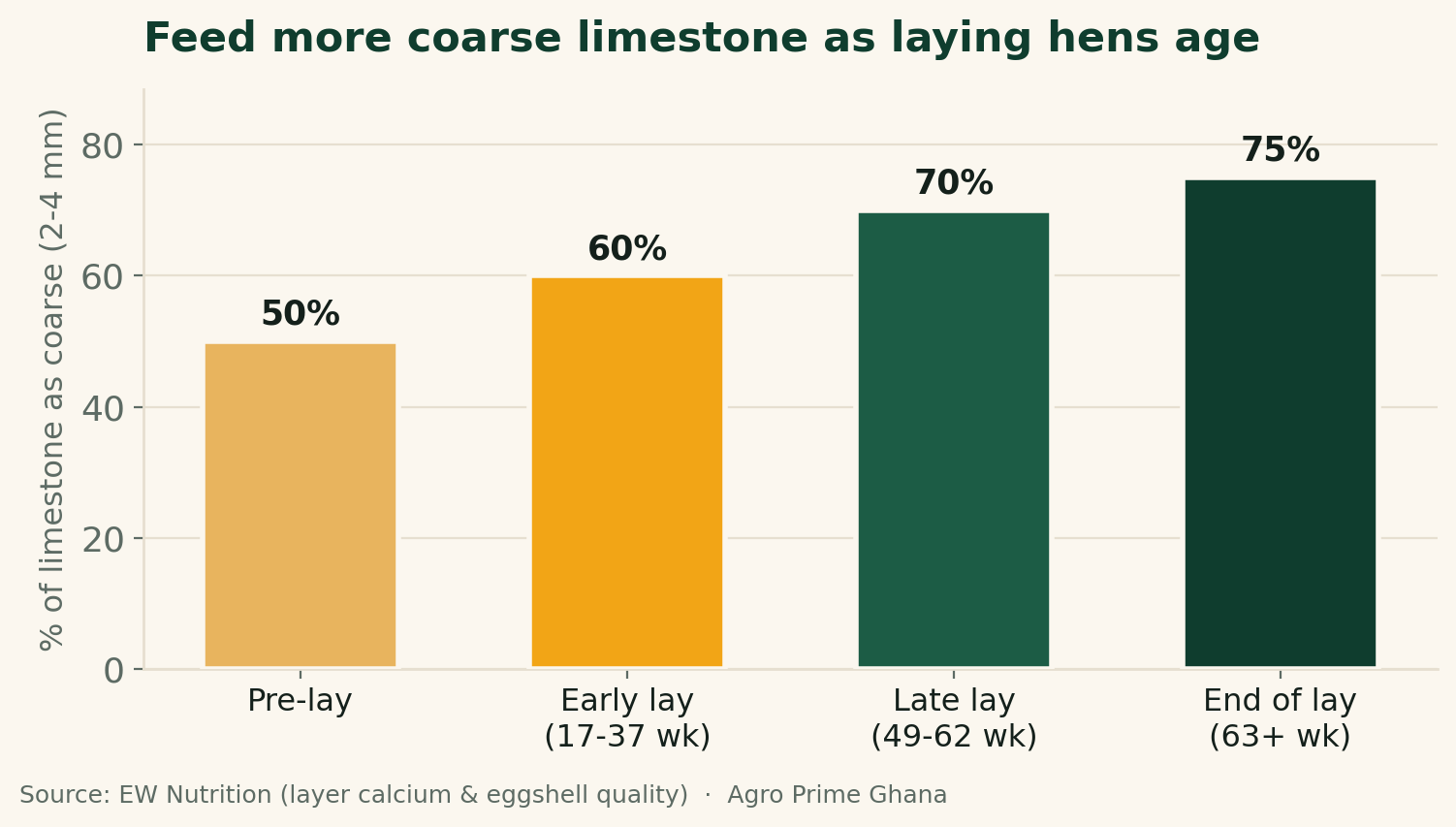
Here is the single most useful thing a layer keeper can learn about calcium: not all limestone should be fine powder. The size of the limestone particle changes how fast it dissolves and therefore when the calcium reaches the hen. Fine calcium carbonate (under about 1–2 mm) passes through the gut in only 2–3 hours, so a hen fed only fine limestone absorbs her calcium quickly during the day and then runs short overnight. But eggshell formation takes 12–14 hours and happens mainly at night, when the hen is not eating. Coarse limestone or oyster shell particles (roughly 2–4 mm) solve this: they are retained in the gizzard and dissolve slowly, releasing calcium steadily through the night exactly when the shell gland needs it. The result is stronger shells, fewer cracks, and less calcium pulled from the hen's own bones. Best practice is to feed a mix of fine and coarse limestone, with the coarse fraction rising as the hen ages — from roughly half-and-half at point of lay to as much as three-quarters coarse in an old flock, because shell quality naturally declines with age and older hens need the overnight supply most. Providing coarse calcium is also covered in grit and oyster shell for poultry, and its role in preventing thin shells in eggshell quality problems.
Field note: fix the shells before you blame the hens
When a layer flock starts throwing thin, cracked or soft-shelled eggs, keepers often reach first for "old hens" or "disease." More often the calcium is fine in quantity but wrong in form — all powder, nothing coarse — so the hens have no overnight calcium reserve and rob their own skeletons to finish each shell. Adding a coarse limestone or oyster-shell fraction, and letting hens pick at coarse calcium in the afternoon and evening, often turns shell quality around within a couple of weeks without changing anything else. It costs almost nothing. Before you cull a flock for "poor shells," check whether the calcium they are getting is arriving at the right time of day, not just in the right total amount.
What goes wrong: rickets, thin shells and cage-layer fatigue
Calcium and phosphorus problems announce themselves clearly if you know the signs. In growing chicks, a shortage or imbalance — too little calcium, too little available phosphorus, or too little vitamin D3 to use them — causes rickets: soft, rubbery bones, bent legs, a soft beak, lameness around 10–14 days, and ribs that bead and flatten. (Vitamin D3 is essential here because without it the bird cannot absorb calcium at all, however much is in the feed — see rickets in poultry.) In layers, the first sign is usually eggshell quality: thinning, cracking, soft or shell-less eggs. Left uncorrected, sustained calcium demand with inadequate supply drives osteoporosis and its most dramatic form, cage-layer fatigue — the MSD Veterinary Manual describes this as paralysis during or just after peak production caused by fracture of the vertebrae, with hens found collapsed on their sides, unable to reach feed and water, because they have drained their own skeletons to keep making shells. The manual's prevention advice is instructive: a diet of at least 4% calcium in the run-up to first egg, and 65–70% of the limestone as coarse particles (2–4 mm). We cover the full picture in cage layer fatigue. The common thread is that these are all supply-and-timing failures — fixable with the right amount, the right ratio and the right particle size.
Get calcium and phosphorus right — with feed and advice from Agro Prime
Balancing limestone and DCP correctly — the right amounts, the right Ca:P ratio, and coarse calcium for layers — is what separates flocks with strong bones and hard shells from those plagued by rickets, cracks and cage-layer fatigue. Agro Prime Ghana supplies quality poultry feed formulated for each stage, and can advise on calcium and phosphorus levels, coarse-limestone or oyster-shell supplementation and ration balancing, whether you buy finished feed or mix your own. If you are fighting thin shells, soft bones or a flock that is collapsing at peak lay, let us help you get the minerals right. Message us on WhatsApp (+233 24 915 1503) or book a visit for feed supply and a ration review.
Buying and using limestone and DCP well in Ghana
A few practical habits keep the mineral side of your feed honest. Know your limestone's calcium content — it varies with the source, so when you buy from a new supplier, treat the calcium level as approximate and watch shell quality after the switch; a simple on-farm solubility check dissolving limestone in dilute acid can flag a poor, hard-to-dissolve source. Buy the right particle sizes: you need fine limestone for the bulk of the ration and a supply of coarse limestone or oyster shell (2–4 mm) for the layer's overnight calcium — do not assume one bag of ground limestone does both jobs. Source DCP from reputable suppliers, because feed phosphates vary in quality and in how available their phosphorus actually is, and a cheap phosphate that the bird cannot absorb is no bargain. Store both dry — minerals do not spoil like vitamins, but caked, damp or contaminated mineral is hard to mix evenly. And match the mineral levels to the stage: a pre-lay diet lifts calcium toward 2.5% to prime the hens, and full lay pushes it to 3.5–4.5%, while phosphorus stays modest throughout. If you formulate your own feed, build calcium and phosphorus in deliberately as we describe in layer mash formulation and grower pullet feeding, rather than adjusting by eye.
The bottom line on limestone and DCP
Limestone and DCP are the mineral backbone of every poultry ration: limestone the cheap bulk calcium at 34–38%, DCP the available phosphorus at around 18% that grain cannot supply. Growing birds need both in a tight, balanced ratio to build sound bone; laying hens need a great deal of calcium — several percent of the diet — with phosphorus kept modest, because each shell is about two grams of calcium made fresh overnight. Get the amounts wrong and you see rickets in chicks and thin shells in layers; get the ratio or the timing wrong and you get cage-layer fatigue, hens collapsing at peak lay from their own drained skeletons. The masterstroke for layers is particle size: feed part of the limestone coarse, 2–4 mm, so it dissolves slowly in the gizzard and feeds calcium through the night when the shell is being built. Amount, ratio and particle size — get those three right, and calcium and phosphorus stop being a source of trouble and become the quiet foundation of strong birds and hard-shelled eggs.
Frequently asked questions
What is the difference between limestone and DCP in poultry feed?
How much calcium does a laying hen need?
What is the ideal calcium to phosphorus ratio in poultry?
Why should layer limestone be coarse rather than fine?
What happens if a chicken gets too little calcium or phosphorus?
Can I use oyster shell instead of limestone?
Do I still need DCP if my feed already has limestone?
How do I know if my limestone is good quality?
Sources & further reading
- Merck/MSD Veterinary Manual — Mineral Deficiencies in Poultry (calcium and phosphorus deficiency, Ca:P imbalance, rickets, cage-layer fatigue, coarse-limestone prevention).
- MSD Veterinary Manual — Nutritional Requirements of Poultry (layer calcium and available-phosphorus requirements, Ca:available-P ratios through the laying cycle).
- EW Nutrition — Nutrition and management for eggshell quality (limestone particle size, fine vs coarse dissolution timing, coarse fraction by hen age).
- Feed Strategy — limestone calcium variability in layer diets; University of Kentucky — dicalcium phosphate composition.
- Agro Prime Ghana guides: calcium for laying hens, grit and oyster shell, and cage layer fatigue.
About Agro Prime Ghana
Agro Prime Ghana Limited runs a poultry hatchery and mixed agribusiness in Kasoa, supplying day-old chicks and supporting poultry keepers across the country. These guides combine hands-on hatchery and farm experience with current veterinary and nutrition references. We supply healthy day-old chicks (broilers and layers), point-of-lay pullets, quality feed and hands-on farm support nationwide. This article is general educational information, not a substitute for professional veterinary or nutrition advice. Ready to start or expand? Book a visit or message us on WhatsApp (+233 24 915 1503) to order chicks, feed or advice.