Walk into any feed store around Kasoa and you will see them lined up behind the counter: sachets of "gut tonic," tubs of toxin binder, bottles of acidifier, bags of premix that promise to "boost growth" and "stop coccidiosis." Some of these feed additives earn their place many times over; others are money you could have spent on better maize. The trouble is that most keepers buy them on the strength of a label and a shopkeeper's word, without a clear picture of what each one actually does, when it helps, and when it is simply riding on the fear of disease. This guide walks through the main families of poultry feed additives — probiotics, prebiotics, acidifiers, toxin binders and coccidiostats — and explains, in plain terms, which problems each is built to solve under Ghanaian conditions.
Written by the Agro Prime Ghana poultry team and reviewed against current references (the Merck/MSD Veterinary Manual and university poultry-extension material). Last updated September 2026.
Key takeaways
A feed additive is anything added to feed in tiny amounts to do a specific job beyond basic nutrition. The main working families are: coccidiostats (in-feed drugs that hold the coccidiosis parasite in check — the most tightly regulated additive, with withdrawal periods); probiotics (live "good" bacteria such as Lactobacillus that help crowd out Salmonella and E. coli); prebiotics (feed for those good bacteria, such as mannan-oligosaccharides); acidifiers (organic acids that lower gut pH so pathogens struggle); and toxin binders (adsorbents that mop up mould poisons like aflatoxin so less is absorbed). None of these fixes bad feed, bad water or bad management — they are the fine-tuning on top of a sound ration, not a substitute for one. Buy them for a reason, use them at the right rate, and observe withdrawal periods before slaughter.
What "feed additive" really means
The phrase gets used loosely, so it helps to be precise. A feed additive is a substance included in the ration in very small quantities to achieve a particular effect — protecting the feed, protecting the gut, controlling a parasite, or shifting the balance of microbes in the bird's favour — rather than to supply bulk energy or protein the way maize and soya do. University poultry-extension material groups the common ones into recognisable families: coccidiostats, probiotics (direct-fed microbials), prebiotics, acidifiers, enzymes, antioxidants, mould inhibitors, toxin binders and pigments. Using them well means matching the additive to the problem you actually have, because one that is superb at one job does nothing for another: a toxin binder will not stop coccidiosis, and a coccidiostat will not rescue mouldy maize. The most common and expensive mistake we see is keepers spending on the wrong additive while the real fault — wet litter, poor grain, dirty water — goes unaddressed.
Why additives matter more in the Ghanaian setting
Two realities make this subject unusually important here. First, our climate and feed supply push birds' guts hard: warm, humid conditions favour the coccidiosis parasite in the litter and the moulds that make aflatoxin in stored maize and groundnut, so the specific additives that address those two threats — coccidiostats and toxin binders — carry real weight. Second, the global move away from antibiotic growth promoters has changed what sits in the feed. For decades, low-dose in-feed antibiotics were used routinely to push growth and steady the gut; as that practice is restricted worldwide over antimicrobial-resistance concerns, the additives that step into the gap — probiotics, prebiotics and acidifiers, often grouped as "gut-health" products — have moved from novelty to mainstream. The catch is that their benefits are far less predictable than a coccidiostat's. The Merck Veterinary Manual is blunt about probiotics: their production benefits are "highly variable," and they work best during stressful periods when the gut flora is disturbed. Understanding that variability is the difference between using these products shrewdly and wasting money on them.
The five additive families at a glance
Before going family by family, it helps to see them side by side — what each is, the job it does, and the honest caveat that goes with it.
| Additive family | What it is / does | The honest caveat |
|---|---|---|
| Coccidiostats | In-feed drugs (ionophores or chemical) that keep Eimeria parasite numbers low while birds build immunity | Most regulated additive; has a withdrawal period before slaughter; resistance builds with careless use |
| Probiotics | Live beneficial bacteria/yeast that help exclude pathogens and steady the gut | Benefits variable; best value under stress and after antibiotics; needs to stay alive in storage |
| Prebiotics | Non-digestible ingredients (e.g. MOS) that feed good bacteria and bind some pathogens | Support, not cure; effect is modest and depends on the base diet |
| Acidifiers | Organic acids that lower gut and feed pH so pathogens struggle to grow | Not a disinfectant for filthy water; correct dose and form matter |
| Toxin binders | Adsorbents that bind mould toxins (aflatoxin) so less is absorbed from the gut | Insurance only; cannot make badly contaminated grain safe; buy clean grain first |
Coccidiostats: the most important — and most regulated
Of all the additives, coccidiostats are the ones most keepers already rely on, whether they know it or not, because most commercial broiler and grower feeds contain one. Their job is to hold the coccidiosis parasite (Eimeria) in check while young birds develop natural immunity, which matters enormously in Ghana's warm, damp litter where the parasite thrives. They fall into two broad groups. Ionophores — such as monensin, lasalocid and salinomycin — are produced by fermentation and are technically antibiotics, though they are not used in human medicine; they allow a low, controlled level of parasite exposure so immunity still develops. Chemical (synthetic) coccidiostats — such as amprolium, decoquinate, diclazuril, halofuginone and robenidine — act through other routes. Because they are drugs, coccidiostats are the most tightly controlled additive class: they carry withdrawal periods, meaning the medicated feed must be stopped a set number of days before birds are slaughtered so residues clear, and careless continuous use of a single product encourages resistance. If you mix your own feed, the decision to include a coccidiostat — which one, at what rate, and when to withdraw it — is one to make deliberately; our guides to making poultry feed and the broiler feeding guide cover where it fits. For long-lived layers and breeders, a coccidiosis vaccine is often preferred over lifelong in-feed medication.
Field note: know whether your feed already carries a coccidiostat
The mistake we see most often is doubling up out of worry — adding an anticoccidial to birds already eating a medicated commercial feed, or mixing two different coccidiostats. Before you add anything, check the feed tag or ask your supplier what is already in the bag. Just as important is the other direction: broiler finisher feed is frequently formulated without a coccidiostat precisely so there is no residue at slaughter, so a flock coming off medicated grower onto plain finisher is briefly more exposed if litter is wet. Knowing what is in the feed at each stage tells you when to lean harder on dry litter and daily observation instead.
Probiotics: live bacteria, variable rewards
Probiotics — often sold as "direct-fed microbials" or "gut tonics" — are preparations of live beneficial micro-organisms. The Merck Veterinary Manual notes that these typically consist of selected strains of lactobacilli and streptococci, with unicellular yeasts also used. The idea is straightforward and sound: seed the gut with helpful bacteria so they crowd out the harmful ones. Merck lists their proposed mechanisms as preventing colonisation of the gut by pathogenic coliforms such as E. coli and Salmonella, altering nutrient absorption and gut transit, and tipping the microbial balance towards beneficial species — an idea sometimes called competitive exclusion. Where probiotics genuinely shine is at moments of stress and disruption: newly hatched chicks with a "blank" gut, birds coming off a course of antibiotics, and flocks under heat or transport stress. That is also their limitation. Merck is candid that the growth-performance benefits are inconsistent and "highly variable," while the food-safety benefit — reducing carriage of pathogens like Salmonella — is more reliable. The practical takeaways: give probiotics real value by using them at the right moments (day-old, post-antibiotic, during stress) rather than as a permanent line item; and remember they are live organisms that must survive heat and time on the shelf, so a product cooked in a hot store or long expired may contain very little that is still alive.
Prebiotics: feeding the good bacteria
If a probiotic adds good bacteria, a prebiotic feeds the ones already there. Prebiotics are non-digestible feed ingredients the bird cannot break down but that selectively nourish beneficial gut microbes. The best-known in poultry are mannan-oligosaccharides (MOS), derived from yeast cell walls, and fructo-oligosaccharides (FOS). MOS has a second trick: certain harmful bacteria bind to the mannose sugars on it instead of latching onto the gut wall, so they leave with the droppings. The effect is real but modest — a support measure that maintains gut health rather than a treatment for a sick flock, with benefit depending heavily on the base diet. Prebiotics are frequently combined with a probiotic in one product (a "synbiotic"), and for most Ghanaian keepers they are worth considering as part of an early-life or stress-period strategy rather than something to run continuously regardless of need.
Acidifiers: turning the gut against pathogens
Acidifiers are organic acids — such as formic, propionic, citric, lactic and butyric acids and their salts — added to feed or water to lower pH. The logic rests on a simple biological fact: many of the bacteria that cause trouble in poultry, including Salmonella and E. coli, grow poorly in acidic conditions, while the beneficial lactic-acid bacteria tolerate acidity well. By lowering the pH in the crop and upper gut, acidifiers make the environment less hospitable to pathogens and can improve the activity of digestive enzymes. Some organic acids do double duty as mould inhibitors in the feed itself — propionic acid is a classic feed preservative that slows mould growth in stored grain, though it is important to understand that it stops new mould, it does not destroy toxin that mould has already produced. Acidifiers have become popular as one of the antibiotic-growth-promoter alternatives, and in the right setting they help. What they are not is a substitute for clean water: dosing acid into a filthy, biofilm-clogged drinker line is no cure for poor hygiene. Get the water clean first, then use an acidifier to keep it that way.
Toxin binders: insurance against mould poison
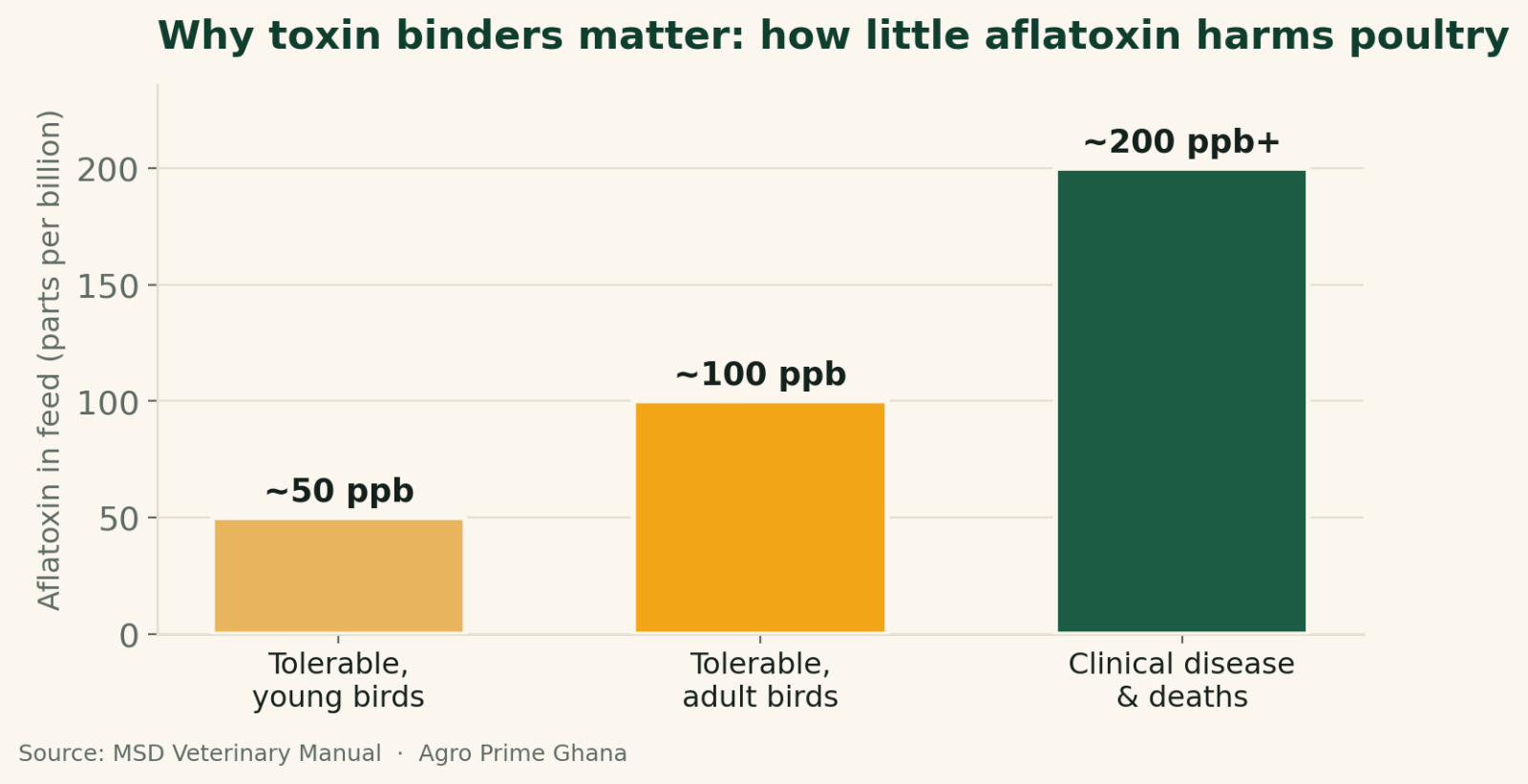
Toxin binders — mycotoxin adsorbents — address the aflatoxin problem that sits at the heart of so much hidden underperformance in Ghanaian flocks, because maize and groundnut, our feed staples, are exactly the crops most prone to aflatoxin in our hot, humid storage conditions. A binder is a material (clays such as bentonite and aluminosilicates, or yeast-cell-wall products) that latches onto mould toxins in the gut so they pass out in the droppings instead of being absorbed into the bird. Used sensibly, a binder is a worthwhile insurance layer, especially where grain quality is hard to guarantee batch to batch. But two honest limits must be stated plainly. First, a binder cannot rescue badly contaminated grain — it reduces absorption, it does not make poison safe, so clean, well-dried maize and groundnut come first and the binder is backup, never a licence to buy cheap mouldy grain. Second, different binders bind different toxins with different efficiency, and none is perfect. The chart above shows why the stakes are high: harm begins at levels measured in parts per billion, which is precisely why keeping toxin as low as possible — through good grain and a binder as backstop — matters so much. Our writing on making poultry feed and the layer feeding guide covers the grain-quality and ration side in detail.
Field note: additives are the last 10%, not the first 90%
The pattern we have learned to trust is this: farms that struggle rarely struggle because they skipped an additive; they struggle because of wet litter, poor-quality maize, dirty drinkers, overcrowding or a shaky vaccination programme. When someone asks us which "booster" will fix a disappointing flock, the honest answer is usually to look at those fundamentals first, because no probiotic or acidifier can out-run bad feed or a damp house. Additives are the fine-tuning that lifts a well-managed flock the final stretch — genuinely useful, but only once the basics are right. Spend on the basics first; reach for the additive to sharpen an operation that is already sound.
Enzymes, antioxidants and the supporting cast
A few other additives round out the picture. Enzymes help birds extract more from raw ingredients: xylanases break down fibre in wheat and other grains to reduce gut viscosity, and phytase releases phosphorus locked up in plant phytate so less inorganic phosphate must be bought in — in maize-soya diets, phytase especially can genuinely trim feed cost and cut phosphorus in the droppings. Antioxidants such as ethoxyquin, BHT and BHA protect the fats and fat-soluble vitamins in feed from going rancid, which matters in our heat where feed spoils quickly. Pigments (natural or synthetic xanthophylls) are used where a deep yellow yolk or skin is wanted for market. None is a health rescue, but each does a defined, sensible job — and the rule still holds: include one because you have a specific reason, not because it was on the shelf.
How to buy and use additives sensibly
Pulling it together, a sound approach starts from good management — clean water, dry litter, good grain, correct vaccination — because additives sharpen a good operation and cannot rescue a poor one. Match each additive to a real problem: a coccidiostat (or vaccine) for coccidiosis pressure, a toxin binder where grain quality is uncertain, probiotics and prebiotics at moments of stress and after antibiotics, an acidifier for gut health and water hygiene, enzymes to squeeze value from the grains you use. Use each at the correct inclusion rate, since more is not better and overdosing wastes money or, with drugs, risks residues; respect withdrawal periods on any medicated additive; and buy from suppliers you trust, storing products (especially live probiotics) cool and dry so they still work when opened.
The bottom line on feed additives
Feed additives are a genuine part of modern poultry keeping, and a few of them — coccidiostats against a parasite our climate loves, toxin binders against the aflatoxin riding in on our maize and groundnut — address problems that are very real in Ghana. Others, the gut-health family of probiotics, prebiotics and acidifiers, are useful but variable, worth most at moments of stress and as part of the shift away from routine antibiotics. What ties the subject together is discipline: know what each additive does, use it for a reason and at the right rate, observe withdrawal periods, and never let a sachet on the counter substitute for clean water, dry litter and good grain. Treat additives as the last careful ten percent on top of solid fundamentals and they earn their keep; treat them as a shortcut and they quietly drain the margin they were meant to protect.
Frequently asked questions
What are feed additives in poultry, and are they necessary?
What is the difference between a probiotic and a prebiotic?
Do probiotics actually improve growth in chickens?
What is a coccidiostat and does my feed already have one?
Do toxin binders make mouldy feed safe to use?
How do acidifiers help poultry?
Are feed additives a replacement for antibiotics?
Can I use several additives together?
Sources & further reading
- Merck / MSD Veterinary Manual — Probiotics for Animals (organisms used, mechanisms of competitive exclusion, variability of benefits, effect of stress and age).
- Penn State / eXtension Small and Backyard Poultry — Feed Additives for Poultry (additive categories: coccidiostats, probiotics, prebiotics, acidifiers, enzymes, antioxidants, mould inhibitors, toxin binders).
- MSD Veterinary Manual — Aflatoxicosis in Animals (tolerable aflatoxin levels in poultry feed, why toxin binders matter).
- Agro Prime Ghana guide: how to make poultry feed.
About Agro Prime Ghana
Agro Prime Ghana Limited runs a poultry hatchery and mixed agribusiness in Kasoa, supplying day-old chicks and supporting poultry keepers across the country. These guides combine hands-on hatchery and farm experience with current veterinary and nutrition references. This article is general educational information, not a substitute for professional veterinary or nutritional advice — for a specific flock or feed problem, consult a qualified vet or animal nutritionist. Need chicks, feed advice or farm support? Book a visit or message us on WhatsApp (+233 24 915 1503).