The weeks between the brooder and the first egg are the quietest, least glamorous phase of a layer's life — and the most quietly decisive. There are no eggs to count and no obvious drama, so it is tempting to coast: buy the cheapest grower feed, let the birds "grow themselves," and wait for point of lay. Yet almost every problem that shows up in a laying flock — a delayed start, small eggs, a peak that never quite arrives, hens that fall apart mid-cycle — can be traced back to how the pullet was fed and grown during exactly these forgotten weeks. A hen lays with the body she brought to point of lay. This guide explains how to feed growers and pullets through phase feeding and body-weight targets so that, at eighteen to twenty weeks, you hand the laying house a bird that is ready.
Written by the Agro Prime Ghana poultry team and reviewed against current references (commercial layer breed management guides and university poultry-extension material). Last updated September 2026.
Key takeaways
Rearing a pullet is about building a body, not chasing early eggs. The tool is phase feeding: a high-protein chick starter (about 20–22% crude protein, roughly 0–6 weeks), a lower grower/developer (about 14–16% protein through to point of lay), then a pre-lay feed before the first egg to lift calcium. The scorecard is body weight for age and uniformity: a modern brown pullet should reach roughly 460 g by 6 weeks, about 1,050 g by 12 weeks, and around 1,400–1,500 g by 18 weeks, with most of the flock within a tight band of that target. Growing pullets need only about 1% calcium; hold off the high-calcium layer feed until point of lay (around 18–20 weeks). Get body weight and uniformity right and the flock starts on time, peaks well and lays a long, steady cycle.
Why the growing period decides the laying period
A pullet is being built to a specification, and the specification is a frame and a body condition that can sustain a long, demanding laying cycle. During rearing she lays down her skeleton, her muscle, her digestive capacity and — critically, near the end — the medullary bone and fat reserves she will draw on once eggs start. If she arrives at point of lay underweight or unevenly grown, she simply does not have the body to support peak production, and no amount of good layer feed afterwards fully rescues it. University poultry-extension guidance makes the point directly: many of the problems that appear in a laying flock can be traced to insufficient body weight during the growing period. That is the whole reason to take rearing seriously. The eggs a hen will lay next year are, in a real sense, decided by how you fed and grew her this month — which makes the grower phase one of the highest-return, lowest-attention stages in the entire enterprise.
Phase feeding: matching the feed to the stage
Phase feeding means changing the ration as the bird's needs change, rather than feeding one compromise feed throughout. A pullet's protein requirement is highest when she is tiny and growing fastest, and falls as she matures, so the feeding programme steps down in protein and steps up, at the very end, in calcium. The standard commercial sequence runs like this. A chick starter, high in protein at roughly 20–22%, carries the fast early growth of about the first six weeks. A grower (sometimes split into grower and a later developer) at about 14–16% protein takes the bird through the long middle stretch to near point of lay, supporting steady frame growth without pushing the bird to lay down excess fat. Finally, a pre-lay feed in the last week or two before the first egg lifts calcium to prime the hen for shell formation. Each step matches the feed to the job the body is doing at that moment — and skipping or muddling the steps is where rearing goes wrong.
Body weight targets: the scorecard that matters
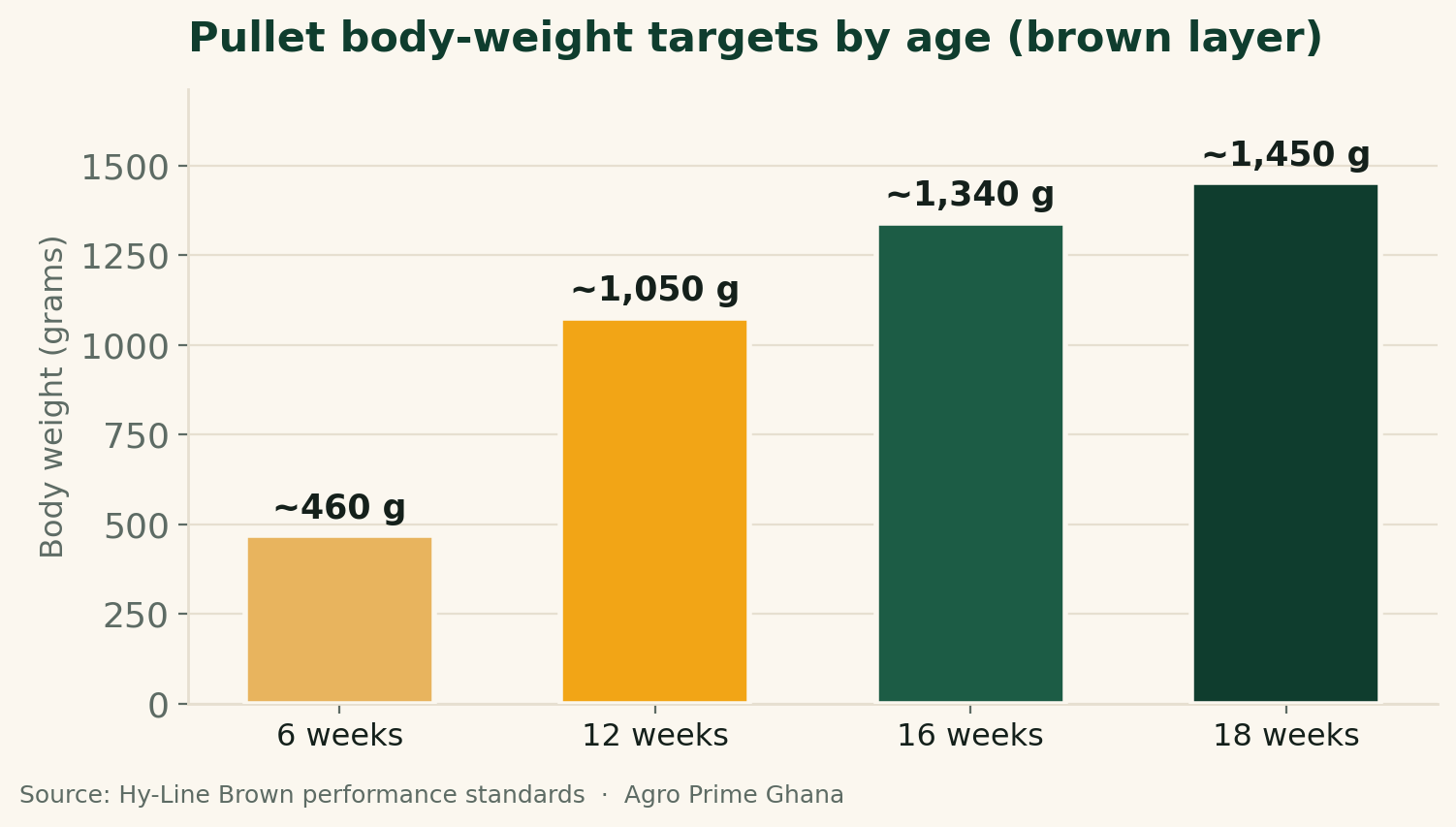
If there is one number to watch through rearing, it is not the age of the birds but their weight for that age. Modern layer strains have published body-weight targets for every week, and hitting them is the clearest sign that feeding and management are on track. For a commercial brown layer such as the Hy-Line Brown, the standard weights run to roughly 460 g at 6 weeks, around 1,050–1,100 g at 12 weeks, about 1,300–1,380 g at 16 weeks, and roughly 1,410–1,490 g at 18 weeks, with the hen reaching 50% production at around 20 weeks (about 139 days from hatch). White strains run lighter; check the guide for your actual breed. The practical discipline is simple but powerful: weigh a sample of birds regularly — a batch of them on a scale every week or two — and compare to the target. If the flock is running behind, act early with better feed access and management; catching a shortfall at 8 weeks is easy, while discovering it at 17 weeks is almost too late.
| Age | Feed phase | Approx. protein | Target body weight (brown layer) |
|---|---|---|---|
| 0–6 weeks | Chick starter | ~20–22% | ~460 g by 6 weeks |
| 6–12 weeks | Grower | ~15–16% | ~1,050 g by 12 weeks |
| 12–16 weeks | Developer | ~14–15% | ~1,300–1,380 g by 16 weeks |
| ~16–18 weeks | Pre-lay (calcium lifted) | ~15–16% | ~1,410–1,490 g by 18 weeks |
| ~18–20 weeks on | Layer feed | ~16–18% | Point of lay; 50% lay ~20 weeks |
Uniformity: a flock that grows together lays together
Average weight alone can hide a problem, which is why experienced rearers watch uniformity just as closely. A flock can hit its average target while being made up of some heavy birds and many light ones — and that flock will come into lay raggedly, with different birds starting at different times, a slow climb to a mediocre peak, and uneven egg sizes. A uniform flock, where most birds sit within a tight band of the target weight, switches on together and peaks sharply. Uniformity is built by good management as much as by feed: enough feeder and drinker space so timid birds are not crowded out, correct stocking density, prompt attention to sick or lagging birds, and — where flocks are very uneven — grading, so smaller birds can be given extra time or feed to catch up. When you weigh your sample, look not just at the average but at how tightly the birds cluster around it. Scattered weights are a warning to fix access and management before the growing window closes.
Field note: weigh, don't guess
The habit that separates rearers who consistently hit point of lay from those who are forever surprised is embarrassingly simple: they put birds on a scale. Eyeballing a pen tells you almost nothing — a feathered pullet can look full-bodied and be underweight, or look lean and be on target. On the farm we treat regular weighing of a sample against the breed chart as non-negotiable through rearing, because it is the only honest early-warning system there is. A flock drifting below target at 10 or 12 weeks can usually be brought back with better feed and access; the same shortfall found at first egg cannot. The scale costs little and pays for itself many times over.
Calcium: the mistake of feeding layer feed too early
One of the most damaging and most common rearing errors is putting pullets onto high-calcium layer feed too soon. It seems harmless — even generous — but it is not. A growing pullet needs only a modest amount of calcium, on the order of around 1%, to build her skeleton; a laying hen needs far more, typically 2.5–3.5% or more, to make eggshells. Feeding that layer-level calcium to a young pullet whose body is not yet making eggs forces her kidneys to deal with a large calcium surplus she has no use for, and can cause kidney damage and other problems. The high calcium belongs to the laying bird, not the growing one. The correct sequence is to keep pullets on their grower/developer calcium level through rearing, introduce a pre-lay feed with raised calcium only in the last stretch before the first egg to prepare the shell gland and top up bone reserves, and switch to full layer feed at point of lay — around 18–20 weeks, when the flock is beginning to come into production. Timing this switch to the birds, not the calendar alone, is what protects both bone and kidney.
Feeding to the target, not to appetite
Getting a pullet to target weight is not simply a matter of piling on feed. Two failure modes exist, and both are real in Ghana. Underweight pullets — the more common problem — arise from poor-quality feed, inadequate feeder space, heat stress cutting appetite, worms, coccidiosis or disease robbing growth. The fix is to remove those brakes: good feed, plenty of access, parasite control, cool water and shade in the heat, and prompt disease management. The opposite fault, over-fat pullets, comes from feed that is too rich in energy relative to the bird's frame, laying down fat rather than useful body; over-fat pullets can have trouble coming into lay and are prone to problems later. The developer phase, with its moderate protein, is designed partly to grow the frame without over-fattening. The goal throughout is a bird that is on target and well-conditioned — well-muscled and well-framed, neither stunted nor overfat — which is exactly what the phase-feeding programme, matched to regular weighing, is built to deliver. For how the laying phase then builds on this foundation, see our layer feeding guide.
Field note: heat and worms are the two silent brakes on pullet growth
When a Ghanaian pullet flock runs behind on weight, two culprits come up again and again, and neither is the feed formula. The first is heat: in our warm months birds eat less during the hot part of the day, so growth quietly stalls unless you shift feeding to the cooler early morning and evening, keep cool water always available, and ease stocking density. The second is internal parasites: a worm burden drains growth invisibly, so a sensible deworming routine during rearing often does more for body weight than any change of feed brand. Before blaming the ration for a light flock, rule out heat and worms — they are usually the real answer, and both are fixable.
Water, space and the management around the feed
Feed is only as good as the conditions around it. Clean, cool water at all times is fundamental — a pullet short of water eats less and grows less, and in the heat the effect is severe. Adequate feeder and drinker space ensures every bird, not just the bold ones, gets its share, which is the backbone of good uniformity. Correct stocking density and good ventilation keep birds comfortable and eating; overcrowded, hot houses cut intake and spread disease. And a sound health programme — vaccination, parasite control, biosecurity — protects the growth you are paying for, because a disease outbreak in rearing sets weight back at exactly the moment it is hardest to recover. None of this is separate from feeding; it is what allows the feed to do its job. A well-formulated grower ration handed to birds in an overcrowded, hot, under-watered house will still produce a disappointing, uneven flock.
The bottom line on feeding growers and pullets
The pullet-rearing phase is where laying performance is quietly decided, long before the first egg. Feed to the stage with a proper phase programme — high-protein starter, moderate grower and developer, a pre-lay feed to lift calcium at the end — and measure your success not by the calendar but by body weight for age and uniformity, weighing a sample regularly against your breed's chart. Keep growing pullets off high-calcium layer feed until they are actually coming into lay, so you protect their kidneys and time the calcium to the eggshell. And remember that feed works only inside good management: water, space, cool conditions and disease control are what let a pullet reach target. Do this, and at eighteen to twenty weeks you hand the laying house a bird that is on weight, even and ready — one that starts on time, peaks well, and lays the long, profitable cycle the whole enterprise depends on.
Frequently asked questions
What is phase feeding for pullets?
What body weight should a pullet reach at each age?
Why is body weight so important in rearing?
What is flock uniformity and why does it matter?
When should I switch pullets to layer feed?
Why shouldn't I give pullets layer feed early for extra calcium?
My pullets are underweight — what should I check?
Can pullets be too fat?
Sources & further reading
- Hy-Line — Hy-Line Brown Commercial Layers Performance Standards (rearing body-weight targets by age, age at 50% production).
- eXtension Small and Backyard Poultry — Feeding chickens for egg production (starter, grower and layer protein levels, calcium requirements, importance of body weight during rearing).
- Agro Prime Ghana guides: layer feeding guide and how to make poultry feed.
About Agro Prime Ghana
Agro Prime Ghana Limited runs a poultry hatchery and mixed agribusiness in Kasoa, supplying day-old chicks and point-of-lay pullets and supporting poultry keepers across the country. These guides combine hands-on hatchery and farm experience with current breed and nutrition references. This article is general educational information, not a substitute for professional advice — for a specific flock, follow your breed's management guide and consult a qualified animal nutritionist or vet. Need chicks, pullets, feed advice or farm support? Book a visit or message us on WhatsApp (+233 24 915 1503).