Fishmeal is the most expensive ingredient in most Ghanaian poultry rations — and often the most adulterated, cut with sand, salt and ground shell before it ever reaches your birds. Meanwhile, Ghana throws away thousands of tonnes of food and market waste every single day. The black soldier fly sits neatly at the meeting point of those two problems: its larvae eat organic waste and turn it into a fat, protein-rich grub that chickens relish and that can replace part or all of the fishmeal in a diet. For a keeper squeezed by feed prices, farming these larvae — sometimes called "maggot meal" — is one of the few genuinely home-grown ways to cut protein costs. This guide explains how it works, how much protein the larvae really contain, what a setup looks like, and where the honest limits are.
Written by the Agro Prime Ghana poultry team and reviewed against peer-reviewed research on black soldier fly larvae in poultry, including Ghanaian broiler trials. Last updated September 2026.
Key takeaways
Black soldier fly larvae (BSFL) are a high-protein poultry feed grown from organic waste. Dried larvae meal carries roughly 37–63% crude protein depending on processing, plus a lot of fat — comparable to soybean meal (~48%) and approaching fishmeal (~55%). Research in Ghana shows BSFL meal can replace fishmeal completely at around 3% of the diet, or be included up to about 20% of the ration, without hurting broiler growth; pushing to 30% cut daily weight gain by ~14%. The larvae are voracious recyclers — they can reduce organic waste volume by up to 85% — and Ghana generates about 13,500 tonnes of waste a day, roughly 60% of it organic, so raw material is abundant. Feed-cost savings of up to 30% are reported. The main limits are set-up effort, consistent larvae supply, and drying/processing.
What the black soldier fly is — and why it suits Ghana
The black soldier fly (Hermetia illucens) is a harmless, non-pest fly whose adults do not bite, do not feed and do not enter houses looking for food the way houseflies do. All the action is in the larval stage: for about two weeks the grubs eat almost continuously, converting organic material into body mass that is rich in protein and fat. Harvested, killed and dried, those larvae become a feed ingredient. The fit with Ghana is almost too neat. Our warm, humid climate is ideal for the fly's life cycle, which needs no heating. And the raw material is everywhere — Ghana generates on the order of 13,500 tonnes of solid waste a day, of which roughly 60% is organic; in Accra alone daily output is around 2,200 tonnes at about 66% organic, while only around 70% of waste is even collected. That is a mountain of spoiled market produce, brewery and food-processing residue and kitchen scraps that the larvae can eat.
Research framing BSFL as a "circular" solution for Ghana makes the case plainly: the larvae manage waste that would otherwise rot in landfills producing methane, and produce feed protein to displace imported, price-volatile fishmeal and soybean meal. One review estimated larvae farming could divert on the order of 168,000 tonnes of waste a year from Accra's landfills alone. For a poultry farm, the appeal is simpler: cheaper protein grown on-site.
How much protein is really in the larvae?
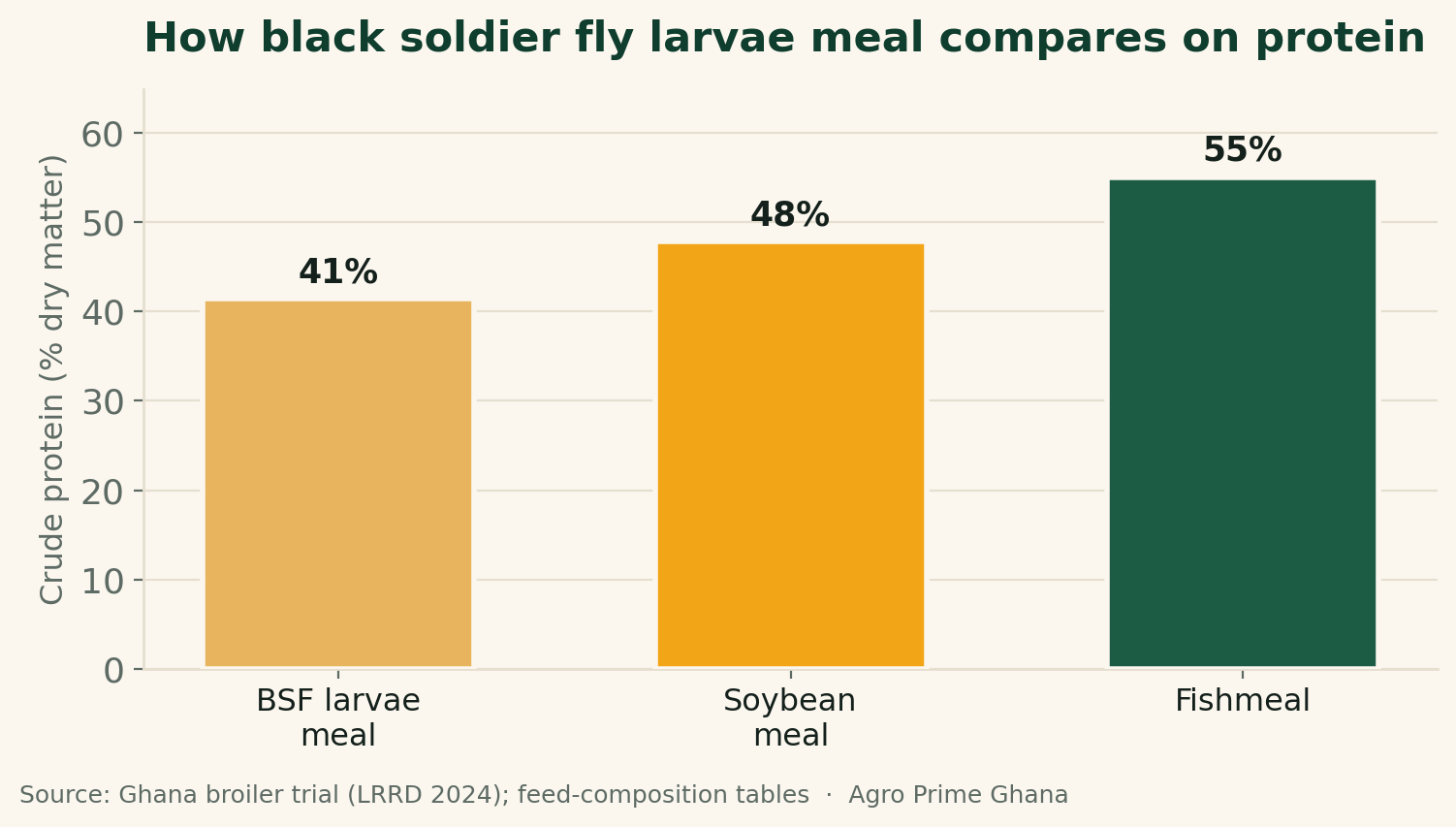
The headline number varies because it depends heavily on what the larvae were fed and how the meal is processed. Across the literature, BSFL meal runs from roughly 37% to 63% crude protein on a dry-matter basis, with fat anywhere from about 7% up to nearly 40%. A Ghanaian broiler trial used a larvae meal testing at 41.4% crude protein, against 47.8% for the soybean meal it was compared with. Processing shifts the picture: defatting the larvae concentrates protein sharply — one study measured defatted BSFL at almost 59% protein — while less-processed or hydrolysed forms sit lower, nearer 38–40%, but retain more fat and, in some trials, higher digestibility.
Crucially, the protein is good-quality animal-source protein with a useful amino-acid profile, including lysine and methionine — the two amino acids most often limiting in cereal-based diets. That is why the larvae behave more like fishmeal than like a plant protein. The fat is a bonus energy source, though very high-fat larvae meal can go rancid in storage and can, at high inclusion, tip the diet's fat balance, which is one reason defatting is common in commercial products.
| Protein feed | Rough crude protein | Notes for the keeper |
|---|---|---|
| Fishmeal | ~55% | Premium, but costly and often adulterated in Ghanaian markets |
| Soybean meal | ~45–48% | Standard plant protein; imported, price-volatile; must be heat-treated |
| BSFL meal (defatted) | ~55–59% | Concentrated protein, more storable; needs processing |
| BSFL meal (whole/dried) | ~38–42% | Higher fat, easy to make on-farm; watch rancidity |
What the research says about feeding it to chickens
The evidence on BSFL in poultry is now substantial and, on the whole, encouraging — with a clear message about how much to use. At modest inclusion, larvae meal can straightforwardly replace fishmeal: one broiler study fully swapped out the fishmeal (about 3% of the diet) for BSFL meal with body-weight gains equal to, and in one processed form slightly better than, the fishmeal control. Push the inclusion higher and there is a ceiling. A Ghanaian broiler trial that tested BSFL meal at 0%, 10%, 20% and 30% found that up to 20% inclusion matched the soybean-meal control on growth and nutrient digestibility, but the 30% diet reduced average daily weight gain by about 14% and worsened feed conversion and digestibility. The researchers concluded that BSFL meal "can be included in broiler chicken diets up to 20% without any adverse effects."
The practical reading for a Ghanaian farm is this: as a fishmeal substitute at low levels, BSFL is essentially a like-for-like swap that saves money. As a larger part of the protein, it can work well up to roughly a fifth of the diet, but beyond that the high fat and chitin (the tough material in the larval skin) start to drag on digestion. Start modestly, keep the ration balanced, and treat 30%+ as the zone where you need real formulation care rather than enthusiasm.
Field note: birds take to larvae fast — but keep the diet balanced
Chickens are natural insectivores, so the first thing you notice is how eagerly they go for larvae — live or dried, they are gone in seconds and the flock is visibly more active foraging for them. That enthusiasm is a trap if you let it become the plan: a bird will happily gorge on grubs and short itself on the energy, calcium and balance the rest of the ration provides. We treat BSFL as a protein ingredient inside a formulated ration, not a free-for-all snack — the same discipline that applies to any protein feed, as set out in our guide to poultry feed ingredients. Fed that way, they are one of the cheapest quality-protein sources you can put in front of a chicken.
Setting up a small larvae operation
The beauty of black soldier fly farming is that the basic biology does most of the work; your job is to give it the right conditions. A simple setup has three parts. First, a rearing or "love" area where adult flies mate and lay eggs — often a mesh cage or netted space with light, warmth and something for the females to lay eggs near (corrugated cardboard strips are a classic egg-laying trap). Second, a growing bin where hatched larvae are fed the organic waste; this is where the bulk conversion happens, and it must drain and breathe so it does not turn into a wet, anaerobic mess. Third, a harvesting method that exploits the larvae's own behaviour: when mature, they instinctively crawl away from the feed to pupate ("self-harvesting"), so a sloped bin with a collection channel lets them walk themselves into a bucket.
Feed the larvae on spoiled fruit and vegetables, market waste, brewers' grains, food-processing residue and similar material — but keep it reasonably clean and avoid anything laced with pesticide, disinfectant or heavy salt. After harvest, the grubs must be killed and dried (sun-drying, oven or a simple dryer) and usually milled into meal for storage; fresh larvae can be fed directly but do not keep. A valuable by-product falls out of the process: the leftover digested material, called frass, is an excellent organic fertiliser — and surveys in Ghana found around 88% of people were willing to eat vegetables grown with BSFL frass, so it has a market of its own. On managing residues and litter on the farm, our litter management guide is a useful companion.
The economics: where the savings come from
The money case rests on displacing bought protein with protein you grow from near-free waste. Reviews of BSFL in Ghana cite feed-cost reductions of up to 30% where larvae substitute for conventional protein, and one worked example showed an added profit of around GH₵1,111 for a 500-bird operation, with cost–benefit ratios as high as 2.12:1 reported for livestock use. Because feed is roughly 70% of poultry production cost, even a partial cut in the protein bill moves the whole profit picture — which is the same logic behind every serious effort at reducing feed cost. Consumer attitudes are not a barrier either: about 87% of Ghanaians surveyed said they would happily eat meat and eggs from BSFL-fed animals.
That said, the economics work best for those who value their own labour reasonably and have a steady, cheap waste stream. The larvae are cheap; the drying, milling and daily attention are not. Small on-farm systems pay off through saved feed cost; large dedicated meal-production plants are a different scale of investment — a full processing facility runs into the millions of cedis, a business in its own right rather than a farm sideline.
Field note: drying and consistency are where beginners struggle
The two things that trip up new larvae farmers are not the flies — they are drying and supply. Fresh larvae spoil fast in our heat, so if you cannot dry a harvest promptly you lose it; a reliable drying method (even good sun-drying on raised, covered racks) is worth sorting out before you scale up. The second is consistency: chickens need feed every day, but a bin cycle takes a couple of weeks, so a single bin gives you feast-and-famine. Running several bins started on a rolling schedule is what turns larvae from an occasional treat into a dependable ingredient you can actually formulate around.
The honest limits
Black soldier fly larvae are promising, not magic, and the constraints are real. Research on the Ghanaian context repeatedly names the same barriers: high initial set-up effort and capital for anything beyond a backyard bin, limited access to financing, immature supply chains for larvae and equipment, regulatory and food-safety gaps around insect feed, and limited technical know-how and awareness. On the biology side, very high inclusion levels depress performance because of fat and chitin, high-fat meal can go rancid, and food-safety discipline matters — larvae reared on contaminated waste can accumulate what they eat, so the substrate must be sensible. None of these are reasons to dismiss the technology, but they are reasons to start small, learn the process on a modest scale, and grow into it rather than betting the farm on it from day one.
The bottom line on black soldier fly larvae
Black soldier fly larvae turn Ghana's abundant organic waste into a high-protein feed that chickens love and that can meaningfully cut the biggest cost in poultry: protein. The larvae carry roughly 37–63% crude protein depending on processing, rival soybean meal and approach fishmeal, and carry the lysine and methionine that plant proteins lack. The research is clear that they replace fishmeal well at low levels and can go up to about 20% of a broiler diet before performance suffers, with reported feed-cost savings of up to 30% and strong consumer acceptance. The real work is not the flies but the discipline around them — clean substrate, reliable drying, rolling bins for steady supply, and keeping the larvae inside a balanced ration rather than treating them as a free snack. Start small, master the cycle, and BSFL can become one of the smartest home-grown answers to Ghana's feed-cost squeeze.
Frequently asked questions
How much protein do black soldier fly larvae contain?
Can black soldier fly larvae replace fishmeal in poultry feed?
What is the maximum I can include in broiler feed?
What do I feed the larvae?
How do I set up a small BSFL system?
Is meat and eggs from BSFL-fed birds safe and accepted?
How much money can it save?
What are the main drawbacks?
Sources & further reading
- Debrah et al., Black Soldier Fly Larvae as a circular solution for organic waste management and sustainable livestock feed in Ghana (waste figures, protein and fat, waste reduction, cost savings, consumer acceptance, constraints).
- Ghanaian broiler feeding trial — Intake, growth performance and nutrient digestibility of broiler chicken fed diets containing black soldier fly larvae meal (41.4% CP meal, 0–30% inclusion, up-to-20% safe level).
- Peer-reviewed trial — Effect of black soldier fly larvae as substitutes for fishmeal in broiler diet (protein of defatted/hydrolysed meal, fishmeal replacement at ~3%).
- Agro Prime Ghana guides: poultry feed ingredients, reducing poultry feed cost, and poultry litter management.
About Agro Prime Ghana
Agro Prime Ghana Limited runs a poultry hatchery and mixed agribusiness in Kasoa, supplying day-old chicks and supporting poultry keepers nationwide. These guides combine hands-on hatchery and farm experience with current research. This article is general educational information, not a substitute for tailored advice from a qualified animal nutritionist or extension officer, especially on feed safety and formulation. Need chicks, feed advice or farm support? Book a visit or message us on WhatsApp (+233 24 915 1503).