A high-producing hen is running one of the most demanding calcium factories in all of livestock. Every single day she pulls together roughly two grams of calcium and lays it down as a hard shell overnight — most of it while she is asleep and not eating a thing. To do that she borrows calcium from her own skeleton, then pays it back from feed the next day. When the borrowing outruns the repayment, day after day, her bones quietly hollow out until one morning she cannot stand: found sitting or lying at the back of the cage, legs splayed, sometimes with a broken bone, unable to reach feed or water. That is cage layer fatigue — osteoporosis in laying hens — and it kills good birds at peak production for a reason that is almost always preventable. This guide explains the bone biology in plain terms and shows exactly how to keep your layers' skeletons strong.
Written by the Agro Prime Ghana poultry team and reviewed against current veterinary and nutrition references (MSD Veterinary Manual, The Poultry Site and Hendrix Genetics). Last updated September 2026.
Key takeaways
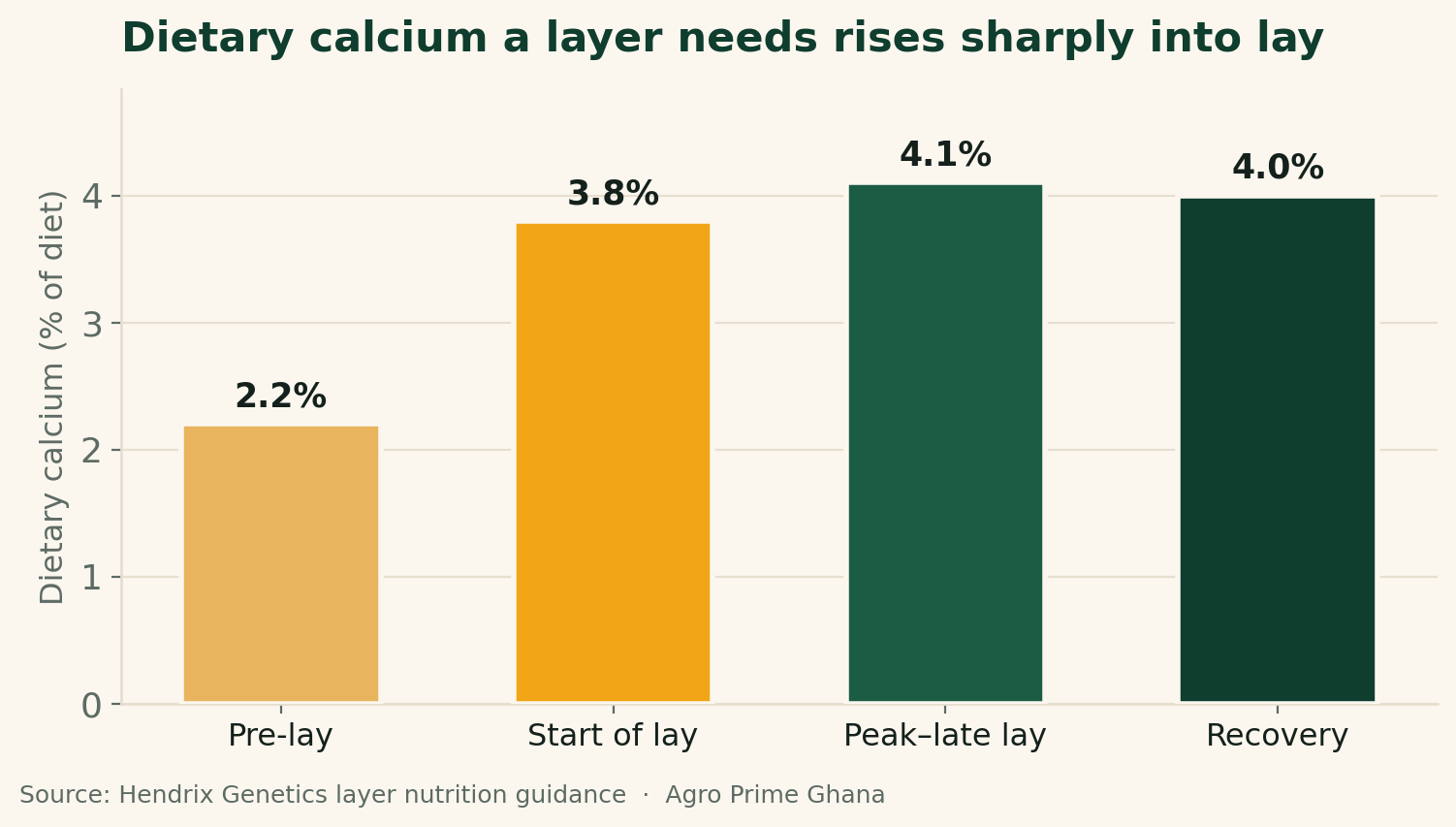
Cage layer fatigue is a form of osteoporosis — bone structure becoming abnormally thin — driven by the huge daily calcium demand of shell formation. A high-producing hen deposits over her laying life more than 25 times the amount of calcium held in her skeleton at any moment, so nearly all shell calcium must come from daily feed. When feed calcium falls short, the hen strips her own structural (weight-bearing) bone, and the damage cannot be reversed while she is in lay. Affected hens are found down at the back of the cage, often paralysed by fractured back-bones pressing on the spinal cord, and may die unable to reach food and water. Prevention is nutritional and managerial: raise dietary calcium into lay (rising from about 2.2% pre-lay to 3.8–4.1%+ in production), feed coarse (2–4 mm) limestone or oyster shell for slow night-time release, get vitamin D3 and phosphorus right, and bring pullets into lay at correct body weight.
The calcium factory: what a laying hen is really doing
To understand cage layer fatigue you first have to grasp the sheer scale of what egg-laying demands. A single eggshell is almost pure calcium carbonate, and forming one draws on the order of two grams of calcium — an enormous amount relative to the size of the bird and, crucially, relative to how much calcium is circulating in her blood at any moment. The Poultry Site puts the lifetime figure starkly: a high-producing hen deposits into her eggshells over 25 times as much calcium as her skeleton contains at any one time. There is simply no way to hold that much calcium in the body, so the hen runs a daily import-export business — taking calcium in from feed and shipping it out as shell — with almost no buffer. The problems begin the moment daily intake cannot keep up with daily output.
Medullary bone: the hen's overnight calcium bank
Nature's answer to the timing problem is a special kind of bone. As a pullet reaches sexual maturity, she develops medullary bone — a spongy calcium store that fills the hollow interior of the long bones, the pelvis and the ribs. The Poultry Site explains that this bone exists specifically as a labile calcium reservoir: it holds calcium for a few hours until it is needed for shell formation, and adds very little to the skeleton's mechanical strength. It only develops in sexually mature females (never in males or immature birds), which is itself a clue to its purpose. The daily rhythm works like this: shell formation happens mostly overnight, when the hen is not eating, so she cannot draw calcium directly from feed. Instead her body transfers calcium out of the medullary reserve into the shell gland. The next day, if her diet supplies enough calcium, she refills that reserve. Medullary bone is, in effect, an overnight bank account — and cage layer fatigue is what happens when it is repeatedly overdrawn.
How the skeleton gets robbed
Here is the mechanism that turns a nutritional shortfall into a down hen. When dietary calcium is insufficient to refill the medullary bank, the hen does not simply stop making shells — her hormones drive her to keep laying, so she takes the calcium from wherever she can. The Poultry Site describes how, when the diet falls short, calcium is transferred one-directionally from structural bone into medullary bone and then out into shells. Structural bone is the weight-bearing scaffolding — the cortical bone of the legs and the trabecular bone of the vertebrae — and once it is being cannibalised to make shells, the skeleton progressively weakens. This is osteoporosis: the structural components of the bone becoming abnormally thin. Do it long enough and bones become so fragile that they fracture under the bird's own movements. In cage layer fatigue specifically, fractures of the thoracic vertebrae (the back-bones) can pinch the spinal cord, producing the classic leg paralysis — the hen is not "tired," she is neurologically down because a weakened back-bone has collapsed.
Recognising cage layer fatigue
The picture is recognisable once you know it. Affected hens are typically at or just past peak production — the point of maximum calcium drain — and are found unable to stand, crouching or lying at the rear of the cage or pen, often with legs splayed to the side. The MSD Veterinary Manual describes cage layer fatigue as paralysis during and just after peak egg production, caused by fracture of the vertebrae affecting the spinal cord, leaving hens unable to reach feed and water. Because they cannot get to resources, birds that might otherwise recover simply starve or dehydrate where they lie — so many "cage layer fatigue" deaths are really deaths from being unable to reach the trough. You may also find birds with fractured legs or wings from ordinary handling or movement, and, flock-wide, the softer early warning is deteriorating shell quality: thin, rough, misshapen or easily cracked eggs as the calcium economy runs into deficit. Poor shells and down birds are two faces of the same problem.
Field note: a down hen at peak is a calcium alarm for the whole flock
When we find a hen sitting at the back, unable to rise, at 28 or 30 weeks — right at peak — we do not treat it as one unlucky bird. We read it as a signal to check the whole flock's calcium supply. Are the birds actually eating the layer ration, or picking out the fine particles and leaving the coarse shell grit? Has feed intake dropped in the afternoon heat, exactly when the hen most needs to bank calcium for the night? Is the calcium level and particle size in the feed right for a flock at peak? One down bird has usually revealed a feeding or intake problem that, left alone, will show up as thin shells and more down hens over the following weeks.
Why it happens — the roads to deficiency
Cage layer fatigue is rarely about a single mistake; it is about the calcium budget running into deficit through any of several routes. The Poultry Site and MSD between them identify the main ones:
- Calcium raised too late. If pullets are still on a grower diet when they start to lay, they are producing shells on a diet built for growth, not for laying — an immediate deficit. Calcium must be lifted as the birds come into production.
- Feed intake dropping. Heat stress or mild disease that cuts feed consumption also cuts calcium intake, tipping a marginal diet into deficit. In Ghana's heat this is a constant risk — see our guide to heat stress in poultry.
- Timid birds eating less. In competitive flocks, subordinate hens eat less than the flock average and can run short even when the ration is correct on paper.
- Ageing hens absorbing less. Older layers become less efficient at absorbing calcium, so late-lay shells and bones suffer.
- Phosphorus and vitamin D3 problems. A phosphorus deficiency prevents proper deposition of calcium into medullary bone, and without adequate vitamin D3 the hen cannot absorb and use calcium efficiently at all. The whole system depends on the calcium–phosphorus–vitamin D3 trio being in balance.
The single most important fix: calcium that arrives at night
Getting enough calcium into the diet is necessary but not sufficient — when and in what form the calcium is available matters just as much, because the critical demand comes overnight. This is where particle size is the quiet hero. Fine, powdery limestone is absorbed and used up quickly, so by the small hours it is gone. Coarse (large-particle) limestone or oyster shell behaves differently: it sits in the gizzard and dissolves slowly, drip-feeding calcium through the night exactly when the shell gland needs it. The MSD Veterinary Manual recommends providing about 65–70% of the dietary calcium supplement as coarse limestone of 2–4 mm particle size, with the remainder as fine limestone. Hendrix Genetics similarly advises shifting toward a higher coarse fraction — around 70% coarse to 30% powder — as the flock moves through lay. In practice this means offering some of the calcium as visible grit-sized particles or oyster shell that the birds bank for the night, rather than all of it as flour-fine powder that is spent by evening.
| Production phase | Approx. dietary calcium | Coarse : fine calcium split |
|---|---|---|
| Pre-lay (run-up to first egg) | ~2.2% | ~50% coarse : 50% powder |
| Start of lay | ~3.8% | ~50% coarse : 50% powder |
| Peak to late lay | towards ~4.1% | ~70% coarse : 30% powder |
| Recovery / older hens | minimum ~4% | ~70% coarse : 30% powder |
Indicative layer calcium targets by phase (Hendrix Genetics); MSD advises coarse limestone at 2–4 mm particle size for slow night-time release. Follow your breed's management guide and feed labels for exact figures.
Prevention: building strong skeletons before and during lay
Because osteoporosis cannot be reversed while a hen is laying — as The Poultry Site notes, hens have little ability to reverse it once in production — the entire strategy is to prevent the deficit ever opening up. The pillars are:
- Rear to a good skeletal frame. Most of a hen's structural bone is laid down during rearing, before she ever lays an egg. Get pullets to target body weight with good uniformity, and do not photostimulate a flock that is behind on weight — bringing under-framed birds into lay sets them up to run out of bone. Correct rearing is the foundation of bone health.
- Lift calcium at the right moment. Increase dietary calcium as the flock approaches lay — visible in reddening, enlarging combs — rather than after eggs are already coming. Many producers use a pre-lay diet (around 2.2% calcium) bridging into the layer ration, then move to full layer levels by the time production climbs.
- Use large-particle calcium. Include coarse limestone or oyster shell so calcium is available overnight, as above. This single practice does more for shell quality and bone protection than simply pushing the total calcium percentage higher.
- Balance phosphorus and vitamin D3. Ensure available phosphorus and vitamin D3 are correct so calcium can actually be deposited and absorbed; the metabolite 25-hydroxy-D3 is used in some diets to improve results. Get feed formulation right — our layer feeding guide covers this.
- Protect feed intake. Anything that keeps hens eating protects their calcium supply: manage heat (feed in the cooler parts of the day, provide cool clean water), control disease, avoid overcrowding so timid birds get their share, and keep feed fresh and palatable.
Field note: watch the feeder, not just the feed label
A ration can be perfectly formulated on paper and still leave hens short, because what matters is what actually goes down the bird. We watch for selective feeding — hens sorting through and leaving the coarse calcium particles at the bottom of the trough — and for feed that sits untouched through the hot afternoon. Running feeders near empty before topping up encourages birds to clean up the coarse grit rather than leave it, and shifting the main feeding to cooler hours protects intake when it counts. The best calcium programme in the world does nothing if the calcium is still in the trough at nightfall.
Can you treat a down hen?
Once a hen is down with fractured vertebrae and paralysis, the outlook for that individual is poor and there is no quick fix that rebuilds bone in a laying bird. The realistic response has two parts. For the flock, treat every down bird as a diagnostic flag and fix the underlying calcium supply immediately — check the ration's calcium level and particle size, confirm birds are actually eating, and address heat or disease knocking down intake — so you protect the many birds not yet affected. For the individual, some mildly affected hens will recover if they are moved somewhere they can reach feed and water easily and are taken off the pressure of peak lay, but hens that are badly fractured or cannot rise should be culled humanely rather than left to starve where they cannot reach the trough. This is one more disease where the money and the welfare both sit firmly on prevention.
The bottom line on cage layer fatigue
Cage layer fatigue is the skeleton paying the price for the eggshell. A hen deposits many times her own skeletal calcium into shells over her laying life, almost all of it drawn from daily feed and banked overnight in medullary bone — and when the feed cannot keep up, she strips her own weight-bearing bones until they fracture and she goes down, often at the very peak of production. It cannot be reversed once it sets in, so the whole answer is to keep the calcium budget in surplus: rear pullets to a strong frame, lift dietary calcium into lay, feed coarse limestone or oyster shell so calcium is there at night, balance phosphorus and vitamin D3, and above all protect feed intake through Ghana's heat. Do that consistently and you get two rewards at once — strong, unbroken shells your customers trust, and hens that stay on their feet and productive right through the laying cycle.
Frequently asked questions
What is cage layer fatigue?
Why does it happen mostly at peak production?
What is medullary bone and why does it matter?
How much calcium does a laying hen need?
Why does calcium particle size matter?
Can cage layer fatigue be cured?
Do vitamin D3 and phosphorus play a role?
How is cage layer fatigue different from ordinary egg-drop or thin shells?
Sources & further reading
- The Poultry Site — Osteoporosis, Cage Layer Fatigue and Poor Shell Quality (medullary vs structural bone, calcium mobilisation, 25× skeletal calcium deposited, one-directional bone loss, prevention).
- MSD Veterinary Manual — Mineral Deficiencies in Poultry (cage layer fatigue and vertebral fracture, coarse limestone at 2–4 mm and 65–70% of supplement, vitamin D3, calcium–phosphorus balance).
- Hendrix Genetics — Understanding cage layer fatigue and calcium deficiency (dietary calcium by phase and coarse-to-fine ratios).
- Agro Prime Ghana guides: layer feeding guide and heat stress in poultry.
About Agro Prime Ghana
Agro Prime Ghana Limited runs a poultry hatchery and mixed agribusiness in Kasoa, supplying day-old chicks and point-of-lay pullets and supporting layer keepers across the country. These guides combine hands-on hatchery and farm experience with current veterinary and nutrition references. This article is general educational information, not a substitute for advice from a qualified veterinary or nutrition professional — for a persistent bone or shell-quality problem, have your ration and management reviewed. Need pullets, feed advice or farm support? Book a visit or message us on WhatsApp (+233 24 915 1503).