Ask most Ghanaian keepers what makes a good feed and they will talk about "protein" — twenty-two percent for chicks, sixteen for layers, the number printed on the bag. But birds do not need protein as such; they need the individual building blocks inside it, the amino acids, in the right amounts and the right balance. A ration can hit its protein target on paper and still starve the flock of the one or two amino acids that actually limit growth and egg output, while overloading it with expensive protein the bird cannot use and must burn off as waste. Understanding amino acids — especially lysine and methionine, and the idea of "ideal protein" — is what separates a feed that merely looks right from one that performs. This guide explains how it works and why it matters for the maize-and-soya rations we mix in Ghana.
Written by the Agro Prime Ghana poultry team and reviewed against current animal-nutrition references (published ideal amino acid profiles for poultry and university feed-science material). Last updated September 2026.
Key takeaways
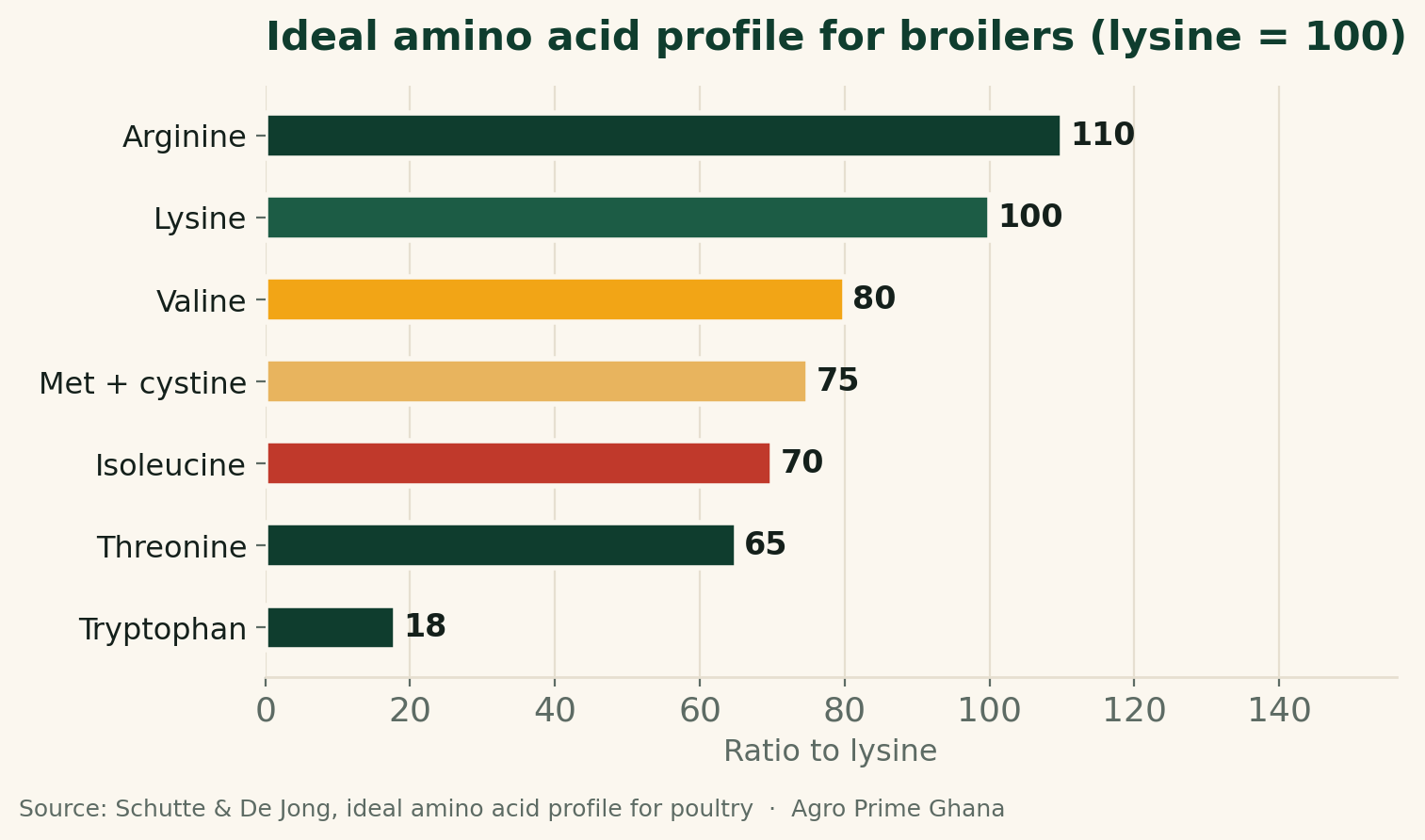
Birds need amino acids, not crude protein for its own sake. About ten are "essential" — the bird cannot make them fast enough and must get them from feed. In our maize-soya diets the two that usually run short first are methionine (the first-limiting amino acid) and lysine (the reference amino acid for balancing all the others). The "ideal protein" approach balances every essential amino acid as a ratio to lysine (lysine = 100). For broilers, published ideal ratios include roughly methionine + cystine 75, threonine 65, tryptophan 18, valine 80 and arginine 110; for layers, methionine about 50 and methionine + cystine about 93. Getting the balance right lets you feed less total protein while growing better birds — cheaper feed, less nitrogen wasted, and cleaner litter. Synthetic DL-methionine and L-lysine are the cheapest way to correct the gaps.
Why protein percentage is the wrong thing to chase
"Crude protein" is simply a measure of how much nitrogen a feed contains, converted to a protein figure. It tells you nothing about which amino acids are present or whether they match what the bird needs. Two feeds can both read 20% crude protein while one grows birds beautifully and the other holds them back, because the quality — the amino acid balance — differs. Proteins are chains of about twenty amino acids, and when a bird digests feed it breaks those chains down and reassembles the amino acids into its own muscle, feathers, enzymes and eggs. Around ten of these are essential for poultry: the bird either cannot make them at all or cannot make them fast enough, so they must come ready-made in the feed. The rest are "non-essential" only in the sense that the bird can build them itself from spare nitrogen. The whole art of feed formulation is supplying the essential amino acids in the right amounts and the right proportions — not simply pushing the protein number higher.
The limiting amino acid: why the weakest link sets the pace
The single most important idea in amino acid nutrition is the limiting amino acid. Growth and egg production run only as fast as the amino acid in shortest supply relative to need — exactly like a barrel made of staves of different heights, which holds only as much water as its shortest stave. You can pour in all the protein you like, but if methionine is the shortest stave, the bird grows at the rate methionine allows and the surplus of every other amino acid is simply burned for energy and excreted as nitrogen. In the maize-and-soybean-meal diets that dominate Ghanaian poultry feeding, the order of shortage is well established: methionine is the first-limiting amino acid, lysine is typically second, and threonine often third. This is why those three are the ones added in purified form to almost every commercial ration. Raise the shortest stave — correct the methionine deficit — and suddenly all that other protein can be put to use, so the flock grows faster on the very same bag of ingredients.
Lysine and methionine: the two that matter most
Methionine is a sulphur-containing amino acid that the bird needs for growth, for feather development (feathers are rich in sulphur amino acids) and for many metabolic reactions. Maize and soya together are naturally short of it, which is why it is first-limiting and why supplemental DL-methionine is standard in poultry feed worldwide. Methionine works closely with cystine, another sulphur amino acid, and because the bird can convert methionine into cystine, nutritionists usually specify the pair together as "methionine + cystine" (often written TSAA, total sulphur amino acids). Lysine is the great muscle-builder — critical for laying down breast meat in particular — and it holds a special place because it has become the reference amino acid against which all the others are balanced. There are good reasons for using lysine as the yardstick: it is used almost entirely for body-protein growth rather than a tangle of other functions, it is easy to analyse, and supplemental L-lysine is cheap and available. Get lysine right, set every other essential amino acid as a proportion of it, and you have a balanced feed.
The ideal protein concept, explained
"Ideal protein" is the framework that ties all this together. The idea is to build a feed whose amino acid profile exactly matches the bird's requirement — so that essential and non-essential amino acids are supplied in the precise proportions needed, with no amino acid in excess and therefore no surplus nitrogen to be wasted. In practice, nutritionists express the requirement for every essential amino acid as a ratio to lysine, with lysine fixed at 100. A powerful and convenient feature of this approach is that, as the published research puts it, the ideal ratio of amino acids relative to lysine "remains largely unaffected by dietary, environmental and genetic factors" — the ratios hold steady even as the absolute lysine requirement shifts with breed, age and conditions. So the nutritionist works out the bird's lysine need for its stage of life, then reads off every other amino acid as a percentage of that. The table below shows published ideal ratios for broilers and for laying hens.
| Amino acid (digestible) | Broilers (ratio to lysine = 100) | Laying hens (ratio to lysine = 100) |
|---|---|---|
| Lysine | 100 | 100 |
| Methionine + cystine | 75 | 93 |
| Methionine (alone) | ~40–47 | 50 |
| Threonine | 65 | 66 |
| Tryptophan | 18 | 19 |
| Valine | 80 | 86 |
| Isoleucine | 70 | 79 |
| Arginine | 110 | — |
Notice how the sulphur amino acids sit higher for layers (methionine + cystine at 93 versus 75) — laying hens have a relatively greater need for them, tied to egg production and feather maintenance over a long life. These ratios are the practical heart of feed formulation: they turn a single lysine figure into a full amino acid specification.
Field note: the cheapest kilo of gain often comes from a spoon of methionine
When a home-mixed maize-soya ration disappoints — birds growing slowly, feathering poorly, eating well but not thriving — the reflex is to add more soya or more fishmeal to "raise the protein." Often the smarter, cheaper fix is to correct the balance rather than the total: a properly measured amount of supplemental methionine, and lysine, frequently does more for growth than a costly heap of extra protein, because it lifts the limiting amino acid instead of piling on ones the bird already has enough of. This is exactly why commercial feeds carry synthetic amino acids. If you mix your own, treat DL-methionine and L-lysine as core ingredients, not optional extras — the difference they make is out of all proportion to the tiny amounts used.
Digestible amino acids: not everything in the feed is available
There is an important refinement that professional formulation depends on. What matters to the bird is not the total amino acid content of an ingredient but the portion it can actually digest and absorb. Different ingredients tie up their amino acids to different degrees; some, especially poorly processed ones, hold amino acids the bird cannot reach. This is why modern requirements and the ideal ratios above are increasingly expressed on a digestible (or "available") amino acid basis rather than total, and why nutritionists prefer to formulate that way. For the practical Ghanaian mixer the lesson is twofold: ingredient quality matters as much as ingredient quantity — a heat-damaged soybean meal or an over-toasted fishmeal delivers less usable amino acid than its label suggests — and the synthetic amino acids (DL-methionine, L-lysine, L-threonine) are attractive precisely because they are close to fully digestible and completely consistent, unlike the variable natural ingredients they top up.
What amino acid balance does across the flock's life
The right amino acid balance pays off differently at each stage. In broilers, lysine drives breast-meat yield and methionine drives early growth and feathering, so starter and grower feeds are built around generous, well-balanced amino acid levels — this is where fast, efficient growth is won or lost. In growing pullets, amino acids build the frame and the body reserves that a hen will draw on once she starts laying. In layers, the sulphur amino acids and lysine underpin steady egg output and egg size, with methionine having a particular influence on egg weight; a layer short of methionine lays smaller eggs and holds production poorly. Across all of them runs the same economic thread: balancing amino acids well lets you lower the crude protein of the diet without losing performance, because you are no longer relying on sheer bulk of protein to drag enough of the limiting amino acids along with it. Our broiler feeding guide and layer feeding guide put these stage-by-stage targets in context.
The economics: why balance saves money and litter
Amino acid balance is not an academic nicety — it is directly a cost and an environmental question. Protein, supplied through soybean meal, fishmeal or groundnut cake, is the most expensive part of the ration. Every percentage point of crude protein you can remove without hurting performance is money saved, and the way to remove it safely is to balance the amino acids precisely so the shortest staves are still met. This is the logic behind low-protein, amino-acid-balanced diets, which use supplemental methionine, lysine and threonine to hit amino acid targets at a lower total protein level. The benefits stack up: cheaper feed, because you buy less high-protein raw material; less wasted nitrogen, because the bird is not burning off surplus amino acids; and drier, less ammonia-heavy litter, because excess dietary protein is the main source of the nitrogen that ends up as ammonia in the droppings. In a hot climate where wet, ammoniacal litter fuels disease, that last benefit is worth real money on its own.
Field note: don't chase egg size with raw protein alone
A common request we hear from layer keepers is how to push up egg size, and the instinct is to raise the protein of the feed. Protein does matter, but egg weight responds especially to the sulphur amino acids — methionine in particular — and to the overall energy and linoleic-acid supply, not to crude protein alone. Piling in extra soya without checking the methionine balance is an expensive and blunt way to chase bigger eggs. It is usually better to make sure the ration meets its methionine-plus-cystine target for layers (a higher ratio to lysine than in broilers) and that hens are eating enough, than to keep lifting the protein number and paying for amino acids the hen does not need.
Getting it right if you mix your own feed
For keepers formulating their own rations, a few principles turn this theory into practice. Start from good energy and protein ingredients — quality maize and soybean meal — but do not stop at the protein percentage; think about the amino acids inside. Treat DL-methionine and L-lysine as standard ingredients, added deliberately at measured rates, because they are the cheapest route to hitting the limiting amino acids and they are almost fully digestible. Where possible, formulate to the digestible amino acid ratios rather than to crude protein alone, using the ideal ratios (lysine as the anchor) as your guide. Watch ingredient quality closely, since heat-damaged protein sources deliver less usable amino acid than their labels claim. And resist the temptation to solve every problem by adding more high-protein material — beyond the point where the limiting amino acids are met, extra protein mostly adds cost and ammonia, not performance. Our guide to making poultry feed covers the mixing side; the amino acid thinking here is what makes those mixes actually perform.
The bottom line on amino acids
Crude protein is a crude measure. What builds a chicken and fills an egg is the supply of individual amino acids, in balance — and in our maize-and-soya feeding, methionine and lysine are the two that decide how well a flock does. The limiting-amino-acid principle explains why: performance runs at the pace of the amino acid in shortest supply, so correcting that one short stave unlocks all the protein already in the feed. The ideal-protein approach makes this manageable by balancing every essential amino acid as a ratio to lysine, and doing it well lets you feed less total protein for the same or better results — cheaper feed, cleaner litter, fewer flies and less ammonia. Stop chasing the number on the bag, start thinking about the balance inside it, and treat supplemental methionine and lysine as the small, high-value tools they are. That shift in thinking is one of the most profitable a Ghanaian feed mixer can make.
Frequently asked questions
What are amino acids and why do chickens need them?
What is the limiting amino acid?
Why are methionine and lysine so important?
What is the "ideal protein" concept?
What are the ideal amino acid ratios for broilers and layers?
Can I just add more soya or fishmeal instead of amino acids?
What does digestible amino acid mean?
Does amino acid balance really lower feed cost?
Sources & further reading
- Schutte & De Jong, "Ideal amino acid profile for poultry" — published ideal amino acid ratios relative to lysine for broilers and laying hens (CIHEAM Options Méditerranéennes).
- The Poultry Site — The ideal amino acid requirements and profile for broilers, layers and broiler breeders (ideal protein concept, lysine as reference amino acid).
- Agro Prime Ghana guides: how to make poultry feed, broiler feeding guide, and layer feeding guide.
About Agro Prime Ghana
Agro Prime Ghana Limited runs a poultry hatchery and mixed agribusiness in Kasoa, supplying day-old chicks and supporting poultry keepers nationwide. These guides combine hands-on hatchery and farm experience with current animal-nutrition references. This article is general educational information, not a substitute for professional advice from a qualified animal nutritionist — for precise ration formulation, work with a nutritionist and current ingredient analyses. Need chicks, feed advice or farm support? Book a visit or message us on WhatsApp (+233 24 915 1503).