Walk into any poultry farm around Kasoa where the keeper mixes their own feed, and you will usually find the same quiet anxiety: is this ration actually giving the birds the protein they need, or am I guessing? Feed is by far the biggest cost in poultry — commonly 60–70% of what it takes to raise a bird — so a ration that is a few points short on protein wastes money twice over, once on the ingredients and again on the growth you never get. The Pearson Square is the oldest and simplest tool for taking the guesswork out of that decision. It will not design a perfect diet on its own, but it lets you blend ingredients to hit a target protein level using nothing more than a pen, and it is a genuinely useful skill for any Ghanaian farmer buying maize, soya and fishmeal by the bag. This guide explains exactly how it works, with worked examples built on real local ingredient values.
Written by the Agro Prime Ghana poultry team and reviewed against current animal-nutrition references (Donkoh & Attoh-Kotoku, KNUST, and FAO feedstuff data). Last updated September 2026.
Key takeaways
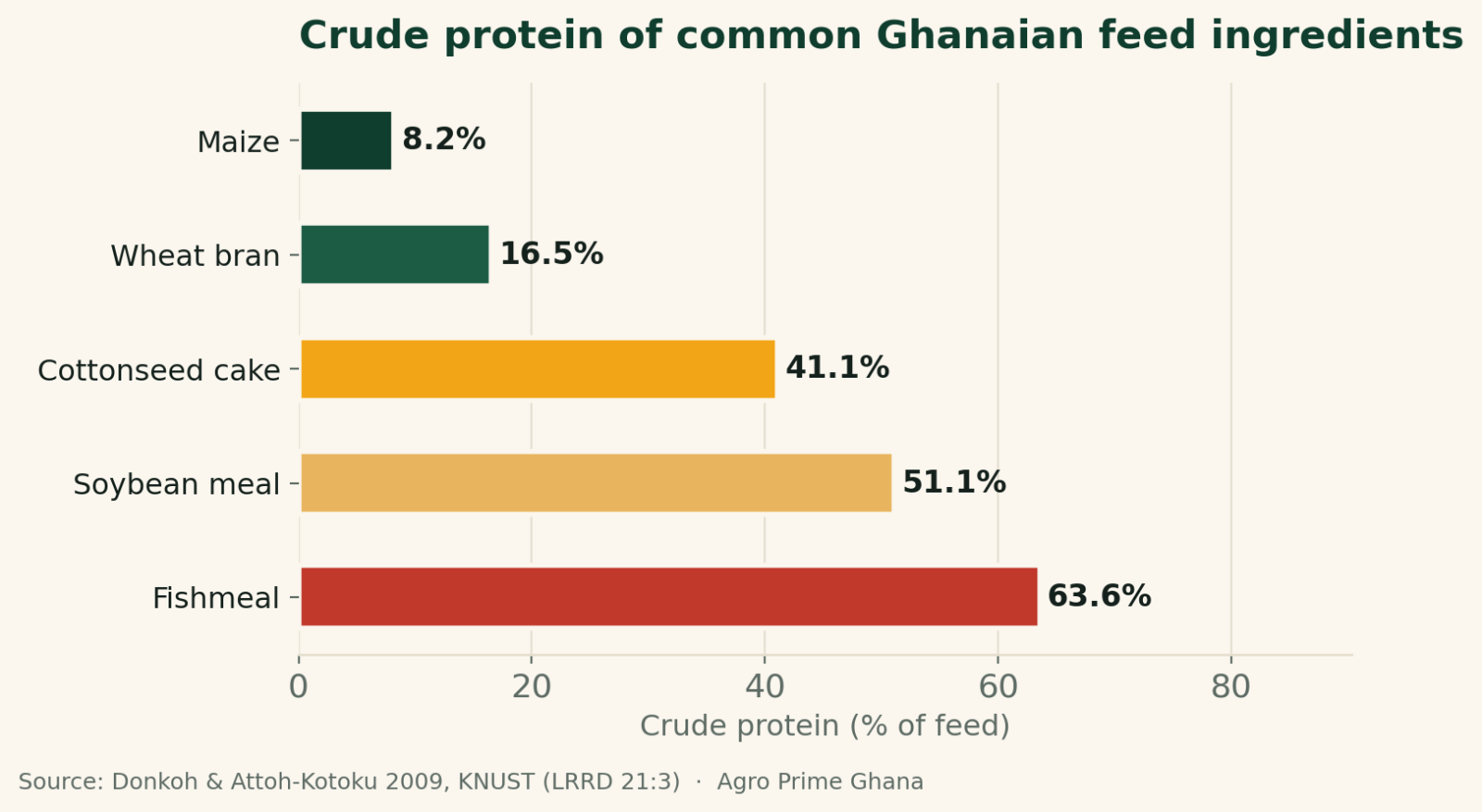
The Pearson Square is a quick method for blending two feedstuffs — one high in protein, one low — to hit a target crude protein (CP) percentage. You put the two ingredient CP values on the left corners, your target in the middle, subtract diagonally, and read off the parts of each ingredient. Local CP values matter: Ghanaian studies put maize at roughly 8–9% CP, wheat bran ~16%, soybean meal ~48–51%, and fishmeal ~48–64%, with groundnut cake around 45%. Typical protein targets are about 22–23% for broiler starter, 18–20% for growers/finishers, and 16–18% for layers. The square balances protein only — you still have to check energy, calcium, phosphorus, methionine and lysine, and add a vitamin–mineral premix. Used sensibly, it turns feed mixing from guesswork into arithmetic.
What the Pearson Square is — and what it is not
The Pearson Square (sometimes called the "box method") is a very old piece of feed-mixing arithmetic that answers one narrow question: if I want a mix of a given protein level, how much of a high-protein ingredient and how much of a low-protein ingredient do I combine? That is all it does, and understanding that limit is the key to using it well. It is a two-ingredient balancing act — one "energy" feed that is low in protein, such as maize, and one "protein" feed that is high in protein, such as soybean meal or fishmeal. As the trade guides that teach the method make plain (see the walkthrough at Feed Strategy), you write the protein value of each ingredient at the left corners of a square, put your target in the centre, and subtract along the diagonals to find the parts of each ingredient required. It is elegant precisely because it is simple: no spreadsheet, no software, no electricity — just a value you can trust for each ingredient and a minute of arithmetic. What it will not do is balance energy, amino acids, calcium, phosphorus or vitamins. A ration can hit its protein target perfectly on the square and still be a poor diet if the energy is wrong or the calcium is missing. Treat the square as the first step, not the whole job.
Why getting formulation right matters so much in Ghana
Feed economics are unforgiving here. Because feed is the dominant cost in poultry, and Ghana's rations lean heavily on maize — a crop whose price swings with the season and import pressure — every farmer mixing feed is chasing a nutritional target while ingredient costs keep moving. Buy protein you do not need and you burn cash; skimp on it and birds grow slowly, layers miss peak, and feed conversion worsens. The Ghanaian feedstuff study by Donkoh and Attoh-Kotoku at KNUST measured local ingredients and found real variation — their fishmeal samples ranged from about 49% to 64% crude protein — which is exactly why formulating from assumed textbook values can quietly let you down. The Pearson Square does not fix ingredient variability, but it forces you to write down the number you are trusting for each feedstuff, and that discipline alone catches a lot of expensive mistakes. If you are new to mixing at all, start with our guide on how to make poultry feed in Ghana and use the square alongside it.
Know your ingredients before you touch the square
The square is only as good as the numbers you feed it, so the first job is knowing the crude protein of what is actually in your store. The values below draw on the KNUST Ghana feedstuff study and standard FAO feed tables; treat them as working figures, because the same ingredient varies with source, processing and freshness. The worked ration in the table further down puts these to use in a real grower mix.
| Ingredient | Role in the ration | Approx. crude protein | Parts in a worked 18% grower mix* |
|---|---|---|---|
| Maize | Main energy source | ~8–9% | 62 kg |
| Wheat bran | Energy / fibre, bulk | ~16% | 10 kg |
| Soybean meal | Main plant protein | ~48–51% | 18 kg |
| Fishmeal | Protein + amino acids | ~48–64% | 6 kg |
| Groundnut cake | Protein (aflatoxin-risk) | ~45% | — |
| Oyster shell / limestone | Calcium | — | 2 kg |
| Premix + salt + methionine/lysine | Vitamins, minerals, amino acids | — | 2 kg |
*Illustrative 100 kg grower mix landing near 18% CP; always cross-check against a nutritionist's specification, adjust for your measured ingredient values, and guard against aflatoxin in maize and groundnut cake.
The Pearson Square, step by step
Here is the method in full, using two ingredients most Ghanaian keepers have on hand: maize (call it 9% CP) and soybean meal (call it 48% CP). Suppose you want a simple mix at 18% CP — a reasonable grower/finisher level.
- Step 1. Draw a square. Write your target, 18, in the centre.
- Step 2. Put maize's protein (9) at the top-left corner and soybean meal's protein (48) at the bottom-left corner.
- Step 3. Subtract diagonally, always the smaller from the larger. Top-left to centre: 18 − 9 = 9; write this at the bottom-right corner. Bottom-left to centre: 48 − 18 = 30; write this at the top-right corner.
- Step 4. Read the results across from each ingredient. The top-right figure (30) is the parts of maize; the bottom-right figure (9) is the parts of soybean meal. Total parts = 30 + 9 = 39.
- Step 5. Convert to percentages. Maize = 30 ÷ 39 = 76.9%; soybean meal = 9 ÷ 39 = 23.1%.
So a blend of roughly 77% maize and 23% soybean meal gives you about 18% crude protein. You can prove it: (0.769 × 9) + (0.231 × 48) = 6.9 + 11.1 = 18.0. That check — multiply each ingredient's fraction by its protein and add them up — is worth doing every time; it takes ten seconds and catches arithmetic slips before they cost you a batch. Notice the logic built into the square: the ingredient furthest from the target in protein terms ends up as the larger share, which is why the low-protein maize dominates the mix.
Field note: measure your own ingredients where you can
On the farm we have learned to distrust a single "book value" for fishmeal and groundnut cake in particular, because both vary a lot with source and adulteration. Fishmeal sold in the market is sometimes stretched with salt, bran or shell, which drags its real protein well below the 60%-plus you are paying for. When a batch of birds underperforms on a ration that looked correct on paper, the ingredient is often the first suspect, not the formula. Where a feed mill or lab will run a proximate analysis, it is money well spent for anyone mixing in volume — and at minimum, buy protein feeds from sources you trust and inspect every delivery.
Using the square for real rations: the two-ingredient trick
Real poultry feed is never just two ingredients, so how do practitioners stretch a two-ingredient tool to a full ration? The standard trick is to treat your feed as two groups: an "energy" group (maize, wheat bran, rice bran) and a "protein" group (soybean meal, fishmeal, groundnut cake). Work out the average protein of each group as you intend to combine them, then run those two averages through the square exactly as above. If your protein group is a 50:50 blend of soybean meal (48%) and fishmeal (60%), its average is 54%; if your energy group is mostly maize with a little bran, its average might be about 10%. Put 10 and 54 on the square against your target, and it tells you the proportion of energy group to protein group; you then split each group back into its individual ingredients in the ratio you chose. It is not as precise as computer least-cost formulation, but it is far better than guessing and stays inside what a busy farmer can do by hand.
A worked grower ration you can adapt
The table earlier in this guide lays out an illustrative 100 kg grower mix aiming near 18% CP: about 62 kg maize, 10 kg wheat bran, 18 kg soybean meal, 6 kg fishmeal, 2 kg calcium source (oyster shell or limestone), and 2 kg of premix, salt and synthetic amino acids. The protein ingredients (soybean meal and fishmeal) are doing the heavy lifting, the maize and bran provide energy and bulk, and the last 4 kg fixes the things the square ignores — minerals, vitamins and the amino acids methionine and lysine that plant proteins run short on. This is the shape of a workable ration, but it is a starting template, not a prescription: your exact figures depend on the real protein of your maize and soya, your birds' age, and whether you are feeding broilers or layers. For age-appropriate targets, read our broiler feeding guide and layer feeding guide alongside this one, and adjust the square's target to match the stage you are feeding.
Balancing what the square leaves out
Because the Pearson Square only balances protein, the difference between a passable ration and a good one lives in the parts it cannot see:
- Energy. Birds eat to meet their energy need, so a ration too low in energy leaves them hungry and a ration too high dilutes everything else. Maize supplies most of the energy; if you cut maize to raise protein, watch that energy does not fall too far.
- Calcium and phosphorus. Layers in particular need a lot of calcium for eggshell — far more than a grower — which is why the calcium source is a separate line, not something the protein maths handles. Getting the calcium-to-phosphorus balance wrong is a direct route to rickets in growers and thin shells in layers.
- Amino acids. Crude protein is a blunt measure. Two rations can share the same protein figure yet perform very differently because one is short on methionine or lysine, the amino acids that limit growth in maize-soya diets. This is why supplemental methionine and lysine earn their place in the premix line.
- Vitamins and trace minerals. A commercial vitamin–mineral premix, added at the maker's inclusion rate, covers what whole ingredients cannot reliably supply.
None of this makes the square useless — it makes it the first calculation in a sequence. Nail the protein with the square, then layer the rest on top.
Field note: cheapest protein is not cheapest feed
When maize prices climb, the temptation is to lean harder on the cheapest protein source to prop up the protein figure. But a ration that reads 18% on paper can still perform badly if that protein is poorly digestible or short on the right amino acids — groundnut cake, for instance, is cheap protein but carries a real aflatoxin risk, and over-relied-upon plant proteins leave methionine short. We judge a ration by what the birds do — daily gain, feed conversion, egg numbers and shell quality — not by the protein number alone. The square gets you to the right protein cheaply; the birds tell you whether the rest of the diet is right.
Common mistakes that undo good arithmetic
Most Pearson Square failures are not maths errors — they are input errors. The commonest is trusting an inflated ingredient value: assuming market fishmeal is 65% protein when the real batch is nearer 45% throws the whole mix off, always toward too little protein. Next is ignoring energy — loading soybean meal until the ration is protein-rich but energy-poor, so birds under-eat. Then forgetting the non-protein essentials — feeding a balanced protein blend with no added calcium, premix or amino acids — and not re-running the square when prices or suppliers change, since a new maize source or a switch to groundnut cake changes the numbers. The last, quietly costly one is mixing badly: even a perfect formula fails if ingredients are not ground and blended evenly, so some birds get the premix and others get none. Good formulation and good mixing are two halves of the same job.
The bottom line on the Pearson Square
The Pearson Square earns its long life because it does one useful thing reliably: it turns "how much soya do I add?" from a guess into a calculation any farmer can do on the back of a feed sack. Put your two ingredients' protein values on the corners, your target in the middle, subtract diagonally, and read off the mix — then always check the result by multiplying back. But respect its limits. It balances protein and nothing else, and it is only as honest as the ingredient values you give it, which in Ghana's markets can vary a lot. Use it as the opening move: hit your protein target with the square, then build energy, calcium, phosphorus, amino acids and a premix around it, and let the birds' performance be the final judge. Do that, and you get the real prize — a ration that feeds your flock properly without feeding your money to guesswork.
Frequently asked questions
What is the Pearson Square used for?
What crude protein should I target for my birds?
What is the crude protein of maize, soybean meal and fishmeal in Ghana?
Can I use the Pearson Square for a full poultry ration?
Why does my feed underperform even when the protein maths is correct?
How do I check my Pearson Square answer is right?
Is groundnut cake a good protein source for poultry?
Do I still need a vitamin–mineral premix if my protein is balanced?
Sources & further reading
- Donkoh A. & Attoh-Kotoku V. (2009), Nutritive value of feedstuffs for poultry in Ghana, Livestock Research for Rural Development 21(3), KNUST — local crude protein and energy values for maize, soybean meal, fishmeal, wheat bran and cottonseed cake.
- Feed Strategy — Formulating feed using the Pearson Square method (step-by-step method and worked example).
- FAO — feed ingredient composition (crude protein of soybean meal, peanut/groundnut meal, cottonseed meal, wheat bran and fish meals).
- Agro Prime Ghana guides: how to make poultry feed, broiler feeding guide, and layer feeding guide.
About Agro Prime Ghana
Agro Prime Ghana Limited runs a poultry hatchery and mixed agribusiness in Kasoa, supplying day-old chicks and supporting poultry keepers across the country with practical feeding and management advice. These guides combine hands-on hatchery and farm experience with current animal-nutrition references. This article is general educational information, not a substitute for a qualified nutritionist's ration formulation — for large or commercial mixing, have your ingredients analysed and your diets checked. Need chicks, feed advice or farm support? Book a visit or message us on WhatsApp (+233 24 915 1503).