An inverter with a battery bank keeps a poultry farm's lights, small fans, brooder controls and incubator running through a power cut by converting stored battery power into mains-style electricity the instant the grid fails — silently, automatically, and with no fuel. It is the cheapest and fastest-reacting backup for small, essential loads and short outages, and it pairs beautifully with solar to recharge for free in Ghana's sun. Its limit is stored energy: batteries hold a fixed number of watt-hours, so an inverter alone cannot run banks of heavy ventilation fans for many hours the way a generator can. This guide explains how to size an inverter and its batteries from your real loads, how battery chemistry changes what you get, how solar fits in, and where an inverter beats a generator — and where it does not.
Written by the Agro Prime Ghana poultry team and reviewed against current industry references (off-grid battery-sizing guidance and poultry brooding standards). Last updated September 2026.
Key takeaways
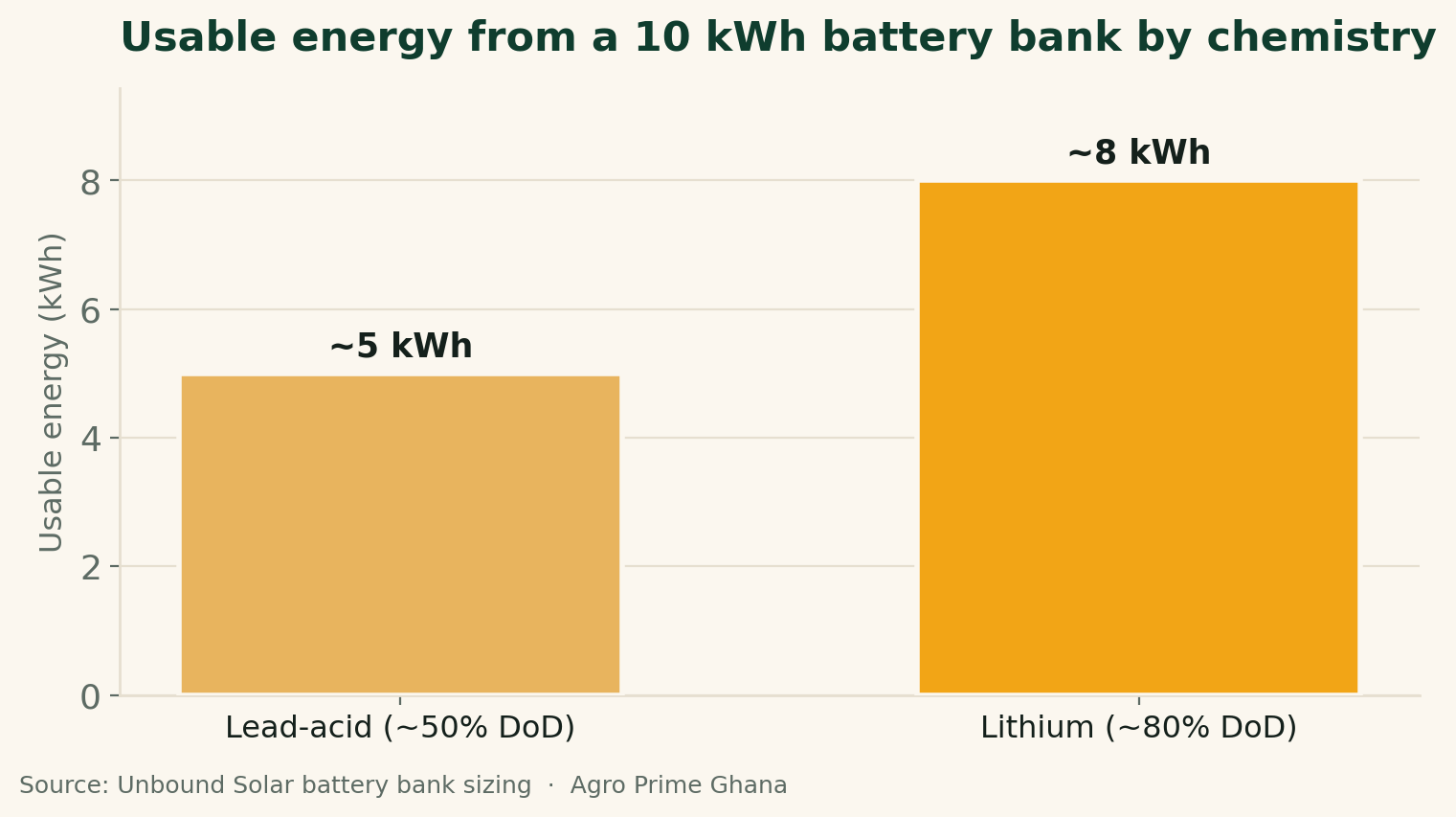
An inverter turns battery power into AC electricity instantly when the grid fails — perfect for lights, small fans, brooder controls and an incubator, and for short outages. Size the battery from watt-hours: storage needed (kWh) = daily kWh you must run ÷ usable depth of discharge (DoD). That DoD depends on chemistry: lead-acid gives only ~50% usable, while lithium (LiFePO4) gives 80–95% — so a 10 kWh lead-acid bank yields about 5 kWh, a 10 kWh lithium bank about 8 kWh. Convert watt-hours to amp-hours with Ah = Wh ÷ battery voltage, add about 10% for inverter and charging losses, and size the inverter on its surge rating because motors spike at start-up. Solar recharges the bank for free by day. For heavy, long ventilation loads a generator still wins — many farms use both.
What an inverter-battery system does for a poultry farm
An inverter-battery system stores electricity when the grid is on and delivers it as normal AC power the moment the grid goes off, bridging the outage with no noise, no fumes and no delay. On a poultry farm its great strength is speed and simplicity: unlike a generator there is nothing to start — the changeover is instant, which matters because a few minutes without brooder heat or ventilation controls can stress birds. It is also the most affordable entry point to backup power. Because it switches over instantly, some larger farms use a small inverter to cover the seconds between a blackout and their generator starting up.
The catch is capacity. A battery holds a fixed amount of energy, measured in watt-hours (Wh) or kilowatt-hours (kWh), and once it is spent the inverter stops until it recharges. That makes an inverter ideal for loads that are small, short, or both — lights, small fans, the electronics controlling a gas brooder, a running incubator, and cover for brief cuts — but poorly suited on its own to running banks of large tunnel fans through a long, hot afternoon. That trade-off is why the inverter sits within a wider backup power plan rather than replacing every other option.
How to size the battery: start with watt-hours
Sizing an inverter-battery system is really about sizing the battery, and it begins with a watt-hour budget. List each load you must run during an outage, note its wattage, and decide how many hours you need it. Multiply watts by hours for each load and add them up to get the watt-hours (or kilowatt-hours) you must store. For example, 200 W of lights and small fans plus a 150 W incubator, run for four hours, is (350 W × 4 h) = 1,400 Wh, or 1.4 kWh — before losses and the depth-of-discharge adjustment described below.
Two corrections turn that raw figure into the battery size you must buy. First, add roughly 10% for inefficiencies in the inverter and charging. Second, and far more important, divide by the battery's usable depth of discharge — because you cannot safely drain a battery to zero. The formula the industry uses is simple:
Storage needed (kWh) = Daily kWh you must run ÷ usable depth of discharge
A household example from Unbound Solar shows the method: to cover 10 kWh of use with lithium at 80% DoD, you need 10 ÷ 0.8 = 12.5 kWh of storage. On our small poultry example, 1.4 kWh of use with lithium becomes about 1.75 kWh of battery; with lead-acid at 50% DoD it becomes 2.8 kWh. That difference between chemistries is the single biggest factor in what a battery bank costs and delivers.
Battery chemistry: why usable capacity is not nameplate capacity
A battery's headline capacity is not the energy you can actually use, because draining any battery fully shortens its life — and how much you may safely take out depends heavily on chemistry. This catches most farmers out. According to off-grid sizing guidance, flooded and sealed lead-acid batteries (including AGM and gel) offer only about 50% usable depth of discharge, while lithium (LiFePO4) batteries offer 80–95%. In plain terms, "a 10 kWh lithium bank gives you about 8 kWh to spend before recharging, while a 10 kWh lead-acid bank safely gives up only about 5." Lithium also lasts far more cycles and tolerates Ghana's heat better, though it costs more upfront; lead-acid is cheaper but you must buy roughly twice the nameplate capacity for the same usable energy, and replace it sooner.
Once you know the usable kWh you need, convert to the amp-hours batteries are sold in with another simple formula: Ah = Wh ÷ system voltage. So a 24,000 Wh (24 kWh) bank at 48 volts is 24,000 ÷ 48 = 500 Ah. Higher system voltages (24 V or 48 V rather than 12 V) carry the same power at lower current, meaning thinner cables and lower losses — most serious off-grid systems now use 48 V. The table compares what you really get from the two common chemistries.
| Feature | Lead-acid (flooded / AGM / gel) | Lithium (LiFePO4) |
|---|---|---|
| Usable depth of discharge | ~50% | 80–95% |
| Usable energy from a 10 kWh bank | ~5 kWh | ~8 kWh |
| Upfront cost | Lower | Higher |
| Cycle life / longevity | Fewer cycles, replace sooner | Many more cycles, longer life |
| Effective cost per usable kWh over time | Often higher (buy ~2× capacity, replace sooner) | Often lower over the system's life |
Field note: buy the battery you'll actually use, not the label
The commonest disappointment we see is a farmer who buys "a 200 Ah battery" expecting a full day of cover and gets far less, because half of a lead-acid battery is off-limits and the inverter and cables eat a little more. Always size on usable energy: decide the watt-hours you must run, divide by the honest depth of discharge, add a margin for losses, then look at what to buy. And keep batteries cool and ventilated — heat is the great enemy of battery life in our climate, so a shaded, airy cupboard will outlast one baked next to a hot wall.
Sizing the inverter: surge, not just running watts
The inverter itself is sized by power, not energy — it must supply the total watts of everything switched on at once. But the number that matters is not only the running watts; it is the surge. Motors — even the small fans and pumps on a modest system — draw an inrush several times their running figure at the instant they start, and the inverter has to swallow that spike without shutting down. As off-grid guidance stresses, "surge matters more than running watts." So choose an inverter whose continuous rating comfortably covers your simultaneous load, and whose surge (peak) rating covers the start-up spike of your largest motor starting while everything else is already on. A "pure sine wave" inverter is worth the extra cost, because it produces clean power that motors, incubators and controls run on happily, whereas cheaper "modified sine wave" units can make motors run hot and upset sensitive electronics.
Field note: test the system before you trust it with chicks
A battery bank that has never been discharged under real load is an assumption, not a backup. Before a batch of chicks arrives, kill the mains with your critical loads running and watch the inverter take over — confirm the fans and brooder controls actually run. Repeat every few months, because battery capacity fades quietly with age, and the night of an outage is the wrong time to discover it.
Pairing with solar: free recharging in Ghana's sun
An inverter-battery system becomes far more powerful when you add solar panels, and Ghana's abundant sunshine makes this an obvious fit. Solar recharges the battery by day at no running cost, so instead of only bridging a short cut on stored energy, the system keeps topping itself up — running daytime loads directly from the sun and storing the surplus for the evening. For farms this turns backup into everyday savings: the sun carries ventilation, pumping and lighting through the brightest part of the day, cutting both the grid bill and generator fuel. The same logic is why solar suits hatching, as in a solar-powered incubator. A solar-inverter-battery combination sized around your critical loads is one of the most effective ways to build a farm that quietly ignores dumsor, and a companion to reliable ventilation.
Protect your chicks' first days — plan power and stock together
The loads an inverter is best at protecting — brooder controls, small fans, lights, an incubator — are exactly the ones your youngest, most vulnerable birds depend on. At Agro Prime Ghana we advise on this whole setup, from sizing an inverter and battery bank to laying out the brooder, and supply the healthy day-old chicks, point-of-lay pullets and feed to stock the farm. Setting up brooding or a small hatchery? Message us on WhatsApp at +233 24 915 1503 or book a farm-setup consultation, and we will match the power system to the birds you plan to keep.
Inverter or generator? Pros, cons, and using both
An inverter-battery system and a generator solve overlapping but different problems. An inverter's advantages are decisive for small, essential loads: it is silent, needs no fuel, requires little maintenance, and switches over instantly, with none of the delay of a generator that must crank and warm up. That instant, unattended response makes it especially valuable for protecting brooding chicks and for the night-time outages that catch farmers asleep. Its weakness is equally clear: stored energy is finite, so it cannot run a heavy load like a full bank of tunnel fans through a long outage without an impractically large battery bank.
A generator is the mirror image: it handles large, sustained loads for as long as fuel lasts, but it is noisy, thirsty, needs maintenance, and (without an automatic transfer switch) must be started by hand. For many Ghanaian farms the answer is not to choose but to combine: use an inverter-battery — ideally with solar — to cover lights, controls, small fans and the instant of changeover, and keep a right-sized generator for the heavy loads during longer cuts. Each covers the other's blind spot — a layered approach that is a hallmark of well-run brooding.
The bottom line on inverters and batteries
An inverter with a battery bank is the cheapest, fastest and simplest way to keep a poultry farm's essential small loads alive through a power cut — lights, small fans, brooder controls and an incubator — switching over instantly and silently the moment the grid fails. Size it from watt-hours, not guesswork: budget the watts and hours you must run, add about 10% for losses, and divide by the honest depth of discharge for your battery type — remembering that lead-acid gives only about half its nameplate while lithium gives 80–95%. Size the inverter on its surge rating and prefer a pure sine wave unit. Add solar to recharge for free in Ghana's sun. And be honest about the limit: for heavy ventilation over long outages a generator still wins, so the resilient farm usually runs both.
Frequently asked questions
What can an inverter run on a poultry farm during a power cut?
How do I size a battery for my inverter?
Lithium or lead-acid batteries for a poultry farm?
How many watt-hours does my system really deliver?
Can I add solar to my inverter and battery later?
What size inverter do I need?
Is an inverter cheaper to run than a generator?
Will an inverter protect my chicks at night automatically?
Sources & further reading
- Unbound Solar — Battery Bank Sizing (storage formula, depth of discharge by chemistry, watt-hours to amp-hours, loss margins).
- Cobb-Vantress — Brooding Fundamentals (chick heat needs that inverter-backed brooders must protect).
- Citi Newsroom — context on Ghana's ongoing dumsor risk (Institute for Energy Security).
- Agro Prime Ghana guides: backup power for a poultry farm, sizing a generator, and solar-powered incubators.
About Agro Prime Ghana
Agro Prime Ghana Limited runs a poultry hatchery and mixed agribusiness in Kasoa. We advise on farm setup — including sizing inverters, batteries and solar to protect brooding, ventilation and water — and supply healthy day-old chicks (broilers & layers), point-of-lay pullets, quality feed and hands-on farm support across Ghana. This article is general educational information, not a substitute for professional electrical advice; have battery and inverter systems specified and installed by a qualified technician. Setting up or expanding a farm? Book a visit or message us on WhatsApp (+233 24 915 1503) to order chicks, feed or advice.