To size a generator for a poultry farm in Ghana, add up the running watts of every load you must power during an outage — brooders, ventilation fans, water pumps and lights — multiply the total by about 1.25 to cover motor start-up surges, and choose a generator whose continuous output comfortably exceeds that figure. For most commercial houses of a few thousand birds this lands around 10–15 kW (roughly 12–19 kVA), but the only number that matters is the one you calculate from your own equipment. Get it right and the generator carries your birds through dumsor without stalling; get it wrong and you either waste money on an oversized machine that guzzles fuel, or buy one too small that trips the moment the fans kick in. This guide covers estimating the load, converting to kVA, budgeting fuel, and keeping the machine ready for the next blackout.
Written by the Agro Prime Ghana poultry team and reviewed against current industry references (poultry-equipment engineering guidance and diesel generator data). Last updated September 2026.
Key takeaways
Size a generator from a real list of watts, not a guess. Sum the running watts of your critical loads, then multiply by about 1.25 to cover the surge motors draw at start-up. Convert watts to kVA by dividing kW by a power factor of about 0.8 (so 10 kW ≈ 12.5 kVA). Choose on continuous rating, not peak, and run the machine at 50–80% of load, where diesels are most efficient. Fuel is the big cost — roughly 0.21–0.26 litres per kWh, so a 20 kVA set at 75% load burns around 3.4 L/h. Fit an automatic transfer switch (ATS) so the set starts itself within seconds — vital for brooding. Service on a simple schedule: check oil every 20 hours, change oil and filter every 200 hours, full service every 2,000 hours or yearly.
Why generator size matters so much on a poultry farm
A generator is the backbone of backup power on most commercial Ghanaian poultry farms — the only affordable way to run large, sustained loads (banks of ventilation fans, water pumps and brooders) for hours at a stretch, for as long as fuel lasts. But its usefulness depends entirely on being the right size. An undersized generator will overload and trip when your fans and pumps all draw current at once — exactly when you need it, during a hot afternoon outage. An oversized one wastes money twice: you pay too much to buy it, and a diesel run at light load is inefficient, wet-stacks (glazes its cylinders with unburnt fuel), and wears badly. The sweet spot, as suppliers consistently advise, is a machine that spends most of its time between roughly 50% and 80% of rated load. Sizing is one leg of a complete backup power plan, alongside inverters and stored water. It matters more here than on a stable grid because Ghana's "dumsor" outages are frequent and unscheduled, so a farm may run its generator many hours a month — and both the sizing and the fuel efficiency must be right.
Step one: estimate the load you must power
The first and most important step is an honest list of every load the generator must carry during an outage, with its wattage. This is not the whole farm's connected load — only the equipment you have decided is critical: heat for young chicks, ventilation in closed houses, water pumping, and essential lighting (deciding this list is covered in our backup power guide). Read the wattage off each nameplate. Typical items on a commercial house include:
- Ventilation fans — usually the biggest single load. Tunnel fans are commonly 3–7 HP each (1 HP ≈ 746 W, so a 5 HP fan is roughly 3,700 W running), and houses often run several at once.
- Brooder heaters / heat lamps — electric brooder heaters are commonly around 3 kW; heat-lamp banks add up fast.
- Water pump — a borehole or booster pump, often 1–3 HP (roughly 750–2,200 W running).
- Lighting — modest with modern LED, but layer houses on a lighting programme need it reliably.
- Feed augers or other motors, if essential.
Field note: don't forget the surge when motors start together
Nameplate running watts tell only half the story. When the generator picks up, motors that were off can all try to start at once, each pulling several times its running current for a moment. If your sizing only added running watts, that combined inrush can trip the set just as the load comes back. Staggering how equipment restarts, or sizing with real surge headroom, avoids a set that runs fine until everything kicks in at once.
Add the running watts to get your base load. Then account for electric motors — fans and pumps — pulling a large surge at the instant they start, several times their running current. Engineers recommend a safety factor of about 1.25 to absorb that surge; motor-heavy setups where several fans start together can need more. The result is your target capacity in watts. As a rough sense-check, suppliers put small flocks (under ~500 birds) at around 5–7 kW, commercial houses of a few thousand birds at roughly 9.5–15 kW, and larger complexes above 15 kW — but always trust your own calculation over these bands.
Step two: convert kW to kVA and read the rating correctly
Generators are usually sold in kVA (kilovolt-amperes), while your load list is in kW (kilowatts). The two are linked by the power factor, typically around 0.8 for a mixed farm load: kVA = kW ÷ power factor. So a 10 kW load needs about 12.5 kVA, and a 15 kW load about 18.75 kVA. Round up to the next standard size for headroom.
Two rating details save you from a bad purchase. First, always size against the generator's continuous (prime) rating, not its peak or standby "maximum" — ventilation fans draw a sustained load for hours, so a 13 kW unit rated for 12 kW continuous is a safer buy than a 15 kW unit rated for only 10 kW. Second, remember the 50–80% target: pick a size where your calculated load sits in that band, so you have surge headroom without running the engine so lightly that it wastes fuel and glazes up.
| Your critical running load | +25% surge factor | ≈ kVA (PF 0.8) | Typical farm |
|---|---|---|---|
| ~4 kW | ~5 kW | ~6–7 kVA | Small flock / backyard, brief cuts |
| ~8 kW | ~10 kW | ~12–13 kVA | One commercial house, few thousand birds |
| ~12 kW | ~15 kW | ~18–20 kVA | Larger house or two houses |
| ~20 kW | ~25 kW | ~30–32 kVA | Multi-house complex |
Illustrative bands only — always size from your own nameplate wattages and have the choice confirmed by a qualified electrician.
Field note: size for the day everything runs at once
The mistake we see most often is sizing a generator for the average day instead of the worst one — adding up fans as if they run one at a time, forgetting the afternoon when a fresh chill on the brooder, a full set of tunnel fans and the water pump all call for power together. Size for that moment — the hottest afternoon with the youngest birds and the pump filling tanks — and everyday running looks after itself. It is also worth leaving room for growth: if you plan to add a house next year, a slightly larger set now can save replacing the whole machine later.
Step three: budget the fuel — the real cost of a generator
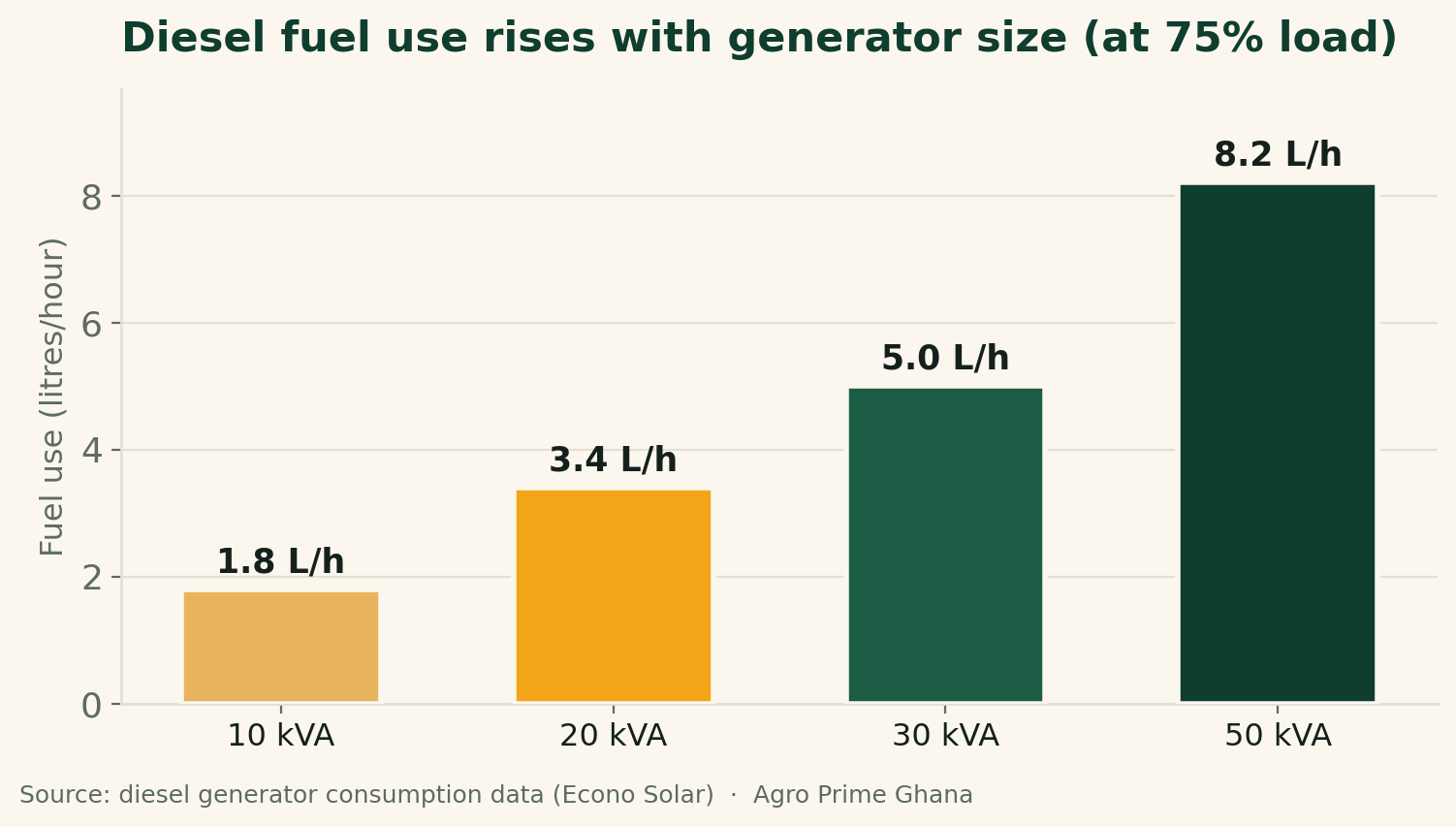
Buying the generator is the small cost; feeding it is the big one. Industry figures put fuel at 70–80% of a diesel generator's lifetime cost. A modern diesel burns roughly 0.21–0.26 litres per kWh produced, rising with load. Published figures for common sizes, at typical loads, look like this (from diesel generator consumption data):
- 10 kVA — about 1.3 L/h at 50% load, 1.8 L/h at 75%, 2.4 L/h at full load.
- 20 kVA — about 2.4 L/h at 50%, 3.4 L/h at 75%, 4.5 L/h at full load.
- 30 kVA — about 3.6 L/h at 50%, 5.0 L/h at 75%, 6.6 L/h at full load.
- 50 kVA — about 5.8 L/h at 50%, 8.2 L/h at 75%, 10.9 L/h at full load.
Turn this into a monthly cost by multiplying litres per hour by the hours you expect to run and by the diesel price. If dumsor forces four hours a day on a 20 kVA set at 75% load, that is roughly 3.4 × 4 ≈ 13.6 litres a day. This is a core input to your overall poultry farm electricity cost, and the main reason many farms pair a generator with solar or an inverter — to keep the diesel off during daylight and short cuts and reserve it for the heavy load.
Step four: automatic transfer and instant changeover
A generator only protects birds if it comes on in time. An automatic transfer switch (ATS) senses when the grid fails, starts the generator, and transfers the load — typically within about ten seconds — then reverses when mains returns, all without anyone present. For a poultry farm this is not a gadget; it is the difference between a manageable outage and a dead brooder, because the dangerous cuts come at night when no one is awake to pull-start a machine. If a full ATS is beyond budget, at least site the generator where it can be started fast, keep it fuelled, and make sure more than one person knows how to start it. An inverter with batteries switches over instantly with no delay, which is why some farms use one to cover the seconds between the outage and the generator picking up.
Match your generator to the flock you plan to keep
Sizing a generator well starts with knowing how many birds you will run and in what housing — the same information that determines your chick order. At Agro Prime Ghana we advise on this whole picture — house design, ventilation, backup power and stocking density — so your generator, housing and flock are matched from the start. We then supply the healthy day-old chicks, point-of-lay pullets and feed to fill the houses. Planning a new build or expansion? Message us on WhatsApp at +233 24 915 1503 or book a farm-setup consultation, and we will get sizing and stocking right together.
Step five: keep the generator ready — maintenance
A generator that will not start when dumsor hits is worse than none. Diesel sets reward a simple routine — the "20/20/20" rhythm: check the oil every 20 running hours, change the oil and filter every 200 hours, and carry out a full service (coolant, belts, injectors) every 2,000 hours or once a year, whichever comes first. On top of that, run the generator briefly under load every week or two, so you catch a flat battery, stale fuel or a fault before an emergency does. Keep fuel fresh and clean, keep the air filter clear of harmattan dust, and store enough fuel on site to cover a realistic outage. Skipping this is how a farm ends up with an expensive machine that is silent on the one night it is needed.
The bottom line on generator sizing
Sizing a generator for a Ghanaian poultry farm is a five-step discipline, not a guess. List the critical loads and add up their running watts; multiply by about 1.25 for motor surge; convert to kVA by dividing kW by a power factor of around 0.8; and pick a machine whose continuous rating puts your load in the efficient 50–80% band with a little room for growth. Budget the fuel honestly — it is the bulk of lifetime cost — and reserve the diesel for the heavy jobs by pairing it with solar or an inverter for daylight and short cuts. Fit an automatic transfer switch so the set starts itself before a chilled brooder or hot house can do damage, and maintain it on the 20/20/20 rhythm. Do this, and your generator becomes quiet insurance rather than an expensive gamble.
Frequently asked questions
What size generator do I need for a poultry farm in Ghana?
How do I convert kW to kVA for a generator?
Why do I multiply the load by 1.25 when sizing?
How much diesel does a poultry-farm generator use?
Do I need an automatic transfer switch?
Is it better to buy a bigger generator to be safe?
How often should I service a poultry-farm generator?
Can I run only part of my farm on the generator?
Sources & further reading
- Poultry-farm generator selection guidance — load listing, safety factor, continuous vs peak rating, ATS timing and the 20/20/20 maintenance schedule (how to choose a generator for a poultry farm).
- Diesel generator fuel consumption data — litres per hour by kVA and load, and the ~0.21–0.26 L/kWh rule of thumb (Econo Solar).
- Citi Newsroom — context on Ghana's ongoing dumsor risk (Institute for Energy Security).
- Agro Prime Ghana guides: backup power for a poultry farm, inverter & battery backup, and managing heat stress.
About Agro Prime Ghana
Agro Prime Ghana Limited runs a poultry hatchery and mixed agribusiness in Kasoa. We advise on farm setup — including sizing backup power, housing and ventilation — and supply healthy day-old chicks (broilers & layers), point-of-lay pullets, quality feed and hands-on farm support across Ghana. This article is general educational information, not a substitute for professional electrical advice; have your generator and transfer switch specified and installed by a qualified electrician. Planning a new build or expansion? Book a visit or message us on WhatsApp (+233 24 915 1503) to order chicks, feed or advice.