The Hy-Line Brown is a commercial brown-egg hybrid layer bred to reach 50% production at about 139 days, peak in the mid-to-high 90s per cent, and lay on the order of 380-plus eggs to 80 weeks and over 480 to 100 weeks — while eating roughly 109–117 g of feed a day at a feed conversion near 2.1–2.2 kg of feed per kg of egg. It is one of the world's most widely stocked layers precisely because it is so balanced: prolific, efficient, persistent and hardy. For a Ghanaian egg farmer that balance is attractive, but the numbers on Hy-Line's data sheet were measured under managed conditions, and a hen laying through Kasoa's heat and the harmattan will only get near them if you rear, feed and cool her properly. This guide translates the Hy-Line Brown performance standard into what to actually expect and do on a farm here.
Written by the Agro Prime Ghana poultry team and reviewed against current breed references (Hy-Line Brown Commercial Layer Performance Standards and FAO production guidance). Last updated September 2026.
Key takeaways
The Hy-Line Brown is a sex-linked hybrid brown layer: chicks can be sexed by down colour at hatch. Per the breed's performance standard it reaches 50% lay at ~139 days, peaks around 94–98%, and lays roughly 256–271 eggs to 60 weeks and 466–498 eggs hen-housed to 100 weeks, with rearing livability near 98% and cycle livability around 91%. Daily feed intake in lay is about 109–117 g, feed conversion about 2.06–2.24, mature body weight around 1.8–1.9 kg, and egg weight rising from ~55–58 g at 26 weeks to ~62–66 g later. In Ghana's heat, expect real-world output nearer the FAO's 180–200 eggs per hen per year for hot climates unless you manage heat, water and feed. It is a very close cousin of the ISA Brown and Lohmann Brown.
What is a Hy-Line Brown?
The Hy-Line Brown is a commercial hybrid layer produced by Hy-Line International, one of the oldest and largest layer-breeding companies in the world. Like the other leading brown layers it is a sex-linked cross, so pullet and cockerel chicks can be told apart by down colour on the day they hatch — which is why hatcheries can supply pure pullet flocks with confidence. It is a medium-sized layer bred over many generations not for meat but for a specific package of traits: high egg numbers, good shell strength, efficient feed use, a long and persistent laying cycle, and a manageable temperament. Hy-Line markets it as "the world's most balanced brown egg layer," and the phrase is fair — it does not top every single metric, but it does most things well and holds up over a long cycle. It belongs to the same family of red-brown hybrids as the Lohmann Brown and the ISA Brown, and for a Ghanaian farmer the three are practical alternatives rather than dramatically different birds.
Hy-Line Brown performance standards
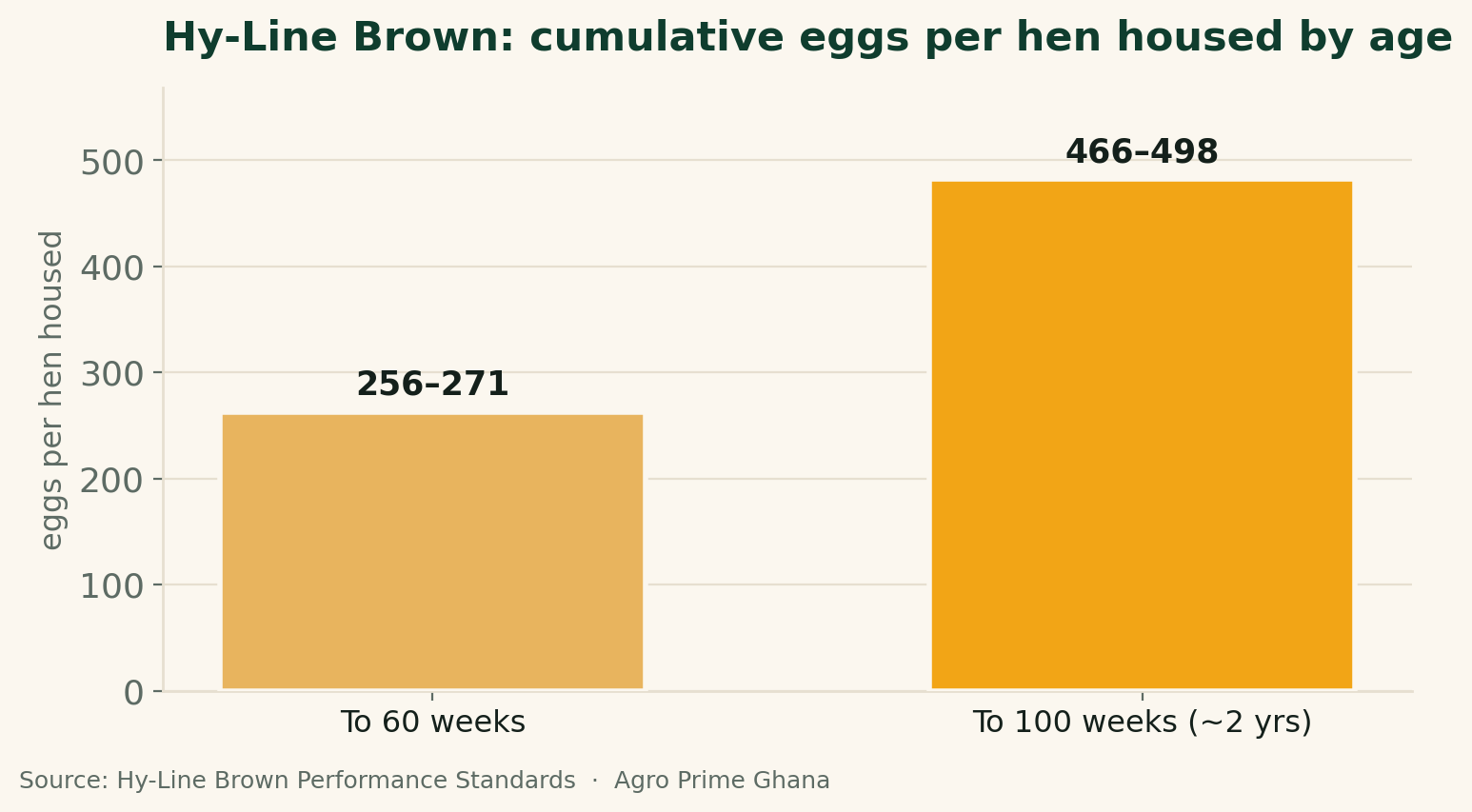
Hy-Line publishes detailed commercial performance standards, and they describe a genuinely prolific, efficient layer. The flock reaches 50% production at about 139 days of age, climbs to a peak of roughly 94–98% hen-day, and lays approximately 256–271 eggs hen-housed to 60 weeks and 466–498 eggs hen-housed to 100 weeks — comfortably clearing 380 eggs by around 80 weeks on the way. Rearing livability to 17 weeks is about 98%, and livability across the full cycle to 100 weeks around 91%. During lay the bird eats roughly 109–117 g of feed per day, converting feed at about 2.06–2.15 kg per kg of egg to 60 weeks and 2.15–2.24 to 100 weeks. Mature body weight is about 1.8–1.9 kg, and egg weight rises from around 55–59 g at 26 weeks to 62–66 g in the later cycle. Total feed used in rearing to 17 weeks is around 6 kg per bird. These are strong numbers — but they are what the genetics can do under good conditions. The FAO's benchmark is the reality check: commercial layers manage 250–300 eggs a year in temperate climates but only 180–200 in hot, humid ones. Same bird, different environment.
| Hy-Line Brown metric | Breed-standard figure | What it means on your farm |
|---|---|---|
| Age at 50% lay | ≈139 days (~20 weeks) | Comes into lay promptly; get lighting and layer feed ready by ~18 weeks |
| Peak production | ≈94–98% hen-day | Close to an egg per hen per day at the top — if pullets are well grown and cool |
| Eggs to 60 weeks | ≈256–271 (hen housed) | Your first-year output benchmark to track against |
| Eggs to 100 weeks | ≈466–498 (hen housed) | Long, persistent cycle; most keepers cull before this on economics |
| Feed intake | ≈109–117 g/day | Budget ~110–115 g × flock × days; feed is the dominant cost |
| Feed conversion | ≈2.1–2.2 kg feed / kg egg | Efficient — only on a correctly balanced layer ration |
| Egg weight | ≈55–58 g rising to 62–66 g | Pullet eggs start small and grade up as the flock ages |
Is the Hy-Line Brown a good layer for Ghana?
Yes — the Hy-Line Brown is well suited to Ghanaian egg production, provided you manage the heat, because its balance of persistence and feed efficiency plays to exactly what matters when feed is expensive. But the same heat that makes those traits valuable also caps output. A laying hen is comfortable around 18–24°C; above roughly 27–30°C she pants, eats less and drinks much more, and reduced feed intake directly cuts egg numbers, egg size and shell quality. That is why the FAO's hot-climate figure of 180–200 eggs a year, not the 300-plus a temperate cage house can achieve, is the honest planning number here. The levers are the same ones every good layer keeper in Ghana pulls: open, well-ventilated housing with real cross-flow and roof shade; cool, clean water that never runs short in the afternoon; feeding in the cool of early morning and evening so birds eat their full ration; and a slightly denser hot-season feed so a smaller intake still delivers enough energy, protein and calcium. Get those right and the Hy-Line Brown's efficiency shines; get them wrong and you pay for good genetics you never see. Our guides to increasing egg production and layer feeding cover the routine in detail.
Field note: protect the afternoon drink and you protect the egg
The single most common reason a promising layer flock quietly underperforms in our climate is not the breed — it is water. On a hot afternoon a Hy-Line Brown will drink roughly double her cool-weather intake, and if the drinker line is warm, low-pressure or running short just when she needs it most, she eats less, and eggs follow feed down within days. We make a habit of physically checking flow and water temperature at the far end of the line in the heat of the day, not the cool of the morning when everything looks fine. Cool, plentiful water in the afternoon is one of the cheapest ways to defend your peak.
Hy-Line Brown vs ISA Brown vs Lohmann Brown
The three leading brown layers are close cousins, and for a Ghanaian farmer the differences between them are small next to the difference good management makes. All are red sex-linked hybrids bred for the same package of traits, and their headline numbers overlap heavily: the Hy-Line Brown quotes about 466–498 eggs hen-housed to 100 weeks at a 94–98% peak; the ISA Brown quotes about 476 eggs and a ~97% peak; the Lohmann Brown-Classic sits in the same band. Feed intake (roughly 110–117 g/day) and feed conversion (roughly 2.1–2.2) are near-identical across the three. So the deciding factor is rarely the spec sheet — it is which quality pullets you can actually get, from a source that vaccinates properly, at the right age. A healthy, well-reared Hy-Line pullet will beat a stressed, underweight bird of any brand. If you want the wider view of layer options here, see our guide to the best layer breeds for Ghana.
| Brown layer | Eggs to ~100 weeks (hen housed) | Peak lay | Feed / day |
|---|---|---|---|
| Hy-Line Brown | ≈466–498 | ≈94–98% | ≈109–117 g |
| ISA Brown | ≈476 | ≈97% | ≈112 g |
| Lohmann Brown-Classic | Comparable (~470s) | Low–mid 90s% | ≈110–120 g |
Rearing Hy-Line Brown pullets to hit the standard
The Hy-Line Brown's laying performance is decided in the rearing house, weeks before the first egg — a flock that is underweight or uneven at point of lay will never reach the peak the standard promises. The breed's own figures show rearing livability near 98% and a target rearing feed intake of about 6 kg to 17 weeks; the goal of all that feed is a uniform flock hitting body-weight targets, because body weight at maturity is the best single predictor of peak lay and egg size. Practically, that means weighing a sample of pullets regularly and grading out the small tail, running a proper grower and pullet feeding programme so birds are on target and not fat, and holding a steady lighting programme in rearing before stepping day length up as they approach lay. Move pullets to the layer house and switch to layer feed before they come into lay, not after, so their calcium reserves are built for shell production. Vaccinate on schedule and keep the rearing environment clean and low-stress. Do this and the flock comes into lay evenly, climbs to a strong peak, and holds it — which is the whole point of buying a persistent breed.
Get Hy-Line-quality layers and feed from Agro Prime
Agro Prime Ghana supplies healthy, vaccinated day-old layer chicks and point-of-lay (POL) pullets — brown layers of the kind described here — together with quality layer and grower feed and practical advice on rearing to body-weight targets, lighting and hot-season feeding. If you are planning an egg unit, we can help you size the flock to your market and set the pullets up to reach and hold their peak. Message us on WhatsApp (+233 24 915 1503) or book a visit to order chicks, pullets or feed and talk through your numbers.
Field note: weigh the pullets, don't guess them
Hy-Line's numbers lean hard on uniform, on-target body weight, and the cheapest way to lose a peak is to skip weighing during rearing and simply assume the flock is "looking good." A flock can look fine to the eye and still hide a heavy tail of small, under-grown pullets that will never lay well. On our floor we weigh a representative sample every couple of weeks in rearing, compare it to the target, and grade out and feed up the small birds separately — because once they are all in the layer house, that tail is invisible in the crate but very visible in your total egg count. Cheap scales pay for themselves in eggs.
Managing the laying cycle and calcium
Once the Hy-Line Brown is laying, the job is to defend the peak and keep shells strong as the flock ages. Egg weight climbs steadily from around 55–58 g at 26 weeks toward 62–66 g later in the cycle, and larger eggs demand more shell — so calcium management becomes central. Feed a properly formulated layer ration with adequate calcium, ideally with part of it as larger particles or oyster shell fed later in the day, so the hen has calcium available overnight when the shell is being formed; our guide to calcium for laying hens explains the timing. Keep energy and amino acids up, especially in the heat when intake falls, and never let feed quality slip to cut costs — thin shells, smaller eggs and a sagging peak cost far more than the feed you saved. Keep a firm lighting programme to sustain lay, watch the laying curve and shell quality as the flock ages, and keep good records so you can see when feed cost per saleable egg says it is time to move a flock on. Managed this way a Hy-Line Brown flock lays persistently and profitably deep into the cycle.
The bottom line on the Hy-Line Brown
The Hy-Line Brown is a balanced, prolific, feed-efficient brown layer that suits Ghanaian egg farming well when it is reared and managed properly. Its performance standard — 50% lay at ~139 days, a 94–98% peak, 380-plus eggs by 80 weeks and 466–498 to 100 weeks, at ~110–117 g of feed a day — describes what good management unlocks, not what heat and neglect deliver. Under our climate, plan around the FAO's 180–200 eggs a year for hot regions and treat everything above that as reward for cooling the house, protecting the afternoon drink, feeding for the heat and rearing strong, uniform pullets. It is a near-twin of the ISA and Lohmann browns, so choose whichever quality pullets you can reliably source. Get the pullet and the feed right, manage the calcium and the heat, and the Hy-Line Brown will earn its "balanced layer" name on your farm.
Frequently asked questions
How many eggs does a Hy-Line Brown lay?
At what age do Hy-Line Brown hens start laying?
How much feed does a Hy-Line Brown eat per day?
Is the Hy-Line Brown better than the ISA Brown or Lohmann Brown?
Is the Hy-Line Brown suitable for Ghana's climate?
What body weight should a Hy-Line Brown reach?
How long does a Hy-Line Brown stay in lay?
Why are my Hy-Line Brown eggs small at first?
Sources & further reading
- Hy-Line International — Hy-Line Brown Commercial Layers Performance Standards (age at 50% lay, peak, eggs to 60/100 weeks, livability, feed intake and conversion, body and egg weight).
- Hy-Line International — Hy-Line Brown variety overview (breed positioning and characteristics).
- FAO — Egg Production (Small-scale poultry production) (commercial layer output in hot/humid vs temperate climates).
- Agro Prime Ghana guides: ISA Brown layer guide, Lohmann Brown layer guide, best layer breeds for Ghana, layer feeding, grower and pullet feeding, and calcium for laying hens.
About Agro Prime Ghana
Agro Prime Ghana Limited runs a poultry hatchery and mixed agribusiness in Kasoa, supplying day-old chicks and point-of-lay pullets and supporting poultry keepers nationwide. These guides combine hands-on hatchery and farm experience with current breed and industry references. This article is general educational information, not a substitute for professional veterinary or agronomic advice. Ready to start or expand your layer flock? We supply healthy day-old layer chicks, POL brown-layer pullets, quality feed and hands-on support — book a visit or message us on WhatsApp (+233 24 915 1503) to order chicks, pullets, feed or advice.