A good day-old chick is bright-eyed, alert, dry and fluffy, stands firmly on straight legs, has a clean, fully healed navel and a soft (not hard, swollen) belly, and weighs roughly two-thirds of the egg it hatched from — about 38–45 grams for a normal table egg. That five-second visual check, done on a sample of chicks the moment a box is opened, is one of the highest-return habits in poultry, because chick quality is the biggest thing you cannot fix later. If a hundred weak, dehydrated, poorly-healed chicks go into your brooder, no amount of good feed, heat or medicine will turn them into the flock you paid for. This guide gives you the exact signs of a good versus a poor day-old chick, a checklist you can run on delivery day in Kasoa or anywhere in Ghana, and the reasons each sign matters for first-week survival.
Written by the Agro Prime Ghana hatchery team and reviewed against current industry references (Aviagen/Ross broiler management guidance and The Poultry Site chick-quality literature). Last updated September 2026.
Key takeaways
A first-grade day-old chick is active, dry, fluffy and standing tall, with clear bright eyes, a clean, closed, dry navel, straight legs and clean toes, and a soft, supple belly (a hard, distended belly means an unabsorbed yolk sac). It should weigh about 66–68% of its hatching egg — roughly 38–45 g for most eggs — and should right itself within about 3 seconds when placed on its back. Reject chicks that are wet, panting, pasted, pale, listless, have red or swollen hocks, an open or black "button" navel, unhealed navel strings, or crooked legs. The Pasgar score starts every chick at 10 and deducts a point per defect; a good batch averages 9.0 or higher. Chilled chicks can suffer roughly 2.7× the 7-day mortality of comfortable ones, so temperature at delivery matters as much as the chick itself.
Why chick quality decides your first week
Chick quality decides your first week because a day-old chick is still finishing the job of being born, with almost no reserves to spare. It arrives carrying a residual yolk sac — its packed lunch of energy, fat and maternal antibodies — and its early survival depends on that yolk being properly drawn in, its navel sealed over it, and the bird being strong enough to find water and feed within hours. A weak or poorly-hatched chick starts life behind, and the gap widens fast. The first seven days set the ceiling for the entire flock: uneven, sickly starts show up later as poor uniformity, stunted birds, weak feed conversion and higher condemnations. On a broiler that should roughly quadruple its hatch weight in the first week, a slow, dehydrated start it never fully recovers from is money quietly leaking out of the pen. This is why experienced keepers judge a hatchery not by the price on delivery day but by how the chicks look and perform in week one.
There is also a hard economic logic to it. The chicks are one of your cheapest inputs over the life of the flock — feed dwarfs them — yet they set the outcome for everything you spend afterwards. Paying slightly more for genuinely strong, well-vaccinated chicks, and learning to inspect them, is one of the best-value decisions in the enterprise. If you are still deciding where to source, our guides on choosing healthy day-old chicks and where to buy day-old chicks pair with this checklist.
What a good day-old chick looks like
A good day-old chick looks alert, upright and comfortable in its own body. The industry's traditional quality markers, summarised by The Poultry Site, are simple: the chick stands tall, has clear bright eyes, a clean well-healed navel, good fluff covering, good colour rather than a pale look, few defects on toes, legs and beak, and no sign of infection such as an inflamed navel. Put a handful down and a good batch is busy — chicks move, peck, respond to sound and find their feet. Pick one up and it should feel warm, plump and firm, struggle in your hand, and have a belly that is soft and pliable, not tight like a filled balloon.
The most useful single habit is to turn the chick over and look at three things in a row: the navel (closed, dry, hard to find — barely a mark), the hocks (clean and pale, not red or scabbed), and the vent (clean, not pasted with dried droppings). Then set it down and watch it walk away on straight legs with clean, uncurled toes. That whole examination takes seconds and catches the great majority of problem chicks.
Field note: use a quick Pasgar-style score on a sample, not on every chick
On our hatchery floor we don't try to grade a thousand chicks one by one — we sample. Pull about 30 to 50 chicks from different parts of several boxes and run them through the five Pasgar checks: reflex (does it flip back onto its feet within about three seconds?), navel (clean, closed, dry — no black scab or string?), hocks (no red patches?), beak (no dried blood, red dot on the tip, or dried albumen?), and belly (soft and supple, not tight?). Each defect costs a point off a starting 10, and a healthy batch averages 9.0 or better, as Royal Pas Reform describes. If your sample is scoring low, the whole batch deserves a hard conversation with the supplier before those chicks cost you a bad week.
Chick weight: the number most farmers skip
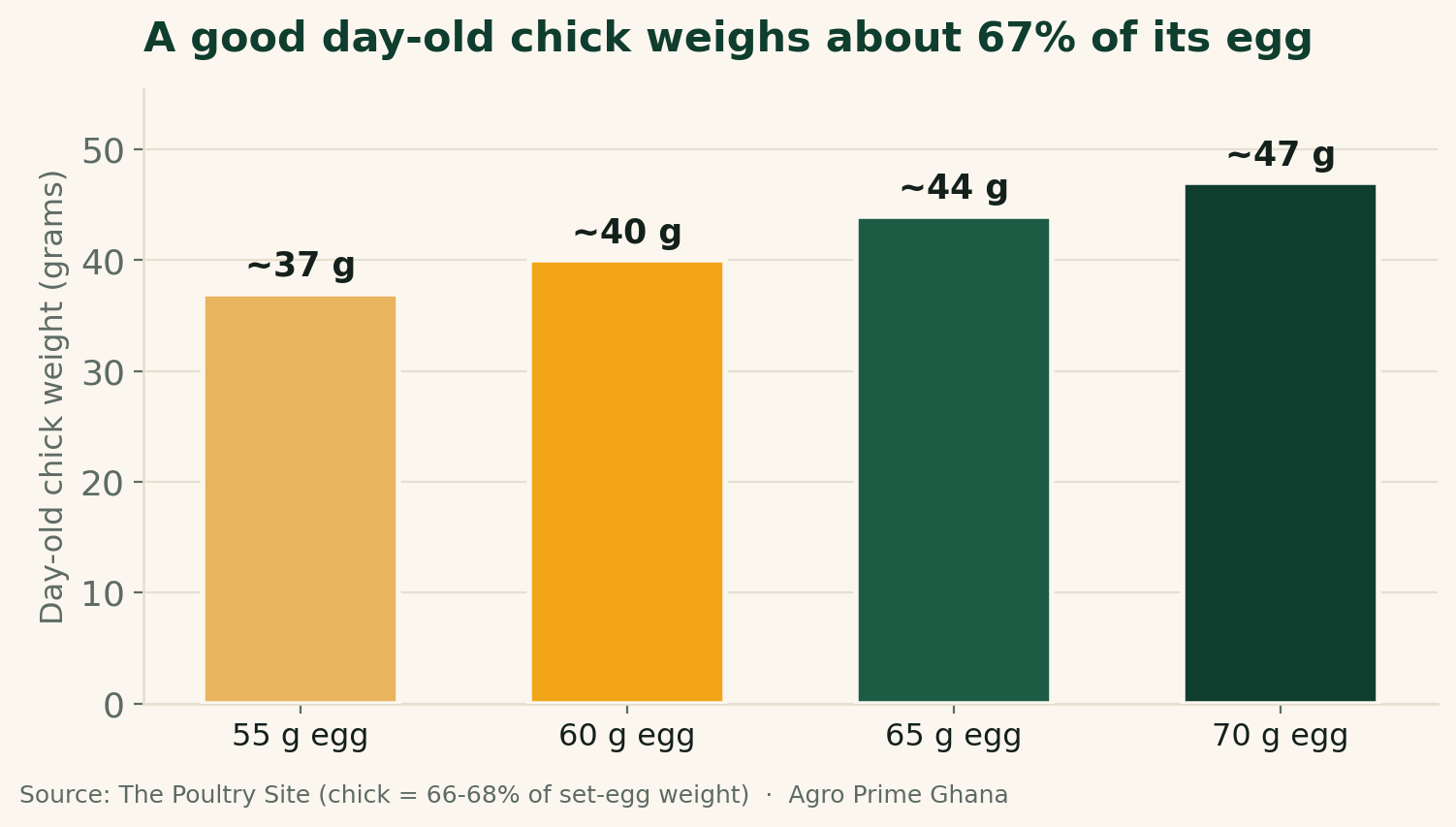
A day-old chick should weigh roughly 66–68% of the egg it hatched from — about two-thirds — which for most Ghanaian hatching eggs lands a normal chick in the 38–45 gram range. That ratio, reported by The Poultry Site, is worth knowing because weight is objective where the eye is subjective. A cheap gram scale on delivery day tells you two things at once: whether chicks are the right size and whether they are uniform. Tiny chicks often come from small or old eggs and lag all the way through; a wide weight spread in one batch signals uneven incubation and predicts an uneven flock. You are not chasing a magic number — a bigger egg gives a bigger chick — but chicks appropriately heavy for their egg source and close to each other in weight.
Weight also flags dehydration: a chick held too long in the hatcher or in transit loses moisture and feels light and "empty." Combine the scale with the belly feel — a good chick is plump and firm, a dehydrated one is light, and a hard, over-full belly means an unabsorbed yolk sac. Both warn that the first week will be harder than it should be.
The full delivery-day checklist
Here is the practical run-through to do the moment boxes arrive, before you sign and before chicks go under heat — fast but methodical, on a sample from several boxes:
- Activity and reflex. Alert, noisy, moving; rights itself within about three seconds when placed on its back. Sluggish, floppy or silent chicks are a red flag.
- Eyes. Clear, round, bright, fully open — not dull, sunken or half-closed.
- Down/fluff. Dry, fluffy, clean. Wet, sticky or stained down points to a poor, late or over-humid hatch.
- Navel. Clean, closed, dry and hard to see. Reject an open navel, a black "button" or scab, a string, or any wet, red or smelly navel — the classic route into navel ill (omphalitis).
- Belly. Soft, supple, rounded. A hard, tight belly means the yolk sac was not absorbed.
- Legs, hocks and toes. Straight legs, pale hocks, straight toes. Splayed legs and curled toes are culls — see spraddle leg in chicks.
- Beak and face. Even beak (no cross-beak), clear nostrils, no dried blood or albumen on the tip.
- Vent, weight and warmth. Vent clean; weight roughly 38–45 g and uniform; chicks warm, not cold, in the hand.
Good chick versus poor chick, at a glance
The table below sets the strong chick against the weak one on each check, so you and anyone helping you receive birds can spot the difference quickly.
| What you check | Good day-old chick | Poor / reject chick |
|---|---|---|
| Activity / reflex | Alert, noisy, rights itself in ~3 seconds | Listless, floppy, slow or unable to stand |
| Eyes | Clear, bright, fully open | Dull, sunken, half-closed |
| Down / fluff | Dry, fluffy, clean | Wet, sticky, matted, stained |
| Navel | Clean, closed, dry, hard to find | Open, black button, string, red or wet |
| Belly | Soft, supple, rounded | Hard, tight, swollen (retained yolk) |
| Legs / hocks / toes | Straight legs, pale hocks, straight toes | Splayed/bent legs, red hocks, curled toes |
| Weight | ~38–45 g and uniform | Very light, "empty," or wildly uneven |
| Feel | Warm, plump, firm, struggles | Cold, thin, limp |
Field note: colour and noise tell you a lot before you even pick a chick up
Before we handle individual chicks, we read the whole box. A good batch is loud in a busy, contented way and evenly coloured — bright, clean yellow down without pale, washed-out or dirty-looking birds mixed in. A box that is quiet, or one where a good number of chicks look dull, pale or damp, is a warning before you have checked a single navel. We also glance for chicks lying flat or not moving with the group. None of this replaces the hands-on checklist, but it means that by the time we start turning chicks over, we already have a fair sense of whether this is a strong batch or one to scrutinise hard.
What poor quality is telling you about the hatchery
Most chick defects are not random — they are fingerprints of what happened during incubation, so reading them tells you something about your supplier. Red hocks follow insufficient moisture loss during incubation, while large, string or "leaky" navels typically come from hatching at too high a temperature and humidity, as The Poultry Site notes. Wet, sticky, late-hatched chicks and unabsorbed yolks point to problems with egg storage, incubation temperature or the hatch window; a small, uneven batch often traces back to small or aged eggs. You do not need to be a hatchery engineer to use this — just recognise that a run of the same defect across many chicks is a system problem at the source, not bad luck, and a fair basis to ask questions or change supplier.
Order strong, vaccinated day-old chicks from Agro Prime Ghana
Everything on this checklist is exactly what a serious hatchery should be delivering as standard. At Agro Prime Ghana we supply healthy, well-hatched day-old broiler and layer chicks — dry, uniform, with clean healed navels and vaccinated at the hatchery (including Marek's disease) — plus honest brooding advice so your birds get the first week they need. If you want chicks you can inspect with confidence, or you are planning your next batch, message us on WhatsApp (+233 24 915 1503) or book a visit to the hatchery in Kasoa. We would rather you check our chicks against this list than take our word for it.
Temperature at delivery: the quality you can lose in an hour
Even a perfect chick can be ruined by the wrong temperature on the way to your farm, so chick handling is part of chick quality. A day-old chick's target internal (cloacal) temperature is about 40.0–40.6°C, and it cannot yet regulate its own body heat. Research summarised by The Poultry Site found chicks held too cold suffered roughly 2.7 times the seven-day mortality of comfortable chicks, and even overheated chicks about 1.5 times. The signs are unmistakable: cold chicks huddle and pile, hot chicks pant and spread apart, comfortable chicks settle evenly. If a delivery arrives with chicks piled and chirping in cold boxes, or gaping in hot ones, some of the quality you paid for is already gone. Insist on prompt, cool-of-the-day transport and get chicks under a pre-warmed brooder quickly — see transporting day-old chicks and the brooder temperature chart.
What to do with the weak chicks you do find
Even a good batch will contain a few chicks that fall short. Obvious culls — chicks that cannot stand, have severe leg deformities, gaping unhealed navels or are clearly dying — are kindest culled promptly; keeping them alive spreads infection without a real chance of a healthy bird. Borderline chicks that are simply slow or small can often be saved: place them nearest the heat and a shallow drinker and give them warm, calm conditions for a day or two. Keep a running count of what you culled and why, because a high reject rate on arrival is data — it tells you the batch, and possibly the supplier, underperformed, and it feeds decisions about who you order from next. Good record keeping turns a bad batch into a lesson.
The bottom line on chick quality
Day-old chick quality is the one input you must judge for yourself, because it is the one you cannot correct after placement. The good chick is easy to recognise: alert and noisy, dry and fluffy, bright-eyed, standing on straight legs, with a clean healed navel, a soft belly and a weight around two-thirds of its egg. The poor chick tells on itself — wet, pale, listless, pasted, red-hocked, hard-bellied or uneven. Sample 30 to 50 chicks from several boxes, run them through the checklist, weigh a handful, and keep temperature under control from box to brooder. Do that on every delivery and you turn chick quality from a gamble into a decision — and give your flock the strong first week everything else depends on.
Frequently asked questions
How do I know if a day-old chick is healthy?
How much should a day-old chick weigh?
What is the Pasgar chick quality score?
What does a good navel look like on a day-old chick?
Why does chick quality matter so much for survival?
Should I reject or cull weak chicks?
Can cold or hot transport spoil good chicks?
How many chicks should I inspect on delivery?
Sources & further reading
- The Poultry Site — Chick quality and grading (visual quality markers, chick weight as 66–68% of egg weight, navel and hock defects, cloacal temperature).
- Royal Pas Reform — Pasgar score: an easy chick quality assessment method (the five criteria, scoring and batch thresholds).
- The Poultry Site — Factors affecting chick comfort and liveability (target cloacal temperature, chilled vs overheated chick mortality, behaviour).
- Agro Prime Ghana guides: choosing healthy day-old chicks, transporting day-old chicks, and the brooder temperature chart.
About Agro Prime Ghana
Agro Prime Ghana Limited runs a poultry hatchery and mixed agribusiness in Kasoa, hatching and supplying day-old chicks and working alongside poultry keepers across the country. These guides draw on that hands-on hatchery experience, checked against current industry and veterinary references. We supply healthy day-old chicks (broilers and layers), point-of-lay pullets, quality feed and practical farm support nationwide. This article is general educational information, not a substitute for professional veterinary advice. Ready to start or expand? Book a visit or message us on WhatsApp (+233 24 915 1503) to order chicks, feed or advice.