
The ISA Brown is a commercial brown-egg hybrid layer, bred in France by the Institut de Sélection Animale, that a well-managed flock can carry to around 476 eggs per hen to 100 weeks of age at a peak lay of about 97% — while eating roughly 112 g of feed a day and staying calm and easy to handle. That combination of high output, docile temperament and hardiness is why it has become one of the most popular layers in the world, and a sensible choice for Ghanaian egg farmers. But a data sheet drawn up for a climate-controlled European cage house is not the same as a hen laying through the harmattan in Kasoa. This guide sets out what the ISA Brown really delivers, how it stacks up against the other brown layers you can buy here, and how to get close to those numbers under Ghanaian conditions.
Written by the Agro Prime Ghana poultry team and reviewed against current breed references (ISA / Hendrix Genetics management data and FAO production guidance). Last updated September 2026.
Key takeaways
The ISA Brown is a red-brown sex-linked hybrid layer: pullet and cockerel chicks can be told apart by down colour at hatch. Under good management it reaches 50% lay at about 145 days (≈20–21 weeks), peaks near 97%, and lays around 476 eggs to 100 weeks at an average egg weight of about 62–63 g, with a feed conversion near 2.1 kg feed per kg of egg and livability around 92%. It is prized for a calm temperament and broad adaptability to different climates and housing. In Ghana's heat, expect real-world output closer to the 180–200 eggs per hen per year that the FAO cites for commercial layers in hot, humid climates unless you actively manage heat, water and feed. It is a close cousin of the Lohmann Brown and Hy-Line Brown, and differences between them are marginal compared with how well you rear and feed them.
What is an ISA Brown?
The ISA Brown is not a pure breed but a four-line commercial hybrid, developed by the French breeding company Institut de Sélection Animale (ISA), now part of Hendrix Genetics. It is a sex-linked cross: a red male line is mated to a silver (white) female line, and the chicks inherit down colour by sex — brown/buff pullets and pale/white cockerels — so a hatchery can sex the chicks by eye on day one. That is one practical reason these birds are so widely traded: you can order pure pullets with confidence. Genetically it belongs to the same family of high-output brown layers as the Lohmann Brown and the Hy-Line Brown, all of them selected over decades for egg numbers, shell quality, feed efficiency and docility rather than for meat. The bird is a medium-sized layer, coming into lay at around 18–20 weeks and finishing a first laying cycle well beyond 80 weeks. When people say a hen is a "brown layer" in Ghana, an ISA Brown, a Lohmann or a Hy-Line is usually what they mean.
ISA Brown performance: the real numbers
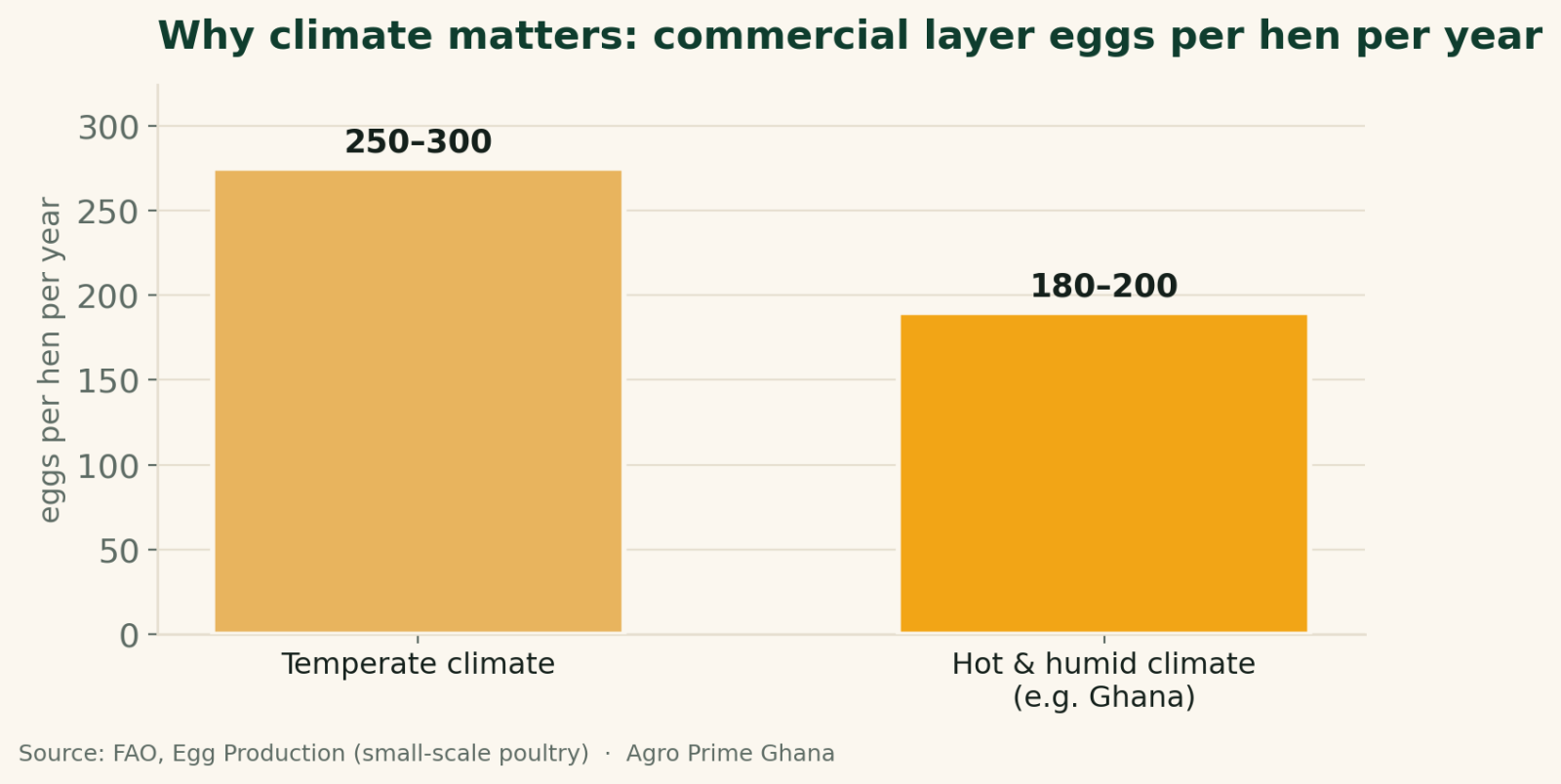
According to ISA's own commercial layer figures, a flock kept in good conditions reaches 50% production at about 145 days, climbs to a peak of roughly 97% hen-day lay, and produces on the order of 476 eggs per hen housed to 100 weeks of age — close to two full years of laying. Average egg weight settles around 62.5 g (a large egg), cumulative feed intake averages about 112 g per bird per day during lay, and the feed conversion ratio is roughly 2.14 kg of feed per kg of egg. Livability over the long cycle is around 92%, mature body weight is about 1.95 kg, and shell and internal quality stay strong (shell strength around 4,150 g/cm² and Haugh units near 85). These are the figures the breed is capable of; treat them as a ceiling to aim at, not a promise. They assume good chicks, correct rearing, balanced feed, clean water, disease control and reasonable temperatures — and in a hot house, every one of those numbers slips unless you manage for it. The FAO puts the reality plainly: commercial layers in hot, humid climates average 180–200 eggs a year, against 250–300 in temperate ones. The genetics are the same; the environment is not.
| ISA Brown metric | Breed-standard figure | What it means on your farm |
|---|---|---|
| Age at 50% lay | ≈145 days (20–21 weeks) | Plan feed and lighting changes for ~18 weeks; point-of-lay pullets are almost there |
| Peak production | ≈97% hen-day | Nearly an egg per hen per day at the top of the curve, if fed and cooled well |
| Eggs to 100 weeks | ≈476 per hen housed | Long, persistent cycle — most keepers cull earlier as lay and shell quality drift down |
| Average egg weight | ≈62–63 g (large) | Sells in the larger crate grades; early pullet eggs start smaller |
| Feed intake | ≈112 g/day | Budget ~112 g × your flock size × days — feed is the biggest cost by far |
| Feed conversion | ≈2.1 kg feed / kg egg | Efficient, but only on a properly balanced layer ration |
| Livability | ≈92% over the cycle | Assumes vaccination and biosecurity; losses climb fast without them |
Is the ISA Brown suited to Ghana's climate?
Yes, with active heat management — brown layers are robust and the ISA is specifically bred to "adapt well to different climates," but no high-output hen escapes the physics of heat. A laying hen is comfortable at roughly 18–24°C; above about 27–30°C she starts to pant, eat less and drink far more, and when feed intake falls, so do egg numbers, egg size and shell strength. That is the mechanism behind the FAO's 180–200 eggs figure for hot climates. In a Kasoa or Accra layer house the job is to blunt that heat: open, well-oriented housing with good cross-ventilation, roof insulation or a wide overhang, and never a still, hot corner. Give cool, clean water without interruption — a hen that stops drinking in the afternoon heat stops laying — and check the flow rate on every drinker line. Feed in the cooler parts of the day (early morning and late evening) so birds eat their full ration, and lift the nutrient density of the feed a little in the hottest months so each smaller mouthful still delivers enough energy, protein and calcium. During the harmattan, watch dust and dryness; in the wet season, watch damp litter and ventilation. Our guides to increasing egg production and layer feeding go into the day-to-day detail. Manage the heat and the ISA Brown performs very well here; ignore it and even the best genetics disappoint.
Field note: judge a flock by the curve, not by one good week
New layer keepers often celebrate the day the flock "hits 90%" and then panic when it dips. What matters is the shape of the whole laying curve — a steady climb to peak by about 26–30 weeks, a strong plateau, and then a slow, gentle decline. On our floor we weigh a sample of pullets during rearing and again as they come into lay, because underweight, uneven pullets never peak properly no matter how good the layer feed is. If your flock is light at point of lay, the eggs you have already lost were lost in the brooder and grower house, not in the layer house. Get the pullet right first; the ISA Brown's genetics do the rest.
ISA Brown vs Lohmann Brown vs Hy-Line Brown
For most Ghanaian farmers the honest answer is that the three leading brown layers are far more alike than different, and management matters more than the badge on the box. All three are red sex-linked hybrids selected for the same goals, and their published numbers sit within a whisker of each other: the ISA Brown quotes about 476 eggs to 100 weeks and a ~97% peak; the Hy-Line Brown quotes roughly 466–498 eggs hen-housed to 100 weeks at a 90-something-percent peak; the Lohmann Brown-Classic is in the same territory over a comparable cycle. Egg weight, feed intake (around 110–115 g/day) and feed conversion (around 2.1–2.2) are similarly close. So the choice usually comes down to which quality pullets you can actually get, from a source you trust, at the right age and vaccination status — not to a marginal difference on a spec sheet. A healthy, well-vaccinated Lohmann pullet will always out-lay a stressed, badly reared ISA Brown. If you want a fuller comparison of the layer options available here, see our guide to the best layer breeds for Ghana.
| Brown layer | Eggs to ~100 weeks (hen housed) | Peak lay | Feed / day |
|---|---|---|---|
| ISA Brown | ≈476 | ≈97% | ≈112 g |
| Hy-Line Brown | ≈466–498 | ≈94–98% | ≈109–117 g |
| Lohmann Brown-Classic | Comparable (~470s) | Low–mid 90s% | ≈110–120 g |
Temperament and handling
The ISA Brown is known for being calm, docile and easy to manage, which is a genuine operational advantage, not just a backyard nicety. Quiet birds are less prone to piling, smothering and stress-driven drops in lay, they handle routine work — vaccination, weighing, moving to the layer house — with less panic, and they are less likely to tip into feather-pecking and cannibalism when managed sensibly. That temperament also makes the ISA a favourite for smaller and semi-intensive setups where people are in and out of the pen. None of this removes the basics: overcrowding, sudden noise, hunger, red light and poor ventilation will unsettle even a docile flock, so keep stocking sensible, routines predictable and beaks and diets in order. But all else equal, a placid layer is easier to keep laying, and the ISA Brown earns its reputation here.
Getting ISA Brown output on a Ghanaian farm
The gap between the breed sheet and your egg trays is closed in the rearing house and the feed store, long before peak lay. Start with quality day-old pullets or point-of-lay birds from a source that vaccinates properly and can tell you the flock's history. Rear them to hit body-weight targets — a well-grown, uniform pullet is the single best predictor of a good laying cycle, which is why we weigh and grade. Run a proper lighting programme: hold day length steady in rearing and increase it as birds approach lay to trigger and sustain production; our poultry lighting guide covers the steps. Feed a correctly formulated layer ration with enough energy, protein, amino acids and — critically in the heat — calcium for shell quality, ideally with a portion as larger particles or oyster shell fed later in the day; see our notes on calcium for laying hens. Keep water cool, clean and always flowing. Vaccinate against Newcastle and the other core diseases, and keep biosecurity tight, because immunosuppression and disease will pull a flock off peak faster than almost anything. Do these things consistently and an ISA Brown flock in Ghana will lay well and long.
Start or expand your layer flock with Agro Prime
Agro Prime Ghana supplies healthy, vaccinated day-old layer chicks and point-of-lay (POL) pullets — brown layers bred for exactly the output described here — along with quality layer feed and hands-on advice on rearing, lighting and feeding for our climate. Whether you are starting your first 50 birds or scaling a commercial egg unit, we can help you match flock size to your market and set the pullets up to reach their peak. Message us on WhatsApp (+233 24 915 1503) or book a visit to order chicks, pullets or feed and talk through your plan.
Field note: the pale cockerels are telling you something
Because the ISA Brown is sex-linked, a genuine pullet flock should be almost uniformly brown as day-olds, with cockerels showing as pale or white chicks. If you open a box of "pullets" and see a scatter of white chicks mixed in, the sexing — or the source — is not what it should be, and you will be feeding cockerels that never lay. We always take a moment to eyeball down colour on arrival rather than assuming, because a few percent of mis-sexed birds quietly eats into the economics of a layer flock for months. Buy sexed pullets from a source that stands behind its hatchery work.
Common ISA Brown mistakes to avoid
Most disappointing ISA Brown flocks fail for a handful of avoidable reasons. Underweight, uneven pullets at point of lay is the big one — they never peak, and no layer feed fixes a poorly reared grower. Bringing birds into lay too early or too late through a sloppy lighting programme flattens the curve. Skimping on calcium and feed quality to save money shows up immediately as thin shells, smaller eggs and a lower peak — a false economy when feed is already your biggest cost. Letting water run short or warm in the afternoon heat quietly costs eggs every single day. Weak biosecurity and missed Newcastle vaccinations can wipe out a flock or knock it off lay for weeks. And expecting European cage-house numbers in an open Ghanaian house sets you up to feel cheated by a bird that is actually performing normally for its environment. Avoid these and the ISA Brown is a dependable, profitable layer.
The bottom line on the ISA Brown
The ISA Brown is a proven, high-output, easy-tempered brown-egg hybrid that suits Ghanaian egg production well — provided you meet it halfway. Its published numbers (about 476 eggs to 100 weeks, a ~97% peak, ~62 g eggs, ~2.1 feed conversion) describe what good management can achieve, not what heat and neglect will hand you. Under our climate, realistic output tracks the FAO's 180–200 eggs a year for hot regions unless you actively cool the house, keep water flowing, feed for the heat and rear strong pullets. It is a near-twin of the Lohmann and Hy-Line browns, so pick whichever quality pullets you can reliably source rather than agonising over spec sheets. Rear the pullet right, feed the calcium, manage the heat and vaccinate — and the ISA Brown will lay long, lay well, and be a pleasure to keep.
Frequently asked questions
How many eggs does an ISA Brown lay per year?
At what age do ISA Brown hens start laying?
Are ISA Browns good for hot climates like Ghana?
What is the difference between an ISA Brown and a Lohmann Brown?
How much feed does an ISA Brown eat per day?
Can you tell male and female ISA Brown chicks apart at hatch?
How long should you keep ISA Brown layers?
Are ISA Browns aggressive or easy to handle?
Sources & further reading
- ISA / Hendrix Genetics — ISA Brown product and performance data (age at 50% lay, peak production, eggs to 100 weeks, egg weight, feed intake, feed conversion, livability).
- FAO — Egg Production (Small-scale poultry production) (commercial layer output in hot/humid vs temperate climates, mortality and management).
- Agro Prime Ghana guides: Lohmann Brown layer guide, best layer breeds for Ghana, layer feeding, increasing egg production, calcium for laying hens, and poultry lighting programmes.
About Agro Prime Ghana
Agro Prime Ghana Limited runs a poultry hatchery and mixed agribusiness in Kasoa, supplying day-old chicks and point-of-lay pullets and working alongside poultry keepers across the country. These guides draw on that hands-on hatchery and farm experience, checked against current breed and industry references. This article is general educational information, not a substitute for professional veterinary or agronomic advice. Ready to start or expand your layer flock? We supply healthy day-old layer chicks, POL brown-layer pullets, quality feed and practical support — book a visit or message us on WhatsApp (+233 24 915 1503) to order chicks, pullets, feed or advice.