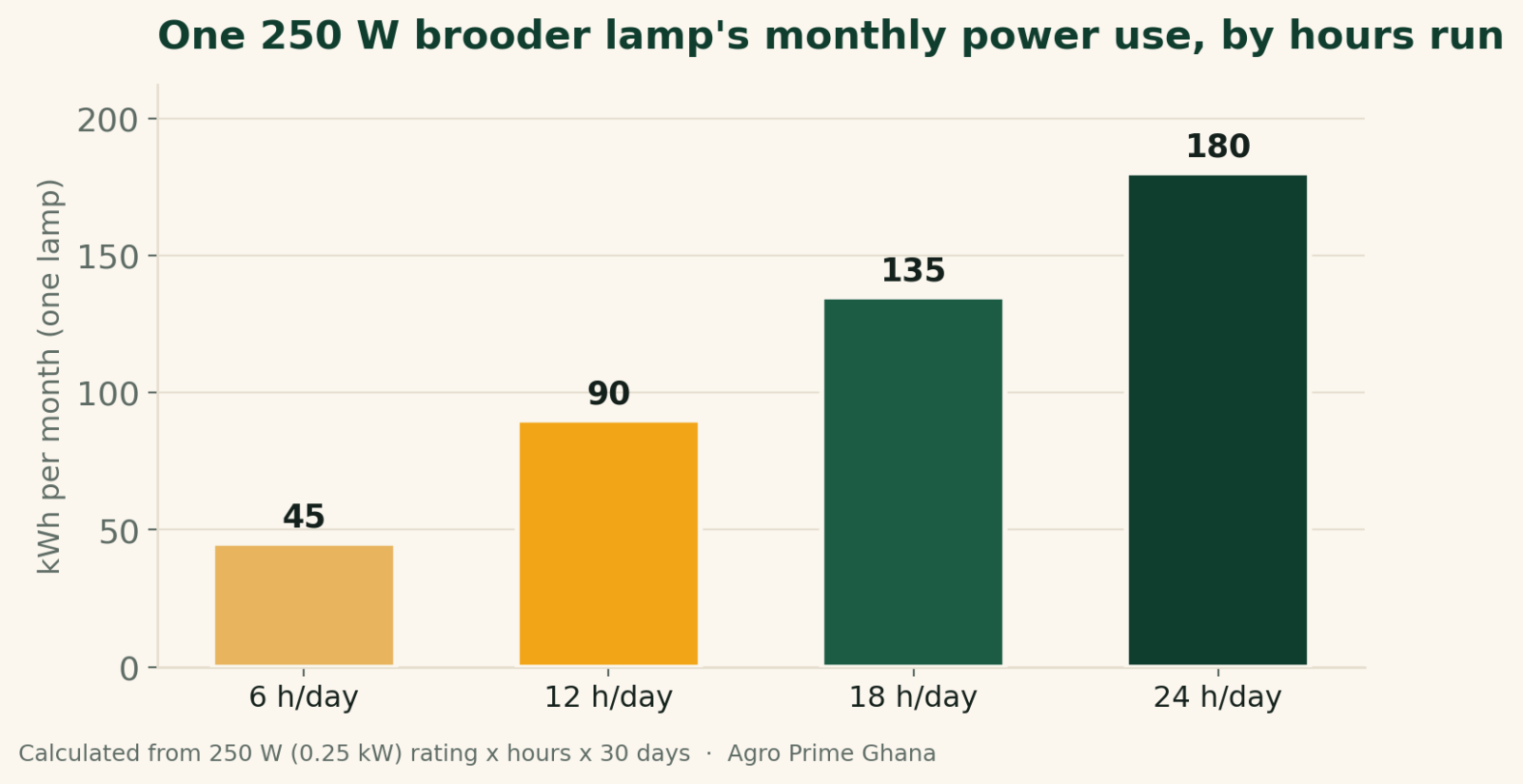
Electricity is one of the few farm costs you can cut sharply without hurting your birds — if you understand where it goes. On a Ghanaian poultry farm the biggest power users are, in rough order, brooding heat, ventilation fans, lighting, water pumping and (for hatcheries) incubation. A single 250-watt brooder heat lamp left running around the clock can burn about 6 kWh a day — roughly 180 kWh a month for one lamp — so a brooding house full of them is often the largest line on the bill. This guide explains what actually uses power on a poultry farm, how to estimate your monthly bill under Ghana's 2026 tariffs, and the efficiency and solar changes that genuinely lower it.
Written by the Agro Prime Ghana poultry team and reviewed against current industry references and Ghana's PURC electricity tariff decisions. Last updated September 2026.
Key takeaways
The main power users on a poultry farm are brooding heat, fans, lights, water pumps and incubators. A 250 W brooder lamp run 24/7 uses about 6 kWh/day (~180 kWh/month), so brooding dominates the bill in the first weeks. Estimate any device's cost as power (kW) × hours × tariff. Ghana's PURC raised electricity tariffs by 3.49% effective 1 July 2026, and the non-residential (commercial) energy charge sits at roughly GH¢1.80–2.20 per kWh depending on your consumption band — check your own ECG bill, as rates are reviewed quarterly. The biggest savings come from efficient brooding (right heat, insulation, LED lighting), right-sized pumps and fans, and solar for pumping and lighting — which also protects you from grid outages.
What actually uses electricity on a poultry farm?
Before you can cut a bill you have to know what is spending it, and on a poultry farm the loads fall into a handful of clear categories. Ranked by how much they typically cost over a production cycle:
- Brooding heat. Keeping day-old chicks warm is by far the most energy-hungry job on many farms, because heat lamps or heaters run long hours during the first weeks of life. This is where the biggest, most controllable spend sits.
- Ventilation fans. In closed or curtain houses with mechanical ventilation, fans can run many hours a day, especially in hot weather when they double as cooling. Larger fans drawing several hundred watts each add up fast.
- Lighting. Layer and breeder houses run controlled lighting programmes, and lights on for 14–16 hours a day across several houses is a steady, ongoing load — one that switching to LED cuts dramatically.
- Water pumping. A borehole's submersible pump uses power every time it fills the tanks. Its share of the bill depends on your water volume, pump size and how efficiently it runs — see our guide to borehole water.
- Incubation (hatcheries). Incubators and hatchers run continuously for weeks, holding precise temperature and humidity, so a hatchery's incubation load is a large, round-the-clock draw — covered in our incubator guide.
- Everything else. Feed mills and mixers, egg-handling equipment, office and security lighting, refrigeration and fencing add smaller amounts.
Knowing this order tells you where to focus: chasing a few watts on office lights while a brooding house runs inefficient heat lamps around the clock is effort spent in the wrong place.
Why brooding heat dominates the early bill
Brooding is the single biggest electricity story on most poultry farms, and the arithmetic is stark. A standard infrared brooder heat lamp is typically 250 watts, and in the first days chicks need heat around the clock. Run one 250 W lamp for 24 hours and it uses 0.25 kW × 24 h = 6 kWh a day — about 180 kWh over a month for a single lamp. A brooding area warmed by a bank of such lamps can therefore run up a serious bill before the birds have eaten much feed at all. This is why efficient brooding is not just about chick survival; it is one of the largest energy decisions you make.
The good news is that brooding energy is highly controllable. Because the goal is to keep chicks at the right temperature — not simply to burn watts — anything that holds heat in and lets you use less of it saves money directly: good insulation and draught-proofing, a well-set brooder guard, the correct number and height of lamps for the number of chicks, and turning heat down on schedule as the chicks feather and the weather allows. Farms that brood well use markedly less energy than farms that leave lamps blazing "to be safe." Getting this balance right is the heart of good brooding practice, and for farms with unreliable power it is worth reading alongside brooding without electricity.
How to estimate your electricity bill
Estimating any device's cost uses one simple formula, and once you can apply it you can budget the whole farm:
Energy cost = power (kW) × hours run × tariff (GH¢ per kWh)
Power comes from the device's rating (a 250 W lamp is 0.25 kW; a 750 W pump is 0.75 kW). Hours is how long it runs in the period. Tariff is your ECG rate per kWh. Work through each major device, add them up, and you have a defensible monthly estimate. For example, ten 250 W brooder lamps running 24 hours use 10 × 0.25 × 24 = 60 kWh a day; over a 30-day brooding month that is 1,800 kWh, and at a non-residential rate of around GH¢2 per kWh that is roughly GH¢3,600 for brooding heat alone in that month. The table below shows the daily energy of common loads so you can build your own estimate.
| Device | Typical power | Hours/day | Energy/day | Notes |
|---|---|---|---|---|
| Brooder heat lamp | 250 W (0.25 kW) | 24 | ~6 kWh | The big early load; multiply by number of lamps |
| Small chick heater (few chicks) | 60–80 W | 24 | ~1.4–1.9 kWh | Lower-wattage option for small numbers |
| Ventilation fan (each) | 0.3–0.75 kW | 8–18 | ~2.4–13 kWh | Runs longest in hot weather; several per house |
| House lighting (LED) | Low per fitting | 14–16 | Small | LEDs cut this load sharply vs incandescent |
| Submersible water pump | 0.5–1.5 kW | Varies | Depends on volume | Cost tracks your daily water volume |
| Incubator (hatchery) | Varies by size | 24 | Continuous | Round-the-clock for the full set-and-hatch cycle |
These are planning figures, not precise ratings — always use the actual wattage printed on your own equipment. But even rough numbers reveal the pattern: the round-the-clock loads (brooding, pumping, incubation) and the many-hour loads (fans, lights) drive the bill, so those are where efficiency pays.
Ghana's electricity tariffs: the basics
Understanding your tariff turns the formula above into real cedis. In Ghana, electricity prices are set by the Public Utilities Regulatory Commission (PURC) and reviewed regularly, with quarterly adjustments for the exchange rate, inflation, fuel costs and the generation mix. In its mid-2026 review, PURC increased electricity tariffs by 3.49% across all customer categories, effective 1 July 2026, and water tariffs by 0.85%. That "across the board" point matters: as a commercial farm you are billed on a non-residential (or, if large, a special-load) tariff, and these move with each review.
A working poultry farm is almost always billed as a non-residential customer, not on the cheaper residential lifeline rate. Under the 2026 tariffs the non-residential energy charge sits in the region of GH¢1.80–2.20 per kWh depending on your consumption band, with larger operations on special-load tariffs — but because rates are reviewed quarterly and depend on your exact band and any service charges, the reliable figure is the one on your own ECG bill. Read your bill, find your energy charge per kWh, and use that number in the cost formula. Two practical points follow: first, higher consumption bands are charged at higher rates, so cutting total usage can also move you into a cheaper band; and second, tariffs have trended upward, so efficiency investments that look marginal today tend to look better each year.
Field note: read your bill, don't guess your tariff
The most common mistake we see is farmers budgeting power off a half-remembered "unit price" that is often a residential figure, then being shocked by the commercial bill. Your ECG bill breaks down the energy charge per kWh, the consumption band you fall in, and any service or fixed charges — and that is the only tariff that matters for your farm. Photograph a few months' bills, note the kWh used and the charge, and you will see both your true cost per unit and your usage trend. That single habit turns electricity from a mystery into a line you can plan and cut, and it tells you quickly whether a solar or efficiency investment will pay back.
Cutting the bill: efficiency first
The cheapest kilowatt-hour is the one you never use, so efficiency comes before generation. The measures that move the needle on a poultry farm, roughly in order of impact:
- Brood efficiently. Since brooding heat is the biggest early load, this is where the biggest savings live: insulate and draught-proof the brooding area so heat stays in, use the right number and height of lamps for the chick count, and step heat down on schedule rather than leaving lamps on "to be safe." Consider more efficient heat sources where practical.
- Switch all lighting to LED. LEDs use a fraction of the power of incandescent bulbs for the same light, and layer and breeder houses run lights many hours a day — so the saving compounds across every house, every day. This is often the fastest simple payback on the farm.
- Right-size and maintain pumps and fans. An oversized or worn pump wastes energy every time it runs; a fan clogged with dust and feathers works harder for less airflow. Size pumps to the job (see sizing equipment correctly), keep fans and pumps clean and serviced, and use ample water storage so the pump runs in efficient, planned cycles rather than short, frequent bursts.
- Run heavy loads off-peak where you can. Pumping to fill tanks and other non-urgent loads can be scheduled to avoid clustering all demand at once, which also eases pressure on any generator or solar system.
- Maintain the whole electrical system. Loose connections, undersized cabling and failing equipment waste energy and create fire and safety risks. A well-maintained system simply uses less.
Solar: real savings and outage protection
Once you have cut waste, solar is the change that most transforms a Ghanaian poultry farm's energy picture — because it attacks the two problems at once: a high, rising grid bill and unreliable supply. Solar suits some loads better than others, so target it well:
- Solar water pumping. This is the standout win. A solar-powered borehole pump filling an elevated tank during daylight removes the pumping electricity bill entirely and keeps water flowing during outages — and water demand peaks in the sunny afternoon heat, exactly when solar is strongest. Paired with generous storage, it is one of the most cost-effective solar investments on a farm.
- Solar lighting. Powering LED house lighting from solar (with batteries for the pre-dawn and evening hours of a lighting programme) cuts a steady daily load and keeps light programmes running through grid cuts, which protects lay.
- Solar or hybrid for critical loads. For the loads where an outage is dangerous — brooding heat, incubation, ventilation in a closed house — solar with battery storage, or a solar-and-generator hybrid, provides both savings and the backup that keeps birds alive. This dovetails with a proper backup-power plan.
Solar is a capital investment, so judge it the same way you judge a borehole: work out the load it will offset, the grid cost it removes each month (using your real tariff), and the outage losses it prevents, then compare that against the system cost. On a commercial farm carrying a rising non-residential bill and real outage risk, well-targeted solar — especially for pumping and lighting — increasingly pays for itself and keeps paying as tariffs rise.
Plan power and water together when you set up
Electricity, water and backup power are one system on a poultry farm, and the cheapest time to get them right is at the setup stage — sizing the pump, planning storage, choosing LED lighting and deciding where solar fits, before the houses are built and the birds arrive. Agro Prime Ghana advises on farm setup, including energy and water planning, and supplies the healthy day-old chicks (broilers and layers), point-of-lay pullets and quality feed to stock the farm once it is running efficiently. For a setup consult that includes a realistic power and water plan, message us on WhatsApp at +233 24 915 1503 or book a farm visit.
The bottom line on cutting electricity costs
Electricity is a big, controllable cost on a poultry farm, and the way to master it is to know where it goes, measure it, and cut it in the right order. Brooding heat, fans, lighting, pumping and incubation drive the bill — with a single 250 W brooder lamp using about 6 kWh a day, brooding usually leads. Estimate any load with power × hours × tariff, and use the real non-residential rate from your own ECG bill, remembering PURC reviews tariffs quarterly and raised them 3.49% in mid-2026. Then attack the bill: brood efficiently, switch to LED, right-size and maintain pumps and fans, and bring in solar for pumping and lighting — which cuts cost and shields you from outages at the same time. Plan power and water together from the start, and electricity becomes a line you control rather than one that controls you.
Frequently asked questions
What uses the most electricity on a poultry farm?
How do I estimate my poultry farm's electricity bill?
What is the electricity tariff for a poultry farm in Ghana?
How much does a brooder heat lamp cost to run?
Can solar power save money on a poultry farm?
What is the cheapest way to lower a poultry farm's power bill?
Does switching to LED lighting really make a difference?
How do water pumping and storage affect my electricity cost?
Sources & further reading
- Citi Newsroom / PURC — Electricity tariffs up 3.49%, water 0.85% effective 1 July 2026 (PURC tariff review, across all customer categories).
- Electricity Company of Ghana — Current Tariff (billing bands and the PURC-approved rates that appear on your bill).
- Public Utilities Regulatory Commission (PURC), Ghana — tariff decisions and reckoner (how tariffs are set and reviewed).
- Agro Prime Ghana guides: brooding day-old chicks, borehole water, water storage and backup power.
About Agro Prime Ghana
Agro Prime Ghana Limited runs a poultry hatchery and mixed agribusiness in Kasoa, supplying day-old chicks and working with poultry keepers across the country. We advise on farm setup — including energy, water and backup-power planning — and supply healthy day-old chicks (broilers and layers), point-of-lay pullets, quality feed and hands-on farm support nationwide. This article is general educational information, not a substitute for professional electrical-engineering advice, and tariff figures change with each PURC review — always confirm against your current ECG bill. Setting up or scaling a farm? Book a visit or message us on WhatsApp (+233 24 915 1503) for a setup consult and to order chicks, feed or advice.