
The hatch window is the span of time over which the chicks in one setting emerge from their shells, and in a well-run hatch it should be tight — roughly a single day, not two or three. For chicken eggs, hatching happens on day 21, and you want the great majority of a batch to pip and break out within about a 24-hour band, with all chicks out by the end of that day. When the window instead stretches wide — some chicks appearing far too early on day 19 or 20, stragglers still struggling on day 22 — that spread is not just untidy. It is a message. It usually tells you the eggs ran too hot or too cold, or were uneven from the start, and it is one of the most useful diagnostic signals a small hatchery in Ghana has. This guide explains what a normal hatch window looks like, what a too-early or too-wide window is telling you, and how to time your pull so chicks leave the machine strong.
Written by the Agro Prime Ghana hatchery team and reviewed against current industry references (Mississippi State University Extension, Cobb-Vantress and The Poultry Site). Last updated September 2026.
Key takeaways
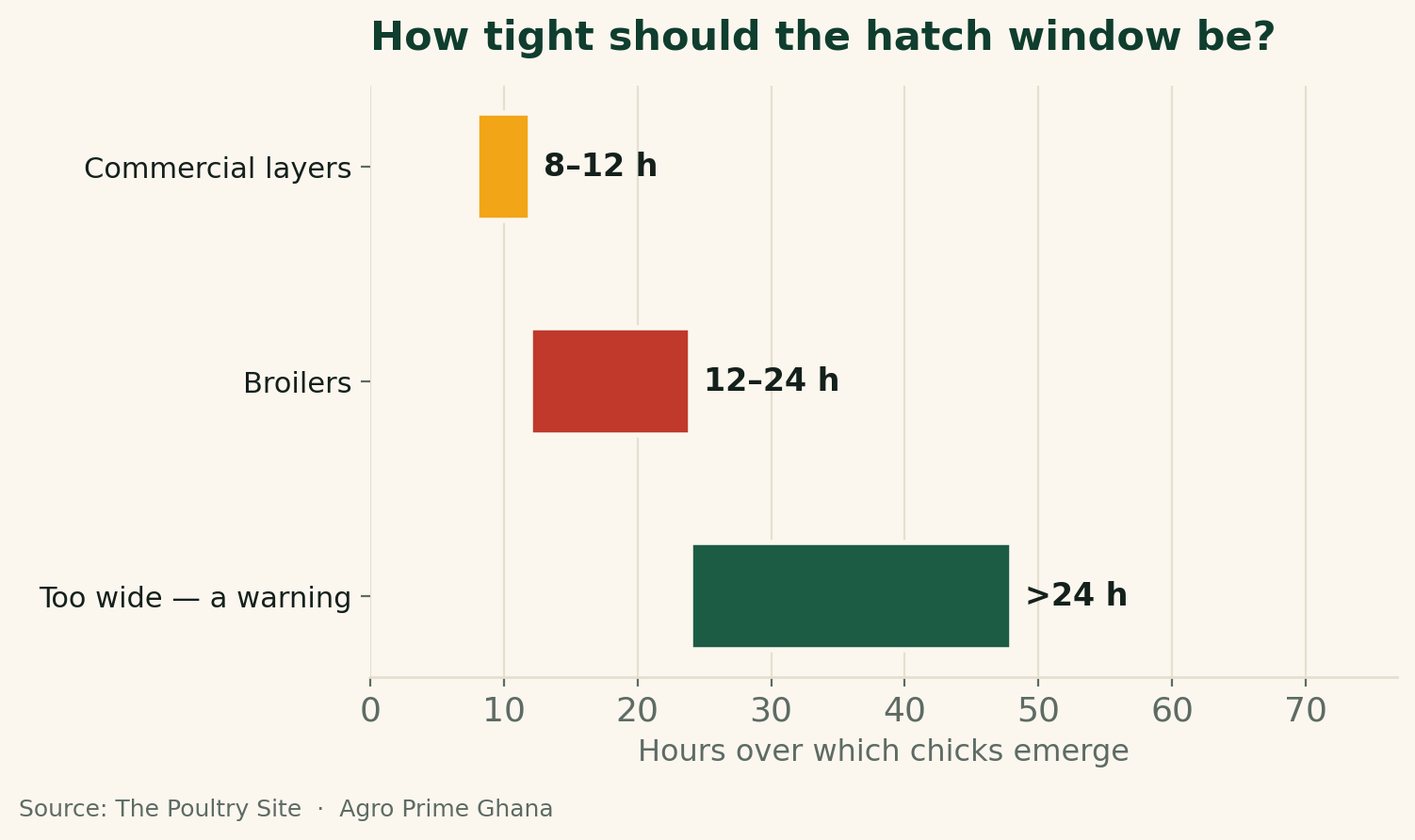
The hatch window is the time from the first chick out to the last. A good window is tight and centred on day 21 — commercial layers hatch over roughly 8–12 hours and broilers over about 12–24 hours, and it should not exceed 24 hours. Chicks should all be out by the end of the 21st day; birds that hatch after the 22nd day are usually weak. An early, front-loaded hatch (chicks out well before day 21, with large navels and dehydration) points to eggs run too hot. A late or badly spread-out hatch points to eggs run too cold or uneven temperature. Temperature is the single biggest driver of hatch timing, so the window is really a thermometer for your incubation. Pull chicks when about 90–95% are out, dry and fluffed — not at the first crack, and not so late they dehydrate.
What exactly is the hatch window?
The hatch window is the length of time over which a batch of eggs actually hatches — measured from the moment the first chick breaks free to the moment the last viable chick does. It is not the same as the incubation period. The incubation period for chicken eggs is a fixed biological clock of about 21 days; the hatch window is the spread around that point. Two hatcheries can both "hatch on day 21" and yet be worlds apart: one has every chick emerge within a neat 18-hour band, while the other has chicks trickling out over three days. That spread is the window, and its width tells you how uniform the eggs and the machine were.
According to Mississippi State University Extension, all chicks should be out of their shells by the end of the 21st day, and chicks that hatch after the 22nd day "are not usually healthy and vigorous." That single sentence captures why the window matters: birds at the extreme early and late edges of a wide window are the ones that tend to be weak, small, or slow to thrive. A tight window is not cosmetic — it is a flock of chicks that are all roughly the same physiological age when they meet feed and water for the first time.
Why the width of the window matters in Ghana
A tight hatch window matters most because of what happens after the hatch. In any hatchery — ours included — chicks are held in the machine and then in the delivery box for some hours before they reach a farm and their first feed. The Poultry Site notes that delaying access to feed after hatching depresses the relative growth rate of chicks, and that this effect falls differently on early-hatched versus late-hatched birds. Think through what that means for a wide window: a chick that hatched on the morning of day 20 has already been sitting, burning its yolk reserve, for a day and a half before a chick from the same batch that only emerges late on day 21. By the time they both reach feed, the early bird is dehydrated and past its best, and the late bird is only just ready. You cannot serve both well. A tight window collapses that gap so every chick meets feed at close to the same point in its short post-hatch clock.
This is sharpened by Ghanaian conditions. Deliveries here often involve real distances and heat — chicks moving from Kasoa out to farms across Greater Accra, the Central Region and beyond, sometimes on hot afternoons. Every extra hour a chick spends hatched-but-unfed in a warm box is an hour of yolk and moisture spent. A hatch spread over two days effectively widens the age gap in your delivery box before the journey even begins, and it is the oldest, earliest-hatched chicks that pay for it on a long, hot trip. Managing the window is part of the same discipline as good egg and chick handling — it is about not wasting the narrow head start a day-old chick is born with.
What a tight, normal window looks like
Uniformity is the goal, and the numbers are worth committing to memory. The Poultry Site reports that with good management a hatch window of 12 to 24 hours is achievable for broilers, while commercial layers are usually tighter still, at just 8 to 12 hours, and that in a well-managed hatch the window "should not exceed 24 hours." Small-scale and home incubators rarely match a commercial single-stage machine, so on a tabletop or cabinet incubator in Ghana a realistic, good result is most chicks out within roughly a day, centred on day 21, with only a few outliers. The table below gives you the benchmarks to judge your own hatch against.
| What you observe | What a good hatch looks like | What it usually signals if it drifts |
|---|---|---|
| First chicks pip / hatch | Late day 20 to early day 21 | Well before day 20 = eggs too hot; after day 21 = eggs too cold |
| Bulk of the batch out | Within an 8–24 hour band on day 21 | Spread over 2–3 days = uneven or fluctuating temperature |
| All viable chicks out by | End of day 21 | Stragglers on day 22–23 = cold spots, big eggs or old eggs |
| Navel and body | Clean, healed navels; dry, fluffy chicks | Large, unhealed navels + dehydration = overheating |
What a too-early or front-loaded hatch tells you
If chicks start pouring out noticeably early — well into day 20, or even day 19 — and arrive with large, poorly-healed navels, red hocks and a dehydrated, "hard" feel, the message is almost always the same: the eggs ran too hot. Heat speeds embryonic development, so an over-warm incubator simply runs the clock fast and delivers the hatch ahead of schedule. Mississippi State Extension is explicit that a high incubation temperature causes an early hatch, and that excessive heat is dangerous — many embryos die if held at 105°F (about 40.6°C) for just 30 minutes. Cobb-Vantress describes the same pattern from the hatcher's side: overheating in the 24 hours after transfer leads to an early hatch, large navel buttons, dehydrated chicks and elevated mortality. So an early, front-loaded window is not a lucky, fast hatch — it is a warning that your machine, or a hot corner of it, is cooking the embryos. The chicks that survive it are the small, hard, big-navelled ones that struggle in the brooder.
The practical response is to verify and lower your running temperature. A forced-air incubator should sit near 100°F (37.8°C) and a still-air machine nearer 102°F (38.9°C) at egg height, per Mississippi State Extension, with the hatching phase run about a degree cooler. Check your thermometer against a known-good reference, look for hot spots, and make sure the room the incubator sits in is not itself pushing the machine up on a hot Ghanaian afternoon. Chronic early hatches are one of the classic threads to pull on in any incubation troubleshooting exercise.
Field note: read the navels, not just the calendar
On our hatchery floor the hatch window and the look of the chicks are read together, because one explains the other. When a batch comes early and the chicks show big, unhealed navels and dry, reddish shanks, we treat that as a temperature problem to fix on the next set, not a one-off. When a batch is merely a little early but the chicks are clean-navelled, fluffy and vigorous, that is far less worrying. The width and position of the window points you to the cause; the condition of the chicks confirms it. Handling a suspect batch also overlaps with knowing what a healthy day-old chick should look like in the first place.
What a late or too-wide hatch tells you
The opposite pattern — a hatch that starts late, drags on, and leaves stragglers still working on day 22 or 23 — usually means the eggs ran too cold, or the temperature was uneven. Cold slows development, so a low average temperature pushes the whole hatch back, and Mississippi State Extension notes that incubating eggs at around 90°F (32°C) for three to four hours will slow development. But the more revealing signal is not just lateness — it is spread. A window stretched across two or three days points to temperature that was uneven across the machine: warmer eggs on one shelf or near the element hatched on time, cooler eggs in a corner or a poorly-circulated pocket lagged behind. Cobb-Vantress links cooler hatcher conditions to small navel buttons and extended hatch windows, and The Poultry Site is blunt that temperature is "the most crucial factor for the rate of embryonic development." A wide window is, in effect, a map of the temperature differences inside your incubator.
Not every wide window is the machine's fault, though, and it pays to rule out the eggs themselves. A spread-out hatch can also come from mixing egg sizes and ages: large eggs and older stored eggs both take longer to hatch, so setting a jumble of small pullet eggs, big double-yolkers and week-old and three-week-old eggs together will naturally widen the window even in a perfect incubator. That is one more reason the discipline starts before the machine — with selecting and grading the eggs you set. Fix the obvious temperature unevenness first (circulation, hot and cold spots, a reliable thermometer), then tighten up egg selection, and the window narrows.
When to pull the chicks — getting the timing right
Pulling — taking chicks out of the machine — is where a good window can still be spoiled by bad timing. Pull too early and you interrupt the tail of the hatch, chilling and stressing chicks that are still emerging and leaving late eggs to fail. Pull too late and the first-out chicks, which have been in a warm machine for many hours, dehydrate and burn through the yolk reserve they need for the journey and the first feed. The judgement is about the batch as a whole: wait until roughly 90 to 95% of the chicks are out, dry and fluffed up, and moving around actively, then pull. A handful of genuine late stragglers is not worth sacrificing the bulk of a strong, dried-off batch for.
A few practical habits keep pull timing clean. Resist the urge to open the machine repeatedly during the hatch to "check" — every opening drops the humidity that the pipping chicks need and can shrink-wrap membranes onto the ones still inside. Do not help early: a chick that cannot get out on its own is usually telling you something (often a temperature or humidity problem earlier in the set), and assisted chicks are frequently the weak ones. And once chicks are pulled, get them promptly into a properly prepared brooder — the head start you protected by managing the window is only banked if the birds meet warmth, water and feed soon after. That hand-off is the subject of our guide to brooding day-old chicks.
Get strong, uniform day-old chicks from a managed hatch
Timing a tight hatch window takes a reliable machine, careful egg selection and daily attention — which is exactly what a working hatchery is built to do. If you would rather skip the incubation risk and simply receive healthy, evenly-hatched, vigorous day-old chicks, that is what we supply. Agro Prime Ghana runs its own hatchery in Kasoa and sells broiler and layer day-old chicks from managed hatches, along with hatching eggs and hands-on incubation advice if you run your own incubator. Tell us what you need and we will help you plan it. Message us on WhatsApp at +233 24 915 1503 or book a visit to the hatchery.
Field note: log first-pip and pull times for every set
The cheapest hatchery upgrade we know is a notebook. For each batch we jot the date and time the first egg pips, the time the bulk are out, and the time we pull — plus a quick note on chick quality. Over a few sets those numbers turn vague impressions into a real pattern: "our machine consistently pips half a day early and chicks have big navels" is an actionable temperature problem, where "the hatch felt a bit early" is not. Kept alongside your set dates and egg sources, that log is the backbone of any serious incubator temperature and humidity tuning.
The bottom line on the hatch window
The hatch window is one of the most honest signals your incubation gives you. A good hatch is tight and lands on day 21 — layers over about 8 to 12 hours, broilers over 12 to 24, everyone out by the end of the day and pulled when 90 to 95% are dry and fluffed. When that window drifts, listen to it: an early, front-loaded hatch with big navels and dehydration means the eggs ran too hot, while a late, spread-out hatch with day-22 stragglers means they ran too cold or unevenly — or that you set a mixture of egg sizes and ages. Fix the temperature, tighten your egg selection, resist opening the machine, and pull at the right moment, and the window narrows on its own. Do that, and you are not just hatching more chicks; you are hatching a batch that is uniform, vigorous and ready to grow.
Frequently asked questions
What is the hatch window in incubation?
How many days does it take chicken eggs to hatch?
Why are my chicks hatching too early?
What does a late or spread-out hatch mean?
When should I take chicks out of the incubator?
Is it bad if my hatch window is more than 24 hours?
Should I help a chick that is struggling to hatch?
Does egg size affect the hatch window?
Sources & further reading
- Mississippi State University Extension — Hatching Quality Chicks (21-day incubation, all chicks out by day 21, day-22 chicks not vigorous, temperature effects on hatch timing, incubation temperatures).
- The Poultry Site — Managing the Hatch Window (8–12 h layer and 12–24 h broiler windows, ≤24 h target, temperature as the key driver, delayed feed access).
- Cobb-Vantress — Managing the Hatcher Environment (overheating → early hatch, large navels, dehydration; cooling → small navels, extended window).
- Agro Prime Ghana guides: incubator temperature & humidity, incubation troubleshooting, and brooding day-old chicks.
About Agro Prime Ghana
Agro Prime Ghana Limited runs a poultry hatchery and mixed agribusiness in Kasoa, hatching and supplying day-old chicks and supporting poultry keepers across the country. These guides combine hands-on hatchery experience with current industry references. We supply healthy day-old chicks (broilers & layers), point-of-lay pullets, quality feed, hatching eggs and hands-on farm support across Ghana. This article is general educational information, not a substitute for professional veterinary or hatchery advice. Ready to start or expand? Book a visit or message us on WhatsApp (+233 24 915 1503) to order chicks, hatching eggs or advice.