
Every unhatched egg in your tray is a written report on what went wrong — if you know how to read it. Breaking out the eggs that failed to hatch and sorting them by when the embryo died (early, mid or late) is the single most powerful troubleshooting tool a hatchery has, because each stage of death points to a different cause: temperature, humidity, turning, ventilation, nutrition, contamination or malposition. A run of clear, never-developed eggs means a fertility or storage problem; a run of fully-formed chicks dead in the shell after day 17 usually means humidity, ventilation or heat went wrong at the end. This guide shows you how to perform a breakout analysis on your own bench, what the normal proportions look like, and how to translate each pattern into the specific fix under Ghanaian conditions.
Written by the Agro Prime Ghana hatchery team and reviewed against current hatchery references (Aviagen breakout guidance, The Poultry Site and Royal Pas Reform). Last updated September 2026.
Key takeaways
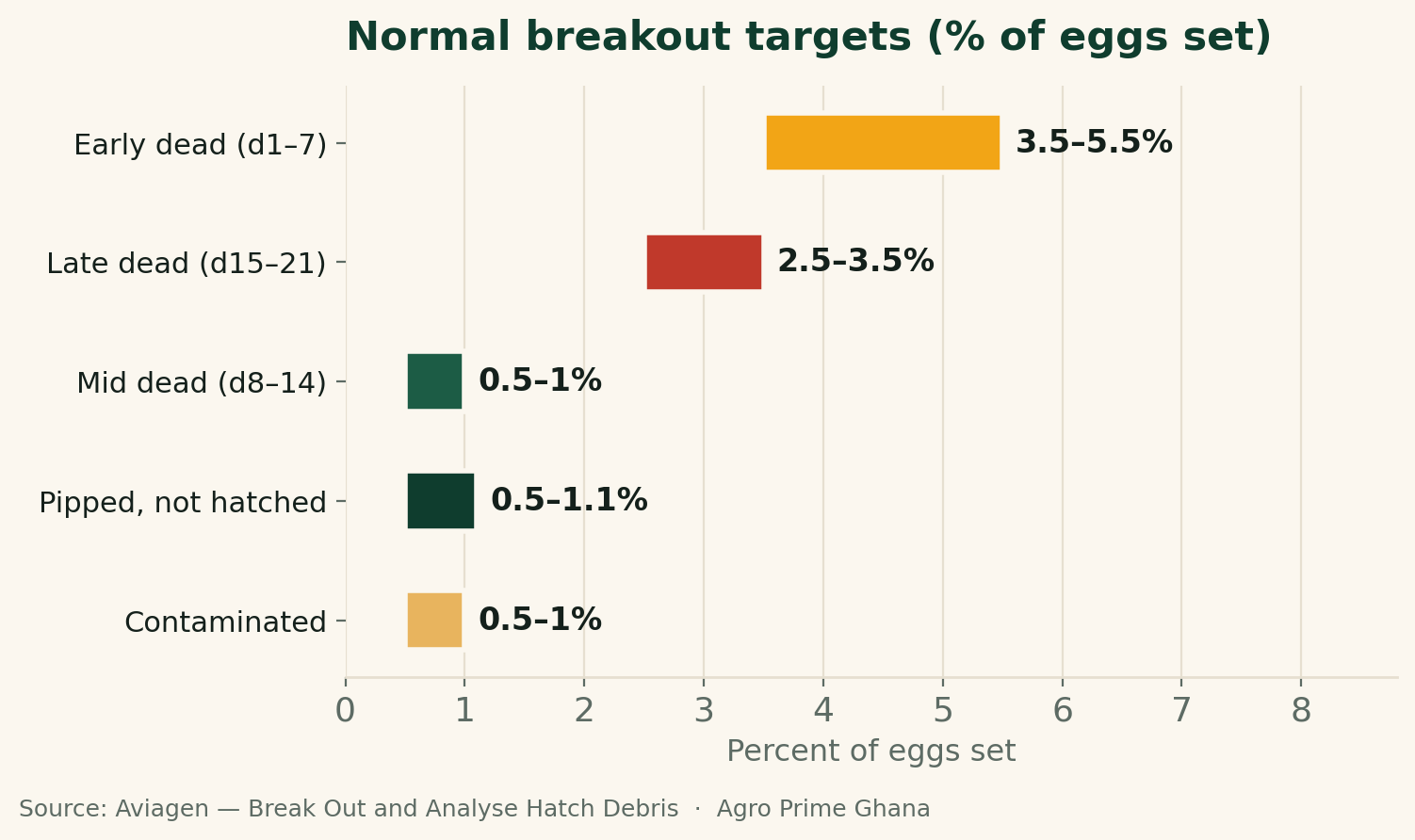
Breakout analysis means opening unhatched eggs and classifying each by the stage the embryo reached: infertile, early dead (days 1–7), mid dead (8–14), late dead / dead-in-shell (15–21), pipped-not-hatched, contaminated and malpositioned. In a healthy hatch, mortality splits roughly 50:50 between the first and last week. Typical targets from Aviagen: early dead about 3.5–5.5%, mid dead 0.5–1%, late dead 2.5–3.5%, pipped-not-hatched 0.5–1.1%, contaminated 0.5–1%. A spike in any one category points to a specific cause — early death to storage/fertility/temperature, late death to humidity, ventilation and end-of-cycle heat, contamination to dirty eggs and poor hygiene. The pattern tells you what to fix.
What is dead-in-shell and why does breakout analysis matter?
"Dead-in-shell" refers to embryos that developed but died before hatching — most strictly, those that died in the last stage of incubation after the yolk sac begins retracting into the body, from about day 17 onward, as Royal Pas Reform defines it. In everyday hatchery use, though, the phrase covers all the fully-formed chicks that failed to break out, and the job of breakout analysis is to work out when each embryo died, because the timing is the diagnosis. An egg that never developed is telling you about fertility or egg handling; an embryo that died in the first week is telling you about storage or early incubation temperature; a feathered chick dead in the shell at day 19 is telling you about the humidity, ventilation and heat of the final days. Without breakout, a poor hatch is a mystery. With it, the tray becomes a set of instructions.
This matters commercially because hatchability is money. Every fertile egg that fails to hatch is a chick you paid to set, incubate and lose. A hatch of fertile (HOF) around 90–96% is considered good, and the way you climb toward that number is not guesswork — it is reading your failures systematically, set after set, and fixing the specific cause each pattern reveals. On our floor the discipline of breaking out unhatched eggs after every batch has done more to lift hatchability than any single equipment upgrade, because it turns vague disappointment into a named, fixable problem.
How do I actually perform a breakout?
A breakout needs nothing more than a bench, gloves, a knife or scissors, and a strong stomach — it is not pleasant, but it is quick once you have done a few. Work through the unhatched eggs one at a time. Open each carefully at the wide end and look: is there any sign of development at all? A clear egg with an intact yolk and no blood is either infertile or a very early death (the two look alike after incubation and are hard to separate by eye). If there is a small embryo or a blood ring — a ring of blood in the egg where a young embryo died and the blood settled — that is an early death. Larger embryos with an egg tooth but no feathers are mid deaths; well-feathered chicks that fill the shell are late deaths. Note whether the chick had pipped internally (beak into the air cell) or externally (through the shell), whether the yolk was drawn in or still external, and whether anything smells rotten or looks discoloured, which signals contamination.
Classify each egg into a category and tally them, ideally as a percentage of total eggs set. Aviagen's breakout guide uses the egg tooth and feathering as the key landmarks: early deads (days 1–7) end where the egg tooth appears, mid deads (8–14) have an egg tooth but no obvious feathers, and late deads (15–21) are well feathered and fill the shell. Do this for every set and keep the numbers — one breakout is a snapshot, but a run of them is a trend you can act on. Good hatchery record keeping is what turns individual breakouts into real diagnosis.
What do normal proportions look like?
In a healthy hatch, embryo mortality is not spread evenly — it clusters into two natural peaks, one in the first week and one in the last, with a quiet middle. The Poultry Site notes that for a strong hatch, mortality divides roughly 50:50 between the first and last week of incubation, with very little death in the mid period. This U-shaped pattern is normal biology: the first week is when the vital organs form and vulnerable embryos are lost, and the last week is when the chick makes the huge physiological switch to breathing air and hatching. Deaths in the quiet middle (days 8–14) are unusual and, when they spike, point specifically to problems like overheating or nutritional deficiency.
The table below gives the working target percentages Aviagen publishes for each category. Treat them as benchmarks, not laws — flock age shifts them, and older breeder flocks naturally run higher early and late mortality — but if one of your categories is running well above these, that is your signal to investigate that specific cause.
| Category | Stage / landmark | Typical target | Points mainly at |
|---|---|---|---|
| Early dead | Days 1–7 (up to egg-tooth) | ~3.5–5.5% | Egg storage, early temperature, fertility, flock age |
| Mid dead | Days 8–14 (egg tooth, no feathers) | ~0.5–1% | Overheating, nutritional deficiency, contamination |
| Late dead / dead-in-shell | Days 15–21 (feathered, fills shell) | ~2.5–3.5% | Humidity, ventilation, end-of-cycle heat, turning, malposition |
| Pipped, not hatched | External pip ~day 20 | ~0.5–1.1% | Low hatcher humidity (shrink-wrap), poor ventilation, turning |
| Contaminated / rotten | Any stage; off-smell, discoloured | ~0.5–1% | Dirty/floor eggs, poor hygiene, cracked shells |
Early deaths: what days 1–7 are telling you
A spike in early deaths — embryos lost in the first week, often showing as blood rings — usually points backward to what happened before the eggs went into the machine, or to the first days of incubation. The most common Ghanaian cause is egg storage: hatching eggs held too long, or stored too warm in our climate, lose viability, and the embryos that do start are weak and die early. Eggs should be stored cool and set promptly; our guide on storing hatching eggs before setting covers the temperatures and holding times. Other early-death drivers are a machine that comes up to temperature too slowly, rough handling or jarring of eggs in transit, condensation on eggs ("sweating") when cold-stored eggs meet warm humid air, and — importantly — breeder flock problems that produce weak or nutritionally-deficient embryos. Because true infertiles and early deads look alike after incubation, a high "clear" count is worth investigating for both fertility (rooster ratio, flock age) and early death.
Mid deaths: the quiet middle that should stay quiet
Deaths in days 8–14 should be rare, so when this category climbs it is a specific red flag — most often overheating or a nutritional deficiency in the breeder ration. By the second week the embryo is generating its own metabolic heat, and a machine running even slightly too hot, or with poor airflow that lets heat pool, pushes embryo temperature past what it can survive. This is a very real risk in Ghana, where high ambient temperature in the incubator room stacks on top of the embryos' own heat. Contamination can also kill in this window, as bacteria that entered through a dirty or cracked shell multiply and overwhelm the embryo. A mid-death spike is your cue to check your temperature calibration and airflow (see incubator ventilation) and to look hard at the breeder feed.
Field note: read the whole tray, not one dramatic egg
The mistake we see most often is a keeper who opens one rotten, exploding egg, recoils, and decides the whole hatch was "infection." One contaminated egg is normal; a pattern is the diagnosis. What we do is break out every unhatched egg, tally the categories, and look at where the weight of the losses sits. Ten clear eggs and three blood rings is a storage-and-fertility conversation. Twelve feathered chicks dead in the shell, most pipped internally, is a humidity-and-ventilation conversation. The single ugliest egg on the bench is rarely the one that tells you what to change — the count is.
Late deaths and dead-in-shell: the end-of-cycle story
Late death — a well-feathered chick that filled the shell and then died in the last week, with or without pipping — is the classic "dead-in-shell" and the most information-rich category, because it points squarely at the final days of incubation. The leading causes are humidity and ventilation. If the eggs did not lose enough moisture through incubation (humidity too high, target is 11–13% weight loss over the first 18 days), the chick is oversized and can effectively drown at internal pip, unable to make the switch to air breathing. If ventilation was poor and CO2 built up, fully-formed embryos suffocate late — one of the most common reasons for feathered dead-in-shell with no other explanation. End-of-cycle overheating exhausts the chick during the demanding pipping phase, and inadequate turning earlier in incubation can leave the embryo poorly positioned or with a membrane it cannot free itself from.
The pipped-not-hatched sub-group deserves its own attention, because it is so often a Ghanaian humidity failure. A chick that externally pipped and then died in the shell has usually been shrink-wrapped: the hatcher humidity dropped — from a keeper opening the machine to check, or from dry harmattan air — the membrane dried and tightened around the chick, and it could not rotate to zip. Keeping the hatcher closed and humid solves most of these. If you are seeing many pipped-but-dead chicks, resist the urge to help each one and instead fix the humidity; our note on assisted hatching explains why patience beats intervention and why the real fix is upstream.
Malpositions: when the chick was in the wrong place
Some late deaths are chicks that developed normally but ended up in the wrong position to hatch. The correct hatching position is head under the right wing, pointed toward the air cell at the wide end of the egg. When you break out late deads, note the position: a chick with its head in the small end of the egg (away from the air cell), its head between its thighs, its feet over its head, or its beak over the wrong wing was malpositioned and could not pip into the air cell to breathe. A low level of malposition is normal and unavoidable, but when it exceeds about 2% of eggs it signals a management cause: eggs set small-end-up instead of large-end-up, inadequate turning (wrong angle or frequency), too little moisture loss, low late-incubation temperature, older breeder flocks, or nutritional deficiencies in the breeder ration. The pattern of malpositions, in other words, is another line in the report — one that usually reads back to how the eggs were set and turned.
Struggling to lift your hatchability? Let us look at your breakout
Reading a breakout well takes practice, and the fix is usually one or two specific settings, not a whole new machine. Agro Prime Ghana runs a working hatchery in Kasoa and helps farmers diagnose poor hatches from their own numbers — send us your category tally (how many clear, blood-ring, mid, late, pipped, rotten) and your machine's temperature and humidity, and we will help you read it. And if you would rather buy strong day-old chicks than fight a difficult hatch, that is our core business: healthy broiler and layer chicks with troubleshooting support. Message us on WhatsApp (+233 24 915 1503) or book a visit. Start with our guide to improving hatchability.
Turning a breakout into a fix: the workflow
The value of breakout analysis is entirely in acting on it, so build a simple routine. After each hatch, break out and tally every unhatched egg by category; write the percentages next to that set's records with the temperature, humidity and egg-source details. Then read the dominant category and act on its likely cause: a lot of clears means look at fertility and egg storage; a spike in early deads means egg handling, storage time and early temperature; unexpected mid deaths mean check for overheating and breeder nutrition; feathered dead-in-shell means review humidity (weight loss) and ventilation; pipped-not-hatched means protect hatcher humidity; a pile of rotten eggs means egg hygiene and sourcing; excess malpositions means egg orientation and turning. Change one thing at a time, re-run, and read the next breakout. Over a few sets this converts a stubbornly poor hatch into a steadily improving one — and it costs nothing but the discipline to look.
The bottom line on dead-in-shell analysis
A failed egg is not a dead loss — it is data. By breaking out your unhatched eggs and sorting them by when the embryo died, you turn a disappointing hatch into a specific, named problem you can fix. Remember the shape of a healthy hatch: mortality split roughly evenly between the first and last week, a quiet middle, early death around 3.5–5.5% and late death around 2.5–3.5%. When a category spikes, follow it to its cause — early death to storage, handling and fertility; mid death to overheating and nutrition; late dead-in-shell to humidity, ventilation and end-of-cycle heat; pipped-not-hatched to hatcher humidity and shrink-wrapping; rotten eggs to hygiene; malpositions to setting and turning. Do this after every batch, keep the numbers, and change one thing at a time. The hatcheries with the best hatchability are simply the ones that read their failures most honestly.
Frequently asked questions
What does dead-in-shell mean?
How do I do a breakout analysis on unhatched eggs?
What causes late dead-in-shell chicks?
What is a normal percentage of eggs to fail to hatch?
Why are so many of my chicks pipping but then dying in the shell?
How can I tell an infertile egg from an early dead one?
What is the correct hatching position, and what is a malposition?
How does breakout analysis help me improve hatchability?
Sources & further reading
- Aviagen — How To: Break Out and Analyse Hatch Debris (category day ranges, egg-tooth and feathering landmarks, target percentages, causes by category).
- The Poultry Site — Analysing embryo mortality (50:50 early/late mortality split, late dead-in-shell causes: overheating, ventilation, drowning at internal pip).
- Royal Pas Reform — Correctly interpreting 'dead in shell' (defining dead-in-shell from ~day 17 yolk-sac retraction).
- The Poultry Site — Chicken Embryo Malpositions and Deformities (normal position head-under-right-wing; malposition causes and the 2% threshold).
- Agro Prime Ghana guides: improving hatchability, storing hatching eggs, incubator ventilation, hatchery record keeping.
About Agro Prime Ghana
Agro Prime Ghana Limited runs a poultry hatchery and mixed agribusiness in Kasoa, hatching and supplying day-old chicks and supporting poultry keepers across the country. These guides combine hands-on hatchery experience with current hatchery references. This article is general educational information, not a substitute for professional advice on your specific machine or flock. We supply healthy day-old chicks (broilers & layers), point-of-lay pullets, quality feed and hands-on farm support across Ghana. Fighting a poor hatch, or would rather just buy strong chicks? Book a visit or message us on WhatsApp (+233 24 915 1503) to order chicks, feed or advice.