Beak trimming — often called debeaking — is the removal of a small part of a bird's beak, usually about a quarter to a third of it, to stop hens injuring and killing each other through feather pecking and cannibalism. It is done early in life, ideally at day-old in the hatchery, and when it is carried out correctly by trained hands it prevents far more suffering than it causes. But it is not a routine every Ghanaian keeper needs, and done badly — too late, too much, on the kitchen table with a hot cutlass — it does real harm. This guide explains why beak trimming exists, the methods used, the right age, the honest welfare picture, and the alternatives that can let a well-run flock skip it altogether.
Written by the Agro Prime Ghana hatchery team and reviewed against current industry and welfare references (poultry extension guidance, Hy-Line technical material and the American Veterinary Medical Association). Last updated September 2026.
Key takeaways
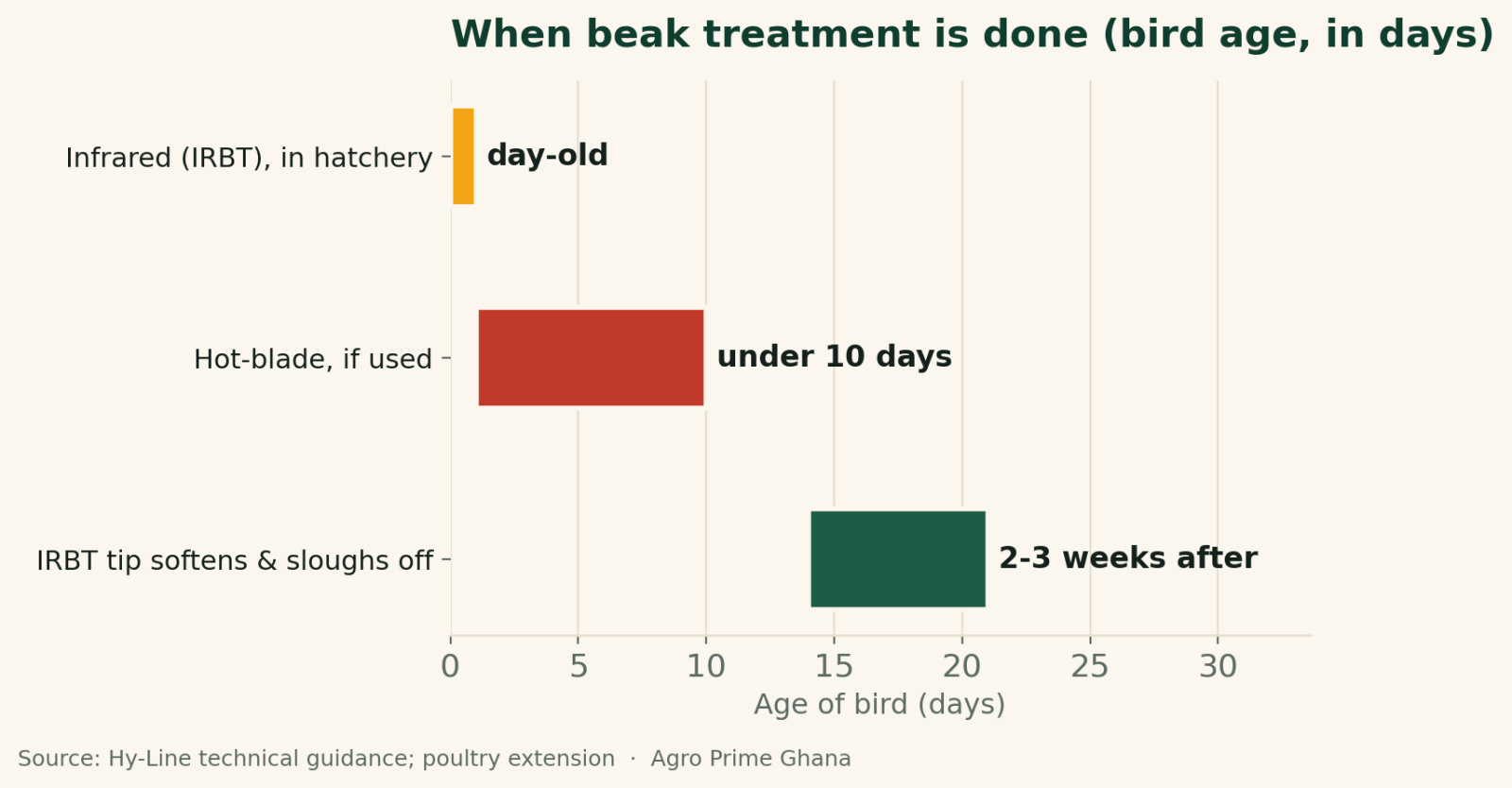
Beak trimming removes roughly one-quarter to one-third of the upper beak (or both beaks) to control feather pecking and cannibalism, which can otherwise kill many birds in a crowded flock. It is best done at day-old (1 day) in the hatchery by infrared beak treatment (IRBT), or by hot blade in birds under 10 days old — trimming young birds causes less lasting pain than trimming adults. Every method involves some pain, so it is only justified where the risk of cannibalism is real. With IRBT there is no open wound; the treated tip simply softens and sloughs off over 2–3 weeks. The long-term goal is to need it less by using calmer breeds, dim light, good space, balanced feed and enrichment. Small backyard flocks in Ghana usually do not need it at all.
What is beak trimming (debeaking)?
Beak trimming is the partial removal or blunting of a bird's beak to reduce the damage it can do when it pecks other birds. The older word "debeaking" is misleading — the aim is never to remove the whole beak, only the sharp hooked tip. According to poultry extension guidance, the procedure removes "approximately one-quarter to one-third of the upper beak or both upper and lower beaks," leaving the bird able to eat, drink and preen but blunting the point that tears skin and draws blood. It is used mainly in egg-laying strains — commercial layers and the pullets that become them — because these birds are kept in large groups for long lives, exactly the setting where pecking outbreaks spread fastest. It is far less common in broilers, which are slaughtered young before serious pecking usually develops. That distinction matters in Ghana: many small keepers raise a few dozen birds and never trim a single beak, while a 500- or 2,000-bird layer house is a different proposition entirely.
Why farmers trim beaks — and why it matters in Ghana
Farmers trim beaks to prevent feather pecking and cannibalism — behaviours that, once they start in a flock, can escalate into serious injury and death within days. The extension guidance is blunt about the trigger: trimming is used to prevent pecking and cannibalism "when management practices... are not sufficient." A single bird with a bleeding vent, a pecked comb or a cloacal prolapse attracts the attention of the whole flock; blood provokes more pecking, and a vice that began with one victim can run through a pen. In Ghanaian layer houses the classic risk factors stack up quickly: crowding to save on housing, bright open-sided pens flooded with tropical daylight, heat stress that makes birds irritable, boredom on bare floors, and feed short on protein or the amino acid methionine. Any of these can tip a flock into pecking, and once cannibalism takes hold the losses are sudden. Beak trimming does not cure the underlying management problem, but it buys a critical safety margin — a blunt beak simply cannot inflict the same wound as a sharp one. This is why, for larger commercial layer flocks, most breed companies and welfare bodies accept trimming as the lesser harm, while urging that the causes be fixed too.
Methods of beak trimming compared
There is more than one way to trim a beak, and the method matters as much as the decision to trim. The extension guidance describes four approaches — mechanical, hot-blade, electrical and infrared — and singles out infrared as "a preferred choice for beak trimming in terms of animal welfare." The table below compares the two that matter most for Ghanaian layer producers, alongside the "no-trim" route that good management can make possible.
| Approach | How it works | Age / timing | Welfare and practical notes |
|---|---|---|---|
| Infrared (IRBT) | Infrared energy treats the beak tip and inhibits regrowth; no cutting, no open wound | Day-old, in the hatchery | Preferred on welfare grounds; automated and consistent; tip sloughs off over 2–3 weeks; done with day-old vaccination |
| Hot blade | A heated blade cuts and cauterises the beak tip in one action | Best under 10 days old | Effective but manual; result depends heavily on operator skill; risk of over-trimming and lasting pain if done late or badly |
| No trimming | Prevent pecking through breed, light, space, feed and enrichment | Not applicable | Best welfare outcome where achievable; demands disciplined management; realistic for small and well-run flocks |
Hot blade vs infrared: how each works
The hot-blade method is the one most Ghanaians have seen: a heated blade cuts off the beak tip and cauterises the cut to stop bleeding in a fraction of a second. Done by a skilled operator on a bird under ten days old it is quick and effective, but it is entirely manual — the amount removed and the cautery depend on the person, so quality varies. Trim too little and the flock is not protected; trim too much, or too hot, and you leave a painful, malformed beak.
Infrared beak treatment (IRBT) is the modern alternative. As Hy-Line's technical guidance explains, it is "performed in the hatchery at one day of age": the chick is held for under 15 seconds while infrared energy treats the beak tissue and "inhibits beak regrowth." There is no cutting and no open wound — the chick leaves with an intact-looking beak, then over the next "2–3 weeks the treated beak tip will soften and slough off gradually." Being automated, it is more consistent than hand trimming, can be combined with day-old vaccination, and keeps trimming crews out of your houses. One condition is non-negotiable afterwards: Hy-Line stresses that "unrestricted access to drinking water is a critical control point," recommending a nipple flow of at least 70 ml per minute, so a bird with a tender beak never struggles to drink.
At what age should beak trimming be done?
The single most important welfare rule is to trim as young as possible. Extension guidance describes trimming "chicks of egg-laying strains at 1 to 10 days of age," and infrared treatment is done at just one day old in the hatchery. The reason is biological: a chick's beak tip at day-old is far less developed than an adult's, so treating it early causes less pain and avoids the chronic pain that can follow when older birds are trimmed. The AVMA's review of the welfare implications of beak trimming notes that trimming older birds can lead to neuromas — tangles of nerve tissue in the healing stump associated with lasting pain — whereas very early trimming is much less likely to do so. In practice: if a flock is to be trimmed, decide before the chicks are even ordered, so it can be done at the hatchery at day-old — never leave it until the birds are half-grown and a pecking outbreak is underway. Trimming a stressed, feathered, four-month-old pullet by hand is close to the worst case for both welfare and results.
Field note: decide before you order, not during a crisis
The commonest mistake we see is a keeper who never planned to trim, hits a cannibalism outbreak at 12 or 16 weeks, and then tries to "debeak" the whole panicked flock by hand in a hurry. By then the birds are large, the beaks are fully developed, the stress of catching adds to the losses, and the pecking is already established. If you are running a commercial layer flock and know your housing and light are hard to control, make the beak-treatment decision at the point of ordering chicks, so it can be done properly at day-old — or commit fully to the no-trim management route from the brooder. A crisis is the wrong moment to reach for a hot blade.
Is beak trimming painful? The welfare question
Yes — every method of beak trimming involves some pain, and honesty about that is the starting point for doing it responsibly. The beak is a living, nerve-rich organ the bird uses to explore its world, and extension guidance states plainly that "any of these systems involves some pain to the bird." That is why the practice is controversial and increasingly regulated in some countries, and why it should never be a casual, do-it-anyway routine. The welfare case rests on a comparison of harms: a brief, minor pain from a well-executed day-old treatment against the prolonged, severe suffering of birds being pecked bloody or killed by their flock-mates. Where cannibalism risk is genuinely high — a large layer flock in bright, hard-to-manage housing — a good early trim is the lesser harm. Where that risk is low or can be managed away, trimming simply adds pain for no benefit. The responsible position is to trim only when needed, always as young as possible, by the least painful method, and by trained people — extension guidance is firm that "only trained and monitored personnel should perform beak trimming."
Need calm, well-started layer pullets that rarely turn to pecking?
The best defence against cannibalism starts long before point of lay: strong chicks from docile layer strains, brooded without crowding and reared on balanced feed. Agro Prime Ghana supplies healthy day-old layer chicks and point-of-lay (POL) pullets from proven brown-egg strains, and we can advise on a brooding, lighting and feeding plan that keeps a flock settled — the surest way to avoid ever needing a hot blade in a hurry. If you would rather order chicks that have been beak-treated at day-old, we can talk through whether that fits your housing. Message us on WhatsApp (+233 24 915 1503) or book a visit to plan your next layer batch.
Alternatives to debeaking every Ghanaian keeper should try first
Beak trimming treats the symptom; the alternatives treat the cause, and for many flocks they remove the need to trim at all. Extension guidance names the key levers as "genetic selection, management of light, and management of nutrition," and practical experience adds space and enrichment. In a Ghanaian setting the checklist looks like this:
- Choose calmer strains. Modern commercial brown-egg layers have been selected for docility. A settled genetic line is far less prone to feather pecking than a flighty one — worth weighing when you pick a breed (see our guide to the best layer breeds for Ghana).
- Control light intensity. Pecking is a bright-light problem. Blindingly bright, open-sided pens make birds restless and make wounds and vents easy targets. Dimmer, even lighting calms a flock — the single most powerful free tool many keepers overlook.
- Give them room and avoid crowding. Overstocking concentrates stress, heat and competition. Adequate floor, feeder and drinker space lowers the tension that sparks pecking in the first place.
- Feed a balanced ration. Diets short on protein, methionine, fibre or salt push birds to peck. Getting the layer ration right — including adequate calcium for laying hens and amino acids — removes a major driver.
- Add enrichment and pecking outlets. Something to peck at that is not another bird — hanging greens, a block, scattered grain, pecking substrates — redirects the behaviour. Good perches and nest boxes also reduce vent pecking by giving hens somewhere private to lay.
None of these is exotic or expensive. Together they are why a well-managed flock can go from brooder to spent-hen without a beak ever being touched.
Field note: fix the light and the feed before you blame the beak
When a keeper calls us about sudden pecking, the first questions we ask are never about the beak — they are about the house. Is the pen glaringly bright at midday? Are birds crammed in tighter than planned? Did the feed change, or run short on protein? Is a prolapsed or injured bird sitting in the flock, drawing attention? More often than not, one of those is the real trigger, and dimming the light, easing the stocking, correcting the ration and removing the injured bird settles the flock without any trimming at all. A blunt beak is a safety net, not a substitute for getting the basics right — and the basics are cheaper.
Do small backyard flocks in Ghana need debeaking?
Usually not. Beak trimming is a tool designed for large, intensively housed layer flocks, and most Ghanaian backyard and small commercial keepers — a few dozen to a couple of hundred birds with reasonable space, shade and daily attention — will never face the runaway cannibalism that justifies it. In these flocks the better path is entirely the management one: sensible stocking, calmer breeds, decent feed, something to peck at, and prompt removal of any injured bird. Trimming becomes a serious consideration only as flocks grow larger, more crowded and harder to manage, especially long-lived layers in bright open housing — and even then the decision should be made deliberately, in advance, and paired with fixing the underlying conditions. If your operation is small and well-run, treat debeaking as something you have chosen not to need. Our guides to cannibalism and pecking and poultry welfare and handling go deeper on prevention.
The bottom line on beak trimming
Beak trimming is a genuine welfare trade-off, not a routine to apply thoughtlessly. Where the risk of feather pecking and cannibalism is real — typically in large, long-lived layer flocks — a properly executed trim removes about a quarter to a third of the beak, prevents far more suffering than it causes, and is best done at day-old by infrared treatment or, failing that, by hot blade under ten days of age. Every method hurts to some degree, so it must always be done young and by trained hands. For most Ghanaian keepers, though, the smarter investment is in the causes: docile breeds, dim and even light, enough space, balanced feed and enrichment. Get those right and you remove the reason to trim in the first place — the outcome that is best for the birds, cleanest for your reputation, and cheapest in the long run.
Frequently asked questions
What is beak trimming or debeaking in poultry?
Why is beak trimming done?
At what age should beak trimming be done?
What is infrared beak treatment (IRBT)?
Is beak trimming painful for the bird?
What are the alternatives to debeaking?
Do small or backyard flocks in Ghana need beak trimming?
Will a trimmed beak grow back or stop a hen eating?
Sources & further reading
- Poultry Extension — Beak Trimming of Poultry (purpose, methods, amount removed, age, welfare, alternatives, trained personnel).
- Hy-Line International — Technical Update: Infrared Beak Treatment (day-old timing, mechanism, sloughing over 2–3 weeks, water requirements).
- American Veterinary Medical Association — Welfare Implications of Beak Trimming (pain, neuromas, age effects).
- Agro Prime Ghana guides: cannibalism and pecking, poultry welfare and handling, and best layer breeds for Ghana.
About Agro Prime Ghana
Agro Prime Ghana Limited runs a poultry hatchery and mixed agribusiness in Kasoa, supplying day-old chicks and supporting poultry keepers across the country. These guides draw on hands-on hatchery and farm experience, checked against current industry and welfare references. This article is general educational information, not a substitute for professional veterinary or welfare advice — if your flock is pecking or you are unsure whether to trim, speak to a qualified poultry adviser. We supply healthy day-old chicks (broilers & layers), point-of-lay pullets, quality feed and hands-on farm support. Ready to start or expand? Book a visit or message us on WhatsApp (+233 24 915 1503) to order chicks, feed or advice.