Walk into a lot of Ghanaian layer houses at first egg and you will find the same quiet problem: eggs on the floor, in the corners, under the drinkers — cracked, dirty, and worth less by the crate. The birds are healthy and feeding well, but nobody taught them where to lay, and the house was never set up to guide them. Two humble pieces of equipment fix most of this: nest boxes that hens actually want to use, and perches that give them somewhere to roost off the litter. Get the numbers, the placement and the timing right and you cut floor eggs, keep shells clean, calm the flock at night, and protect the birds' legs and feet. This guide covers how to design, size and place both — grounded in how poultry are really kept around Kasoa.
Written by the Agro Prime Ghana poultry team and reviewed against smallholder poultry guidance from the FAO and published poultry-welfare research on perching and nesting behaviour. Last updated September 2026.
Key takeaways
Plan for roughly one nest space per 4–6 hens in a manual system (about 5–7 per box with good automatic nests), and install nests a week or two before first egg so pullets learn them. Keep nests dim, private and slightly sloped, raised off the floor, with clean, soft litter inside — bright, exposed or dirty nests push hens onto the floor. Give perches about 15 cm of length per bird (rails roughly 3–6 cm wide, rectangular with rounded edges), spaced about 30 cm apart and set well away from walls. Chicks will start hopping onto low perches in the first week or two, and early perch access is one of the strongest tools for reducing floor eggs later. Floor eggs climb sharply once nests get overcrowded — field data shows crowding a nest can push floor-egg rates from under 2% to 7% and beyond.
Why perches and nest boxes matter more than they look
Both perching and nesting are strong, hard-wired behaviours in the domestic hen — not luxuries you add if you have spare wood. A hen approaching lay becomes restless and actively searches for an enclosed, sheltered spot; if she cannot find a nest she is comfortable with, she will lay wherever she happens to be, and once a few hens start laying in a floor corner, others copy them and a bad habit sets in fast. Roosting is just as deep: given the chance, birds climb to rest above ground level, especially at night, where they feel safer from ground threats. Denying these behaviours does not just stress the birds — it costs you money in dirty and broken eggs, and it loads the flock's legs and feet, because birds that spend all night packed on damp litter suffer more footpad problems and weaker bones. A review of perching research summarising many studies links perch access to stronger leg bones, less aggression, reduced footpad dermatitis and — critically — fewer floor eggs when perches are provided early. In other words, this is cheap equipment that pays back in cleaner eggs, calmer birds and sounder legs.
How many nest boxes, and how many birds each
The single most common nest-box mistake in Ghana is simply not having enough of them. As a working rule, plan for about one individual nest space for every 4–6 laying hens; well-designed automatic or roll-away nests can carry a few more, in the region of 5–7 hens per box. The reason to err toward more, not fewer, is behavioural: hens like to lay in the morning peak all at the same time, so if there are too few nests they queue, squabble, get impatient and drop eggs on the floor. Field experience on commercial nests shows this vividly — running a nest at a sensible ratio can keep floor eggs under 2%, while pushing one extra hen per nest into an already-busy box has been observed to lift floor eggs to around 7%, with crowded nests commonly running floor-egg rates in the 8–15% band. Every egg on the floor is a downgrade or a loss, so the maths of adding a few more nests is almost always in your favour.
Nest design matters as much as nest count. Hens strongly prefer a nest that is enclosed, dim and private, with a comfortable floor and enough room to turn around but not so much that several birds pile in and break eggs. Practical dimensions that work well are a box roughly 30 cm wide, 30 cm deep and 30–35 cm high for individual nests, with a gently sloped floor (around 7–9°) if you are using roll-away nests so eggs move out of reach and stay clean. Keep the inside darker than the house — a curtain or low front lip helps — because bright nests feel exposed and unattractive. The table below sets out sensible starting figures.
| Design point | Practical target | Why it matters |
|---|---|---|
| Hens per nest space | 4–6 (manual); up to 5–7 (good automatic) | Too few nests means queuing, squabbling and floor eggs at the morning peak |
| Individual box size | ~30 × 30 × 30–35 cm | Enough to turn and settle, snug enough to feel safe and protect eggs |
| Nest floor slope (roll-away) | ~7–9° | Rolls eggs gently out of the nest so they stay clean and uncracked |
| Light inside nest | Dimmer than the house | Hens seek a private, sheltered spot; bright nests get avoided |
| Nest height off floor | Raised (accessible by ramp/perch) | Off damp litter, cleaner eggs; birds like laying slightly elevated |
| Litter inside nest | Soft, clean, topped up | Dirty or wet nest material sends hens back to the floor |
Where to put nests — and when to install them
Placement decides whether hens ever find the nests in the first place. Position nest boxes along the walls or in the darker, quieter parts of the house, away from the busiest feeding and drinking traffic, and never in a bright, exposed spot or directly under a window where daylight floods in. Raise them off the floor so eggs stay clean and hens feel secure, but make the entrance easy to reach — a low perch, rail or ramp in front of the nest gives hens a landing step and encourages use. Spread nests around the house rather than clustering them all in one place, so no bird has to walk far, and make sure every corner of the floor is either occupied by equipment or made unattractive for laying (good light there, no dark hidey-holes).
Timing is the part most keepers miss. Install and open the nests a week or two before you expect the first eggs — typically as pullets approach 16–18 weeks, depending on breed — so the birds explore and learn them before the laying urge hits. Hens that meet nests only after they have already started laying on the floor are far harder to retrain. If you rear your own pullets, this dovetails with the rest of point-of-lay preparation covered in our layer feeding guide.
Field note: what we do about floor eggs in the first fortnight of lay
The first two weeks of lay decide the habit for the whole cycle, so that is when we pay closest attention. We open the nests early, keep them the darkest, most inviting spot in the house, and top up the nest litter so it always feels soft and clean. Just as important, we go round several times a day and lift any hen we find setting up to lay in a floor corner and place her in a nest, and we block off the tempting dark corners with equipment or extra light. Walking the house and gathering floor eggs frequently in those first days stops one hen's bad corner from becoming the whole flock's habit. A little patience here saves months of dirty, cracked floor eggs.
Perches: how much, how wide, how high
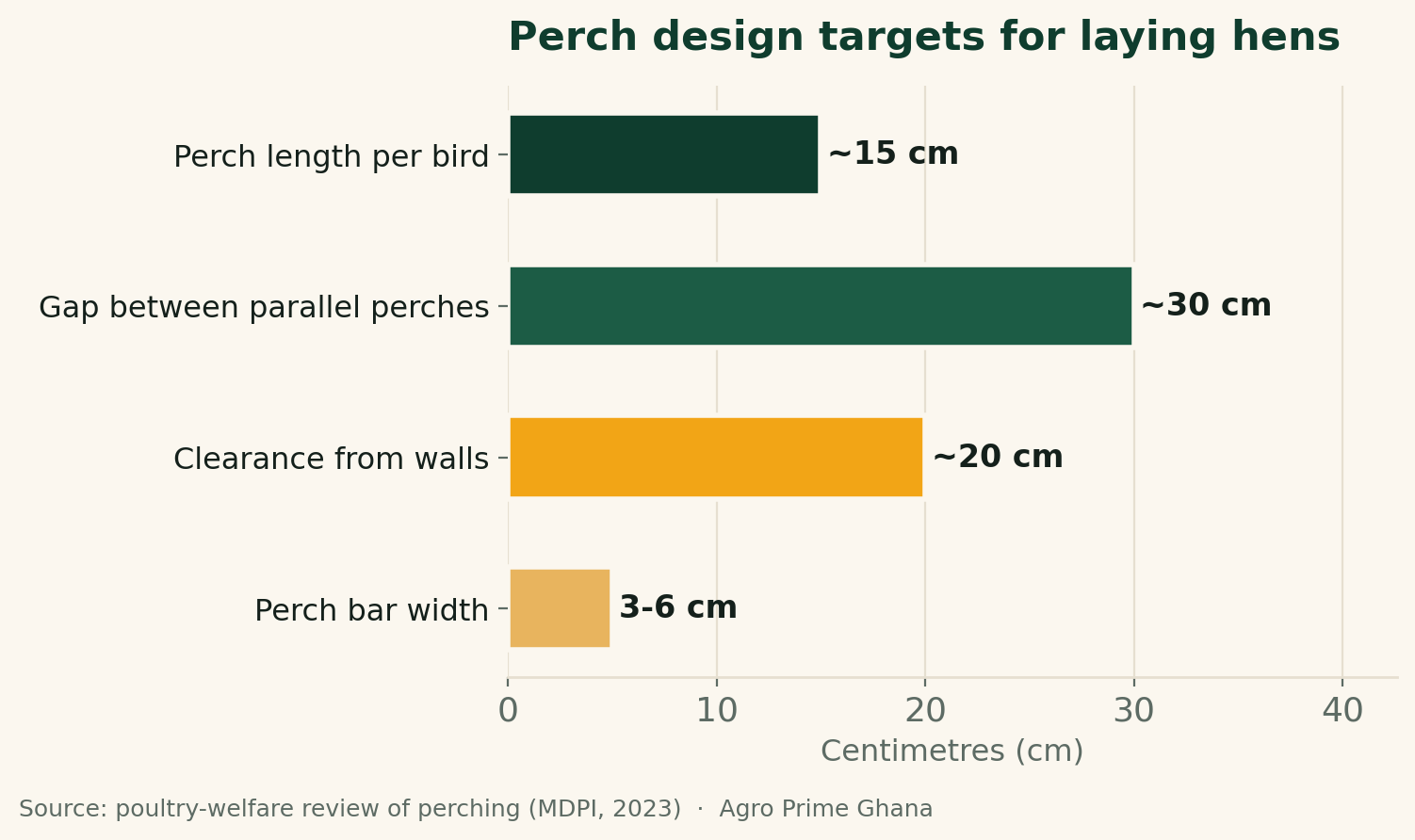
Perches give birds what they instinctively want — a place to rest off the ground — and they earn their keep in leg health, flock calm and cleaner birds. The workable figures come straight from perching research. Allow roughly 15 cm of perch length per bird as a minimum, which is the commonly cited allowance for cage-free hens; if you have room, a touch more is better, since hens naturally leave a few centimetres between neighbours and settle most comfortably at around 18 cm each. Make the perch itself 3–6 cm wide, and favour a rectangular rail with rounded top edges over a thin round pole — the flat top lets the hen's foot lock on and grip without constant balancing, which reduces slipping and keeps her steady through the night.
Geometry matters too. Space parallel perches about 30 cm apart so birds are not crowded or fouling one another, keep them at least 20 cm clear of the walls, and leave enough headroom above. Where you use several heights, remember hens prefer lower perches by day for standing and moving about and higher ones at night for roosting, so a stepped arrangement suits their routine. Keep perches sturdy and level; a wobbling or sagging perch gets abandoned. Perches also pull birds up off the litter at night, which helps keep the deep litter drier and in better condition — a topic we cover in our guide to poultry litter management.
Start perches early — in the brooder
One of the clearest findings in the research is that early perch access matters. Chicks begin hopping onto low perches within the first week or two of life, and pullets given perches young learn to jump, balance and navigate height — skills that translate directly into fewer floor eggs and fewer birds injured trying to reach elevated nests as adults. A flock that has never seen a perch until point of lay is clumsy in three dimensions and slow to take to raised nests. So put a few low, stable perches into the brooding and rearing area from early on, keeping them low enough that day-old and week-old chicks can hop up without hurting themselves. It is a small addition to the brooding setup that pays back in a flock far more comfortable with height by the time the nests open.
The floor-egg problem, and how to beat it
Floor eggs are the single biggest reason to care about nests and perches, so it is worth being systematic about them. They happen for a handful of predictable reasons: not enough nests, nests that are too bright, too dirty or badly placed, dark tempting corners on the floor, nests opened too late, and flocks that never learned to perch or use height. Tackle each one directly. Provide enough nests at the right ratio; make them the dimmest, cleanest, most private spot in the house; place them where hens naturally travel; open them before first egg; remove floor temptation by lighting corners and blocking dark gaps; and rear birds with early perch access so they are comfortable seeking out and climbing into nests. In the first weeks of lay, collect floor eggs often and lift floor-laying hens into nests. Done together, these steps routinely drop floor eggs into low single figures, protecting both egg quality and your income.
Field note: reading the flock at dusk
A quick evening walk tells you a lot about whether your perches are working. When the house settles for the night, birds that are content will space themselves out along the perches, gripping calmly, with the litter below them clearer than it was during the day. If instead you see birds still piling into corners on the floor, crowding at one end of a perch while another sits empty, or avoiding a perch altogether, something is off — often a perch that wobbles, is too narrow, sits too close to a wall, or leaves too little room per bird. We treat the dusk settle as a free daily inspection: calm, evenly spread roosting birds mean the setup is right; heaps and gaps mean go and check the perch itself.
Building it affordably in a Ghanaian house
None of this requires imported equipment. Nest boxes can be built well from timber, plywood or repurposed materials, sized to the figures above, with a sloped floor and a shaded front, and set along a wall on legs or brackets to lift them off the litter. Line them with clean, dry, soft material and top it up regularly. Perches are even simpler — planed timber rails of the right width, edges rounded off with a plane or sandpaper so there are no splinters or sharp corners, fixed securely and level at sensible heights, and easy to lift out for cleaning. Whatever you build, keep hygiene in mind: nests and perches that cannot be cleaned become reservoirs for mites and disease, so design them so you can get in, scrape, wash and, when needed, treat. Good airflow around this equipment matters too, which ties into whole-house ventilation, especially in our warm, humid conditions.
Common mistakes to avoid
A few errors show up again and again. Too few nests is the classic, and it guarantees floor eggs no matter how good the nests are. Bright or exposed nests defeat the hen's need for privacy and stay empty while the floor fills up. Opening nests too late, after floor-laying has already started, means fighting an established habit. Round, thin or slippery perches that birds cannot grip get abandoned and offer none of the leg-health benefit. Dirty nest litter quietly sends hens back to the floor. And skipping perches in rearing leaves you with a flock that is awkward with height and slow to take to raised nests. Every one of these is cheap to fix if you plan for it before the birds come into lay rather than after.
The bottom line on perches and nest boxes
Perches and nest boxes are low-cost equipment that solves a high-cost problem. Give the flock enough nests — around one space per 4–6 hens — make each nest dim, clean, private and slightly sloped, place them well and open them a week or two before first egg, and most hens will lay where you want them to. Provide perches at about 15 cm per bird on rounded, 3–6 cm rails, spaced sensibly and introduced early in rearing, and you get calmer birds, stronger legs, drier litter and fewer floor eggs. In a Ghanaian house where every cracked or dirty egg eats into a thin margin, that combination of cleaner eggs, healthier birds and steadier flock behaviour is one of the best returns you will get from a few planks of wood.
Frequently asked questions
How many nest boxes do I need for my hens?
Why are my hens laying eggs on the floor instead of in the nests?
When should I install nest boxes?
How much perch space does each hen need?
What shape and size should a perch be?
Do chicks need perches, or only adult hens?
How do I keep eggs clean and reduce cracks?
Can I build nest boxes and perches myself?
Sources & further reading
- FAO — Small-scale poultry production: housing and equipment (nesting, roosting and housing basics for smallholder flocks).
- Pekár et al. / poultry-welfare review — Effects of perching on poultry welfare and production (perch space per bird, width and shape, spacing, early perch access, and effects on floor eggs, bone strength and footpad health).
- Agro Prime Ghana guides: layer feeding guide, poultry litter management, and poultry house ventilation.
About Agro Prime Ghana
Agro Prime Ghana Limited runs a poultry hatchery and mixed agribusiness in Kasoa, supplying day-old chicks and working alongside poultry keepers across the country. These guides draw on that hands-on hatchery and farm experience, checked against current poultry-management references. This article is general educational information, not a substitute for advice tailored to your own house and flock. Need chicks, layer setup advice or farm support? Book a visit or message us on WhatsApp (+233 24 915 1503).