A good weekly poultry management schedule turns farming from a scramble into a routine: it fixes a small set of essential tasks to specific days so nothing important — feeding, water hygiene, vaccination, weighing, record-keeping, biosecurity — ever gets forgotten. The daily non-negotiables (feed, clean water, and walking the flock) happen every single day; on top of them you layer weekly jobs across Monday to Sunday so the workload is spread and the flock is never neglected. Many Ghanaian keepers lose birds not to some exotic disease but to drift: the drinker that went uncleaned for a week, the vaccination that slipped, the wet corner of litter no one turned. A written weekly schedule is the cheapest fix for all of that. This guide gives you a practical, honest weekly framework — plus the numbers behind the key tasks — that you can adapt to broilers, layers or a mixed farm.
Written by the Agro Prime Ghana poultry team and reviewed against current industry references (Aviagen Ross management guides and MSD Veterinary Manual). Last updated September 2026.
Key takeaways
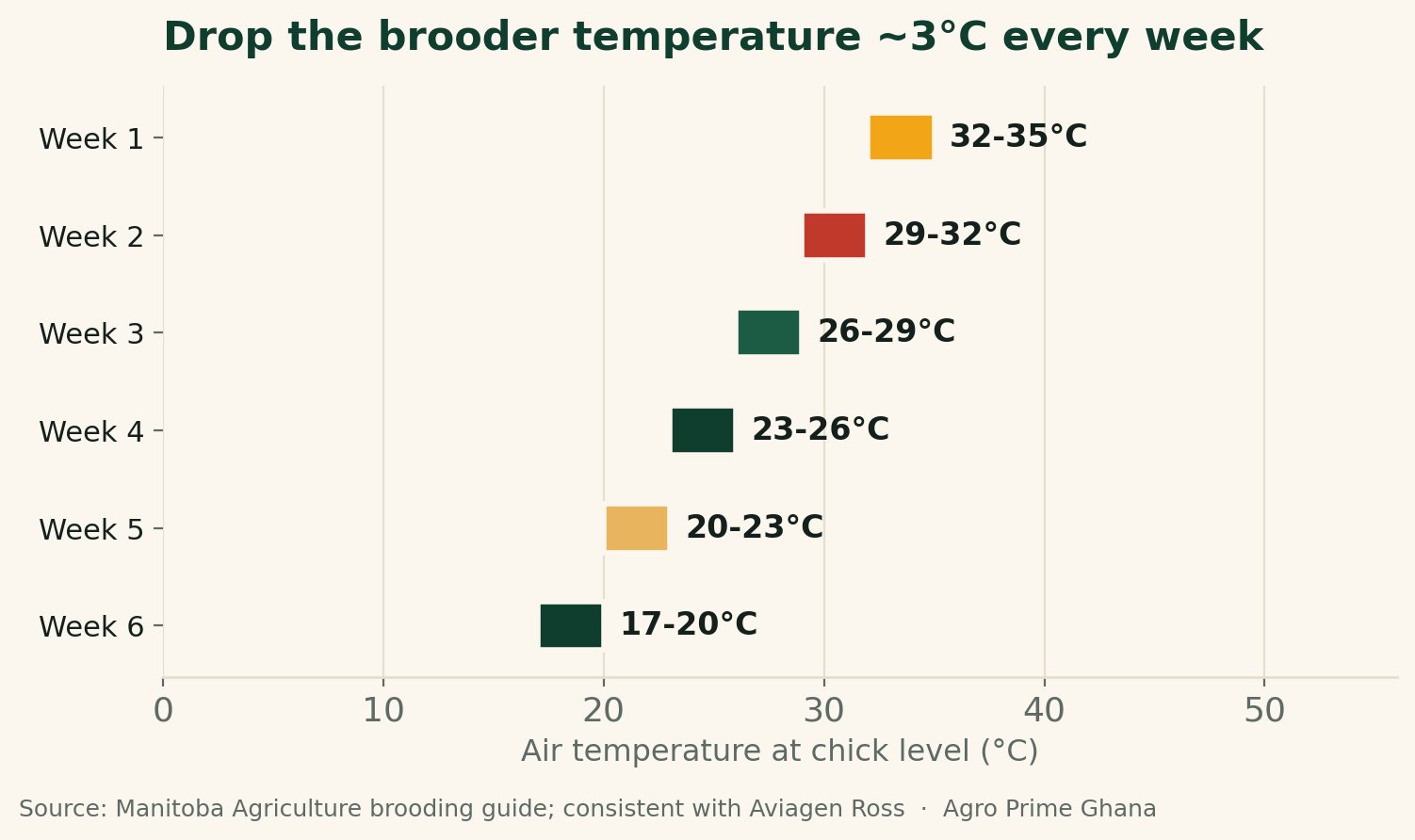
Split poultry work into daily non-negotiables and weekly scheduled tasks. Every day: check feed, provide clean water, walk the flock and remove dead birds. Each week, assign specific jobs to specific days — a deep drinker clean, a weekly weigh-in of at least 100 birds or 1% of the flock to track growth and uniformity, litter turning, a biosecurity/footbath refresh, feed-stock check, and a records update. During brooding, drop the house temperature by about 3 C every week — from around 32-35 C in week 1 to 20-23 C by week 5 — and adjust the vaccination calendar to your birds' ages. A schedule works only if it is written down and someone is accountable for each task. The exact days matter less than doing every task, every week, without gaps.
Why a written weekly schedule beats working from memory
A weekly schedule matters because poultry problems are cumulative and quiet: they build up over days of small omissions before they show as sickness or lost growth. Birds need the same core inputs every day — feed, clean water and a watchful eye — but many essential tasks are weekly or periodic, and those are exactly the ones that slip when a farm runs on memory and mood: the drinker that grows biofilm, the litter that cakes and breeds disease, the vaccination that is missed, the records that go blank. Writing the week down, and making one named person responsible for each task, converts good intentions into reliable practice, survives staff changes, and lets you delegate without losing control. Good record-keeping is the backbone of this: a schedule tells you what to do, and records tell you whether it worked.
Daily non-negotiables: the tasks that never wait for a schedule
Before any weekly plan, some jobs happen every single day, twice where possible, because they keep birds alive and are never "scheduled" to a particular day. Fresh feed must be available and feeders checked so they never run empty for long. Clean, cool water must be available at all times — birds off water for even a few hours in Ghana's heat suffer quickly. And most importantly, you must walk the flock, ideally morning and evening, observing how birds sit, sound and behave: quiet, alert, evenly spread birds are healthy; huddling, gasping, or a suddenly silent pen are warnings. Dead birds are removed and counted daily — their number is one of the most useful early signals you have. Everything in the weekly schedule sits on top of these daily duties; it never replaces them.
The weekly schedule at a glance
Below is a practical weekly template built on generally recommended best practice. The specific days are a suggestion — swap them to suit your farm and market days — but cover every task each week. Daily jobs (feed, water, flock walk, remove and count dead birds) are assumed throughout.
| Day | Focus | Key weekly tasks (on top of daily feed, water & flock walk) |
|---|---|---|
| Monday | Reset & plan | Deep-clean and disinfect drinkers; check the week's feed stock and reorder in good time; plan any vaccinations/medications due this week |
| Tuesday | Health & vaccination | Give any due vaccination or treatment; inspect birds individually for signs of disease, lameness or parasites; add vitamins/electrolytes if handling or stress is expected |
| Wednesday | Litter & house | Turn and top up litter; remove wet/caked patches; check ventilation, curtains and any leaks; clear cobwebs and dust |
| Thursday | Weigh & assess growth | Weigh a sample (≥100 birds or 1% of flock); compare to target weight and check uniformity; adjust feed plan if birds are behind |
| Friday | Biosecurity | Refresh footbath disinfectant; check perimeter, rodent control and wild-bird exclusion; clean and disinfect equipment; review visitor log |
| Saturday | Equipment & repairs | Service feeders, drinkers, brooders and fans; fix leaks and gaps; check feed store for damp, mould and pests |
| Sunday | Records & review | Update records (feed used, water, mortality, weights, sales, costs); review the week; plan next week and restock supplies |
The brooding weeks: what changes week by week
During the first weeks of life, the single most important scheduled change is temperature — and it follows a clear weekly pattern. Chicks arrive unable to regulate their own body heat, so the brooder starts warm and is reduced gradually as the birds feather up. A widely used guideline, consistent with the Aviagen Ross approach and set out in the Manitoba Agriculture brooding guide, is to start week 1 at about 32-35 C at chick level and then reduce by about 3 C each week: roughly 29-32 C in week 2, 26-29 C in week 3, 23-26 C in week 4, and 20-23 C in week 5, settling around 18-21 C thereafter. In Ghana you often reach ambient temperature sooner and need less added heat by day, but cool harmattan or rainy nights can still require it. The golden rule overrides the chart: watch the chicks — huddled under the heat means too cold, panting and spread to the edges means too hot, evenly distributed and active means just right. Our detailed brooder temperature chart for Ghana breaks this down day by day.
Field note: build your schedule around the flock's age, not just the calendar
A weekly Monday-to-Sunday grid is the frame, but the content of each week shifts with the birds' age. In the brooding weeks, temperature adjustment, crop-fill checks and early vaccinations dominate; in the growing weeks, weighing for uniformity and feed transitions take over; for layers coming into production, the focus moves to lighting, calcium and nest management. We keep a wall chart in each house showing the flock's placement date and age in weeks, so whoever is on duty knows which age-specific tasks belong in this week — not just which day it is. Pair the day-of-week routine with an age-of-flock plan and very little falls through the cracks.
Weekly weighing: the habit that pays for itself
Weighing a sample of birds once a week is one of the highest-value weekly tasks, because it tells you whether your feeding and management are working before the money is lost. The Aviagen Ross guidance is to weigh weekly from placement, sampling a minimum of 100 birds or 1% of the flock, whichever is greater, and to track not just average weight against target but also uniformity — how tightly the birds cluster around that average. A flock that is behind target, or has become uneven, is telling you something is wrong (feed quality, feeder space, disease or heat) while there is still time to act. For broilers this protects finishing weight and feed conversion; for growing pullets, uniform weight is the foundation of a strong laying flock later. Our guide to weighing poultry and flock uniformity explains how to sample and read the numbers properly.
Health and vaccination: the periodic tasks to schedule
Some of the most important tasks are not weekly but happen on a fixed calendar tied to the birds' age, and your schedule's job is to make sure they never slip. Vaccinations — Newcastle disease above all in Ghana, plus Gumboro, fowl pox and others depending on your birds and area — must be given at the right ages, with vaccine kept cold and correctly administered; a missed or mistimed vaccination is a common, avoidable cause of heavy losses. Deworming and coccidiosis control are similarly age- and situation-dependent. Build your bird-specific vaccination and health calendar first, with your vet or supplier, then slot each due date into the relevant week so it is impossible to forget. Because Newcastle disease can devastate an unvaccinated flock and has no cure, treat its vaccination dates as the immovable anchors of your plan — see our Newcastle disease guide. Weekly, you also inspect birds more closely, looking for the lameness, parasites, discharge or poor feathering that a quick daily walk can miss.
Start the schedule right: healthy chicks and a ready-made plan
A weekly schedule is far easier to run when you start with strong, uniform chicks and a clear age-by-age plan already in hand. At Agro Prime Ghana we supply healthy day-old broilers and layers and point-of-lay pullets, and we can hand you a practical brooding, feeding and vaccination calendar to build your weekly schedule around. Starting a new batch and want a schedule that actually fits Ghanaian conditions? Message us on WhatsApp (+233 24 915 1503) or book a visit, and we will set you up with chicks and a management plan together.
Biosecurity and hygiene: the weekly discipline that prevents disease
Biosecurity is most effective as a steady weekly rhythm rather than a panic during an outbreak. Each week, refresh the footbath with fresh disinfectant, check that the perimeter, rodent control and wild-bird exclusion are holding, and clean and disinfect shared equipment. Between batches, the bigger jobs kick in: a full clean-out, wash, disinfection and rest of the house before new birds arrive, so each flock starts clean rather than inheriting the last one's disease load. Drinker hygiene deserves its own weekly slot — a deep scrub to remove the biofilm that harbours bacteria — because dirty water quietly undermines everything else you do. These routines are simple and cheap, yet they separate a farm that occasionally has a scare from one that regularly loses birds. Our full guide to poultry biosecurity gives a complete farm routine you can fold into your weekly plan.
Records and review: closing the loop each week
The task that ties the whole schedule together is a weekly records-and-review session — ideally on the quietest day. Update your figures for feed used, water, mortality, sample weights, medications, sales and costs, then step back and read them. Rising mortality, a dip in feed or water intake, or weights falling behind target are early warnings you can only see if you write the numbers down and look at them. This review is also where you plan ahead: order feed before you run out, line up next week's vaccinations, and restock supplies. Over a full cycle, these records tell you your real feed conversion, your true cost per bird or per crate of eggs, and whether the flock made money — the information you need to run poultry as a business, not a hobby.
Field note: the footbath everyone stops refreshing by week three
The most neglected weekly task we see is the footbath. It goes in with good intentions on day one, and by the third week it is a tray of muddy, rain-diluted water doing nothing — worse than useless, because it breeds false confidence. A disinfectant footbath only works when the solution is fresh, at the right strength, and the visible dirt is scrubbed off boots before stepping in it. We tie ours to a fixed weekly day so it never drifts. It is a tiny job, but a live footbath at the door is one of the cheapest barriers you have against carrying disease into the house.
The bottom line on a weekly poultry schedule
A weekly poultry management schedule works because it converts good intentions into reliable action. Underneath it sit the daily non-negotiables — feed, clean water, and walking the flock — that never wait for a schedule. On top, a simple Monday-to-Sunday plan spreads the essential weekly jobs so none is forgotten: drinker cleaning, weighing at least 100 birds or 1% of the flock, litter turning, biosecurity, equipment care, and a records review. Layered over that is an age-based calendar for tasks that follow the birds' development — the weekly ~3 C brooder temperature drop, vaccinations, feed transitions and, for layers, lighting and calcium. Write it down, make someone accountable, and read your records every week. The exact days barely matter; doing every task, every week, without gaps is what keeps a Ghanaian flock healthy, growing and profitable.
Frequently asked questions
What tasks should be done daily on a poultry farm?
How often should I clean poultry drinkers?
How often should I weigh my chickens?
By how much should I reduce brooding temperature each week?
What is the best day to do vaccinations?
Do layers and broilers need different weekly schedules?
How do I keep track of everything on the schedule?
What weekly tasks prevent disease outbreaks?
Sources & further reading
- Aviagen — Ross Broiler Pocket Guide (2025) (weekly weighing of ≥100 birds/1%, brooding temperatures, daily management fundamentals).
- Manitoba Agriculture — Brooding Temperatures for Small Poultry Flocks (week-by-week brooding temperature chart; ~3 C reduction per week).
- MSD Veterinary Manual — Newcastle Disease in Poultry (why vaccination scheduling is critical).
- Agro Prime Ghana guides: brooder temperature chart, weighing & uniformity, record-keeping, Newcastle disease and biosecurity.
About Agro Prime Ghana
Agro Prime Ghana Limited runs a poultry hatchery and mixed agribusiness in Kasoa, supplying day-old chicks and supporting poultry keepers nationwide. These guides combine hands-on hatchery and farm experience with current industry references. This article is general educational information, not a substitute for professional veterinary or extension advice tailored to your flock. We supply healthy day-old chicks (broilers & layers), point-of-lay pullets, quality feed and hands-on farm support across Ghana. Ready to start or expand? Book a visit or message us on WhatsApp (+233 24 915 1503) to order chicks, feed or advice.