To supply hotels and restaurants with chicken and eggs in Ghana profitably, you must deliver the same quality, same size and same quantity on the same day every week, invoice cleanly, and keep the cold chain unbroken from your farm to their kitchen — because for a chef, reliability beats price almost every time. This is one of the most attractive markets a Ghanaian poultry farmer can serve: hotels, restaurants, chop bars, canteens and caterers buy in steady volume, pay better than the live-bird market when you meet their standard, and stick with a supplier who never lets them down. But it is also the market that punishes inconsistency hardest. A chef who plans a menu around your birds cannot afford a week where the chicken is too small, the eggs arrive cracked, or you simply do not show up. This guide explains exactly how to win and keep restaurant and hotel accounts — on consistency, cold chain, invoicing, contracts and pricing — using the Ghanaian market as it really is.
Written by the Agro Prime Ghana poultry team and reviewed against current industry references (Ghana MoFA and FAO food-handling guidance). Last updated September 2026.
Key takeaways
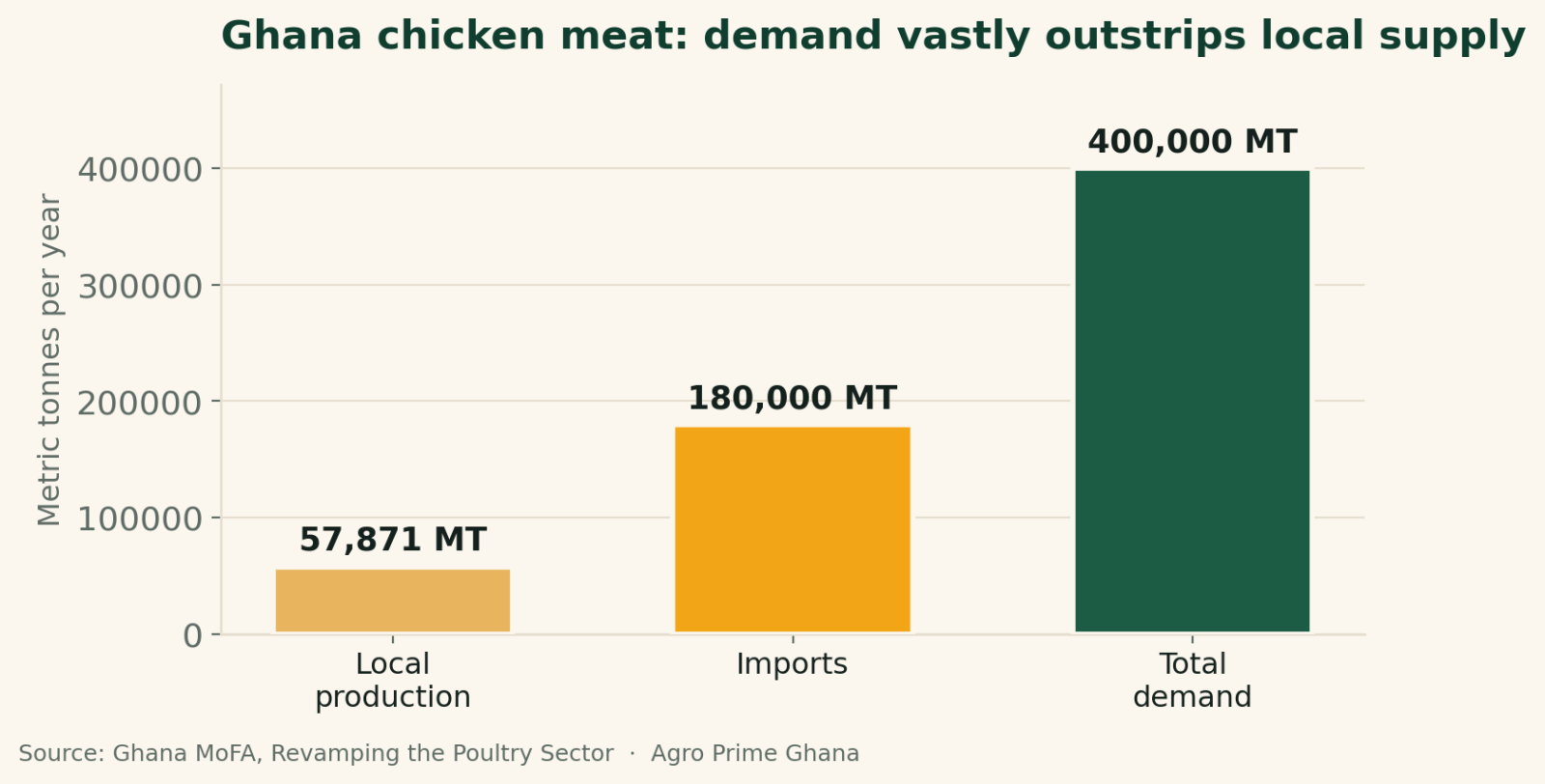
Ghana imports the overwhelming majority of the chicken it eats — national demand is around 400,000 MT a year against local production of roughly 57,871 MT, with imports near 180,000 MT and broiler meat making up over 80% of all meat imports. That gap is your opportunity, and hotels and restaurants are the highest-value door into it. To win these accounts, compete on reliability, not just price: standard-size birds and clean eggs on a fixed schedule, an unbroken cold chain (chilled meat near 0-4°C, eggs held at about 10-13°C in our climate), professional invoicing, and a simple written supply agreement. Serve eggs where Ghana is already competitive and birds where you can guarantee weight and hygiene, and you turn one satisfied kitchen into a standing weekly order.
Why hotels and restaurants are a market worth chasing in Ghana
Hotels and restaurants are worth chasing because they buy steadily, in volume, and to a spec you can plan around — and Ghana's poultry supply is nowhere near meeting demand. According to Ghana's Ministry of Food and Agriculture, national poultry-meat demand is roughly 400,000 metric tonnes a year while local production is only about 57,871 MT, leaving a shortfall filled by around 180,000 MT of imports; broiler meat alone accounts for over 80% of the country's meat imports. Chicken is the most popular animal protein in the country, with per-capita consumption around 13 kg, and much of that demand is met by frozen imports simply because local farmers have not organised to supply it consistently. A farmer who reliably serves even a handful of kitchens substitutes directly for imports while capturing a premium market.
What a chef actually needs from a poultry supplier
What a professional kitchen needs, above all, is predictability — the confidence to write your product into next week's menu and know it will arrive exactly as agreed. A chef costs a dish to the gram, so a bird that is 1.2 kg one week and 2.4 kg the next wrecks their portioning and margins. As the table below sets out, kitchens weigh consistent size and quality, a reliable schedule, food safety and clean paperwork ahead of price. Get those right and price becomes a negotiation rather than a deal-breaker, because a cheaper but unreliable supplier costs a kitchen far more in ruined service than it saves per kilo.
| What kitchens value | Live-bird market | A disciplined farm supplier (you) |
|---|---|---|
| Consistent size/weight | Variable, ungraded | Birds graded to a target dressed weight; eggs sorted |
| Reliable schedule | Buyer must chase supply | Fixed delivery day and time, every week |
| Cold chain / hygiene | Often broken; open-air | Chilled, covered, documented from farm to kitchen |
| Invoicing & records | Cash, no paperwork | Proper invoice, delivery note, agreed credit terms |
| Price per kg | Sometimes lower | Fair, stable, quoted in writing |
| Relationship | Transactional | Named contact, dependable, problem-solving |
Consistency: the one thing that wins and keeps the account
Consistency is the single trait that separates farmers who hold hotel contracts for years from those who lose them in a month. It means same size, same quality, same quantity, same day, and it is built on production planning long before delivery: stagger your flocks in weekly or fortnightly cycles so a batch is always reaching market weight as the last one leaves, and start from uniform, healthy day-old chicks that grow into a uniform flock. Grade birds and eggs before they leave the farm, and warn the chef the moment you foresee a shortfall. A kitchen can work around a problem you flag on Tuesday; it cannot work around a no-show on Friday.
The cold chain: keeping your product safe from farm to kitchen
The cold chain is the temperature discipline that keeps chicken and eggs safe between your farm and the customer's fridge, and breaking it is one of the fastest ways to lose an account and endanger diners. For dressed chicken, the FAO treats around 0°C as the target for chilled meat (butcher-style holding is commonly near 4°C), with frozen storage at −18°C or colder. So chill birds quickly after slaughter, keep them cold in insulated boxes with ice packs during transport, and hand them over still cold — never carried warm in an open pan through Kasoa traffic. For eggs, the FAO recommends tropical storage of around 10-13°C and cooling within a few days of laying, since quality is lost fastest in heat. Even without a cold van, short early runs are fine if you control the basics: deliver early before the day heats up, keep product covered and out of the sun, use ice packs and insulated containers, and never let dressed birds sit warm. Our notes on egg storage and handling go deeper.
Field note: the delivery habits that keep chefs loyal
The suppliers kitchens trust are boringly predictable, and that is a compliment. The small disciplines that matter most are: delivering at the same early hour every week so the kitchen can plan its receiving; bringing birds and eggs already graded and counted so the chef is not sorting your product; carrying a clean delivery note the receiver can sign; and keeping everything covered and cool for the whole trip. We also keep one named person as the kitchen's contact, so a question gets a same-day answer. None of this is expensive — it is just done every single time, which is what a busy kitchen is paying for.
Invoicing and records: getting paid like a professional
Professional invoicing turns a farmer into a supplier a hotel's accounts department will keep on the books. Hotels and larger restaurants rarely pay cash on the spot; they work on delivery notes and invoices, often with credit terms of a week or a month. To fit that system, issue a numbered delivery note with every drop (date, item, quantity, weight) that the receiver signs, and follow up with a clear invoice stating your business, the goods and quantities, the unit price, the total and the payment terms. This gets you paid without arguments, makes you look established, and builds the records you will need if you ever seek financing — the discipline we cover in record keeping for poultry farms. Agree credit terms modestly at first; a month of credit to a new restaurant that then closes can wipe out a season's profit, so start tight and loosen only as trust is earned.
Field note: start small and let the account grow
The mistake we most often see is a farmer over-promising to win a big hotel, then failing in a busy week and losing the account for good. It is far better to commit to a volume you can guarantee on your worst week and then grow it. Open with a modest standing order — a fixed number of crates or birds you can meet even when a batch runs late — prove you never miss, and raise the volume only once the kitchen asks for more. A small order kept perfectly is worth far more than a large one broken twice.
Contracts and supply agreements: putting the deal in writing
A simple written supply agreement protects both sides and signals that you take the relationship seriously. It need not be a lawyer's document — a one-page agreement both parties sign is enough — but it should nail down the essentials that cause disputes: what you will supply, how much and how often, the price and how long it holds, delivery day and place, payment terms, and what happens if either side falls short. Writing it down forces both of you to commit honestly to what you can deliver, which is healthier than a vague verbal promise you cannot keep in a heavy festive period. Larger hotels may also ask about your food-safety practices and want to visit your farm — welcome that, because a farm that passes a walk-through wins trust a market trader never can.
Grow into hotel and restaurant supply with the right birds
Supplying kitchens reliably starts with uniform, healthy stock and a staggered production plan — exactly what we help farmers set up. Agro Prime Ghana supplies strong, vaccinated day-old broiler and layer chicks, point-of-lay pullets and quality feed, plus practical advice on batching flocks for steady, standard-weight supply. Message us on WhatsApp (+233 24 915 1503) or book a visit to plan your flock schedule and stock.
Pricing: how to quote so you win the deal and still profit
Price your poultry from your real cost of production plus a fair margin — never by simply undercutting the frozen-import price, which you usually cannot beat on cost alone. Because most of Ghana's chicken is imported, your competitive edge is fresh, local, traceable and reliable, not cheapest. Work out what a bird or a crate of eggs actually costs you (chicks, feed, health, labour, transport, losses), add your margin, and quote a stable price you can hold rather than a low one you will have to raise. Chefs hate surprise price jumps far more than a fair fixed rate, so predictable pricing is itself a selling point. Feed is your biggest lever on cost, so protecting your margin means feeding efficiently — see reducing poultry feed cost. Put the price in your written agreement, state how long it holds, and review it openly only when input costs genuinely move — a kitchen that can budget around you rarely leaves.
Eggs versus dressed birds versus live birds: choosing your lane
Decide which product lane you can serve to a professional standard, because hotels and restaurants buy poultry in three different forms. Table eggs are often the easiest entry point: Ghana is far more competitive in local egg production than in broiler meat, hotel breakfast demand is steady and daily, and eggs need less processing — your task is clean, uncracked, correctly-sized eggs delivered cool and on time. Dressed birds command the best price but demand the most: hygienic slaughter, proper chilling and an unbroken cold chain, which many small farms are not yet set up for. Live birds suit some chop bars and caterers who process on site, and this is where the festive market spikes — see selling live birds in the festive season. Many farmers start with eggs to build trust and cash flow, then add birds once the cold-chain capacity is in place. Pick the lane you can do excellently now, and expand from there.
The bottom line on supplying hotels and restaurants
Supplying Ghana's hotels and restaurants is one of the most rewarding markets in poultry precisely because it is demanding: the country imports most of its chicken, kitchens want a dependable local alternative, and they reward the farmer who delivers the same quality, size and quantity on the same day, week after week. Win the account on consistency and cold-chain discipline, hold it with professional invoicing and a simple written agreement, and protect your profit with honest, stable pricing built on your real costs. Start in the lane you can serve flawlessly — very often eggs — and grow from there. Do this and you stop competing on the frozen-import price altogether, because a chef who can rely on you is not shopping around; they are building their menu around your farm.
Frequently asked questions
How do I start supplying chicken or eggs to a hotel or restaurant in Ghana?
What do restaurants care about most when choosing a poultry supplier?
How do I keep chicken and eggs safe during delivery without a refrigerated van?
Should I supply eggs, dressed birds, or live birds to hotels?
How should I price my poultry for restaurants?
Do I need a written contract to supply a restaurant?
How do hotels usually pay poultry suppliers, and how do I manage credit?
Why supply local hotels when they can buy cheap imported chicken?
Sources & further reading
- Ghana Ministry of Food and Agriculture (MoFA) — Revamping the Poultry Sector in Ghana (national demand ~400,000 MT, local production ~57,871 MT, imports ~180,000 MT, broiler meat >80% of meat imports).
- FAO — Manual on meat cold store operation and management (chilled and frozen meat storage temperatures).
- FAO — Egg packaging, transport and storage (tropical egg storage ~10-13°C, cooling and transport guidance).
- USDA Foreign Agricultural Service / trade reporting — Ghana poultry consumption ~13 kg per capita and heavy reliance on imports.
- Agro Prime Ghana guides: starting a poultry farm, record keeping and poultry marketing.
About Agro Prime Ghana
Agro Prime Ghana Limited runs a poultry hatchery and mixed agribusiness in Kasoa, supplying farmers and food businesses across the country. We supply healthy day-old chicks (broilers & layers), point-of-lay pullets, quality feed and hands-on farm support, and we help farmers plan production to serve demanding buyers like hotels reliably. This article is general educational and business information, not a substitute for professional financial or food-safety advice. Ready to build supply you can promise? Book a visit or message us on WhatsApp (+233 24 915 1503) to order chicks, feed or advice.