A poultry loan or investment proposal in Ghana is a short, evidence-backed document that shows a lender exactly how much money you need, precisely what it will buy, when the farm will generate cash, and how the loan will be repaid from that cash — with realistic projections a banker can check against real Ghanaian costs. Get those four things right and you are ahead of most applicants. Most poultry proposals in Ghana are refused not because the farm idea is bad, but because the paperwork is vague: no clear costing, no month-by-month cash flow, no repayment plan that survives the first feed-price shock. Banks already see poultry as risky — feed swallows most of the budget, disease can wipe out a flock, and the sector has had a rough decade — so the proposal has to do the reassuring. This guide walks through exactly what banks and investors in Ghana want to see, how to structure the document, and how to build projections that stand up to scrutiny.
Written by the Agro Prime Ghana poultry team and reviewed against current industry and finance references (Bank of Ghana, GIRSAL and FAO/USDA poultry data). Last updated September 2026.
Key takeaways
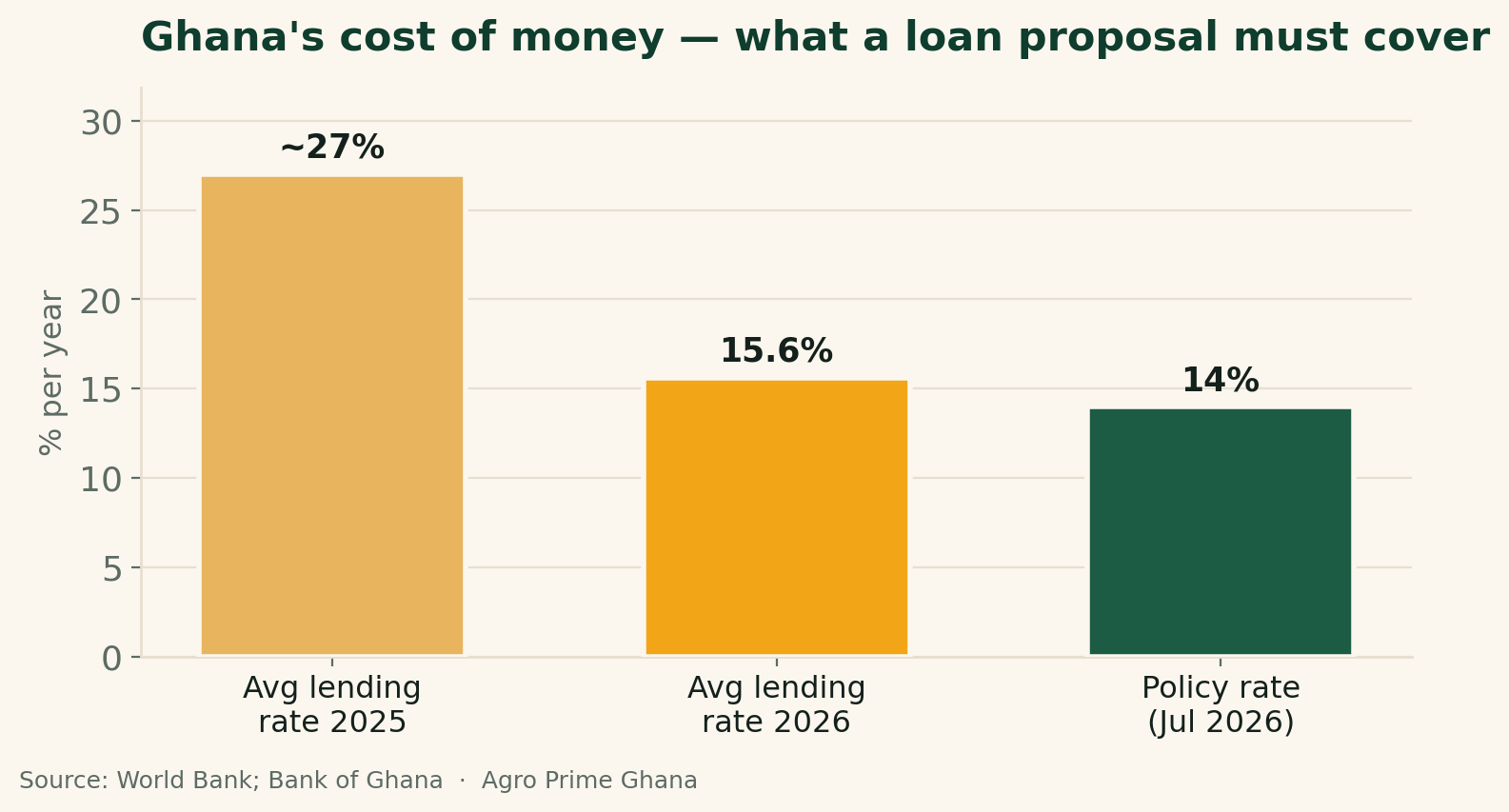
A bankable poultry proposal in Ghana has five parts: an executive summary, a costed investment breakdown, a market plan, a month-by-month cash-flow projection, and a repayment schedule — plus honest risk and mitigation. Anchor every number in real costs: feed is 70–80% of running cost, a broiler reaches market at about 6 weeks, and a layer only starts paying its way at about 20 weeks. Know the cost of money: the Bank of Ghana policy rate sits at 14% (July 2026) and average bank lending rates fell to about 15.6% in 2026 from around 27% a year earlier. If you lack collateral, ask your bank about the GIRSAL credit guarantee, which can cover up to 70% of the loan principal. Lenders fund clear cash flow and competent management — not enthusiasm.
What a poultry loan proposal in Ghana actually is
A poultry loan proposal is the business case a lender reads to decide whether your farm will repay borrowed money on time — the numbers-first summary that sits on top of your fuller business plan. A good proposal answers one blunt question a credit officer is trained to ask: "Where exactly does my repayment come from, and what happens if a flock dies or feed doubles in price?" In Ghana, where lenders have historically been wary of agriculture, the proposal also has to overcome a reputation problem: bankers know the sector has struggled, with industry leaders reporting that many farms shut down under feed-cost pressure and that domestic broiler production now meets only a small fraction of national demand, per the FAO/industry overview of Ghana's poultry sector. Your job is to show that your farm is one of the well-run ones. If you have not yet written the strategy behind it, start with our guides to a poultry business plan and starting a farm.
Why lenders scrutinise poultry so hard in Ghana
Lenders price risk, and poultry carries several risks at once — which is exactly why a strong proposal is worth so much. The first is feed: research on Ghanaian poultry producers finds feed makes up roughly 70–80% of operating cost, per a study of feed choice and profitability in Ghana, and feed prices swing with the maize harvest, which can move sharply within a few seasons — so a banker sees a farm whose single biggest cost is largely outside the owner's control. The second is biological risk — Newcastle disease, avian influenza and other outbreaks can erase a flock overnight. The third is the cost of money itself: the Bank of Ghana held its policy rate at 14% in July 2026, and the World Bank reported average commercial lending rates easing to about 15.6% in 2026 from roughly 27% a year before — and even at the lower level, interest is a real, recurring cost your projection must cover. A proposal that names these risks and shows how you manage each one reads as the work of someone who understands the business.
How much you can realistically ask for — and on what terms
Match the size and type of financing to what the money actually buys — lenders assess "purpose" closely. Farm borrowing falls into two buckets, and mixing them up is a common reason proposals fail.
| Loan purpose | What it funds | Sensible term | What repays it |
|---|---|---|---|
| Working capital | Day-old chicks, feed, drugs, vaccines, litter, casual labour for one cycle | Short — one production cycle (broilers ~2–3 months; a layer round longer) | Sale proceeds of that same flock or its eggs |
| Capital / investment | Housing, cages, feeders/drinkers, a borehole, generator, delivery vehicle, brooder equipment | Longer — 2–5 years, matched to the asset's life | Margin accumulated across many cycles |
Do not fund a poultry house with a short working-capital loan, or a batch of feed with a long capital loan — the mismatch between how fast money is spent and returned is what causes defaults. If you lack the collateral banks usually demand, the Ghana Incentive-Based Risk-Sharing System for Agricultural Lending (GIRSAL) can guarantee up to 70% of the loan principal to a participating bank (it does not cover interest, and cover is decided case by case). Naming this scheme signals you have done your homework; our overview of poultry farm financing in Ghana covers the main lender types.
The structure banks and investors expect
Keep it tight — most credit officers will not read twenty pages. A strong proposal runs five to twelve pages plus annexes, in this order:
- 1. Executive summary (half a page). Who you are, what you run or plan to run, the exact amount, purpose, term and headline repayment logic — enough for a banker to decide whether to read on.
- 2. The business and promoter. Your experience, the site (owned or leased, with tenure documents), current flock or capacity, and your team — this is where you prove management competence, the single thing lenders bet on most.
- 3. The investment plan. A line-by-line costing of what the loan buys, with quotations attached. Vague totals kill credibility; itemised costs build it.
- 4. The market. Who buys your birds or eggs, at roughly what price, and why demand is reliable — festive live-bird sales, standing egg buyers, restaurants, cold stores.
- 5. Financial projections. A month-by-month cash flow, a per-cycle profit estimate, break-even and the repayment schedule — the heart of the proposal.
- 6. Risks and mitigation. Feed price, disease, mortality, market price — each named, each with your specific control measure.
- 7. Annexes. Quotations, land documents, ID, permits, photographs, existing flock records and bank statements.
Building projections a credit officer will trust
Projections fail when they are too optimistic or are round-number guesses with no basis; fix both by building every figure from real, current unit costs and conservative, documented performance. For broilers, a realistic tropical benchmark from a Ghana strain trial is roughly 2.5–2.6 kg live weight at 42 days on about 4.1–4.5 kg of feed per bird (feed conversion around 1.7), with mortality up to about 5%. For feed cost, anchor to a published price such as the Greater Accra Poultry Farmers Association schedule (2026: broiler feed roughly GH₵380–400 for a 50 kg bag, layer mash around GH₵357). Then:
- Build mortality into the numbers. If you buy 1,000 chicks, sell 950 — projecting a 0% loss tells a banker you are inexperienced.
- Cost the whole cycle. Include vaccines, drugs, litter, brooding fuel, utilities, transport, casual labour and interest — not just chicks and feed.
- Price cautiously and cost fully. Use a conservative selling price and a slightly high cost; if the farm still repays on those pessimistic numbers, it is bankable.
- Show cash flow month by month. An annual profit figure hides the dangerous middle of a cycle when money has gone out on feed but nothing has come back.
Field note: the mistake we see most in draft proposals
The single most common flaw we see in a draft is a projection with no month-by-month cash flow — just an annual "revenue minus cost equals profit" that looks healthy on paper. Every credit officer knows the danger sits in the timing: a broiler account can be deep in the red for weeks while the birds eat, then swing positive only when they are sold. If your proposal cannot show the exact month the balance is lowest, and prove you can service the loan through it, you are asking the lender to trust a number you have not worked out. Build the cash flow first — the profit figure falls out of it.
Writing the executive summary that gets you read
The executive summary decides whether the rest is read, so write it last and make it concrete: a banker should finish it knowing the amount, the purpose, the term and the repayment source. Compare a weak opening — "We are seeking funding to expand our profitable poultry business" — with a strong one: "We request GH₵[X] in working capital over one broiler cycle to buy 2,000 day-old chicks and feed for our existing 2,000-bird house in Kasoa. At a conservative farm-gate price and 95% survival, the cycle generates GH₵[Y], repaying principal plus interest within [Z] months, with a buffer of GH₵[buffer]." The strong version names numbers, shows repayment from a specific flock, and proves you have done the arithmetic. Specificity is credibility.
What investors want that banks don't
If you are approaching a private investor or equity partner rather than a bank, the emphasis shifts. A bank wants to be repaid and cares about downside protection; an investor wants to grow their money and cares about the upside, the return, and your credibility as an operator. For investors, add a clear statement of the deal — the amount, the share or return, and how and when they are paid back — and expect them to weigh the management team heavily. Be candid about the sector's difficulty and specific about why your operation succeeds where others struggled — better biosecurity, cheaper feed, a locked-in market, lower-cost point-of-lay stock. Our note on broiler versus layer profit helps frame returns.
Get your input costs and stock right before you submit
A proposal is only as trustworthy as the unit costs inside it, so guessed chick prices, mortality rates and feed figures weaken it. We supply healthy, vaccinated day-old chicks (broilers and layers) and point-of-lay pullets, and are happy to give current, realistic figures — chick and pullet costs, expected feed use per bird, sensible mortality allowances — to cite directly in your projections. Message us on WhatsApp (+233 24 915 1503) or book a visit to walk through your numbers before you submit.
Field note: dress your numbers down, not up
When we help a farmer prepare figures for a lender, we deliberately make them pessimistic: a cautious selling price, a slightly high feed cost, a realistic mortality allowance, and no assumption that every bird sells on its best day. A proposal that still repays comfortably on those numbers is genuinely bankable — and it protects you, not just the bank, because the farm is built to survive a bad cycle. Optimistic projections impress no experienced credit officer.
Collateral, guarantees and the security question
Security is where many Ghanaian poultry loans stall, because farmers rarely have the registered land title banks prefer. Address it head-on rather than leaving the officer to raise it. Options to present include registered land or buildings; the equipment and stock being financed (a chattel or asset charge); a guarantor; a fixed deposit as cash cover; and, importantly, the GIRSAL guarantee, which has channelled well over a billion cedis in guaranteed loans to thousands of agribusinesses through more than forty participating banks. If your collateral is thin, a proposal that already proposes a GIRSAL-backed structure — and shows a cash flow strong enough that the 30% uncovered portion is clearly safe — gives the bank a workable path to "yes."
Records: the quiet thing that wins loans
Nothing reassures a lender like evidence that you already run the farm by the numbers. If you have an existing flock, attach real records — feed used, mortality, weights or egg production, sales and prices — because historic performance is far more persuasive than any projection: it proves your assumptions are grounded in your own results, not a textbook. Even first-timers should show they will keep records from day one; our guide to record keeping on a poultry farm covers the registers that matter.
The bottom line on writing a poultry proposal in Ghana
Lenders and investors in Ghana back poultry farms that prove three things: that the owner understands the business, that the numbers are real and conservative, and that repayment comes from a clearly-mapped cash flow rather than optimism. Anchor every figure in real unit costs — feed at 70–80% of running cost, broilers to market in about six weeks, layers paying their way only from about twenty weeks — and in the real cost of money at today's rates. Name your risks and mitigations, solve the collateral question with tools like the GIRSAL guarantee, and let good records do the talking. Do that, and you turn a risky-looking sector into the kind of fundable, well-managed farm banks are actually looking for.
Frequently asked questions
What should a poultry loan proposal in Ghana include?
How much can I borrow for a poultry farm in Ghana?
What interest rate will I pay on a poultry loan in Ghana?
Can I get a poultry loan without collateral in Ghana?
What is GIRSAL and how does it help poultry farmers?
How do I make my poultry projections believable to a bank?
How long should a poultry loan proposal be?
What makes banks reject poultry loan applications in Ghana?
Sources & further reading
- Bank of Ghana policy rate — Ghana interest rate (14%, July 2026).
- World Bank via MyJoyOnline — average lending rate falls from 27% to 15.6%.
- GIRSAL — Agricultural Credit Guarantee Scheme (up to 70% cover of principal).
- ScienceDirect — feed choice and profitability among Ghanaian poultry producers (feed 70–80% of operating cost).
- FAO / industry — overview of Ghana's poultry sector.
- PMC — broiler strain performance under humid-tropical conditions in Ghana.
- Agro Prime Ghana guides: poultry business plan, poultry farm financing, record keeping.
About Agro Prime Ghana
Agro Prime Ghana Limited runs a poultry hatchery and mixed agribusiness in Kasoa, supplying day-old chicks and working alongside poultry keepers across the country. We supply healthy day-old chicks (broilers and layers), point-of-lay pullets, quality feed and hands-on farm support across Ghana. This article is general educational information, not a substitute for professional financial or agronomic advice. Ready to start or expand — and need realistic input costs and stock figures for your loan proposal? Book a visit or message us on WhatsApp (+233 24 915 1503) to order chicks, feed or advice.