Planning your day-old chick orders means booking with a hatchery in advance, matching the number of chicks to your housing and your market, and placing them on a date you have worked out by counting back from when you need to sell — not simply buying whatever chicks are available on the day you happen to have cash. In Ghana, the farmers who consistently do well are the ones who treat chick ordering as a scheduled decision made weeks ahead, because good day-old chicks sell out around peak placement windows, and a batch bought in a rush — wrong number, wrong breed, wrong week — locks in problems you then feed for the next two or three months. This guide covers why to book ahead, typical hatchery lead times, how to size an order to your house and your buyers, and how to avoid the stockouts that hit every festive season.
Written by the Agro Prime Ghana hatchery team and reviewed against current industry references (Aviagen Ross 308 performance objectives and Ghana Ministry of Food and Agriculture broiler figures). Last updated September 2026.
Key takeaways
Book day-old chicks with a hatchery weeks in advance, especially before festive peaks, because strong chicks sell out fast around popular placement dates. Work out your order date by counting back from your target sale date: broilers take about 6–8 weeks to reach market, layers reach point of lay around 18–20 weeks. Size the order to your housing first — never crowd birds to fit in more chicks — and to buyers you can actually name. Order a small allowance for mortality and culls (the Ministry of Food and Agriculture plans on placing about 1,100 chicks to sell 1,000 broilers, roughly a 9% margin). Confirm breed, sex, vaccination status and a collection date when you book, and plan your brooder to be ready before the chicks arrive.
Why book day-old chicks in advance?
You book day-old chicks in advance because a hatchery cannot conjure healthy chicks on demand — they are the output of a fixed incubation cycle, and demand for them clusters around the same placement dates for everyone. A hen's egg takes about 21 days to hatch, so the chicks you want on a given day had to be set as eggs three weeks earlier. A hatchery plans its egg-setting around the orders it holds; when you book ahead, you are effectively reserving space in a batch that is already being planned, and you get first choice of breed, sex and collection date. When you walk in unannounced, you take whatever is left over — which, in a busy period, may be nothing, or may be the wrong breed, or chicks that have been held too long. Because every broiler farmer counts back to the same festive Sundays and Eids, the pressure on chick supply spikes for a narrow band of placement weeks each year, and that is exactly when booking ahead pays off most. The habit of ordering early also forces the discipline that makes farms profitable: deciding your numbers, breed and dates deliberately rather than reactively.
How long is a hatchery lead time?
Plan on a lead time of at least the incubation period plus the hatchery's order queue — in practice, book a few weeks ahead, and more before peak seasons. The hard biological floor is the roughly 21-day incubation for chicken eggs: chicks available on a given date were set as eggs about three weeks earlier. On top of that, hatcheries schedule their egg-setting against confirmed orders, so during quiet periods a week or two of notice may secure chicks, while in the run-up to Christmas, Easter, Ramadan and the Eids, popular placement dates can be spoken for well ahead. There is a second, quieter reason to book early: it lets you plan around your own readiness, not just the hatchery's. You want the brooder cleaned, disinfected, rested and pre-heated before the chicks arrive, and a firm collection date lets you organise that and arrange careful transport. Rushing chicks into a house that is not ready undoes the value of good chicks. Our guides to where to buy day-old chicks and the day-old chick ordering checklist walk through what to confirm with a supplier before you commit.
Count back from your market to set the order date
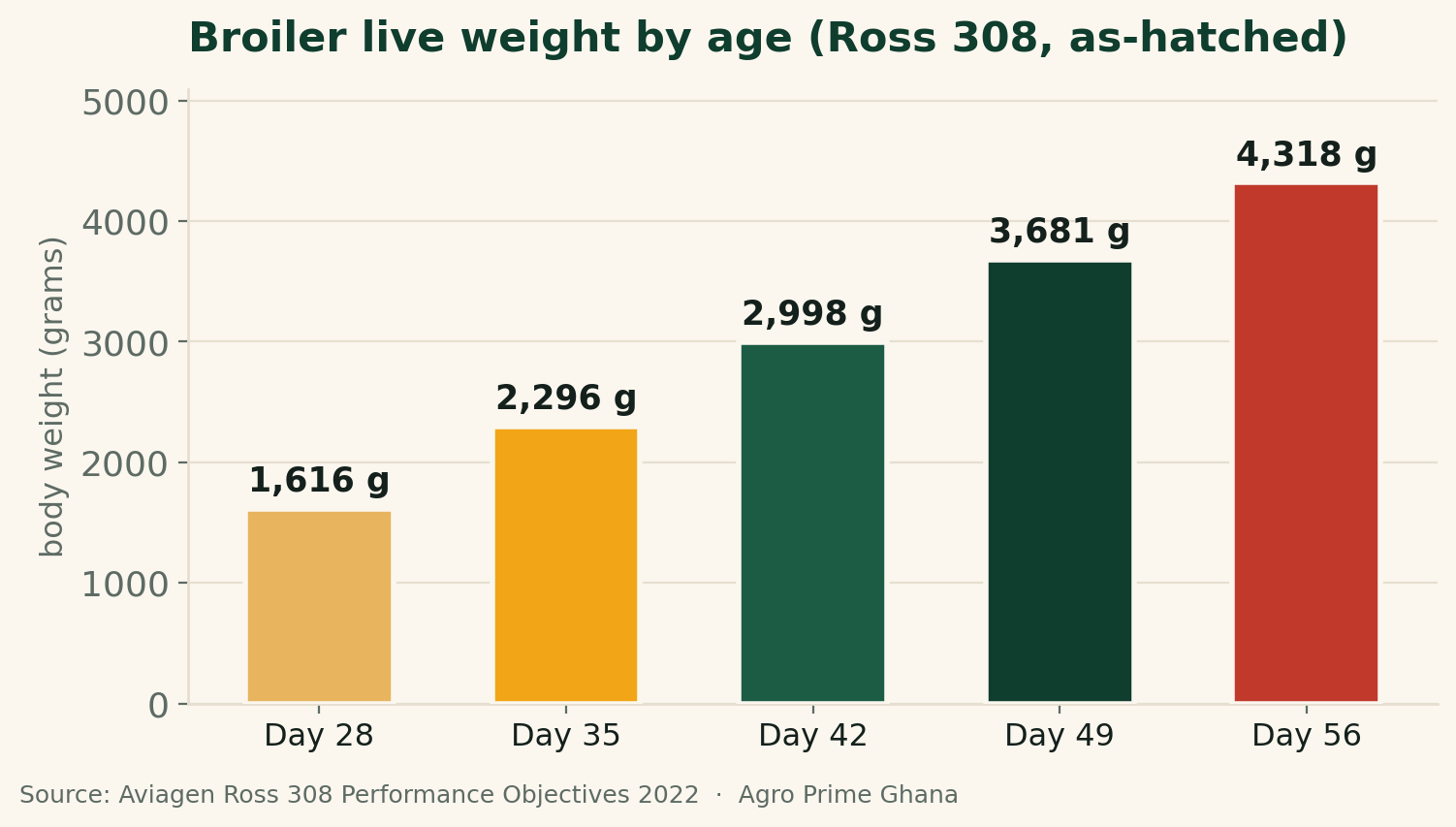
The order date is not "when I have money" — it is a date you calculate by counting back from when you need to sell. Start from your target sale date and subtract the growing period for the bird you are raising, then subtract the incubation and booking lead time to get the date you must place the order. For broilers, the growing period is about six to eight weeks; the Ministry of Food and Agriculture's broiler analysis plans on a seven-week cycle from day-old to market, while a well-managed Ross 308 can, per Aviagen's performance objectives, reach about 2.3 kg by day 35 under ideal conditions. For layers, you are planning much further out — pullets typically come into lay around 18–20 weeks of age — so a layer order is a decision made four to five months before your first eggs. This counting-back logic is the same one that drives festive planning; see our guides to timing broilers for Easter and poultry demand during Ramadan and Eid for how it works around specific peaks, and the broiler production calendar for keeping it all on one schedule.
| Bird type | Time from chick to sale/lay | Order this far before you need output | Key sizing driver |
|---|---|---|---|
| Broilers | ~6–8 weeks to market | Grow-out + ~3-week incubation + booking buffer | Confirmed buyers and finishing space |
| Layers (to point of lay) | ~18–20 weeks to first eggs | ~4–5 months ahead | Layer house capacity and egg market |
| Cockerels / dual-purpose | Longer, slower grow-out | Similar counting-back, longer cycle | Housing time and target sale weight |
Match the order to your housing, not your ambition
The first limit on how many chicks to order is how many birds your house can properly hold — and that limit is real, because overcrowding is one of the most reliable ways to ruin a batch. Crowded birds compete for feed and water, grow unevenly, overheat in Ghana's climate, foul their litter faster and suffer more disease, so an over-ordered flock often ends up worth less than a smaller, well-spaced one. Decide the number your house can carry at proper stocking density for the whole cycle — remembering that broilers are small chicks for only a week or two and large, space-hungry birds by the end — and treat that as your ceiling. If your ambition is bigger than your house, the answer is to build or convert more housing first, or to run more batches over the year through the same house on an all-in/all-out basis, not to squeeze more birds into the space you have. Our guides to building a low-cost poultry house and all-in/all-out management cover both routes. Getting this right at the ordering stage is far cheaper than discovering it at five weeks with a crowded, struggling flock.
Field note: order for the birds you can sell, not the birds you can house
Housing sets the ceiling, but the market sets the sensible number, and they are not the same thing. We have watched farmers fill a house to capacity because "there was room," then struggle to move the birds and end up feeding a finished flock for extra weeks — the most expensive weeks — while the price slips. Before we settle an order, we work through who will actually buy this batch: the regular butcher, the caterer, the households, the church or community group, the market queen. If the confirmed and likely buyers add up to fewer birds than the house holds, we order to the market, not the house. It is nearly always better to sell a smaller batch clean than to carry unsold birds on full feed.
Order a sensible allowance for mortality and culls
Order slightly more chicks than the number of birds you intend to sell, because a normal batch loses a few to mortality and produces some culls and runts that will not make market grade. How much extra? The Ministry of Food and Agriculture's broiler model plans on placing about 1,100 day-old chicks to end up selling 1,000 broilers — roughly a 9% allowance for mortality and culling across the cycle. That is a reasonable planning figure for a well-run farm; a first-timer or a farm with weaker management may need to allow a little more, while a very tight operation may lose less. The point is to build the allowance into the order so that after normal losses you still have the number of saleable birds your buyers are expecting — rather than ordering exactly your sales target and coming up short. Keeping honest records of your own mortality rate over several batches, as in our record-keeping guide, lets you replace this rule of thumb with your farm's real number over time.
What to confirm when you place the order
A good chick order is specific, so nail down the details when you book rather than assuming. Confirm the breed or strain — broiler versus layer is obvious, but within those, a Ross or Cobb broiler and a Lohmann or ISA Brown layer behave differently, and you want the right one for your market. Confirm the sex where it matters (straight-run, or sexed pullets for a layer flock). Confirm the vaccination status at the hatchery — reputable hatcheries vaccinate day-old chicks against key diseases such as Marek's and often Newcastle and Gumboro, and you need to know what has been done so you can plan the rest of your programme; our note on vaccinated versus unvaccinated chicks explains why this matters. Agree the number and the collection or delivery date, and how the chicks will travel, because day-old chicks are fragile and a hot, long, badly managed journey can undo a good hatch — see transporting day-old chicks. Finally, know how to judge the chicks on arrival; our guide to choosing healthy day-old chicks covers the signs of a strong chick.
Book your chicks ahead with Agro Prime — and avoid the peak-season stockout
Agro Prime Ghana runs a hatchery in Kasoa and takes advance bookings for day-old chicks — broilers and layers — as well as supplying point-of-lay pullets. Booking ahead means you reserve strong, well-started chicks for your chosen placement date instead of gambling on what is available on the day, which matters most before festive peaks when good chicks are hardest to find. Tell us the breed, the number and the week you want to place, and we will help you check your counting-back, plan a mortality allowance, and reserve the batch. Message us on WhatsApp (+233 24 915 1503) or book a visit — the earlier you book, the surer your supply and the better your choice of dates.
How to avoid stockouts at peak season
Stockouts happen because demand for chicks concentrates on the same weeks for everyone, so the way to avoid them is to plan against the crowd rather than with it. First, identify your peaks a year ahead and diarise the placement dates, remembering that the Christian peaks (Christmas, Easter) sit on the Gregorian calendar while the Muslim peaks (Ramadan, the Eids) move about eleven days earlier each year — so recalculate the moving ones annually. Second, book as soon as you have the dates, not when the season is already upon you; the earliest bookers get the placement weeks they want. Third, build a relationship with a reliable hatchery rather than shopping around at the last minute — a hatchery that knows you and your schedule can plan its egg-setting around your recurring orders. Fourth, keep a buffer in your own plan: a small allowance in numbers and a few days of flexibility in your placement date absorb the normal wobble of moon-sighting dates and hatch variation. Farmers who do these four things rarely get caught by a stockout; those who leave it to the last week regularly do, and end up either without chicks or with the wrong ones at the worst possible time.
The bottom line on planning chick orders
Planning day-old chick orders in Ghana is a matter of turning chick-buying from a reaction into a schedule. Count back from your market to fix the placement date; size the order to your housing first and your confirmed buyers second; add a sensible allowance — around 9% for a well-run broiler batch — for mortality and culls; specify breed, sex, vaccination and collection date; and book it with a reliable hatchery weeks ahead, earlier still before festive peaks. Do that and your brooder is ready, your chicks are strong and on time, and your batch is sized to sell. Leave it to chance and you inherit the opposite: whatever chicks are left, in the wrong week, in the wrong numbers, feeding a problem you did not have to create. The order is the first and cheapest decision in the whole cycle — make it deliberately.
Frequently asked questions
How far in advance should I order day-old chicks in Ghana?
How do I decide how many chicks to order?
How much extra should I order for mortality?
When do I need to order for layers versus broilers?
What should I confirm when placing a chick order?
How do I avoid chick stockouts at festive seasons?
Is it cheaper to order more chicks at once?
Should I have my brooder ready before ordering chicks?
Sources & further reading
- Ghana Ministry of Food and Agriculture — Broiler profitability analysis (seven-week cycle; ~1,100 chicks placed per 1,000 sold).
- Aviagen — Ross 308 Broiler Performance Objectives (2022) (broiler growth by age).
- Agro Prime Ghana guides: where to buy day-old chicks, day-old chick ordering checklist, and choosing healthy day-old chicks.
About Agro Prime Ghana
Agro Prime Ghana Limited runs a poultry hatchery and mixed agribusiness in Kasoa, supplying day-old chicks and working alongside poultry keepers across the country. We supply healthy day-old chicks (broilers and layers), point-of-lay pullets, quality feed and hands-on farm support, and we take advance bookings so you can secure the right chicks for the right placement week. This article is general educational information, not a substitute for professional veterinary or agronomic advice. Ready to plan and reserve your next batch? Book a visit or message us on WhatsApp (+233 24 915 1503) to order chicks, feed or advice.