Ramadan and the two Eid festivals lift poultry demand across Ghana's Muslim communities — a month of daily communal meals to break the fast, followed by two celebration days when chicken is a natural, affordable and readily available festive protein. For a poultry farmer, the opportunity is real but easy to miss, because the Islamic calendar is lunar: Ramadan and Eid move about ten to eleven days earlier every Gregorian year, so the placement date that worked last year is wrong this year. Nearly one in five Ghanaians is Muslim, concentrated heavily in the north and in the zongo communities of every southern city, and during Ramadan those households eat a substantial meal together every single evening for a month. This guide explains the demand pattern, how to plan birds for Eid al-Fitr and Eid al-Adha, which products sell, and — most importantly — how to time your chick placement around dates that shift every year.
Written by the Agro Prime Ghana poultry team and reviewed against current industry references (Ghana Statistical Service 2021 census and international poultry-demand reporting). Last updated September 2026.
Key takeaways
About 19.9% of Ghanaians are Muslim (2021 census), rising above 45–80% in the three northern regions, so Ramadan and Eid are significant demand periods. During Ramadan, poultry consumption rises sharply in Muslim-majority countries — by around 25% to over 60% in various markets — because chicken is the preferred, affordable protein for breaking the fast. There are two Eids: Eid al-Fitr ends Ramadan (chicken is central), and Eid al-Adha centres on sacrificing livestock but still creates strong poultry demand as an accessible option. The dates are lunar and move roughly 10–11 days earlier each year, and are confirmed by moon sighting, so recalculate chick placement every year — count back your 6–8 week broiler cycle from the festival.
How big is the Muslim festive market in Ghana?
Roughly one in five Ghanaians is Muslim, which makes Ramadan and Eid a genuinely national demand period rather than a regional footnote. According to the Ghana Statistical Service's 2021 Population and Housing Census, reported via Islam in Ghana, about 19.9% of the population identifies as Muslim. That share is far higher in parts of the country: the Northern Region is roughly 80% Muslim, the Upper East around 45% and the Upper West around 40%, and there are large, established Muslim communities in the zongo neighbourhoods of Accra, Kumasi, Tamale and every major town. For a farmer near a city with a substantial Muslim population — including the greater Accra area that Kasoa sits within — the Ramadan and Eid calendar is a recurring commercial event worth planning around, especially because it falls at a different time of year than the Christian festive peaks of Christmas and Easter, letting you spread your festive production across the year.
What happens to poultry demand during Ramadan?
Poultry demand rises during Ramadan because chicken is the preferred protein for the evening meal that breaks the daily fast. Throughout the holy month, families gather each night for iftar, and across the Muslim world this drives a marked, well-documented lift in chicken consumption. Reporting compiled by BAADER shows the scale in various markets: daily poultry production in Jordan rises around 25% during Ramadan, chicken consumption in Egypt has been reported to climb by 66.5% during the month, and in the United Arab Emirates poultry imports from Brazil jumped 27.7% in the months leading up to Ramadan. These are not Ghanaian figures — no equivalent national statistic is published for Ghana — but they illustrate a consistent global pattern: where there are fasting households, poultry demand for the evening meal goes up substantially. BAADER notes the reasons chicken dominates the Ramadan table: it is affordable relative to red meat, nutritionally suited to breaking a fast, and easier to digest, so it becomes "the preferred protein choice" during the month.
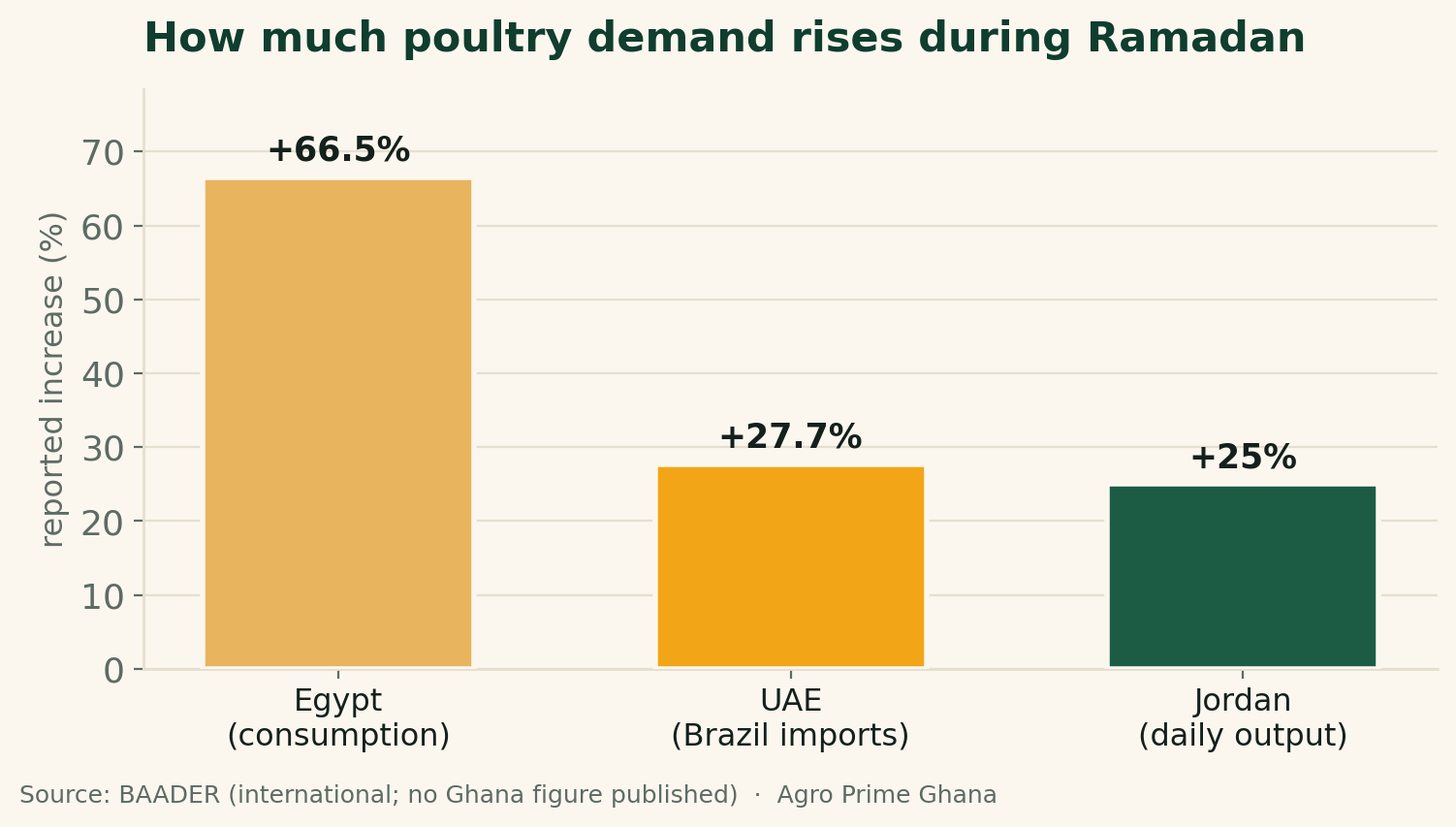
The demand pattern within Ramadan matters for planning. Consumption is spread across the whole month — every evening, not one big day — so unlike the single-day spike of Easter, Ramadan rewards a steady supply of birds over about four weeks. That favours staggered placements or a phased selling plan so you have finished birds available week after week, rather than one batch all hitting weight at once. Then demand builds to a peak around Eid al-Fitr, the celebration that ends the fasting month, when households prepare a larger festive meal and chicken features strongly.
The two Eids sell differently — plan for each
There are two distinct Eid festivals, and they create different kinds of poultry demand, so it pays to understand each. Eid al-Fitr ("the festival of breaking the fast") comes at the end of Ramadan and is a joyful feast day; chicken is a central festive dish, and demand peaks in the run-up as families buy for celebration meals and for hosting. This is the clearer opportunity for the poultry farmer — a festive food occasion where your live birds fit naturally.
Eid al-Adha ("the festival of sacrifice"), which falls roughly two-and-a-half months after Eid al-Fitr, traditionally centres on the sacrifice of livestock — a ram, goat, sheep or cattle — for those who can afford it. That means the headline demand at Eid al-Adha is for larger animals, and their prices soar. But this creates a real poultry opening in two ways. First, many households who cannot afford a ram or bull still want a good festive meal, and poultry is the accessible option. Second, poultry can substitute directly when circumstances demand it: in one Ghanaian example, GhanaWeb reported that when an anthrax outbreak led authorities to ban livestock slaughter in the Upper East, Muslims "turned to chicken, guinea fowls" and fish to still mark the celebration. Guinea fowl in particular is a prized festive bird in the north. So plan Eid al-Fitr as your primary poultry peak and Eid al-Adha as a strong secondary one, sized to your local market.
| Occasion | When | Poultry demand | What sells |
|---|---|---|---|
| Ramadan (the month) | ~29–30 days | Sustained, elevated every evening | Steady supply of table broilers for daily iftar meals |
| Eid al-Fitr | End of Ramadan | Strong peak — festive feast day | Live broilers for celebration meals; the clearest poultry opportunity |
| Eid al-Adha | ~70 days after Eid al-Fitr | Secondary — livestock-led, but real poultry demand | Poultry as the affordable option; guinea fowl valued in the north |
Why the dates move — and why that matters for chick placement
The single most important planning fact is that the Islamic festivals move earlier every year. The Islamic calendar is lunar: its year is about 354 days, roughly eleven days shorter than the 365-day Gregorian year. As a result, Ramadan, Eid al-Fitr and Eid al-Adha all fall about ten to eleven days earlier each Gregorian year, drifting steadily across the seasons over time. On top of that, the exact start of Ramadan and the day of each Eid are traditionally confirmed by the sighting of the new moon, so the precise date is announced only shortly beforehand and can vary by a day between countries and communities. For a farmer, this has a concrete consequence: you cannot reuse last year's placement date. A batch you placed in one calendar week last year would be ready more than a week too late if you repeat it, because the festival itself has shifted earlier.
The discipline is the same as for any festive broiler: count back your grow-out period from the festival. A standard broiler reaches a saleable 1.8–2.5 kg in about six to eight weeks, so once you know the expected date of Eid al-Fitr (or the mid-point of Ramadan you are aiming to supply), subtract six to eight weeks plus a few days of buffer to fix your day-old chick placement date. Because the moon-sighting confirmation comes late, work from the widely published astronomical estimate for planning and place your chicks against that, keeping a small buffer so a day's shift either way does not leave you short. The mechanics of counting back and keeping a forward calendar are covered in our broiler production calendar and, for the Christian peaks, our guide to timing broilers for Easter.
Field note: recalculate every single year, then diary it
The mistake we see most often with the Muslim festive market is a farmer treating it like a fixed calendar date — placing chicks "the same time as last year" and then finding the birds are a week or more behind the festival. Because Ramadan and Eid slide about eleven days earlier annually, that gap compounds. Our habit is simple: at the start of each year, look up the estimated dates for Ramadan, Eid al-Fitr and Eid al-Adha, subtract our real grow-out length plus a buffer, and write the resulting placement dates straight into the production diary. Then we book the chicks against those dates. It takes ten minutes and it is the difference between hitting the market and watching it pass.
Which birds and products sell best
For the daily iftar meals of Ramadan and for Eid al-Fitr, the workhorse product is the live table broiler at a solid family weight — roughly 1.8–2.5 kg — chosen fresh, the same live-bird trade that drives the Christian festive market. Muslim households buying for a religious festival will generally want halal slaughter, so either sell the bird live for the household or a butcher to slaughter properly, or ensure any dressing you offer is done to halal standards; being clear and reliable on this builds trust and repeat custom in Muslim communities. In the northern regions and among northern communities in the south, guinea fowl is a especially valued festive bird and can command a good price where you can supply it. Layer culls and spent hens also find a market for stews and slow-cooked festive dishes. The practical selling tactics — pre-selling to households, butchers, caterers and community groups, and clearing the batch while demand is hot — are the same ones in our selling live birds in the festive season and poultry marketing guides.
Book chicks ahead for the Ramadan and Eid window
Because Ramadan and Eid move earlier each year and the whole community's demand lands in the same weeks, day-old chick demand tightens around the right placement dates — and a farmer who books late risks missing them. Agro Prime Ghana runs a hatchery in Kasoa and takes advance bookings for broiler and layer chicks, so you can reserve strong day-old birds for your Ramadan or Eid placement week rather than competing for leftovers. Tell us which festival you are targeting and how many birds you plan to raise, and we will help you fix the placement date from the year's dates and reserve the chicks. Message us on WhatsApp (+233 24 915 1503) or book a visit — the earlier you reserve, the better your timing.
Managing supply across a whole month
Ramadan differs from a single-day festival because demand is elevated for around a month, then peaks at Eid al-Fitr. The best way to serve that is a phased supply rather than a single batch. If you place one large flock timed only for Eid, you miss most of the month's daily iftar demand and risk a glut of birds all ready at once. Placing two or three staggered batches a week or two apart gives you finished birds week after week through Ramadan, with the last and largest batch timed for the Eid al-Fitr peak. This spreads your cash flow and labour, reduces the risk of one batch's problems sinking the whole plan, and matches the way demand actually builds — steady through the month, cresting at Eid. Our staggered batch production guide sets out how to run overlapping flocks cleanly, ideally on an all-in/all-out basis per house to keep disease down.
The bottom line on Ramadan and Eid poultry demand
Ramadan and Eid open a substantial, recurring poultry market in Ghana — nearly a fifth of the country, concentrated in the north and in every city's Muslim communities — and it conveniently falls at a different time of year than Christmas and Easter, so you can build it into your production calendar without competing with the Christian peaks. Ramadan rewards a steady month-long supply of table broilers for the daily fast-breaking meal; Eid al-Fitr is the clear festive peak; and Eid al-Adha, though livestock-led, still pulls real poultry demand as the accessible option. The whole plan hinges on one habit the lunar calendar forces on you: because the dates slide about eleven days earlier every year and are confirmed by moon sighting, you must recalculate your chick placement from scratch each year, count back your six-to-eight-week grow-out, keep a buffer, and book your chicks early. Get that right and the Muslim festive calendar becomes one of the most reliable demand windows in your year.
Frequently asked questions
Does poultry demand really rise during Ramadan?
How big is the Muslim market for poultry in Ghana?
When should I place chicks for Ramadan and Eid?
Why do Ramadan and Eid dates change every year?
What is the difference between Eid al-Fitr and Eid al-Adha for a poultry farmer?
What poultry products sell best during Ramadan and Eid?
Should I raise one batch or several for Ramadan?
Do I need halal slaughter to sell to Muslim customers?
Sources & further reading
- Ghana Statistical Service 2021 census, via Islam in Ghana (Muslim share of population, regional distribution).
- BAADER — Rising Demand for Poultry During Ramadan: A Global Perspective (consumption increases; why poultry dominates the Ramadan table).
- GhanaWeb — Muslims in Upper East turn to chicken, guinea fowls for Eid-ul-Adha (poultry as festive option).
- Agro Prime Ghana guides: broiler production calendar, selling live birds in the festive season, and staggered batch production.
About Agro Prime Ghana
Agro Prime Ghana Limited runs a poultry hatchery and mixed agribusiness in Kasoa, supplying day-old chicks and working alongside poultry keepers across the country. We supply healthy day-old chicks (broilers and layers), point-of-lay pullets, quality feed and hands-on farm support, and we take advance bookings so farmers can secure chicks for festive peaks like Ramadan and Eid. This article is general educational information, not a substitute for professional veterinary or agronomic advice. Planning birds for the Muslim festive calendar? Book a visit or message us on WhatsApp (+233 24 915 1503) to reserve chicks, feed or advice.