Peak lay is the short, decisive window — usually around 25 to 30 weeks of age — when a healthy layer flock reaches its highest rate of production, commonly 90–96% of hens laying each day, and how you manage it largely sets the profit of the whole flock. Reaching a high peak matters, but holding it matters more: every extra egg a hen lays at peak, and every week you keep her near that peak, is money that costs almost nothing extra to produce because the feed, housing and labour are already being spent. The mistake we see most often on Ghanaian farms is treating the run-up to peak casually — under-feeding pullets just as their demand explodes, getting the calcium or lighting wrong, or letting a heat-stress episode knock the flock — so the birds either never reach a proper peak or drop off it far too fast. This guide explains how to bring a flock to a strong peak, feed and light it to hold that peak, and protect it from the stresses that cause an early, expensive decline.
Written by the Agro Prime Ghana poultry team and reviewed against current industry references (Hy-Line Brown commercial layer management guide and performance standards). Last updated September 2026.
Key takeaways
A well-managed brown-layer flock reaches 50% production at about 20 weeks and peaks at 25–26 weeks, with Hy-Line Brown standards showing hen-day production of roughly 93–98% at peak. To get there and stay there: bring pullets in on target body weight (about 1.35–1.40 kg) with over 90% uniformity; keep them gaining weight through peak — feed intake near peak is about 110–118 g/bird/day; supply enough calcium (around 4% of the layer diet), half of it as coarse limestone or oyster shell for overnight shell formation; give a rising light programme up to about 14–16 hours; and keep cool, clean water flowing (birds drink 1.5–2× their feed weight, more in the heat). Avoid any stress dip around peak — heat, feed changes, water cuts — because production lost at peak is rarely fully recovered.
What "peak lay" is and when it happens
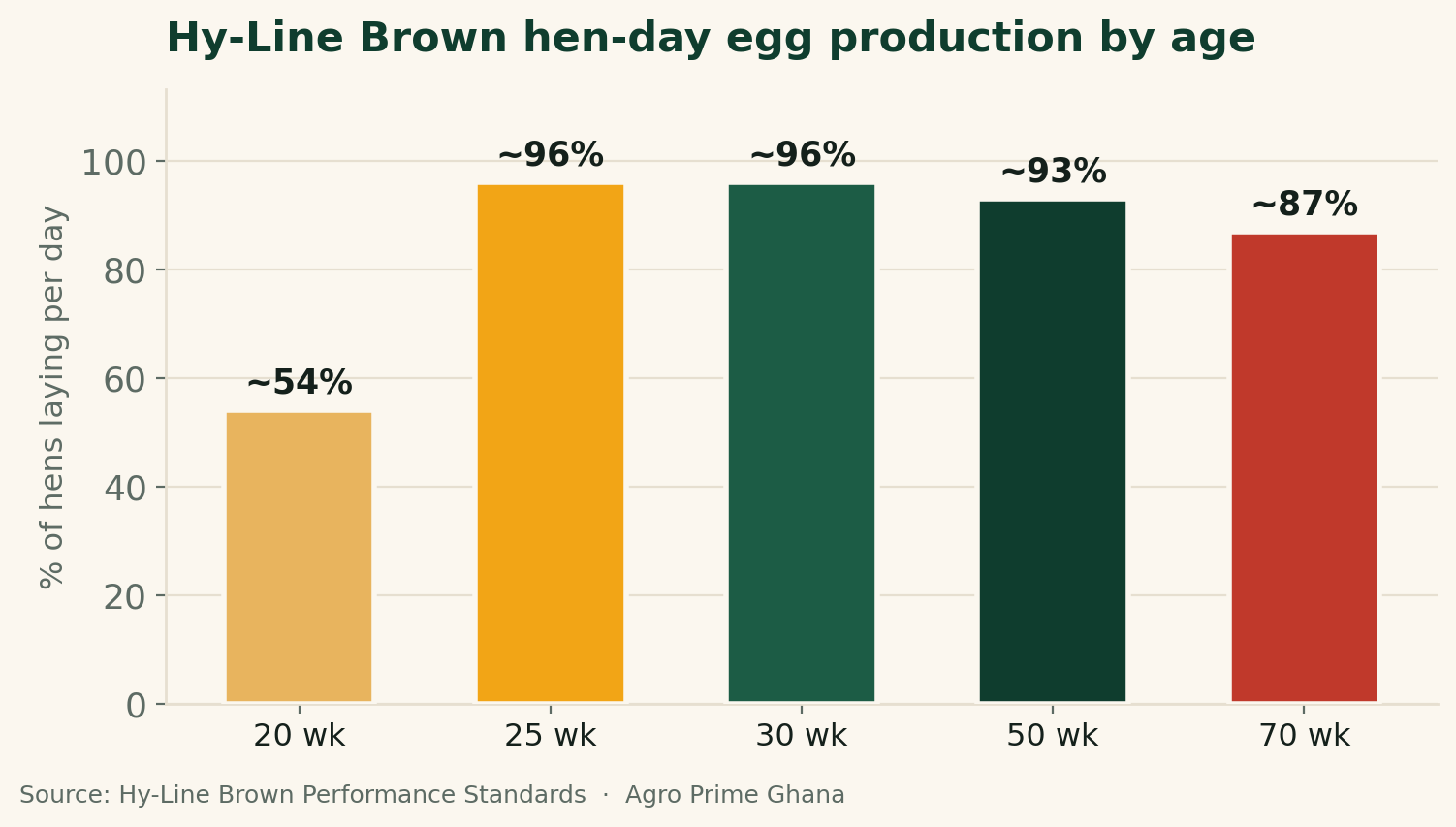
Peak lay is the point in a flock's life when the greatest proportion of hens is laying on the same day — measured as hen-day production, the percentage of the flock laying an egg each day. In a modern brown layer it is not a single day but a plateau of a few weeks in the mid-to-late twenties. The Hy-Line Brown performance standards map it out clearly: the flock reaches 50% production at around 139 days (roughly 20 weeks), climbs steeply to a peak of about 93–98% hen-day at 25–26 weeks, and then holds high — still around 90–96% at 50 weeks and 84–90% at 70 weeks in a well-run flock. The FAO notes that in hot, humid climates a good layer produces on the order of 208 eggs a year, against 250–300 in temperate regions, which is a useful reminder that Ghana's heat itself pulls production down and makes disciplined management around peak even more valuable. The practical meaning is simple: a flock that peaks at 96% and holds well can lay tens of thousands more eggs over its life than the same flock peaking at 85% and sliding early — from the same shed, the same labour and almost the same feed.
Why peak decides the profit of the whole flock
The economics of a layer flock are front-loaded. You spend around 17–18 weeks feeding and rearing a pullet before she lays a sellable egg, so by peak you have already sunk most of the fixed cost. From peak onward, the flock's job is to pay that back and turn a profit — and the height and length of the peak is what determines how much profit there is. Two numbers make the point. First, a difference of even a few percentage points at peak, sustained over months, is a large number of eggs. Second, persistency — how slowly production falls after peak — is worth as much as the peak height itself. A flock that peaks at 95% and declines gently to the high 80s by a year of age is far more profitable than one that peaks at 95% and crashes to 70% by 40 weeks, even though both hit the same peak. Everything in this guide is really about two goals: get the peak high, then make the decline as slow as possible. That is also the theme of our guide to increasing egg production.
Bring the pullet to lay on target: body weight and uniformity
Peak is won or lost before the first egg. A pullet that comes into lay underweight or in a badly uniform flock will never peak properly, because she does not have the body reserves to sustain a high rate of lay while her frame is still finishing. The Hy-Line guide is explicit: "a pullet flock entering into egg production at the correct body weight (1.35–1.40 kg) with uniformity higher than 90% performs best in the production period." Two things follow. First, weigh your pullets — do not guess. A weekly sample weighing through rearing tells you whether the flock is on the breed's target curve and, just as importantly, whether it is uniform (whether most birds are close to the average or the flock is a mix of big and small). Second, the birds must keep growing through peak: Hy-Line targets roughly a 300 g gain (about 18%) between 18 and 25 weeks, warning that "birds should continue to grow during the peaking period" and that "poor nutrition during this period can lead to loss of body weight and soft bones." A hen forced to lay hard while losing weight will drop off peak early and is prone to shell and bone problems. Getting the grower and pre-lay feeding right is covered in our grower and pullet feeding guide.
Feed to the peak, not behind it
The single most common cause of a disappointing peak is feed intake lagging behind the birds' rising demand. Between about 18 and 30 weeks a hen's need for energy, protein and amino acids climbs sharply as she goes from no eggs to nearly one a day while still growing — but her appetite and gut capacity take time to catch up, and Ghana's heat suppresses appetite further. If the feed in front of her is too dilute, or simply too little, she cannot physically eat enough nutrients to fuel a full peak. The Hy-Line standards show feed intake around peak at roughly 110–118 g/bird/day, and the guidance is to "monitor feed intake carefully during transition and adjust dietary nutrient concentration according to actual feed intakes." In plain terms: measure how much your flock is actually eating, and if intake is low (as it often is in hot weather), concentrate the diet — richer in energy, protein and amino acids per kg — so the bird still gets what she needs in the smaller amount she will eat. Never let feeders run empty in the run-up to peak, make sure every bird has feeder space, and consider feeding in the cooler early morning and late afternoon when birds eat more. Our layer feeding guide goes into ration detail.
Field note: the peak you don't feed for is the peak you don't get
When a farmer tells us a flock "peaked at only 82% and won't go higher," the first thing we ask is how much the birds are actually eating, and whether anyone measured it. On more farms than not, the answer is that intake is well below target — feeders half-empty by mid-morning, a diet that was fine for 18-week-old pullets but was never enriched as demand rose, and hot afternoons when the birds barely touch the feed. A flock cannot lay nutrients it never ate. Weigh a feed delivery against bird numbers, work out grams per bird per day, and compare it to the 110-plus grams a peaking hen needs. If intake is short, the fix is almost always to make the feed richer per kilo and to feed in the cool of the day — not to wait and hope the birds "settle." Peak is a window, and it does not wait.
Calcium: the mineral that makes or breaks peak shells
A hen at peak is laying an egg most days, and each shell is roughly 2 grams of calcium — an enormous mineral drain relative to her body. Get calcium wrong at peak and you see it fast: thin, cracked and soft-shelled eggs, and, over time, weak bones as the hen strips her own skeleton to make shell. The Hy-Line Brown management guide puts layer calcium at around 4.1–4.8% of the diet in early lay (weeks 17–35), and — just as important — recommends splitting the limestone roughly 50:50 between fine and coarse particles in early lay, moving to more coarse (40:60 or 35:65) as the flock ages. The reason coarse particles matter is timing: a hen forms her shell overnight, when she is not eating, so she needs a slow-release calcium source sitting in her gizzard through the night. Coarse limestone or oyster shell dissolves slowly and feeds calcium into the blood during those dark hours, exactly when the shell is being laid down; fine limestone alone is used up too early in the day. This is why offering some coarse calcium — mixed in the ration or given separately in the afternoon — is one of the highest-value, lowest-cost things you can do for shell quality at peak. We cover it fully in our guides to calcium for laying hens and grit and oyster shell.
| Phase | Age (Hy-Line Brown) | Dietary calcium | Fine : coarse limestone |
|---|---|---|---|
| Pre-lay | ~1–2 weeks before first egg | Raised, pre-lay diet | ~50% coarse limestone |
| Early lay / peak | 17–35 weeks | ~4.08–4.77% | 50 : 50 |
| Mid lay | 36–55 weeks | ~3.58–4.30% | 40 : 60 |
| Late lay | 56–74 weeks | ~3.75–4.50% | 35 : 65 |
| Extended lay | 75–90 weeks | ~4.03–4.85% | 35 : 65 |
Lighting: the signal that switches on lay
Day length is the master switch for laying. Birds come into lay in response to increasing light, so the programme through rearing and into lay must never decrease once you start stimulating — it only holds or rises. The Hy-Line guidance is to begin light stimulation when pullets reach target weight (about 1.35–1.40 kg), then build day length in steps up toward 14–15 hours to drive a high peak, and hold at a maximum of about 16 hours through the laying period, at around 30 lux intensity. The guide notes that "peak production (96% or higher) should be achieved with 14–15 hours of light." Two Ghana-specific points matter. First, natural day length here is close to 12 hours year-round and fairly constant, so in open houses you must add artificial light (early morning and/or evening) to reach the hours a peaking flock needs — natural daylight alone will not get you there. Second, never cut the hours back once the flock is laying, and keep the timing consistent day to day; an erratic or shrinking light programme tells the hen's body the season is ending and pulls her out of lay. The full method is in our poultry lighting program guide.
Water: the nutrient everyone forgets at peak
An egg is about two-thirds water, and a hen at peak drinks a great deal — the Hy-Line guide notes healthy birds drink 1.5 to 2.0 times as much water as feed, and more in high temperatures, which in Ghana is most of the year. Water is also the first thing to limit intake: a hen that cannot drink enough will not eat enough, and a flock that runs short of water even for a few hours at peak will drop production and may not fully recover. So at peak, water is not a background detail — it is a production input to manage as carefully as feed. Make sure there is enough drinker space for every bird, that water flows freely and is not warm and stale, that lines and drinkers are clean, and that supply never fails during the hottest hours. Cool, clean, unlimited water is one of the cheapest ways to protect a peak, and one of the most commonly neglected.
POL pullets and layer feed that hold their peak
The surest way to a strong, lasting peak is to start with well-reared pullets on the right feed. Agro Prime supplies point-of-lay (POL) pullets brought up to target body weight and uniformity and fully vaccinated, so they come into lay ready to peak — and quality layer feed formulated with the energy, protein and calcium (including coarse limestone) a peaking flock needs. If your flock is approaching lay, or you want a ration and lighting plan built around a strong peak and good persistency, message us on WhatsApp at +233 24 915 1503 or book a visit. Starting right at peak pays back across the whole flock.
Field note: let the eggs tell you before the numbers do
By the time your daily egg count drops, a problem at peak is already a week old. The eggs themselves give earlier warning if you look. Around peak we watch two things on the trays every morning: shell quality and egg size. A rash of thin, rough, or soft shells almost always means a calcium or heat problem — often birds eating too little of the coarse limestone, or shell formation disrupted by hot nights — and it shows up before production falls. Egg size that stalls or dips can signal that nutrient intake is lagging the birds' needs. Neither costs anything to notice; both let you fix feed, calcium or cooling while the flock is still at peak, instead of chasing a production drop you can no longer fully recover. The tray is the cheapest monitor on the farm.
Protecting the peak: avoiding the stress dip
A flock at or near peak is at its most productive and, paradoxically, its most fragile — it is working flat out, so any stress that would barely dent a mid-lay flock can knock a peaking one hard and lastingly. The classic causes of a "peak dip" on Ghanaian farms are: heat stress in the hot afternoons, which cuts feed intake and can crash both production and shell quality; an abrupt feed change or a batch of poor-quality feed (including mould/aflatoxin-tainted maize) at exactly the wrong moment; a water interruption; a disease break that a skipped pre-lay booster left the door open for; and simple disturbances — vaccinating, moving, or frightening birds around peak. The defence is to keep everything the flock relies on absolutely steady through the peak weeks: don't change feed suddenly, don't let water fail, keep the house as cool and well-ventilated as you can, and time any unavoidable handling for the coolest, calmest part of the day. Managing the heat itself is a subject of its own — see our guide to heat stress in poultry. The point to hold onto is that production knocked out at peak is expensive precisely because it rarely comes all the way back; protecting the peak is cheaper than trying to rebuild it.
Holding persistency after peak
Once the flock has peaked, the goal shifts to persistency — a slow, gentle decline rather than a slide. In a well-managed Hy-Line Brown flock, production eases from its 25–26 week peak of 93–98% to still-strong figures in the low-to-mid 90s at 50 weeks and the mid-to-high 80s at 70 weeks. Holding that curve is mostly a matter of not letting anything slip: keep feed intake and nutrient density matched to the flock's needs as it ages (birds eat a little more but lay a little less, so the diet is rephased), keep raising the coarse-calcium share to protect ageing shells, hold the light programme steady, stay on top of parasites and disease, and keep the house cool. Body weight still matters after peak too — a flock that loses condition will drop off faster. Good persistency is unglamorous: it is the reward for consistency, week after week, with no dramatic interventions. Done well, it is where a layer flock earns most of its lifetime profit.
The bottom line on managing peak lay
Peak lay is the few weeks around 25–30 weeks of age when a healthy brown-layer flock reaches its highest rate of production — 90% and above in a well-run flock — and it sets the economics of the entire flock. Win it by bringing pullets to lay on target body weight and uniformity, feeding to the birds' fast-rising demand (concentrating the diet when hot-weather intake is low), supplying about 4% dietary calcium with a good share of coarse limestone or oyster shell for overnight shells, giving a rising light programme to 14–16 hours, and keeping cool, clean water in front of the flock at all times. Then protect it: keep everything steady, guard against heat stress and disease, and avoid the abrupt changes that cause a peak dip you may never fully recover. A high peak held with good persistency is the difference between a layer flock that merely covers its costs and one that genuinely pays.
Frequently asked questions
At what age do layers reach peak production?
What is a good peak production percentage?
How much should layers eat at peak?
How much calcium do laying hens need at peak?
How many hours of light do layers need to reach peak?
Why did my flock drop off peak so quickly?
How do I keep production high after peak (persistency)?
Does Ghana's heat affect peak production?
Sources & further reading
- Hy-Line International — Hy-Line Brown Performance Standards (age at 50% and peak production, hen-day production by age, feed intake and body weight targets).
- Hy-Line International — Hy-Line Brown Commercial Layer Management Guide (feeding to peak, calcium levels and coarse limestone, lighting, water-to-feed ratio, body weight and uniformity).
- FAO — Egg production (Chapter 1) (laying cycle, peak timing and annual egg output in hot climates).
- Agro Prime Ghana guides: layer feeding guide, calcium for laying hens, poultry lighting program, increasing egg production and heat stress in poultry.
About Agro Prime Ghana
Agro Prime Ghana Limited runs a poultry hatchery and mixed agribusiness in Kasoa, supplying day-old chicks (broilers and layers), point-of-lay pullets, quality feed and hands-on farm support to keepers across the country. These guides combine that practical hatchery and farm experience with current industry references. This article is general educational information, not a substitute for professional veterinary or nutritional advice tailored to your flock. Bringing a flock into lay or planning a layer enterprise? Book a visit or message us on WhatsApp (+233 24 915 1503) to order point-of-lay pullets, layer feed or a peak-management plan.