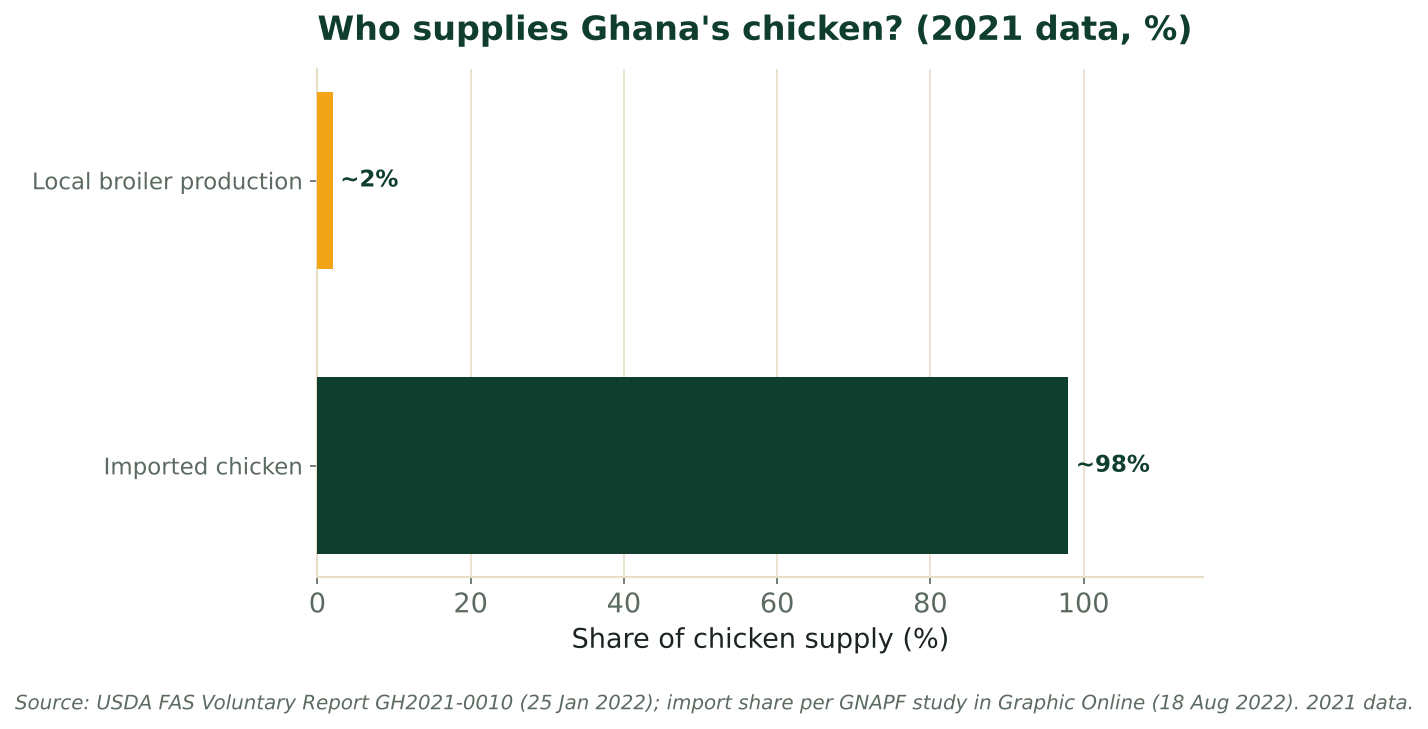
To invest in a poultry farm in Ghana, you put capital into the working parts of a production enterprise: day-old chicks, feed, vaccines, housing, labour and the cash needed to carry a batch to sale. You can do this by building or buying your own farm, by funding a defined batch through a written partnership, or by buying a stake in a company that runs farms. Each route shifts control, capital and risk differently, and none of them guarantees a return. Ghana's chicken market is one of the clearest reasons to look at poultry: local broiler production was estimated to meet only about 2% of chicken demand in 2021. The same market is also exposed to disease, feed costs and policy change, so this guide sets out both the case and the risks.
Written by the Agro Prime Ghana team and reviewed against current market references (Ministry of Food and Agriculture statements reported in January and February 2026, USDA Foreign Agricultural Service data, and a 2022 peer-reviewed study of Ghanaian broiler production). Last updated October 2026. General information, not financial advice.
Key takeaways
Local broiler production was estimated at about 2% of Ghana's chicken demand in 2021, according to the USDA Foreign Agricultural Service. In January 2026 the Sector Minister, Eric Opoku, set 2028 as a target for a possible ban on poultry imports, conditional on local production reaching about 60% of current consumption. A 2022 study found broiler production profitable on cash costs in every system it examined, but unprofitable for some medium-scale farms once depreciation and opportunity costs were counted. Typical broiler grow-out runs 5 to 7 weeks. Disease, feed prices and the timing of sales are the risks that most often decide outcomes.
What you are actually buying
When you invest in a poultry farm, you are buying a share of the cash cycle, not a plot of land or a building. A batch of broilers starts as day-old chicks, consumes feed over several weeks, must be vaccinated and cared for, and is then sold. The money you put in pays for the chicks, feed and running costs until the birds are sold. Whatever is left after the costs of that batch, and after any share owed to the operator, is the return. Housing and equipment matter because they determine how many birds you can run and how well they grow, but they are usually a smaller part of the cash you need for each batch.
That is why the structure of the deal matters as much as the farm. Ask who owns the birds, who pays for each input, who carries losses if mortality is high, and when you receive your share. A farm that looks impressive on a visit can still produce a poor result for you if the agreement is unclear.
The four ways to put money into a poultry enterprise
The table below compares the common routes. The categories are general and will vary by operator and by agreement.
| Route | How much control you have | Capital needed | Time to first cash | Main risk to you |
|---|---|---|---|---|
| Build and run your own farm | Full | High: housing, equipment, working capital | Longest: build, stock, then first batch | Every operating mistake is yours |
| Buy a batch outright (you own the birds) | High, but you need the skills to run it | Medium: chicks, feed, vaccines, labour | Weeks, once the batch is sold | Disease and price in one batch |
| Profit-share partnership on a defined batch | Limited: you rely on the operator's management | Lower: a share of one batch | Tied to the batch cycle | Operator performance and the terms you agreed |
| Shares in a company that runs farms | Minimal | Varies | Depends on dividends or share price | Company performance and market prices |
Why poultry, and why policy matters
The demand case is well documented. The USDA Foreign Agricultural Service's January 2022 Voluntary Report on Ghana estimated 2021 chicken consumption at about 400,000 tonnes and imports at about 350,000 tonnes. Domestic broiler production met only about 2% of demand, and spent layers made up most of domestic chicken meat output. A Ghana National Association of Poultry Farmers study cited by Graphic Online in August 2022 put the imported share of the chicken market at 98%. These figures are dated, so treat them as the direction of the market rather than a live measurement.
Policy is the more recent development. On 26 January 2026, the Sector Minister for Food and Agriculture, Eric Opoku, told GHOne TV that the ministry had set 2028 as a target for a possible ban on poultry product imports. He said the ban was not certain and depended on how much local production Ghana could build. If local producers could meet 60% of current consumption, he said, the policy would be regulation rather than a ban. The stated reasons were protecting local producers from price collapses caused by excessive imports and reducing reliance on foreign meat.
In February 2026, at a stakeholder consultation convened by the ministry's Animal Production Directorate, an Agri Impact specialist said frozen chicken imports supply up to 95% of the market. The same consultation discussed a tenfold increase in domestic poultry production, with a Poultry Sector Master Plan expected later in 2026. No deadline was attached to the tenfold target.
The lesson for an investor is that policy can help a local producer, but it is a moving target. A ban or quota could raise the price local farmers can charge. It could also come later than planned, come in a different form, or never arrive. Build your investment case on today's economics, and treat any future protection as upside, not as a plan.
Where the money goes: the cost structure
A 2022 study in the International Food and Agribusiness Management Review, covering large-scale integrated, medium-scale and small-scale broiler systems in Accra, Kumasi and Dormaa, found that feed and day-old chicks are the most significant cost items. Those two lines will dominate any budget you build. Vaccines, housing upkeep, labour, utilities, transport and the cost of cleaning between batches make up most of the rest.
Feed is where investors most often get caught out. A February 2025 Food Business Africa report, citing the Association of Feed Millers of Ghana, said a 50 kg maize bag had risen from US$16 in January to US$29 at that time, and that starter and finishing feed and soybean meal had more than tripled in price. Those figures are not current. The lesson holds, though: feed can move faster than bird prices, so a batch that breaks even today can lose money after a feed increase. Ask the operator for its feed costs per batch and the dates of the invoices behind them.
For a structured way to test those numbers, see our guides on poultry farm break-even analysis and the poultry business plan. Build the costs from receipts, not from averages you have heard.
How a batch cycle works, and why timing matters
Broilers reach market weight quickly. Appenate's broiler production guide gives a typical grow-out period of 5 to 7 weeks, depending on breed and management. That short cycle is part of the appeal: money is tied up for a shorter time than in a long-term bond or a multi-year project. But the cycle is not the same as the total time your money is committed. Your agreement should show when chicks are delivered, when feed is paid for, when birds are sold and how the proceeds are shared, and whether there is a gap between batches for cleaning and restocking.
Short cycles also mean problems show up fast. A disease outbreak or a price drop affects a batch within weeks, and there may be little time to recover before the next one. That is one reason a poultry investment is better suited to money you can afford to lose than to money you need for the next year.
What a fair partnership agreement should say
Whatever route you take, a written agreement should cover the following. The batch size and the breed. The source of the chicks, with the hatchery and the date of hatch recorded. The vaccination schedule and who keeps the vaccination record. The costs that will be deducted before profit is shared, itemised. How mortality is recorded and how losses are shared. The sale channel and the expected price range, stated as a range rather than a promise. The reporting you will receive and how often. What happens if the operator cannot continue. And how and when your capital and any share of profit will be paid.
If an operator is unwilling to put these points in writing, treat that as a reason to walk away. Serious operators answer detailed questions in writing without fuss.
The risks, stated plainly
Disease is the most serious operational risk. In early 2022, the Ghanaian Times reported that more than 703,966 poultry had been destroyed nationwide in a bird flu outbreak that had hit 10 of Ghana's 16 regions, and that the government planned about GH₵14 million in compensation. More recently, on 3 December 2025, an FAO and Ministry of Food and Agriculture project reported that more than 200,000 birds had been vaccinated against Newcastle disease in the Savannah, North East and Upper East regions. Disease control is therefore a live issue, not a historical footnote. Ask what vaccines the flock receives, when, and whether the records are available.
Feed costs, market prices and imports are the economic risks. The 2022 study noted that imports make local selling seasonal and hit small-scale producers hardest, so prices can be weak at some times of year. Policy is a further risk, because the 2028 import-ban target is conditional and could change. Operator risk is also real: an operator can make mistakes, run short of cash or simply fail. Finally, there is liquidity. Once a batch is placed, your money is usually committed until it sells.
There is also the question of who is offering the opportunity. The Securities and Exchange Commission warned the public on 15 July 2026 about two platforms it said were suspected fraudulent investment schemes, and reported on 22 July 2026 that it had named 23 unlicensed entities. A genuine farm will describe its risks as clearly as its rewards.
Investor note: model your own numbers
Do not rely on a single profit figure from anyone, including us. Build your own simple model using the chick price, feed use per bird, expected mortality, vaccine costs, labour and a range of sale prices. Test a bad case where mortality is higher than expected and feed costs have risen. If the batch only works in the best case, the investment is too fragile for your money.
Where a hatchery-backed partner fits
A hatchery that supplies its own chicks has a direct influence on one of the biggest costs and on early-stage health. Agro Prime Ghana runs a working hatchery in Kasoa, and its partnership model is built around the production batch it controls. That gives a partner one useful question to ask any operator: where do the chicks come from, and can the batch be traced back to its source? Agro Prime Ghana invites people to discuss backing its farming production on a profit-share basis. That is an invitation to discuss terms, not an offer of securities or a guaranteed return.
If you are considering that route, you can see how partnering with Agro Prime works, or message the team on WhatsApp (+233 24 915 1503) with your questions on chick sourcing, vaccination, costs and reporting.
Due diligence before you commit
Start with a site visit, if you can make one. Look at the housing, the biosecurity measures, the stock, the feed store and the records. Then ask for references you can contact yourself, rather than testimonials the operator has chosen. Ask for the batch records: mortality, feed used, vaccines given, sale dates and prices. Check that the business is properly registered and, if your money is being pooled or raised from the public, that it holds the licences required by the Securities and Exchange Commission. Compare the offer with a bank deposit, a Treasury bill and inflation, using current figures.
Finally, start small if you can. A single share of one batch lets you learn how the operator reports, how it handles problems and how payments arrive, before you commit more capital. Consider that a practical test, not a formality.
Investor note: learn the operator before the money
Watch how an operator handles bad news. Ask about the last batch with high mortality or a price drop, and see whether the answer is specific and documented. A clear, honest account of a failed batch is a better sign than a perfect-looking record that cannot be checked.
Who this is and is not for
A poultry investment can suit someone who understands agriculture or is willing to learn it, has money they can afford to tie up and lose, and can live with weaker liquidity than a bank account. It is a poor fit for someone who needs the money back within months, who cannot check records, or who is being pushed to decide quickly. It is also a poor fit for anyone who expects a fixed return. Poultry is a higher-risk asset than a government Treasury bill, and it should be assessed as such. For a fuller look at margins, read whether poultry farming is profitable in Ghana before you decide.
Bottom line
Investing in a poultry farm in Ghana can be a serious way to take part in a domestic food market that still depends heavily on imports. The demand case is real, the cycle is short, and policy may in time favour local production. The risks are equally real: disease, feed, prices, operator performance and weak liquidity. Put the agreement in writing, model the bad case, verify the records and compare the opportunity with current inflation and Treasury bill yields. Do your own research or speak to a licensed adviser before you commit any money.
Frequently asked questions
How much money do I need to invest in a poultry farm in Ghana?
How long does a broiler batch take?
Is poultry farming a safe investment in Ghana?
What is the imported share of Ghana's chicken market?
Will Ghana ban chicken imports?
What are the biggest costs in a broiler batch?
What is the main disease risk for poultry in Ghana?
How do I check if a poultry investment is legitimate?
Sources & further reading
- Starr FM: Govt targets ban on poultry imports to protect local industry, Agric Minister (27 January 2026)
- News Ghana: Ghana targets tenfold poultry production surge to cut imports (February 2026)
- USDA Foreign Agricultural Service: Poultry Voluntary Report, Ghana, GH2021-0010 (25 January 2022)
- Graphic Online: 98% of frozen chicken consumed is imported (18 August 2022)
- International Food and Agribusiness Management Review: Broiler production systems in Ghana (2022)
- Appenate: broiler production guidelines (5 to 7 week grow-out)
- Ghanaian Times: Govt to pay GH₵14m compensation to poultry farmers affected by bird flu (28 January 2022)
- AllAfrica: Ghana, over 200,000 birds vaccinated in three northern regions (3 December 2025)
- Food Business Africa: Ghana's poultry sector struggles as high feed costs pressure farmers (4 February 2025)
- Securities and Exchange Commission Ghana: public notice (15 July 2026)
- Citi Newsroom: SEC names 23 unlicensed online investment schemes (22 July 2026)
About Agro Prime Ghana & a note on risk
Agro Prime Ghana Limited runs a poultry hatchery and mixed agribusiness in Kasoa and invites partners to invest in its farming production through a profit-share on a production batch. This is general educational information, not financial advice, and investing carries risk including loss of capital — always do your own research or consult a licensed adviser. The partner page is an invitation to discuss backing Agro Prime's farming production, not an offer of securities or a guaranteed return. Explore it: see how it works, book a visit, or message WhatsApp (+233 24 915 1503).