Yes, poultry farming can be profitable in Ghana — but the profit is thin, hard-won and utterly dependent on how well you control feed cost and mortality. It is not the easy money it is often sold as. The evidence is clear on both points: a well-run 1,000-bird broiler cycle has shown returns on investment of around 27%, and Ghanaian layer farms average a modest profit of about GH¢2.63 per bird — yet profit efficiency across those same farms averages only about 54%, meaning most keepers leave nearly half their potential profit on the table through poor management. In other words, poultry pays for the disciplined operator and quietly bleeds money for the careless one. This guide gives you the honest economics — broilers versus layers, where the margin comes from, and exactly what drives the line between profit and loss.
Written by the Agro Prime Ghana poultry team and reviewed against current industry references (USDA/FAS Ghana Poultry reports, breed management guides and peer-reviewed Ghanaian profitability studies). Last updated September 2026.
Key takeaways
Poultry can be profitable in Ghana, but margins are tight. Feed is about 70% of production cost, so profit is won or lost mainly on feed price and feed conversion. Broilers offer a fast cash cycle — good strains reach ~2.6–2.8 kg by 42 days at a feed conversion around 1.5–1.6 — while layers give steady income, with a Lohmann Brown laying roughly 320 eggs to 72 weeks. Real Ghanaian data show layer profit averaging about GH¢2.63 per bird and a broiler cycle returning around 27% — when well run. The main profit-killers are high feed cost, mortality near 10% in our climate, poor feed conversion, bad market timing, and competition from imported frozen chicken sold at under half the local price. Profit follows management, not luck.
Is poultry farming actually profitable in Ghana?
Poultry farming in Ghana is profitable for well-managed farms and marginal or loss-making for poorly managed ones — the range is enormous, and management is the deciding variable. The headline evidence is encouraging but qualified. The USDA Foreign Agricultural Service reports that a single-cycle 1,000-bird broiler project remains financially viable, with a return on investment of roughly 27% despite high feed costs. For layers, a study in Scientific African found average profit of about GH¢2.63 per bird, but with a striking spread — from about GH¢1.07 to GH¢9.49 per bird — and a mean profit efficiency of only 54.23%. That last figure is the honest heart of the matter: the average farm could raise its profit by roughly 46% simply by managing better, using the same feed, birds and prices as everyone else.
So the truthful answer is not a simple "yes." It is: profitable if you run it well, in a sector where "well" is difficult and most do not. The difference between the GH¢1 and the GH¢9 layer is not the market — it is feed efficiency, mortality, disease control and shrewd selling. Anyone promising guaranteed, easy poultry profits is selling a story; the real returns go to operators who treat this as the tight-margin business it is.
Why feed decides almost everything
The single most important fact in Ghanaian poultry economics is that feed is about 70% of the total cost of production, as confirmed by profitability research in Scientific African and echoed across the industry. No other cost comes close. That means your profitability is, first and foremost, a feed story: the price you pay for feed, and how efficiently your birds turn it into meat or eggs. Everything else — housing, labour, medication, transport — matters, but they share the remaining 30%. Get feed wrong and no amount of care elsewhere will save the margin.
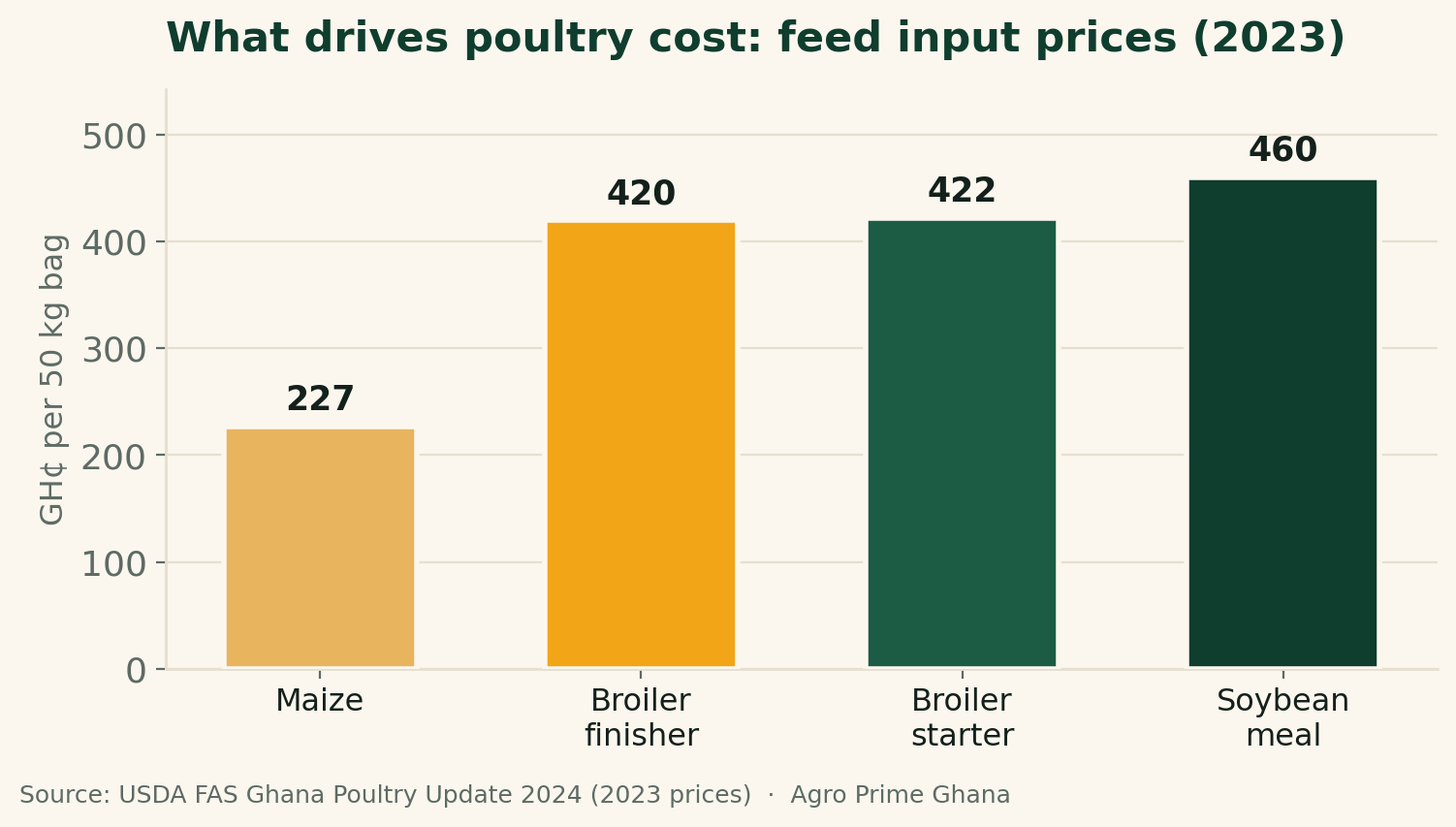
Feed cost is also where the market squeezes hardest, because it is built on maize and soybean meal, whose prices are volatile. In 2023 the USDA reported Ghanaian prices around GH¢227 per 50 kg of maize, GH¢460 for soybean meal, and GH¢420–422 for broiler finisher and starter mash. When maize spikes — after a poor harvest, or when the cedi weakens against import costs — margins can vanish overnight. This is why the profitable farms obsess over two levers: buying feed well (bulk, in season, or mixing their own) and squeezing the best possible feed conversion from every bag. Our guide to reducing poultry feed cost covers the practical moves. If you remember one thing about poultry profit, make it this: you are really running a feed-conversion business that happens to involve birds.
Broilers versus layers: two very different profit shapes
Broilers and layers are both potentially profitable, but they earn money in completely different ways, and the right choice depends on your capital and cash-flow needs. Broilers are a fast, punchy cycle: you buy chicks, feed them intensively for six to eight weeks, and sell — cash in, cash out, several times a year. Good strains such as Cobb 500 and Ross 308 can reach roughly 2.6–2.8 kg by 42 days at a feed conversion near 1.5–1.6 under good conditions. The upside is speed and festival timing; the risk is that everything rests on a short window — a feed spike, a disease hit or a soft market at sale time can turn a cycle negative with no time to recover.
Layers are a slow, steady marathon: you carry pullets for four to five months before the first egg, then earn daily income for a year or more, plus the value of spent hens at the end. A well-managed Lohmann Brown lays around 320 eggs per hen to 72 weeks at peak rates of 94–96%. The upside is a smoother, more predictable income and less exposure to a single sale day; the cost is higher capital and a long wait before any return. The table below lays the two side by side. For a deeper comparison, see broiler vs layer profit.
| Factor | Broilers (meat) | Layers (eggs) |
|---|---|---|
| Time to first income | ~6–8 weeks per cycle | ~4–5 months to first egg |
| Income pattern | Lump sums, several cycles a year | Steady daily/weekly egg sales for 12+ months |
| Key performance number | Feed conversion ~1.5–1.6; ~2.6–2.8 kg by 42 days | ~320 eggs/hen to 72 weeks; peak 94–96% |
| Capital needed | Lower per cycle; faster turnover | Higher; long feeding period before returns |
| Main risk | Feed spike or weak market on a short window | Egg-price dips; disease over a long production run |
| End-of-cycle bonus | — | Spent hens sold (~GH¢30 each) |
What actually drives profit — and loss
Profit in Ghanaian poultry comes down to a handful of levers, and losses come from the same list mishandled. The first and biggest is feed conversion: because feed is 70% of cost, a bird that converts feed efficiently is a profitable bird, and one that wastes feed — through poor genetics, spoiled or poorly formulated rations, disease, or feeder wastage — quietly destroys the margin. The second is mortality: commercial mortality in Ghana runs near 10%, more than double temperate-country levels, per Agricultural and Food Economics, and every dead bird is a total loss that still ate feed on the way out. Cutting mortality from 15% to 5% can be the difference between loss and profit on its own.
The third lever is market timing and price. Local chicken competes with imported frozen cuts sold at under half the price, so you cannot win on price — you win on freshness, quality and timing, especially by aiming broilers at festival peaks when demand and prices rise. The fourth is disease and biosecurity: an outbreak of Newcastle, Gumboro or coccidiosis can erase a whole batch, so prevention is an economic decision, not just a health one. The fifth, often invisible, is management discipline — the daily walking of the flock, the record keeping, the prompt action — which is exactly what separated the GH¢9 layer from the GH¢1 one in the research. Master these five and profit follows; neglect any of them and the tight margin turns red.
Field note: the birds you start with set your ceiling
One truth we see over and over: the profitability of a flock is largely decided on day one, by the quality of the chicks. Weak, poorly hatched or unvaccinated chicks carry higher mortality and poorer feed conversion all the way through — and since feed is 70% of your cost, a bird that eats like a champion but grows like a weakling is pure loss. Strong, healthy, well-vaccinated chicks cost a little more up front and repay it many times over in survival and growth. When keepers come to us after a bad, loss-making batch, the problem often traces right back to where and how the chicks were sourced. You cannot manage your way out of bad genetics or a bad hatch; start with good birds and give your management something to work with.
A realistic picture of the margin
Putting the numbers together gives a sober but workable picture. On the layer side, Ghanaian research found average profit around GH¢2.63 per bird, and a separate analysis of commercial-feed layer units estimated net returns of roughly GH¢2.14 per bird per year — modest per-bird figures that only become meaningful income at scale and with good management. That is why the same study found increasing returns to scale of about 1.56: bigger, well-run flocks are more efficient per bird, which is one reason very small farms struggle to make real money. On the broiler side, the ~27% single-cycle return is attractive precisely because you can repeat it several times a year — but each cycle carries full feed-price and market risk.
Field note: small percentages are the whole game
Newcomers look for the one big trick that makes poultry profitable. There isn't one — there are lots of small percentages that compound. Because the per-bird margin is so thin, shaving your feed conversion by even a tenth of a point, or dropping mortality by a few percent, or cutting feeder wastage, each moves real money, and stacked together they turn a marginal flock into a comfortable one. We have seen two keepers buy the same chicks and the same feed and end a broiler cycle with completely different results, purely because one weighed feed, fixed leaking drinkers, and acted on sick birds the same day. The profit is hiding in the discipline, not in a secret.
The practical takeaway is that per-bird margins are thin, so profit comes from three things stacked together: doing many birds, doing them efficiently, and doing them repeatedly (broilers) or over a long, well-managed run (layers). A handful of birds managed casually will not build wealth; a well-run flock at sensible scale, with tight feed and mortality control, genuinely can. And because the per-bird margin is small, small improvements compound: shaving a few points off feed conversion or mortality moves the whole enterprise from marginal to comfortably profitable.
Start profitable: strong chicks, the right feed, a plan that fits your market
Because poultry margins are thin, profit starts with the basics done right — and that is where we help. Agro Prime Ghana supplies healthy, vaccinated day-old chicks (broilers and layers) and point-of-lay pullets bred for local conditions, along with quality feed and straight advice on feed conversion, batch timing and selling into festival demand. If you want to raise a flock that actually pays — rather than one that eats its way to a loss — talk to us about the right birds and feeding plan for your budget and market. Message on WhatsApp +233 24 915 1503 or book a visit to the hatchery in Kasoa.
How to make poultry pay in Ghana: the practical shortlist
If profitability is mostly about management, then making poultry pay comes down to a short, unglamorous checklist done consistently. Buy strong, healthy, vaccinated chicks so mortality and feed conversion start in your favour. Treat feed as the profit centre it is: buy well, store it safely, formulate or choose it properly, and cut feeder wastage — every improvement in feed conversion drops straight to the bottom line. Keep mortality low with real biosecurity, vaccination and good climate management, because in our heat a careless flock loses birds fast. Time your market: aim broilers at festival peaks and build reliable egg customers who pay on time. Keep records so you know your real feed conversion, mortality and cost per bird — you cannot improve what you do not measure, and record keeping is where hidden losses are found.
Above all, respect the tightness of the margin. Do not overpay for chicks or feed, do not overcrowd, do not skip vaccinations to save a few cedis, and do not assume a high sale price you cannot defend against imports. Poultry rewards the operator who does the ordinary things well, every single day. The farms making real money in Ghana are almost never the ones with the fanciest setups — they are the ones with the best feed conversion, the lowest mortality and the tightest discipline.
The bottom line on poultry profitability in Ghana
Poultry farming is profitable in Ghana for the farmer who earns it. The market is large and growing, real returns exist — around 27% on a well-run broiler cycle and a few cedis of profit per layer that add up at scale — but the margin is thin and unforgiving, dominated by feed at roughly 70% of cost and eroded by mortality near 10% and by imports priced at under half of local chicken. The wide gap in the research between the most and least profitable farms is the whole story: same market, same prices, radically different results, decided almost entirely by management. Control your feed cost and feed conversion, keep birds alive and healthy, time your selling, and run at sensible scale, and poultry will pay. Treat it casually, and it will quietly cost you. Profit here is not luck — it is discipline, measured one bag of feed and one surviving bird at a time.
Frequently asked questions
Is poultry farming profitable in Ghana?
Which is more profitable, broilers or layers?
Why is feed so important to poultry profit?
How much profit can I make per bird?
What are the main reasons poultry farmers lose money?
How do I compete with cheap imported frozen chicken?
How much mortality is normal and how much does it cost me?
Can a small-scale poultry farm be profitable?
Sources & further reading
- USDA Foreign Agricultural Service — Ghana Poultry Voluntary Update 2024 (broiler cycle ROI, feed prices, production vs imports).
- Scientific African — Profit efficiency of layer production in Ghana (average profit per bird, profit efficiency, returns to scale).
- Scientific African — Profitability and choice of feed among poultry producers in Ghana (feed at ~70% of production cost, per-bird net returns).
- Agricultural and Food Economics (Springer) — Evidence from the poultry sector of Ghana (mortality ~10%, import competition, consumption).
- Lohmann Breeders — Lohmann Brown-Classic performance data (eggs per hen, peak lay, feed conversion).
- Agro Prime Ghana guides: broiler vs layer profit, reducing feed cost, Cobb 500 guide, Lohmann Brown guide, and record keeping.
About Agro Prime Ghana
Agro Prime Ghana Limited runs a poultry hatchery and mixed agribusiness in Kasoa, supplying farmers nationwide. We supply healthy day-old chicks (broilers & layers), point-of-lay pullets, quality feed and hands-on farm support, and we help keepers raise flocks that actually turn a profit. This article is general educational information, not a substitute for professional business or veterinary advice tailored to your farm. Ready to start or expand? Book a visit or message us on WhatsApp (+233 24 915 1503) to order chicks, feed or advice.