A break-even analysis for a poultry farm tells you the exact number of birds you must sell, or the exact price per bird or per crate of eggs, at which your income just covers all your costs — the point where you stop losing money and start making it. You calculate it by separating your costs into fixed (housing, equipment, permanent labour — these don't change with flock size) and variable (chicks, feed, drugs — these rise with every bird), then dividing your fixed costs by the profit each bird contributes after its own variable cost. Knowing this single number changes how you run the farm: it tells you whether a batch size is viable before you buy a chick, what price you must not sell below, and how much room you have when feed prices jump. This guide explains fixed versus variable costs in Ghanaian terms, walks through a full worked example for broilers and for layers using real current costs, and shows how to use the result to make decisions.
Written by the Agro Prime Ghana poultry team and reviewed against current industry and production references (GAPFA feed prices, Ghana broiler performance studies and Lohmann layer data). Last updated September 2026.
Key takeaways
Break-even is where total income equals total cost — no profit, no loss. Split costs into fixed (housing, equipment, fixed labour) and variable (chicks, feed, drugs), where feed is 70–80% of running cost. The core formula is break-even birds = fixed costs ÷ (selling price per bird − variable cost per bird). For broilers, variable cost is driven by feed: a bird eats about 4.1–4.5 kg to reach ~2.5–2.6 kg at 42 days, and at 2026 GAPFA prices (~GH₵380–400 per 50 kg bag) that is roughly GH₵34–40 of feed per bird. Always add a mortality allowance (survivors carry the cost of those that died) and a safety margin. Know your break-even price before you sell — it is the floor you must never drop below.
What break-even analysis is and why it matters
Break-even analysis finds the point at which a farm's total revenue exactly equals its total cost — neither loss nor profit. Below that point you are subsidising every bird from your own pocket; above it, each additional bird sold is profit. For a Ghanaian poultry farmer this is one of the most practical numbers you can own, because it converts a vague hope that "poultry is profitable" into a hard target: sell this many birds, at this price, or you lose money. It answers the questions that matter before you spend: Is a batch of 500 worth running given my fixed costs? What is the lowest price I can accept on market day? How far can feed prices rise before this flock stops making sense? In a sector where feed prices swing hard and margins are thin, knowing your break-even is the difference between selling from knowledge and selling in the dark. If you are still deciding whether to run broilers or layers, pair this with our comparison of broiler versus layer profit in Ghana.
Fixed costs vs variable costs — the crucial split
Every break-even calculation starts by sorting your costs into two groups, and getting the split right is what makes the analysis useful. Fixed costs do not change with how many birds you keep in the short run: the poultry house (or its rent and depreciation), cages, feeders and drinkers, a borehole or tank, equipment depreciation, permanent salaried labour and licences — whether you stock 300 birds or 1,000, these cost roughly the same. Variable costs rise directly with each bird: day-old chicks, feed, vaccines and drugs, litter, brooding fuel, casual labour and transport. Feed dominates this group — it is 70–80% of operating cost according to a study of Ghanaian poultry producers — which is why anything that changes feed cost or feed conversion moves your break-even more than almost anything else. The split matters because fixed costs are spread across however many birds you sell, so more birds means a lower fixed cost per bird, while variable cost per bird stays roughly constant — the relationship at the engine of the break-even formula.
The break-even formula in plain terms
Each bird you sell brings in its selling price but has already cost you its own variable cost; the difference is its contribution — what it puts toward covering fixed costs and, after those are covered, toward profit. You break even when the total contribution from all birds sold equals your fixed costs. In formula terms:
- Contribution per bird = selling price per bird − variable cost per bird
- Break-even number of birds = total fixed costs ÷ contribution per bird
- Break-even selling price = variable cost per bird + (fixed costs ÷ birds sold) — in other words, your full cost per bird, the price below which you must not sell.
For eggs the logic is identical, using contribution per crate (or per egg) instead of per bird. These are not academic formulas — they are the sums that tell you, before a cycle starts, whether it can work, and on market day what your price floor is. The table and worked examples below fill them in with real Ghanaian numbers.
| Cost type | Broiler examples | Layer examples | Behaviour |
|---|---|---|---|
| Fixed | House, feeders/drinkers, brooder, permanent labour | House, cages, feeders/drinkers, permanent labour | Same regardless of flock size (short run); spread over birds sold |
| Variable | Chicks, feed, vaccines/drugs, litter, brooding fuel, transport | Pullets, feed, vaccines/drugs, litter, transport, crates | Rise with every extra bird; feed is the biggest by far |
Worked example: break-even for a broiler batch
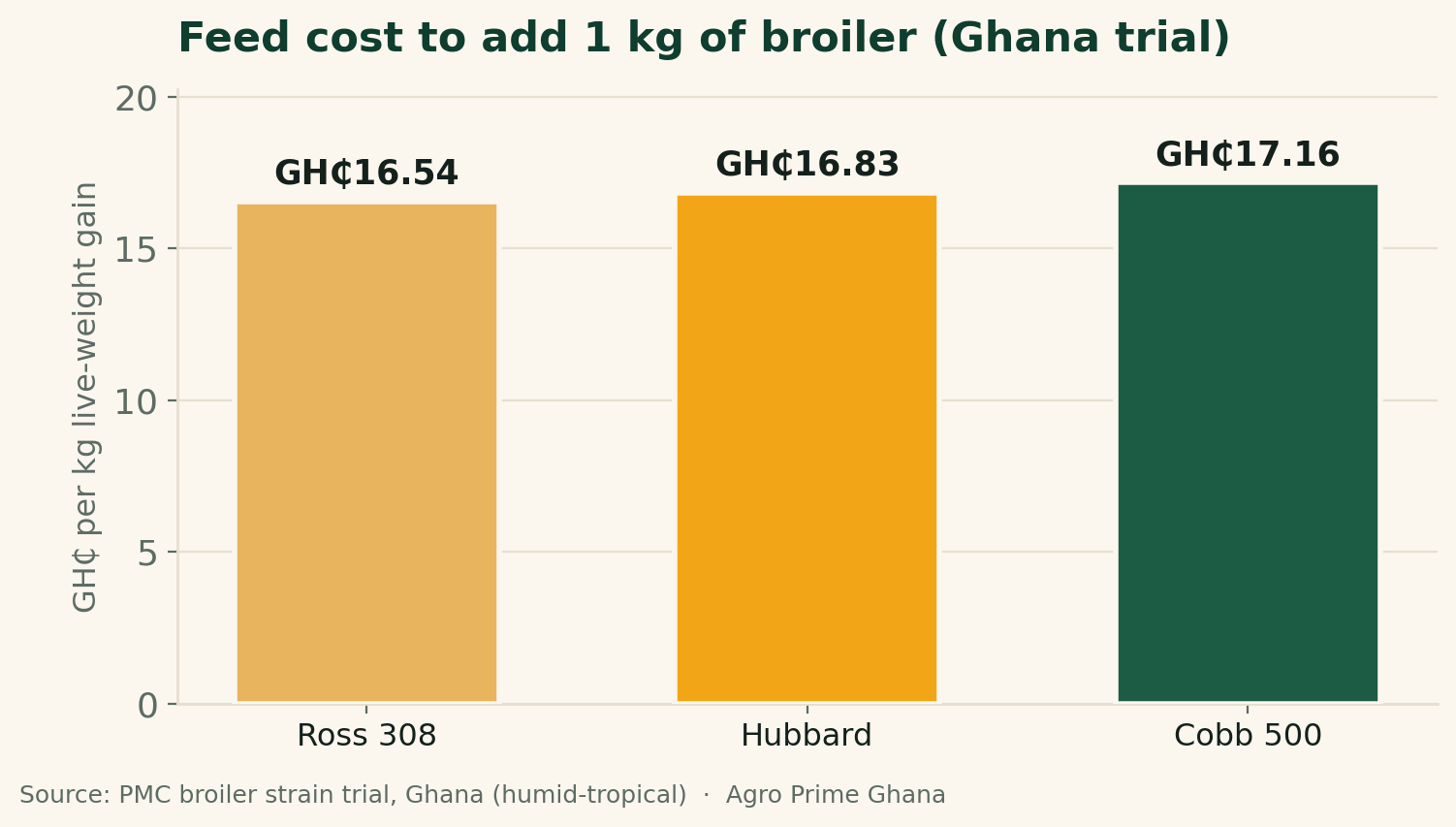
Let's build a realistic broiler example, grounding the big number — feed — in real data and flagging the figures you must replace with your own quotes. A Cobb 500 in Ghana reaches about 2.6 kg at 42 days on roughly 4.5 kg of feed, per a Ghana strain trial. At 2026 GAPFA prices of about GH₵380–400 for a 50 kg bag of broiler feed — roughly GH₵7.6–8.0 per kg — that is about GH₵36 of feed per bird. Now add the other variable costs (use your own quotes): the day-old chick, vaccines and drugs, litter, brooding fuel and transport. Suppose those bring your total variable cost to around GH₵60 per bird, feed being the dominant chunk. Critically, apply a mortality allowance: if you place 1,000 chicks and 5% die — the trial's rate for Cobb 500 — you only sell about 950, so the cost of the 50 dead birds must be carried by the survivors, nudging the effective cost per sold bird up. Then bring in fixed costs (house, equipment depreciation, fixed labour), spread across the batch. The break-even sums are then:
- Contribution per bird = your selling price per finished bird − ~GH₵60 variable cost.
- Break-even birds = fixed costs for the cycle ÷ contribution per bird — the number you must sell just to cover everything.
- Break-even price = variable cost per sold bird + fixed cost per bird = the price floor for the whole batch.
The discipline is to plug in your real chick, feed and selling prices, keep feed anchored to a published rate, and never forget the mortality adjustment — the step most farmers skip, and why real results fall short of paper ones.
Field note: mortality is where paper break-evens go wrong
When farmers show us a break-even that looked comfortable but the real cycle disappointed, the culprit is almost always mortality left out of the sum. Every chick that dies still cost you its share of chicks, feed to that point, and a slice of your fixed costs — and that money has to be recovered from the birds you do sell, so a plan built on 1,000 sold when you realistically sell 940 quietly shifts your true break-even upward. We build every projection on survivors, not birds placed, and treat a few percent mortality as normal. Healthy, uniform, well-vaccinated chicks are the cheapest way to keep that allowance small.
Worked example: break-even for layers and eggs
Layers break even on eggs, and the arithmetic runs per crate. A Lohmann Brown hen at peak lays at about 94–96% and eats roughly 110–120 g of feed a day, per the Lohmann Brown management guide. At around 115 g/day and 95% lay, each egg carries about 120 g of feed; at 2026 GAPFA layer mash of about GH₵357 per 50 kg bag (roughly GH₵7.1 per kg), that is roughly GH₵0.86 of feed per egg, or about GH₵26 of feed per 30-egg crate — again the dominant variable cost. To that add the smaller per-egg shares of drugs, litter, transport and crates, then compare with the crate price to get contribution per crate. The layer break-even also has to reckon with the long unpaid rearing period — a bird reared from day-old eats for about twenty weeks before its first sellable egg, which is why many farmers buy point-of-lay pullets. Our layer feeding guide covers keeping that feed cost per egg as low as possible.
What moves your break-even the most
Because feed is 70–80% of running cost, the levers that shift your break-even most are all about feed and biology. Feed price is the obvious one — a jump in maize or feed pushes your break-even bird count or price straight up, which is why hedging feed cost (buying ingredients at harvest, storing well, mixing your own where sensible) matters so much; see reducing poultry feed cost. Feed conversion is the quieter lever: birds that convert feed efficiently reach weight or lay on less feed, lowering variable cost per bird and pulling your break-even down. Mortality raises break-even by concentrating costs on fewer survivors. Selling price and market timing widen or narrow contribution per bird — a batch sold into festive-season demand has far more headroom above break-even. And flock size spreads fixed costs: too small a batch means each bird carries a heavy fixed-cost share, which is why very small flocks often struggle to clear break-even at all. Good broiler feeding and management improve conversion and survival together — the two variables that decide whether you clear break-even comfortably.
Know your numbers before you stock — we'll help you fill them in
A break-even is only as good as the unit costs inside it, and the two that matter most — feed use per bird and mortality — depend heavily on the quality of the stock you start with. We supply healthy, uniform, well-vaccinated day-old chicks and point-of-lay pullets, and can give you realistic figures for feed consumption, performance and mortality to drop straight into your calculation — and we are happy to work through the break-even for your planned batch size before you commit. Message us on WhatsApp (+233 24 915 1503) or book a visit to run your numbers with us.
Field note: run the sum again at a higher feed price
Before we commit to a batch, we recalculate the break-even a second time with feed priced 20–30% higher than today's, because feed is the one big cost that can move against you mid-cycle. If the batch still clears break-even at that stressed price, we place it with confidence; if it only works at today's price, we know we are exposed and either shrink the batch, lock in feed early, or wait. That five-minute second sum has talked us out of more than one loss-making batch.
Using break-even to make real decisions
The point of the number is to act on it. Once you know your break-even, use it in four concrete ways. First, test batch size: if your break-even bird count is close to or above the flock you can realistically manage and sell, the batch is too small — scale up or rethink. Second, set your price floor: your break-even price per bird or per crate is the number you must never sell below except to salvage a distressed flock; going in to negotiate without it is how farmers get talked into loss-making prices. Third, stress-test feed: recalculate break-even at a feed price 20–30% higher and see whether the batch still works, so you know your exposure before it bites. Fourth, track actuals against plan: keep records so you can compare your real break-even each cycle with the projected one; our guide to record keeping on a poultry farm covers the registers that make this possible. A break-even you calculate once and file away is trivia; one you use to size batches, set prices and stress-test feed is a management tool.
The bottom line on poultry break-even in Ghana
Break-even analysis turns "is poultry profitable?" into a precise, actionable target: the number of birds you must sell, and the price you must not drop below, to cover every cost. Build it by splitting costs into fixed (housing, equipment, labour) and variable (chicks, feed, drugs), remembering that feed alone is 70–80% of running cost. Anchor the big variable — feed — in real figures: roughly GH₵36 for a broiler to 2.6 kg, or about GH₵26 per crate of eggs at current prices. Divide fixed costs by contribution per bird or crate to find your break-even, always adjust for mortality, and add a safety margin. Then use the number — to size batches, set a price floor, stress-test feed-price rises, and check each cycle against plan. A farmer who knows their break-even never accidentally runs a batch that cannot pay for itself.
Frequently asked questions
What is break-even analysis for a poultry farm?
What is the difference between fixed and variable costs in poultry?
How do I calculate break-even number of birds?
How much does feed cost per broiler in Ghana?
What is the break-even price and why does it matter?
Why must I include mortality in the calculation?
What lowers a poultry farm's break-even point?
How do I do a break-even for eggs?
Sources & further reading
- GAPFA — current poultry feed prices in Ghana (2026).
- ScienceDirect — feed choice and profitability among Ghanaian poultry producers (feed 70–80% of operating cost).
- PMC — broiler strain performance under humid-tropical conditions in Ghana (weight, feed intake, FCR, mortality).
- Lohmann Breeders — Lohmann Brown-Classic management guide (lay rate and feed intake).
- Agro Prime Ghana guides: broiler versus layer profit, reducing poultry feed cost, broiler feeding guide, record keeping.
About Agro Prime Ghana
Agro Prime Ghana Limited runs a poultry hatchery and mixed agribusiness in Kasoa, supplying day-old chicks and working alongside poultry keepers across the country. We supply healthy day-old chicks (broilers and layers), point-of-lay pullets, quality feed and hands-on farm support across Ghana. This article is general educational information, not a substitute for professional financial or agronomic advice. Want help running the break-even for your next batch? Book a visit or message us on WhatsApp (+233 24 915 1503) to order chicks, feed or advice.