To evaluate an agribusiness investment in Ghana, check six things before you pay: who runs the operation and whether their history can be verified, whether the numbers are built from real costs, what the main risks are and who bears them, what written document gives you rights, how your money is protected if things go wrong, and how and when you can exit. No checklist removes risk, and no operator can promise a return. A good process makes it much harder to be surprised by the outcome, and it gives you a clear reason to walk away when the answers are weak.
Written by the Agro Prime Ghana team and checked against Bank of Ghana auction results and Ghanaian news reporting (September and October 2026). Last updated October 2026. General information, not financial advice.
Key takeaways
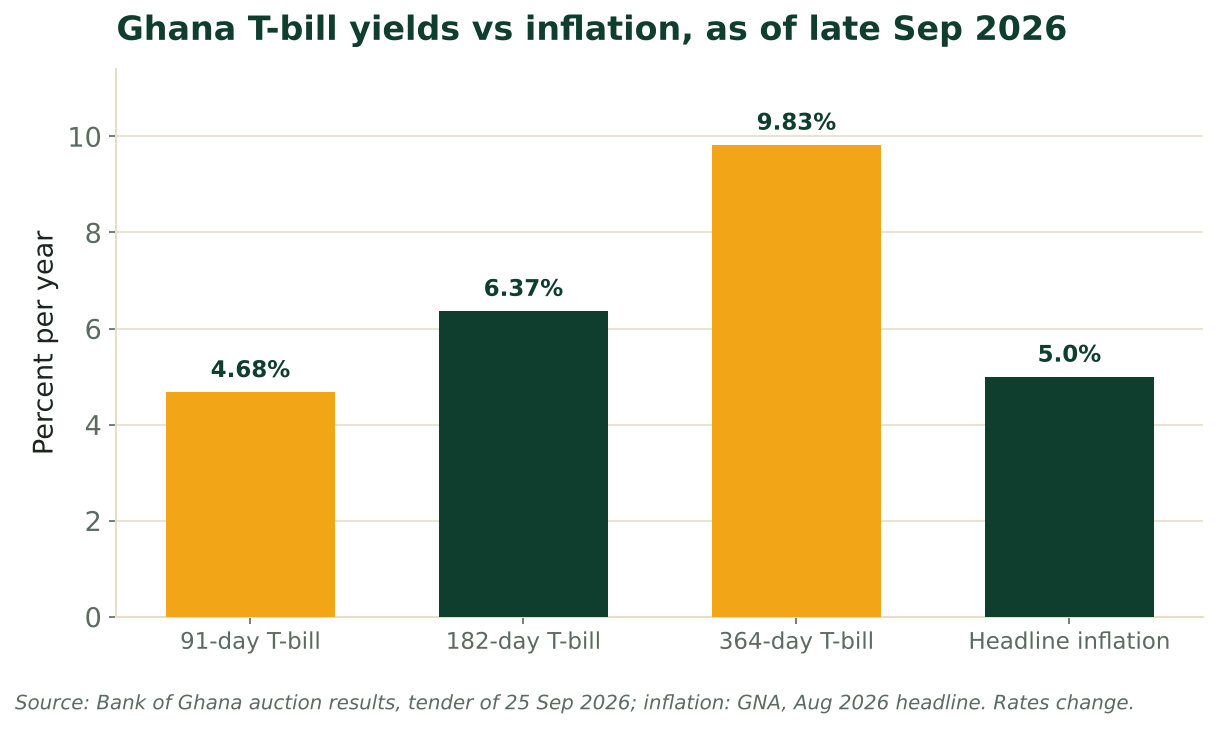
Agribusiness in Ghana has a real demand story: imports have supplied between 80 and 95 percent of chicken consumption, according to February 2026 reporting. That is a market signal, not a return. Compare any farm opportunity with benchmark rates you can check: as of the 25 September 2026 Treasury bill tender, the 91-day bill paid a weighted average of 4.68 percent and the 364-day bill 9.83 percent, while headline inflation was 5.0 percent in August 2026. Test the operator, the cost model, the risks, the contract, the money protection and the exit before you commit. If a pitch promises a fixed return, treat that as a warning.
Why agribusiness draws investors in Ghana, and why that is not enough
Agriculture is one of the few sectors where the demand is visible every day. Chicken, eggs and maize are bought in every market, and government policy has repeatedly named poultry as a priority for import reduction. In February 2026, the Ministry of Food and Agriculture was reported to be drafting a Poultry Sector Master Plan, and the Ministry's own consultations described domestic output as well below national demand. The HAPPY Programme was reported to have raised about 4.6 million birds between December 2023 and December 2025.
None of this tells you whether a particular farm will make money. Demand can be strong while a single operator has high mortality, weak cost control or a poor sales channel. The first job of due diligence is to separate the sector story from the specific investment in front of you.
Test 1: The operator
Most agribusiness losses trace back to the people running the operation, not to the market. Start with what you can verify.
- Legal existence. Ask for the company's registration details and check them with the Registrar-General's Department. A business name on a brochure is not the same as a registered company.
- A physical site you can visit. A farm, hatchery or processing unit should be somewhere you can see working. If a visit is refused or always postponed, note it.
- A track record you can test. Ask how many production cycles the operator has completed, what breed or product was used, and what the results were. Ask to speak to a previous participant. A good operator will welcome this.
- Management depth. Find out who manages day-to-day production, who handles veterinary decisions, and what happens if the main manager leaves.
Agro Prime Ghana runs a hatchery in Kasoa, so the same questions apply to us. You can book a visit and check the site yourself.
Test 2: The numbers
A projection is only as good as its assumptions. Ask for the spreadsheet, not just the headline. Look for these items:
- Cost per bird sold. This should include chicks, feed, vaccines, labour, power, water, transport, litter and a realistic mortality allowance. A figure without the breakdown is not usable.
- Feed as a share of cost. In broiler production feed is usually the largest running cost, so a sensitivity test on feed price matters more than any other line.
- Mortality and weight assumptions. Ask what mortality and average weight the model uses, and where those numbers came from. Ask for the actual results of earlier batches.
- Sale price. Find out whether the price is fixed by contract, set by the market, or simply assumed. A model that holds the price at today's level for a whole cycle is making a bet you should understand.
- Timing. For a short broiler cycle, count the weeks from chick arrival to cash received, not just to sale.
Then compare the expected outcome with what you could earn without operational risk. In late September 2026, the Bank of Ghana's 91-day Treasury bill tender produced a weighted average interest rate of 4.6785 percent, the 182-day bill 6.3701 percent and the 364-day bill 9.8339 percent, according to the Bank of Ghana's auction results. Headline inflation was 5.0 percent in August 2026, up from 4.6 percent in July, as reported by the Ghana News Agency. An agribusiness stake that cannot clearly beat those benchmarks after its risks should be questioned.
Test 3: The risks
Every agribusiness has a list of risks. A serious operator can name them and say what it does about each one. Write down the top five for the specific investment and ask how each is managed.
- Disease. A single outbreak can wipe out a batch. Ask about the vaccination programme, biosecurity, and whether the operator has a vet on call.
- Input cost. Feed, drugs and energy costs can rise during a cycle. Ask whether the sale price moves with input costs or stays fixed.
- Market and buyer concentration. If one buyer takes all output, late payment or a broken relationship can hurt badly.
- Policy. Import rules change. A USDA FAS report on a Bank of Ghana measure described a foreign exchange restriction on a list of imported products, including poultry, introduced to implement a presidential directive. Local producers benefit from some policy moves and are exposed to others.
- Infrastructure. Power interruptions, water supply and transport can all affect birds and deliveries.
- Operator failure. If the operator runs short of cash, what happens to your stake?
Test 4: The legal structure
The most useful protection you can get is a written document that says what you own, what you are owed and how disputes are settled. Ask for it before you pay, and have a lawyer or licensed adviser read it. Check these points:
- Does the document name the operator and you, with clear registration details for both?
- Does it describe what your money buys, such as a share of a specific batch or a share of profit, and does it say what happens to that share if the batch fails?
- Does it define every cost that will be deducted from the batch, and who approves them?
- Does it set out payment dates, reporting frequency and the records you will receive?
- Does it give a dispute route and a governing law?
Licensing matters too. The Securities and Exchange Commission Ghana regulates capital market and investment products. In July 2026 it named 23 unlicensed online investment schemes and advised the public to verify the licensing status of any company offering investment products before committing funds, as CitiNewsroom reported. A farm does not have to be a securities offer to be a legitimate business, but you should ask the operator to explain which legal category its investment falls into.
Test 5: How your money is protected
This question is often skipped and it should not be. A profit-share stake in a farm batch is not a bank deposit, and you should not assume a deposit-style guarantee. Ask directly:
- What assets back the batch, and are they registered in the operator's name or yours?
- If the operator stops trading, who owns the birds, feed and equipment at that point?
- Is there any security or guarantee, and from whom? If the answer is none, that is a legitimate answer, but you should know it before you pay.
- Are funds held in a separate account for the batch, or mixed with the operator's general money?
An honest operator will answer plainly, even when the answer is that protection is limited.
Test 6: The exit
Agribusiness is usually illiquid. Your money may be locked into a cycle, and you may only get it back when the birds are sold and costs are settled. Before you commit, write down:
- When will you receive your first settlement, and what triggers it?
- Can you sell or transfer your stake to someone else? On what terms?
- What is the process if you need your money back early, and what does it cost you?
- What happens to your stake if you do not respond to requests for information?
Red flags that should stop you
Some warning signs are reliable enough to act on. Stop the process if you see any of these:
- A guaranteed or fixed return, especially one well above prevailing Treasury yields.
- Pressure to pay quickly or before you have read the contract.
- Returns said to be paid from new investors' money, or a recruitment element.
- No written terms, or terms that change after you pay.
- Refusal to share cost breakdowns, batch records or the names of previous participants.
- No verifiable address, registration or site.
Comparing agribusiness with the alternatives
An investment case is stronger when it is set against the realistic alternatives. The table below uses dated reference points you can check yourself. It is not a recommendation to choose any of them.
| Option | Typical horizon | Liquidity | Main risks | Dated reference |
|---|---|---|---|---|
| 91-day Treasury bill | About 3 months | High | Rates reset at each auction; may not keep pace with inflation | 4.68% weighted average, tender of 25 Sep 2026 |
| 364-day Treasury bill | One year | Moderate | Rates reset at each auction; income rate can fall | 9.83% weighted average, tender of 25 Sep 2026 |
| GSE-listed equities | Open-ended | Depends on the stock | Prices can fall sharply, including after strong gains | GSE Composite Index up 72.5% year to date, week to 21 Aug 2026 |
| Agribusiness batch stake | One cycle plus settlement, often months | Low | Disease, costs, payment timing, operator and legal risk | No guaranteed return; depends on written terms |
The GSE figure comes from a market wrap dated 24 August 2026. The index had gained about 73 percent from the start of 2026 by March, which is a reminder that strong recent returns do not predict future returns. Equities can fall as quickly as they rise.
Investor note: a high headline rate is a question, not an answer
When an agribusiness pitch quotes a high percentage, ask what it is a percentage of, over what period, after which costs, and whether it is a projection or a result. A rate of return that has not been tested against a real batch, after feed and mortality, tells you very little.
A simple decision process
Once you have worked through the six tests, you should be able to write a short paragraph answering four questions: who is running this, what are the numbers and their weak points, what can go wrong and who bears it, and how do I get my money back. If you cannot answer one of those in writing, you do not yet have enough information to decide.
You may also want a second opinion from a licensed financial adviser, particularly on tax, legal structure and how the investment fits the rest of your savings. Bring the written terms, the cost model and your own list of questions.
If Agro Prime's partner offer is one you are considering, you can see how partnering with Agro Prime works and bring this checklist with you. For questions about the terms, message us on WhatsApp (+233 24 915 1503). The partner page is an invitation to discuss backing farming production, not an offer of securities or a guaranteed return.
Read the operating economics before you judge the deal
The cost model is easier to test if you understand the batch. Our guides to writing a poultry business plan and poultry farm cash flow explain the usual line items and the timing of money in and out. The break-even analysis shows how many birds must sell, and at what price, before a batch covers its costs. A broader look at whether poultry farming is profitable in Ghana covers where profit usually comes from and where it disappears.
Frequently asked questions
What is the first thing to check in an agribusiness investment?
What benchmark should I compare a farm investment against?
What costs should a poultry batch model include?
Is an agribusiness stake guaranteed to pay?
How can I check whether an investment company is licensed in Ghana?
What documents should I ask for before paying?
What if the operator runs into trouble?
Can I get my money back early?
Sources & further reading
- Bank of Ghana: Treasury bill auction results 2026 (tender of 25 September 2026)
- Ghana News Agency: Bank of Ghana maintains policy rate at 14 per cent (25 September 2026)
- MyJoyOnline: T-bill yields, week of the mid-year budget review (26 July 2026)
- FoodBusiness MEA: Ghana plans tenfold increase in poultry production to cut import reliance (16 February 2026)
- USDA Foreign Agricultural Service: Ghana, Bank of Ghana announces policy restricting poultry and rice imports
- CitiNewsroom: SEC names 23 unlicensed online investment schemes (22 July 2026)
- African Markets: GSE Composite Index crosses 15,000 after a 73 percent rally (10 March 2026)
- Market wrap: GSE Composite Index week to 21 August 2026 (24 August 2026)
- Securities and Exchange Commission Ghana
- Bank of Ghana
- Ghana Stock Exchange
About Agro Prime Ghana & a note on risk
Agro Prime Ghana Limited runs a poultry hatchery and mixed agribusiness in Kasoa and invites partners to invest in its farming production through a profit-share on a production batch. This is general educational information, not financial advice, and investing carries risk including loss of capital — always do your own research or consult a licensed adviser. Agro Prime is the operator named in this article, so read it as written by an interested party. Explore it: see how it works, book a visit, or message WhatsApp (+233 24 915 1503).