Extending the laying cycle means keeping a layer flock productive well beyond the usual 72–80 weeks — modern hens can lay close to 500 eggs in a single cycle out to around 100 weeks of age without moulting, if you feed and manage them for it. Whether a longer cycle pays in Ghana depends on the birds still laying enough saleable, sound-shelled eggs to beat the cost of buying and rearing replacement pullets. The limiting factor is rarely the hen's genetic potential — she is born able to lay far more eggs than she ever will — but rather nutrition and health, especially keeping enough calcium flowing to build good shells as she ages. For a Ghanaian layer farmer facing high point-of-lay pullet prices and expensive feed, squeezing an extra 15–25 weeks of good lay out of an existing flock can be one of the cheapest eggs you will ever produce. But it only works if shell quality and lay rate hold up. This guide explains how longer cycles work, what it takes to sustain one, and how to judge when to keep a flock versus replace it.
Written by the Agro Prime Ghana poultry team and reviewed against current industry references (Lohmann Breeders feeding guidance, The Poultry Site and peer-reviewed longevity research). Last updated September 2026.
Key takeaways
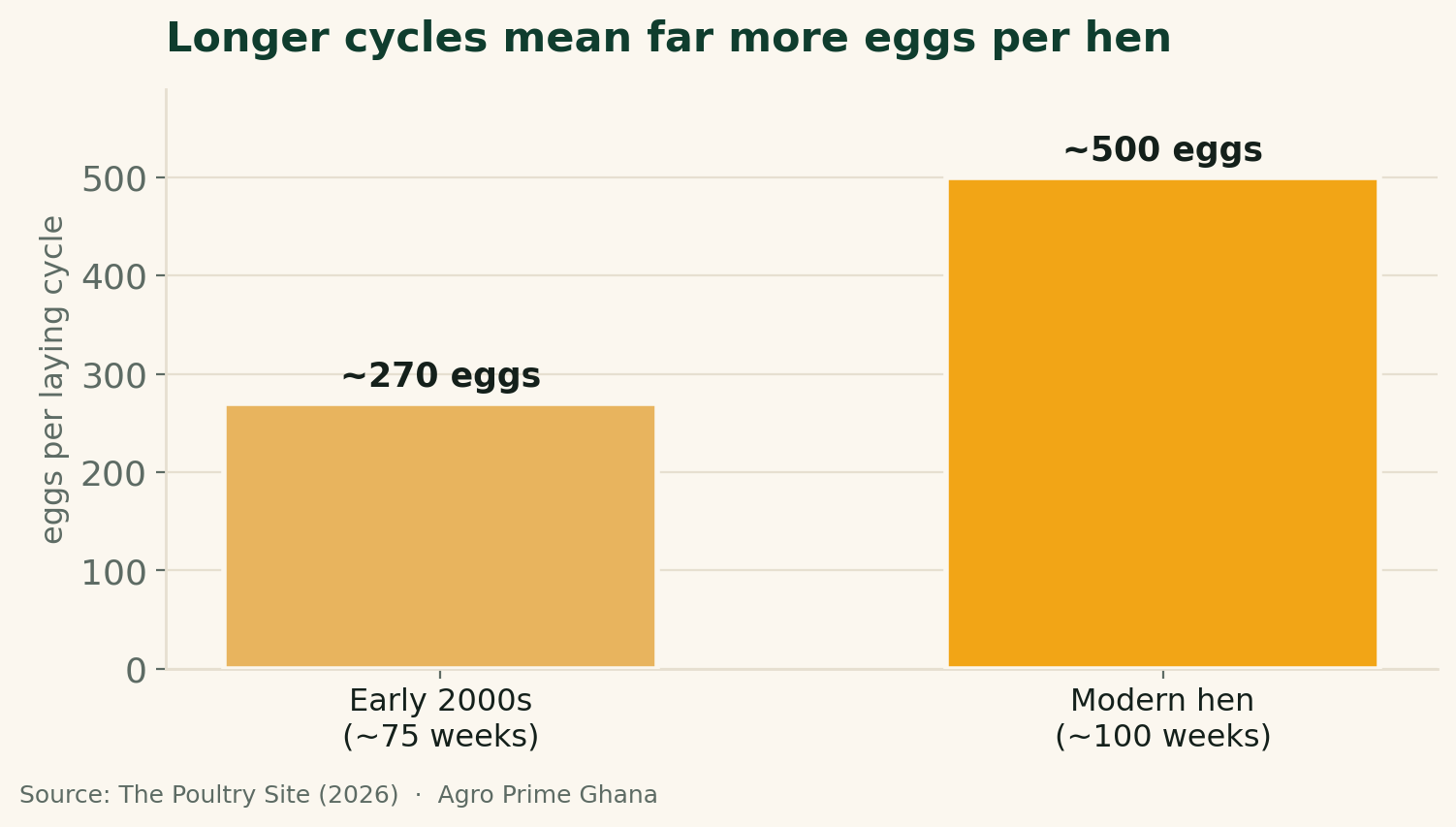
Thanks to genetic and management progress, modern layers can produce close to 500 eggs over ~100 weeks, versus about 270 eggs over 70–80 weeks two decades ago — while eating less feed per egg. Lohmann notes hens can be kept up to 80 weeks in production without moulting, with many flocks pushing beyond 90 weeks. The real constraint is nutrition, not genetics: a laying hen needs roughly 3,000 mg of calcium a day for shells but stores only about 1,000 mg in bone, so calcium supply is decisive. Target about 4.1 g calcium per hen per day, using at least two-thirds coarse limestone/oyster shell for overnight shell formation. Egg weight rises about 2.5 g over a cycle while shells thin, so shell quality is the usual limiting factor. A longer cycle pays when eggs stay saleable and sound-shelled and beat replacement-pullet cost — not automatically.
What does "extending the laying cycle" actually mean?
Extending the laying cycle means keeping a single flock laying productively for longer than the traditional endpoint — pushing from the old norm of around 72–80 weeks of age toward 90, 100 weeks or beyond, ideally in one unbroken cycle without an induced moult. The gains over the last two decades have been striking. As reported by The Poultry Site, modern laying hens can now produce close to 500 eggs over 100 weeks, compared with roughly 270 eggs over 70–80 weeks in the early 2000s — and they do it while consuming less feed overall. Lohmann Breeders' guidance on feeding hens to 100 weeks similarly notes that modern layers can be kept "up to 80 weeks in production, without moulting," with a widely used industry goal of 500 eggs per cycle that many flocks now exceed.
The key insight is where the ceiling really is. The Poultry Site's experts stress that a hen "is born with far more egg-producing potential than she'll ever use in her lifetime" — genetics is not the bottleneck. The actual constraints are keeping her healthy, keeping her eating a properly balanced ration, and above all keeping her shells strong as she ages. Get those right and the extra weeks of lay are largely free eggs, produced without the cost of a new set of pullets.
Why a longer cycle is attractive in Ghana
A longer laying cycle is attractive in Ghana chiefly because the biggest fixed cost in egg production — buying and rearing replacement pullets — gets spread over more eggs. Point-of-lay pullets are expensive, and rearing your own ties up feed, housing and roughly four to five months before a single egg is sold. Every extra week you can keep a healthy, productive flock laying is a week you defer that big replacement cost. When a flock has already paid back its rearing investment, the eggs it lays in weeks 80 to 100 are produced against feed cost alone — often the cheapest eggs in the whole cycle. In a market where both pullets and feed are costly, that maths is compelling.
There is a second benefit: fewer flock turnovers mean fewer risky transitions — depopulation, cleaning, brooding a new batch, and the vulnerable early-lay period. But none of this is automatic. A longer cycle only pays if the older flock keeps laying enough saleable eggs with sound shells; an old flock laying at 65% with many cracked, thin-shelled eggs that get rejected at market can easily lose money against fresh pullets. The decision is a genuine calculation, not a default. For the wider economics, see our guide on layer versus broiler profitability.
The real limit: calcium and shell quality
The single biggest factor deciding whether a long cycle succeeds is shell quality, and shell quality is fundamentally a calcium-supply problem. A laying hen needs a very large amount of calcium relative to her size: The Poultry Site puts the daily requirement for shell formation at roughly 3,000 mg, against only about 1,000 mg she can store in her medullary (leg) bone. That gap means she must take in most of each day's shell calcium from feed, more or less continuously — and as she ages, her ability to absorb and mobilise calcium declines while her eggs get bigger, stretching the same shell over more surface. Lohmann notes that egg weight rises by about 2.5 g on average across a cycle, moving from smaller eggs with thicker shells early on to larger eggs with thinner shells later, which makes declining shell strength "a limiting factor toward the end of a long laying cycle." In short: as the flock ages, more calcium is needed for less reliable results, and shells are what usually give out first.
The nutritional answers are specific. Lohmann's guidance targets about 4.1 g of calcium per hen per day for good shell development, delivered as roughly 4.5% dietary calcium at a 90 g/day intake or 3.4% at a 120 g/day intake — so the right dietary percentage depends on how much your flock actually eats. Just as important is the form of calcium: at least two-thirds should be coarse limestone or oyster shell rather than fine powder. Coarse particles sit in the gizzard and release calcium slowly overnight, exactly when the shell is being formed and the hen is not eating. This single change — swapping some fine limestone for coarse grit or oyster shell — is one of the most effective things you can do for an ageing flock. Our guides on calcium for laying hens and grit and oyster shell go into the practical detail, and egg-shell quality problems covers troubleshooting.
Field note: watch the shells, not the calendar
The most useful thing we tell farmers thinking about a long cycle is to let the eggs, not the birds' age, decide the endpoint. Well before you hit any target week, start tracking two things every week: your lay percentage and your proportion of cracked, soft or thin-shelled eggs going to waste or being downgraded. A flock still laying well with sound shells at 85 weeks is worth keeping; a flock the same age throwing a rising tide of seconds and cracks is telling you the cycle is ending, whatever the plan said. Feel a few shells daily and candle or tap-test a sample — the shells will warn you before the spreadsheet does.
Feeding and managing a flock for a long life
Sustaining a long cycle comes down to consistent nutrition matched to actual intake, strong calcium in the right form, controlled egg weight, and tight health and body-condition management. The practical building blocks:
- Feed to actual performance, not just age. The Poultry Site stresses adjusting the ration to how the flock is really performing rather than following a fixed by-age schedule. Weigh birds and monitor intake and lay rate, and formulate from those numbers.
- Get calcium right — amount and form. Aim near 4.1 g/hen/day, with at least two-thirds as coarse limestone or oyster shell for overnight shell building. This is the biggest single lever for a long cycle.
- Control egg weight to protect shells. Because bigger eggs mean thinner shells, Lohmann advises holding energy steady while gently reducing crude protein and amino acids later in lay to stop eggs getting too large — the opposite of pushing for maximum egg size. This directly trades a little egg size for better shell integrity and a longer usable cycle.
- Protect body condition and start early. Extended-cycle success is set up in rearing and early lay, not rescued at the end. A well-grown pullet with good skeletal reserves and steady early-lay nutrition has the frame to last; Lohmann uses a pre-lay feed of roughly 1 kg per pullet over about 10 days to bridge into lay. A flock that loses condition or has a rough early lay rarely persists well.
- Keep health and biosecurity tight all the way through. An old flock has no spare resilience — a disease knock or heavy parasite load late in lay can end a cycle abruptly. Consistent vaccination follow-up, deworming and biosecurity matter right to the end (see poultry biosecurity).
Field note: feed the coarse calcium late in the day
A small management habit makes a real difference to older flocks: because the shell is built mostly overnight, we make sure the coarse limestone or oyster shell is available in the afternoon and evening, when the hen is filling her gizzard before the lights go out. Topping up an oyster-shell hopper late in the day, rather than only in the morning, means slow-release calcium is sitting in the gut exactly when the shell gland needs it. It costs nothing extra and it is one of the simplest ways to hold shell quality as a flock ages toward the end of a long cycle.
When does a longer cycle actually pay — and when should you replace?
A longer cycle pays when the flock keeps laying enough sound-shelled, saleable eggs that the extra revenue beats the cost of replacing them with fresh pullets — and not otherwise. This is a real calculation, and the honest industry finding is that longer is not always more profitable. The Poultry Site notes that the benefit varies by strain and diet: white-egg hens tend to show clearer profit gains from being kept to 100 weeks, especially on reduced-energy diets, while brown-egg hens can show minimal benefit on a standard diet — and in some cases constant-energy feeding late in lay actually reduces profitability. As one specialist put it bluntly, the assumption "that having longer laying cycles is increasing profitability is not always necessarily true."
So how do you decide on your own farm? Weigh these together:
- Current lay rate. If the flock has dropped well below profitable production and is still falling, the case for replacing strengthens.
- Shell quality and reject rate. A rising share of cracked, thin or soft-shelled eggs that get downgraded or wasted quietly erodes the value of every crate — this is often the deciding factor.
- Replacement cost and availability. High pullet prices and long rearing lead-times favour keeping a decent flock longer; cheap, available pullets tilt toward replacing sooner.
- Feed cost and efficiency. Older hens can eat more per egg; if feed is expensive and efficiency has slipped badly, the old flock loses its edge.
- Egg price and market timing. A strong festive-season price can justify holding a flock a few extra weeks; a price slump can do the opposite.
The clean rule of thumb: keep the flock while it lays enough sound-shelled eggs to beat the all-in cost of new pullets, and plan replacement once shell quality collapses or lay rate falls below your break-even. Our guides on why hens stop laying, moulting management and record keeping help you make that call with real numbers rather than guesswork.
| Signal | Lean toward KEEPING the flock | Lean toward REPLACING |
|---|---|---|
| Lay rate | Still above your break-even and holding | Fallen below break-even and dropping |
| Shell quality | Shells sound, few cracks/seconds | Rising cracked, thin or soft-shelled eggs |
| Pullet cost & availability | Expensive / long lead time | Cheap and readily available |
| Feed efficiency | Still reasonable per egg | Poor — eating a lot per saleable egg |
| Egg price / season | Strong or festive demand ahead | Price slump, weak demand |
| Flock health | Healthy, stable, biosecure | Recurrent disease, no resilience left |
The risks and downsides of pushing a cycle too far
Pushing a cycle too far risks a flood of unsaleable thin-shelled eggs, worsening feed efficiency, and a fragile flock. The clearest danger is shell failure: past a point, an ageing flock's shells thin faster than any ration can compensate, and cracked or downgraded eggs eat the profit of the sound ones — the losses can be silent, because the birds are still laying, just laying eggs you cannot sell at full price. Feed efficiency also drifts the wrong way as maintenance costs rise relative to output, and an old flock has little reserve to shrug off a Newcastle challenge, a heat wave or a parasite burden, so a late-cycle disease event can turn a "just a few more weeks" decision into a loss. The lesson is not to fear long cycles — they are one of the best tools a layer farm has — but to run them on the numbers and end them deliberately, before the downside outweighs the cheap late eggs.
Point-of-lay pullets when it's time to turn the flock over
A long cycle eventually ends, and when the shells go and the lay rate falls, the profitable move is a clean turnover to fresh, well-reared pullets — not limping on. Agro Prime Ghana supplies strong point-of-lay layer pullets and can help you plan the changeover: timing the new batch, all-in/all-out cleaning, and a calcium-smart layer ration to set the next flock up for its own long, productive cycle. We can also advise on feeding your current flock to stretch a few more good weeks safely. Message us on WhatsApp (+233 24 915 1503) or book a visit to plan pullets and feed.
The bottom line on extending the laying cycle
Modern layers can lay close to 500 eggs out to around 100 weeks, and the extra weeks can be the cheapest eggs on the farm — but only if you feed and manage for it, and only if the numbers say so. Genetics is not the limit; nutrition and health are, and calcium is the linchpin. Target about 4.1 g of calcium per hen per day, deliver at least two-thirds of it as coarse limestone or oyster shell for overnight shell formation, and gently rein in egg weight late in lay to protect shell strength. Feed to the flock's actual performance, keep health and biosecurity tight to the end, and watch shells and lay rate rather than the calendar. Then make the keep-or-replace decision on real figures: hold the flock while it lays enough sound-shelled, saleable eggs to beat the cost of new pullets, and turn it over cleanly once shell quality collapses or lay falls below break-even. Run long cycles on the numbers, not on hope, and they become one of the strongest profit levers a Ghanaian layer farm has.
Frequently asked questions
How long can a layer hen keep laying?
Why is nutrition, not genetics, the limit on a long cycle?
How much calcium does an ageing layer need?
Why does shell quality get worse as hens age?
When should I replace my flock instead of extending?
Is a longer laying cycle always more profitable?
How do I keep egg weight from making shells too thin?
What are the risks of pushing a cycle too far?
Sources & further reading
- The Poultry Site — Why nutrition, not genetics, drives extended lay cycles (500 eggs to 100 weeks, calcium requirement, when longer cycles pay).
- Lohmann Breeders — Feeding Laying Hens to 100 Weeks of Age (calcium targets, coarse limestone, egg weight and shell decline, controlling egg weight).
- PMC / peer-reviewed — Optimizing eggshell quality in extended laying periods (shell quality strategies in longer cycles).
- Agro Prime Ghana guides: calcium for laying hens, egg-shell quality problems, and record keeping.
About Agro Prime Ghana
Agro Prime Ghana Limited runs a poultry hatchery and mixed agribusiness in Kasoa, supplying day-old chicks, point-of-lay pullets, quality feed and hands-on farm support across Ghana. These guides combine practical hatchery and farm experience with current industry and veterinary references. This article is general educational information, not a substitute for professional veterinary or nutrition advice tailored to your flock and finances. Planning a long cycle or a flock changeover? Book a visit or message us on WhatsApp (+233 24 915 1503) to order pullets, feed or advice.


