Egg-eating is a learned vice that almost always starts by accident — a hen finds a broken egg in the nest, tastes the shiny leaking contents, develops a liking for it, and then begins deliberately pecking whole eggs open. Because chickens copy one another, one egg-eater quickly teaches the habit to the flock, and once it is established it is extremely hard to stop. That is why the whole battle is won on prevention: stop eggs from breaking, keep nests dark and comfortable, collect eggs often, and make sure the hens' diet has enough calcium and protein so shells are strong and birds are not driven to eat eggs out of deficiency. This guide explains exactly why the habit takes hold in Ghanaian layer flocks and, step by step, how to design it out before it costs you a single crate.
Written by the Agro Prime Ghana poultry team and reviewed against current veterinary and extension references (MSD Veterinary Manual and university poultry extension). Last updated September 2026.
Key takeaways
Egg-eating usually begins with an accidentally broken egg; the hen tastes it, acquires the habit, and others imitate her — so it spreads fast and is almost impossible to reverse once set. The main drivers are thin or broken shells, too few or too-bright nests, infrequent egg collection, overcrowding, boredom, and calcium or protein deficiency. Prevent it by providing enough nests (about one 12"×12" nest per 4–5 hens), keeping nests dark, padded with 2 inches of clean material and raised off the floor, collecting eggs several times a day (many hens lay before 10 a.m.), feeding a balanced layer ration with free-choice oyster shell or limestone for calcium, and never leaving broken eggs in the coop. Identify and remove any confirmed egg-eater quickly, since culprits carry egg on their beak and face — and the rest of the flock is watching.
Why do hens start eating their own eggs?
Hens are not naturally destructive to their eggs — the habit is almost always triggered by opportunity. As poultry extension specialists explain, egg-eating typically starts when a hen encounters a broken egg: the exposed yolk and white are attractive and nutritious, she pecks and eats them, and having learned that eggs are food, she begins breaking sound eggs on purpose. The MSD Veterinary Manual describes the same sequence — the shiny, leaking albumen of a cracked egg "invites exploration, and the hen develops a taste for eggs" — and warns bluntly that the behaviour is almost impossible to stop once it starts, which is why prevention is everything. The reason it becomes a flock-wide disaster rather than a one-bird quirk is that chickens are imitators: when penmates watch one hen feasting on an egg, they copy her, and within days you can have several birds hunting eggs. Understanding this chain — accidental breakage, a taste acquired, imitation — is the key to breaking every link of it.
What makes eggs break in the first place?
Since a broken egg is the usual spark, most prevention is really about stopping eggs from cracking. Eggs break for a handful of predictable reasons, and each points to a fix. Weak or thin shells are a leading cause, and these come mainly from too little calcium in the diet (or poor vitamin D, which the hen needs to use calcium), ageing hens, heat stress, or disease — the same problems behind general shell quality trouble. Too few nests, or overcrowded nests, force hens to lay on top of one another or on the hard floor, where eggs crack. Hard nest floors with no padding let eggs shatter as they drop. Eggs left sitting too long get stepped on and broken. And startled or nervous hens — spooked by dogs, sudden movement or bright, exposed nests — smash eggs as they bolt. Fix the shells and fix the breakage, and you remove the trigger before a single hen ever tastes an egg.
The role of diet: calcium, protein and deficiency
Diet works on egg-eating in two ways, and both matter in Ghana where home-mixed and variable feeds are common. First, calcium builds the shell: a laying hen pulls a large amount of calcium from her diet to form each shell, and if the ration is short, shells go thin and break easily — handing the flock the broken egg that starts the habit. Extension advice is to feed a complete layer ration and to offer free-choice oyster shell or limestone in a separate container so hens can top up their own calcium, rather than dumping extra calcium into the main feed; our guide to calcium for laying hens covers how to get this right. Second, there is a long-standing observation that hens on a diet deficient in calcium or protein are more inclined to peck and eat eggs — effectively trying to replace what their body is missing. The MSD Veterinary Manual notes that nutritional imbalances are among the factors correlated with cannibalistic pecking generally. The practical lesson is the same either way: a properly balanced layer feed with adequate calcium and protein both strengthens shells and removes the nutritional itch that pushes hens toward eggs.
Nest design: the biggest lever you have
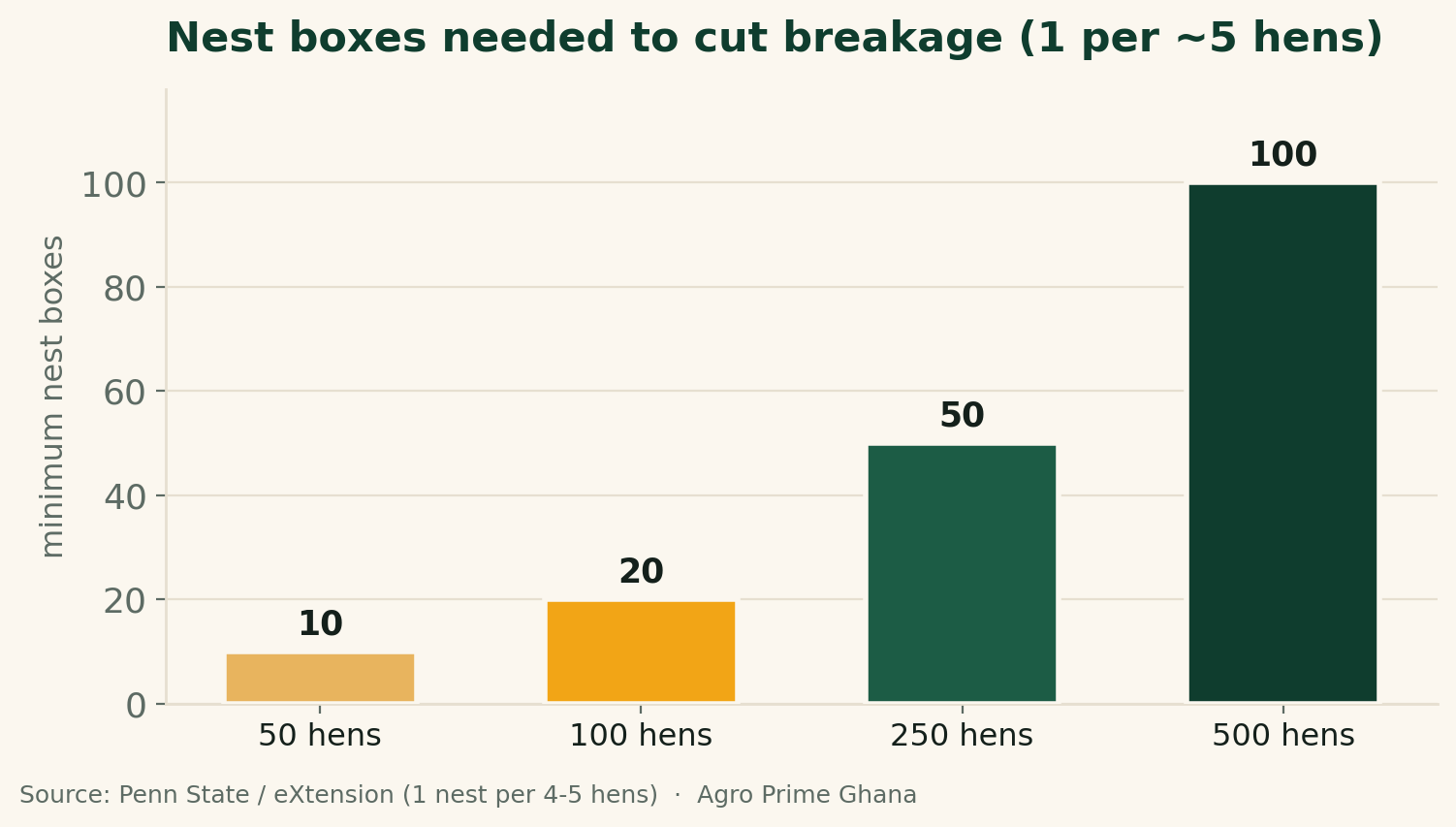
Get the nests right and you prevent most egg-eating before it can start, because good nests mean fewer broken eggs and calmer laying. Poultry extension gives clear, specific targets. Provide about one 12-inch-by-12-inch nest for every four to five hens, and never run fewer than a handful of nests even in a small flock — too few nests cause crowding, floor-laying and breakage. Set nests at least 2 feet off the ground and at least 4 feet from the roosts to cut traffic and keep droppings out. Keep at least 2 inches of clean, dry nesting material (wood shavings, chopped straw or similar) in every nest at all times, so eggs land softly instead of cracking on a bare floor. And crucially, keep nests dark and away from bright light — dim nests are calmer, discourage nervous egg-smashing, and make a laid egg less visible and tempting to a curious hen. These same principles are covered in our guide to perches and nest boxes.
Field note: darker nests, calmer hens, fewer broken eggs
One of the cheapest, most effective changes we see work is simply making the nests darker and softer. A nest box tucked in a shaded, quiet part of the house — or fitted with a strip of dark cloth as a curtain over the entrance — settles hens, keeps the egg out of sight, and cuts the panicky floor-laying that breaks eggs in the open. Pair that with a good, deep bed of clean shavings and you have removed two of the biggest causes of accidental breakage at almost no cost. It is far easier to prevent the first broken egg than to break a flock of the egg-eating habit later.
Roll-away nests: designing the egg out of reach
For farms that want to engineer the problem away, a roll-away nest is one of the most reliable tools. The nest floor is gently sloped so that as soon as a hen lays, the egg rolls forward out of the nest into a covered collection channel or tray, where the hens cannot reach or see it. Because the egg is removed from the birds within seconds of being laid, there is simply nothing for a would-be egg-eater to peck, and eggs stay cleaner and less likely to be broken by other hens climbing in. Roll-away nests are widely recommended precisely because they attack the habit at its root — no accessible egg, no taste acquired, no imitation. They are especially worth considering if you already have an egg-eating problem, are running a larger flock, or cannot collect eggs frequently through the day. Even a simple, well-built sloped nest with a protected catch tray delivers most of the benefit.
Collect eggs early and often
Frequent collection is a free, powerful defence: the less time an egg sits in the nest, the less chance it has to be broken, stepped on or discovered by a bored hen. Extension guidance is to collect eggs often and early — many hens finish laying before about 10 a.m. — so a first collection in the mid-to-late morning takes the bulk of the day's eggs out of harm's way, with one or two more passes through the day. Every egg you gather promptly is an egg that cannot become the broken one that starts the habit, or the sitting target that keeps it going. On a busy farm this discipline slips easily, but it is one of the highest-value routines you have. It also keeps eggs cleaner and fresher for sale, so frequent collection pays twice — see our notes on egg storage and handling.
Overcrowding, boredom and light
Egg-eating shares its roots with the wider family of pecking vices, so the same stresses that cause feather-pecking and cannibalism also push hens toward eggs. The MSD Veterinary Manual links cannibalistic pecking to crowding, excessive light intensity and nutritional imbalances, along with too little feeder space. In practical terms that means three more levers. Avoid overcrowding — packed birds are stressed, break more eggs and are quicker to pick up bad habits; give adequate floor, feeder and drinker space. Cut excessive brightness, especially glaring light in or near the nests, which makes hens jumpy and eggs more visible. And relieve boredom, since idle, under-stimulated hens go looking for things to peck: scattering some scratch grain in the litter in the afternoon, providing perches, and giving birds room to forage all keep beaks busy on something other than eggs. A calm, well-spaced, occupied flock simply does not develop the habit as readily as a crowded, bored, over-lit one.
Prevent egg-eating with the right birds, feed and calcium
Many egg-eating problems trace back to two fixable things: shells that are too thin because the ration is short on calcium, and pullets that were never set up to lay calmly in good nests. Agro Prime Ghana supplies healthy point-of-lay (POL) pullets and balanced layer feed formulated with adequate calcium and protein for strong shells, plus practical advice on nest setup and flock management. If your hens have started eating eggs, or you want to stock a new flock and get the housing and feeding right from day one, message us on WhatsApp (+233 24 915 1503) or book a visit — we will help you find the cause and fix it.
How to stop it once it has started
If the habit is already in your flock, act fast and without illusions — extension and veterinary sources agree it is very hard to fully cure, so your aim is to contain it while you remove every trigger. First, find and remove the culprits: an egg-eating hen usually gives herself away with dried yolk and egg white on her beak and the feathers around her head, and because others imitate her, taking her out of the flock quickly can stop the habit spreading. Many farms cull confirmed egg-eaters for exactly this reason. At the same time, fix all the underlying causes at once — darken and pad the nests, add roll-away nests if you can, collect eggs far more often, correct the calcium and protein in the feed, and relieve crowding and boredom — because removing one hen while leaving broken eggs and thin shells around simply lets the habit restart. Some keepers try filling a blown-out shell with mustard or a strong deterrent to teach hens that eggs taste unpleasant; results are mixed, and it is no substitute for fixing nests, feed and collection. The honest truth is that a flock which has learned to eat eggs may never be perfectly reliable again, which is the whole reason prevention beats cure so decisively here.
The bottom line on egg-eating hens
Egg-eating is a habit built on a single broken egg and spread by imitation, so the winning strategy is to make sure that first egg never breaks and never sits where a hen can reach it. That means strong shells from a calcium- and protein-adequate diet with free-choice oyster shell; enough dark, well-padded, raised nests at about one per four to five hens; roll-away nests where practical; frequent, early egg collection; and a calm, uncrowded, well-occupied flock. Remove any confirmed egg-eater promptly, before the rest learn from her. Do these things and egg-eating stops being a threat you fight and becomes a problem you have quietly designed out — protecting both your egg income and the reputation of the eggs you sell.
Frequently asked questions
Why do my hens eat their own eggs?
How do I stop chickens from eating their eggs?
Does calcium deficiency cause egg-eating?
What is a roll-away nest and does it stop egg-eating?
How often should I collect eggs to prevent egg-eating?
How can I tell which hen is eating the eggs?
Can too few or too-bright nests cause egg-eating?
Is egg-eating curable once the flock has learned it?
Sources & further reading
- MSD Veterinary Manual — Laying and Reproduction in Backyard Poultry and Cannibalism in Poultry (egg-eating trigger, imitation, cannibalistic pecking factors).
- Penn State Extension — Prevention of Egg Eating in Chickens (nest ratio and height, nesting material, calcium, frequent early collection).
- eXtension Poultry — Egg Eating by Chickens in Small and Backyard Flocks (causes, nest management, culling).
- Agro Prime Ghana guides: calcium for laying hens, layer feeding guide, perches and nest boxes, and egg shell quality problems.
About Agro Prime Ghana
Agro Prime Ghana Limited runs a poultry hatchery and mixed agribusiness in Kasoa, supplying day-old chicks (broilers & layers), point-of-lay pullets, quality feed and hands-on farm support to poultry keepers across the country. These guides combine practical hatchery and farm experience with current veterinary and extension references. This article is general educational information, not a substitute for professional veterinary advice — if a flock problem persists, consult a qualified vet or extension officer. Setting up layers or fighting an egg-eating problem? Book a visit or message us on WhatsApp (+233 24 915 1503) to order POL pullets, feed or advice.