Contract farming in Ghana is an arrangement where a farmer grows to a buyer's specification and sells the output back to that buyer on agreed terms, often with inputs such as chicks, feed or veterinary support provided on credit. The model links production to a market that already exists, which is its main appeal. It also moves risk onto the farmer or investor unless the contract is written carefully. If you are thinking about putting money into farming, the real question is not whether contract farming exists, but which side of the contract your money sits on, who carries the losses when a batch fails, and whether you will be paid on time.
Written by the Agro Prime Ghana team and checked against current Bank of Ghana auction data and Ghanaian news reporting (September 2026). Last updated October 2026. General information, not financial advice.
Key takeaways
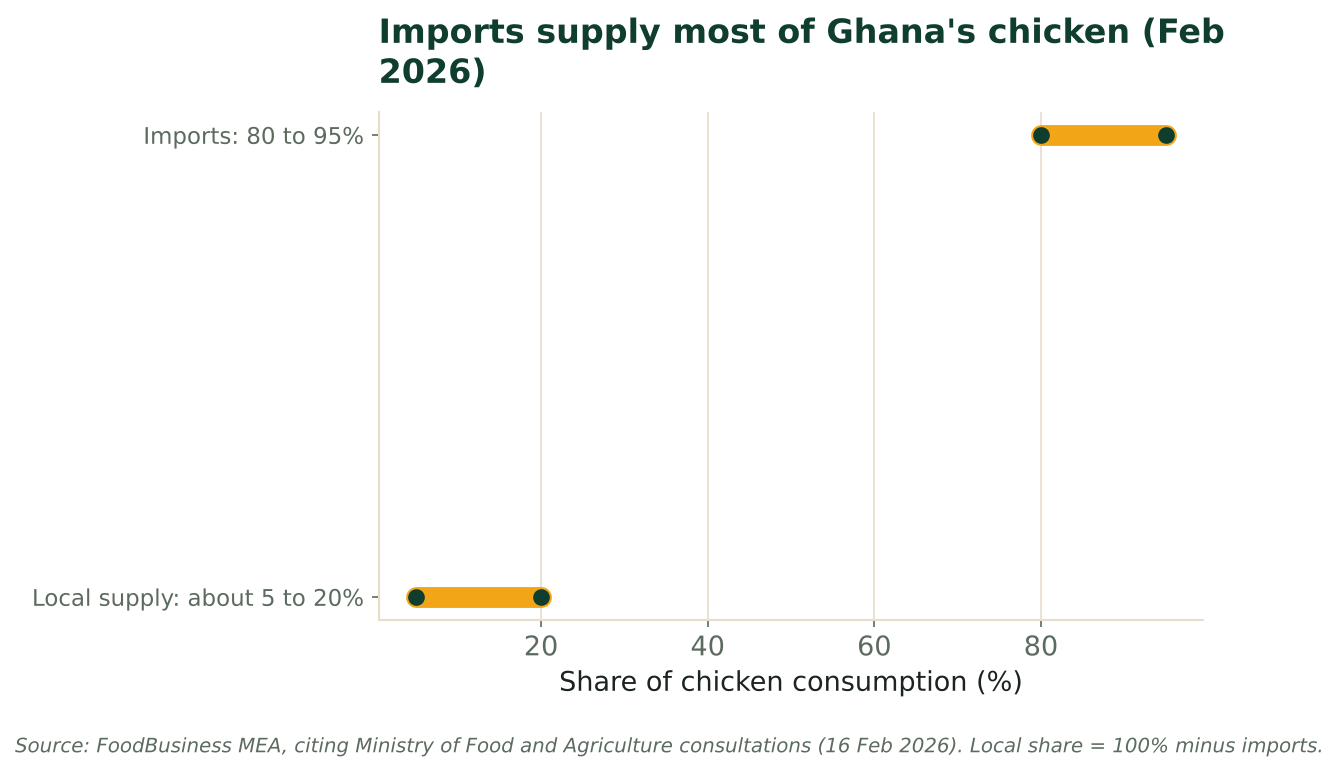
Contract farming (outgrower and offtake arrangements) ties a grower to a buyer. In Ghana, FoodBusiness MEA reported in February 2026 that imports supply 80 to 95 percent of chicken consumption, which is the gap that makes poultry contracts attractive. A 2022 study of broiler contract farming in Ghana found participation was linked to higher sales, farm capacity and spending, but payment terms discouraged farmers from joining. Contract farming is not a guaranteed return. Payment delays, disease, feed costs, and weak contracts can all cut into what you receive. Confirm every figure and the contract text with the operator before you commit money.
What contract farming means in Ghana
There are two common forms. In an outgrower scheme, a company or processor supplies inputs and technical advice to independent farmers, who raise the birds or crops on their own land and sell the harvest back to the company. In an offtake arrangement, a buyer agrees in advance to purchase a defined volume at a defined price or formula, which gives the farmer a market before production starts. Many real schemes combine both.
Broiler contract farming has also been studied in Ghana. A 2022 study in the European Journal of Development Research by Richard Kwasi Bannor and Yaw Gyekye examined broiler contract farming in Ghana. The abstract reports that contract farming positively affected total sales, farm capacity and total expenditure for participating farmers. The authors also found that unfavourable payment terms discouraged participation. The full text is behind a subscription, so the points here come from the abstract only.
Why the import gap makes poultry contracts attractive
The demand side of the case is simple. In February 2026, the FoodBusiness MEA reported that frozen chicken imports supply up to 95 percent of the market, and that imports have stayed between 80 and 95 percent of total consumption despite government efforts over the past decade. The same report says the Ministry of Food and Agriculture is drafting a Poultry Sector Master Plan aimed at reducing that dependence, and that domestic output remains well below national demand.
Older USDA Foreign Agricultural Service figures show the same pattern. In a June 2017 report carried by WATTAgNet, FAS estimated domestic broiler meat output at about 35,000 tons against imports of about 158,000 tons, with the United States supplying roughly 40 percent of imports, mainly frozen leg quarters and wings. Those are 2017 numbers and should be treated as historical context. They do not describe the market today, but the direction has not reversed.
The chart below summarises the 2026 reported split. It is the reason buyers look for reliable local supply, and the reason local growers can find a market. It is not a forecast of prices or profits.
Who carries which risk
A contract divides risk between the parties, and the division is often unequal. The main risks in a poultry contract are:
- Mortality. Disease, heat stress and poor management kill birds. Ask who pays for dead birds, and whether a mortality allowance is built into the price.
- Feed and input prices. Feed is the largest running cost in most broiler operations. A contract that fixes the sale price but lets input prices float can squeeze margins quickly.
- Payment timing. A buyer who pays 30 or 60 days after delivery can leave a grower short of cash for the next batch. The Bannor and Gyekye abstract identifies payment terms as a factor that discouraged farmers from joining broiler contracts.
- Quality rejection. If the buyer can reject birds for weight, condition or other grounds, the rules need to be written down before the batch starts.
- Side-selling. Growers may be tempted to sell to someone else at a better price. Many contracts penalise this, and that penalty should be read as carefully as the price.
Three ways money can enter poultry production
People often use "contract farming" for three different arrangements. They have different risk profiles, so it helps to name which one you are considering.
| Arrangement | Who owns the birds | Who carries mortality risk | What you receive | What to verify |
|---|---|---|---|---|
| Outgrower contract | Usually the grower, on their own land | Mostly the grower, unless the buyer shares it | Agreed price per bird or per kilo, minus deductions | Input costs, deductions, payment days, rejection rules |
| Offtake agreement | The producer | The producer | A pre-agreed buying price or formula for output | Price mechanism, volume commitment, what happens if the buyer defaults |
| Profit-share on a production batch | The operator, with investors holding a stake in the batch | Shared according to the written agreement | A share of the batch profit after agreed costs | How costs are counted, how profit is calculated, timing, and what happens after a loss |
The third row is the one that matters for people reading this site. A profit-share stake is related to contract farming, but it is not the same thing. You are not guaranteed a buyer's price for your share of the birds, and your return depends on how the batch performs and on how costs are defined in the agreement.
What a well-run contract should spell out
Before signing any contract farming or batch-share agreement, you should be able to answer these questions in writing:
- What exactly is being produced, how many birds, and what breed or specification?
- Which costs are charged to the batch, and which are included in the operator's own overhead?
- What is the sale price, or the formula for it, and who sets the weight or quality grades?
- When and how will payment be made, and what happens if the buyer pays late?
- Who is responsible for disease, mortality and losses, and is there an agreed compensation method?
- What are the penalties for breach by either side, and how are disputes settled?
- Can you visit the site, see records and speak to other participants?
If the operator will not put answers like these in writing, treat that as information about the deal.
Benefits, honestly stated
The strongest case for contract farming is that it reduces one kind of risk, which is not knowing where the product will go. A buyer who commits to volume and a timetable lets a grower plan feed purchases, labour and cash flow. For someone new to farming, a contract can also bring technical supervision, access to chicks and feed, and a route to market they could not build alone. The Bannor and Gyekye abstract points to better sales and capacity among participating farmers, which is consistent with this.
Those benefits are real, but they are not the same as profit. A farm can have a guaranteed buyer and still lose money if feed costs rise faster than the contract price, if mortality is high, or if payment arrives late enough to force expensive borrowing.
Investor note: a market gap is a reason to look, not a reason to buy
The 80 to 95 percent import share is a real signal that domestic supply is short. It does not tell you that a particular farm will make money, that its costs are sensible, or that its buyer will pay on time. Use the market gap to decide whether the sector deserves a closer look, then test the operator the way you would test any other business.
The risks that are specific to Ghana
Several risks sit outside the farm gate. Import policy is one of them. In a USDA FAS report on a Bank of Ghana measure, the central bank restricted foreign exchange access for a list of imported products, including poultry, to implement a presidential directive. That is an example of how a policy decision can change the market for local producers quickly, in either direction.
Macroeconomic conditions also matter. The Bank of Ghana's policy rate was 14 percent when its Monetary Policy Committee held it on 25 September 2026, and headline inflation was reported at 5 percent for August 2026, up from 4.6 percent in July, according to Ghana News Agency. Input costs for feed, drugs and transport tend to move with inflation, and a fixed contract price may not keep up. These figures change, so check the latest Bank of Ghana release before making any decision.
How contract farming compares with other options
A contract farming stake is an illiquid, operational investment. It may pay in one lump at the end of a cycle, and it is usually harder to sell than a listed security. It is worth comparing it with the alternatives at the same time you compare it with the farm.
| Option | Typical horizon | Liquidity | Main risk | Reference point (dated) |
|---|---|---|---|---|
| 91-day Treasury bill | About 3 months | High, through the market | Yields change at each auction; may not keep pace with inflation | Weighted average 4.68% (tender of 25 Sep 2026) |
| 364-day Treasury bill | One year | Moderate | Yields change at each auction | Weighted average 9.83% (tender of 25 Sep 2026) |
| GSE-listed equities | Open-ended | Depends on the stock | Prices can fall sharply | GSE Composite Index up 72.5% year to date at 21 Aug 2026 |
| Contract farming or batch stake | One production cycle, about six to seven weeks for broilers, plus settlement | Low | Mortality, feed costs, payment delay, operator risk | Depends on the contract; no guaranteed return |
Treasury bill yields are reported in Bank of Ghana auction results, and the GSE Composite Index figure comes from a market wrap dated 24 August 2026. Both are dated and both move. The point of the comparison is not that one option is better, but that each one makes a different trade between risk, time and access to your money.
How to decide whether this fits you
Contract farming can suit someone who has a clear reason to be interested in agriculture, can wait through a full cycle and settlement period, and can afford to lose the amount invested. It is a poor fit for money you may need within a few months, for emergency savings, or for any amount that would change your household's food or rent if the batch went wrong.
If you do decide to look further, start with the written contract and ask for the operator's records from earlier batches. An operator that has run cycles before should be able to show you mortality, feed use and sale results, even if the numbers are not perfect. An operator that cannot will leave you guessing.
Investor note: read the payment clause before the price clause
Many contract disputes are about when money arrives, not how much is agreed. Before you look at expected returns, find out the payment schedule, what counts as delivery, and what happens if payment is late. A good price paid six months late can be worse than a modest price paid on time.
If you want to see how an Agro Prime batch partnership is structured, you can see how partnering with Agro Prime works, or book a visit to the Kasoa hatchery and ask for the written terms. You can also message us on WhatsApp (+233 24 915 1503) with questions. Our partner page is an invitation to discuss backing farming production, not an offer of securities or a guaranteed return.
Where to read more on poultry economics first
Before you judge any contract, it helps to understand the cost structure of a broiler batch. Our guides on whether poultry farming is profitable in Ghana, writing a poultry business plan, and managing poultry farm cash flow set out the main line items. A break-even analysis shows how many birds need to sell, and at what price, before a batch covers its costs. Use those tools to test any contract you are offered, including ours.
Frequently asked questions
What is contract farming in Ghana?
Is contract farming a guaranteed investment?
How big is the chicken import gap in Ghana?
What is the difference between outgrower and offtake contracts?
Is a profit-share stake the same as contract farming?
What are the main risks of poultry contract farming?
What is a safe way to start?
Where can I check whether an investment is licensed in Ghana?
Sources & further reading
- Ghana News Agency: Bank of Ghana maintains policy rate at 14 per cent (25 September 2026)
- Bank of Ghana: Treasury bill auction results 2026 (tender of 25 September 2026)
- FoodBusiness MEA: Ghana plans tenfold increase in poultry production to cut import reliance (16 February 2026)
- WATTAgNet: Ghana depends on imports to meet chicken meat demand (2 June 2017, citing USDA FAS)
- Bannor and Gyekye (2022): Unpacking the Nexus Between Broiler Contract Farming and Its Impact in Ghana, European Journal of Development Research
- USDA Foreign Agricultural Service: Ghana, Bank of Ghana announces policy restricting poultry and rice imports
- CitiNewsroom: SEC names 23 unlicensed online investment schemes (22 July 2026)
- Securities and Exchange Commission Ghana
- Bank of Ghana
About Agro Prime Ghana & a note on risk
Agro Prime Ghana Limited runs a poultry hatchery and mixed agribusiness in Kasoa and invites partners to invest in its farming production through a profit-share on a production batch. This is general educational information, not financial advice, and investing carries risk including loss of capital — always do your own research or consult a licensed adviser. Agro Prime is the operator named in this article, so read it as written by an interested party. Explore it: see how it works, book a visit, or message WhatsApp (+233 24 915 1503).


