
Rearing cockerels in Ghana means raising male chicks — usually the male counterparts of layer strains — for the live-bird meat market, growing them slowly and cheaply on modest feed and selling them whole, alive, at a premium during festive seasons. It is a genuinely different enterprise from broiler production: the birds are hardier, grow far more slowly, eat less per day, and are prized by local buyers for their firm, tasty meat rather than for fast, tender bulk. For a keeper with limited capital, a bit of space and patience, cockerels can be one of the most forgiving ways into poultry. If you have ever watched broiler prices collapse just after Christmas while a neighbour's leaner, "local-tasting" birds sold briskly straight from the compound, you have already seen why cockerel rearing endures. This guide explains what cockerels are, how they grow, how to feed and manage them for the Ghanaian market, and whether the numbers work for you.
Written by the Agro Prime Ghana hatchery team and reviewed against current industry references (published dual-purpose poultry research and Ghana MoFA/USDA sector data). Last updated September 2026.
Key takeaways
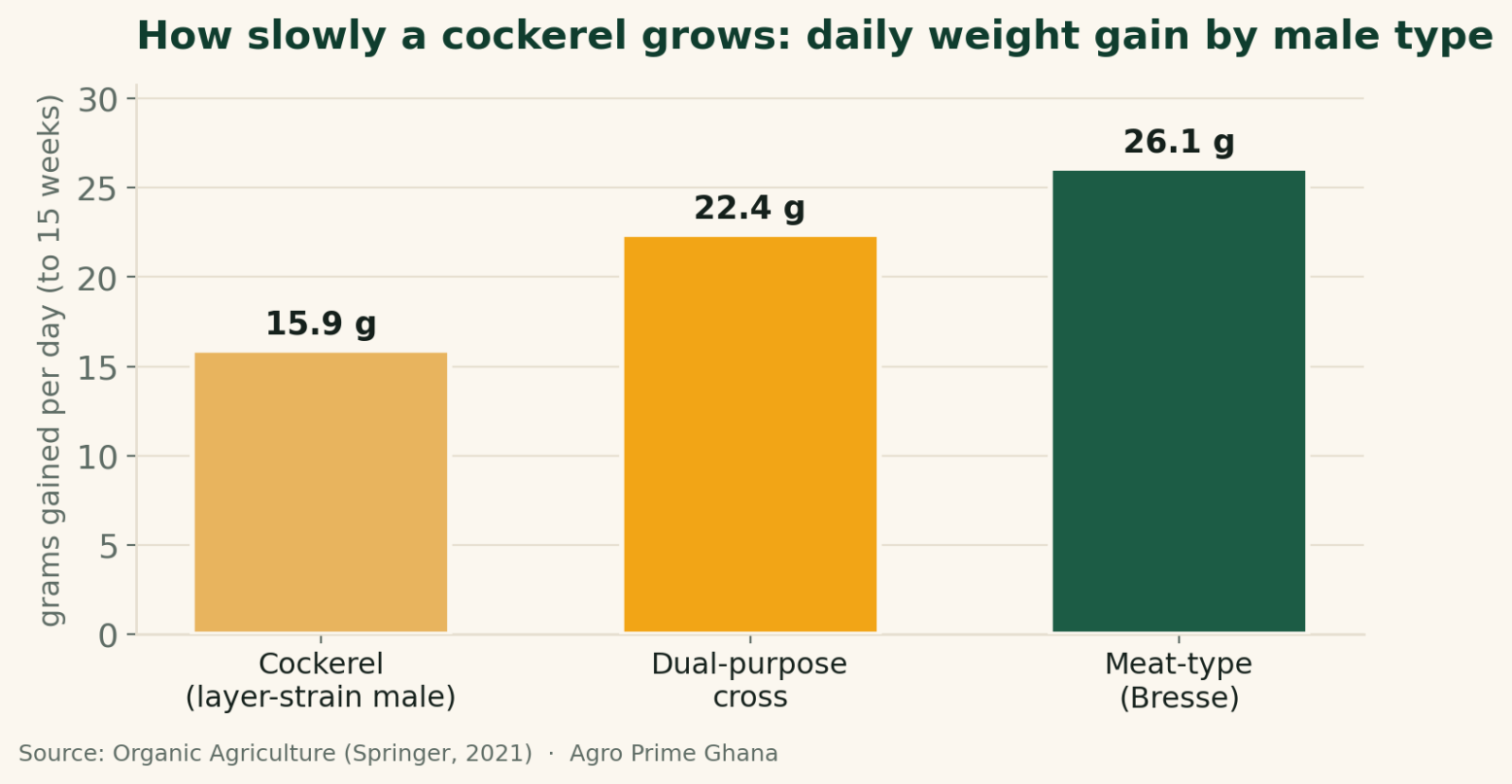
Cockerels are male chicks — most often surplus males from layer hatcheries — reared for meat and sold live at markets. They grow slowly compared with broilers: layer-strain males gain only around 15–16 g a day, versus 22–26 g for meat-type males, so they reach a saleable 1.5–2.5 kg over roughly 12–20 weeks rather than 5–7 weeks. Their advantages are a cheap day-old price, hardiness and disease-tolerance, low feed intake per day, and firm meat that fetches a strong price at festive markets (Christmas, Easter, Eid, funerals). Their drawbacks are slow growth, poorer feed conversion and a longer grow-out that ties up cash. Feed them on a lower-protein grower ration, give them space and time, and target the festive calendar. Local birds are strongly preferred by many Ghanaian consumers, which is why cockerels remain profitable even as imported frozen chicken dominates the supermarket shelf.
What exactly is a "cockerel" in Ghana?
In Ghanaian and West African usage, a cockerel is a young male chicken raised for meat, and in the day-old-chick trade the word almost always means the male counterpart of a layer strain. Commercial layer hatcheries want pullets (females) for egg production, so the males are surplus. Rather than being destroyed, these males are sold cheaply as "cockerel" day-old chicks for meat rearing. As one production guide puts it, cockerels are simply "the male counterparts of the layers," reared and marketed because pullets are reserved for laying. That single fact explains almost everything about the enterprise: because the chicks are a by-product, they are inexpensive to buy; but because they carry layer genetics — bred for eggs, not muscle — they grow slowly and never put on breast meat the way a broiler does. Some farmers also use the term loosely for any hardy male bird grown out for the live market, including improved dual-purpose cockerels; the principles here apply to both, but the classic Ghanaian "cockerel" is the layer-strain male. If you are weighing this against a meat-and-egg bird, our guide to dual-purpose day-old chicks covers the improved Sasso, Noiler and Kuroiler alternatives.
Why cockerel rearing still pays in Ghana
Cockerels survive because they fit a market that imported frozen chicken cannot fully satisfy. Ghana now imports the large majority of the chicken it eats — domestically produced broilers supply only around 20% of consumption, down from roughly 60% at the turn of the century, according to sector reporting drawing on USDA data. But many Ghanaian buyers still pay a premium for a live, locally raised bird with firm meat for a festive meal, a funeral or a naming ceremony. Cockerels slot neatly into that demand: they taste "local," they are sold alive so the buyer can judge health for themselves, and they suit the traditional preference for a leaner, chewier, more flavourful bird. Government has backed the model, too — under Rearing for Food and Jobs, MoFA distributed nearly 73,000 cockerels to some 729 smallholder farmers across 166 districts with a 50% subsidy, precisely because cockerels are a low-risk entry point. For anyone starting out, they are a way to learn poultry husbandry with cheap stock; see our overview on starting a poultry farm in Ghana.
How fast do cockerels actually grow?
Cockerels grow slowly, and setting your expectations honestly is the single most important thing before you buy a single chick. A broiler is a purpose-built meat machine that reaches 2 kg or more in five to seven weeks. A layer-strain cockerel is not: research on male birds of different genetic types found that layer-hybrid males (the closest analogue to the classic cockerel) gained only about 15.9 grams per day, while faster meat-type and dual-purpose males gained roughly 22–26 grams per day (Organic Agriculture, 2021). In practical terms, that means a cockerel takes months, not weeks, to reach a marketable size — commonly a live weight of around 1.5–2.5 kg over about 12–20 weeks, with mature roosters reaching 2.5–4 kg if held to 20–24 weeks. Feed conversion is correspondingly poorer: the same body of research recorded feed conversion ratios of about 3.1–4.7 kg of feed per kg of gain across male types, with the layer-strain birds at the worst end, against roughly 1.6–1.9 for a well-run broiler. You are trading growth speed and feed efficiency for a cheaper chick, a hardier bird and a product the local market specifically wants.
| Trait | Cockerel (layer-strain male) | Broiler (Cobb/Ross) |
|---|---|---|
| Day-old chick cost | Low (surplus males) | Higher |
| Daily weight gain | ~16 g/day | 50+ g/day at peak |
| Time to market | ~12–20 weeks | ~5–7 weeks |
| Feed conversion (feed:gain) | Poor (~3.5–4.7) | Good (~1.6–1.9) |
| Hardiness / disease tolerance | High | Lower; needs tight management |
| Meat character | Firm, lean, "local" taste | Tender, soft, bulky breast |
| Best market | Live festive/traditional sales | Dressed / bulk / restaurants |
Feeding cockerels the smart, low-cost way
Because cockerels grow slowly and are not chasing broiler-style muscle, they do not need — and cannot economically use — expensive high-protein broiler feed for the whole cycle. Start chicks correctly: a chick starter (around 20–22% crude protein) for the first few weeks gives them the protein and energy to build frame and feather and get through the vulnerable brooding period. After that, move them onto a cheaper grower ration (roughly 15–16% protein) for the long middle stretch of the grow-out, and let them forage where you can. Feed is the largest single cost in any poultry enterprise, and it has become brutal in Ghana — maize, the energy base of every ration, has climbed from around GH₵120 to GH₵500–600 per 50 kg bag in recent years (USDA-sourced reporting), which is exactly why a bird that can stretch cheap feed and scavenge has an edge. If you mix your own, study our guides to poultry feed ingredients and cutting feed cost; for the grow-out phase specifically, the principles in grower feeding transfer well to cockerels.
Field note: let them work for part of their feed
The keepers who make cockerels pay rarely feed them like broilers. On a compound or semi-intensive set-up we lean on the bird's natural hardiness: a good grower ration in the morning and evening, and space to scratch, forage and pick up kitchen and farm scraps in between. That foraging genuinely reduces the feed bill on a bird you are already keeping for months, and it suits the cockerel's constitution — these are robust birds that do well with room to move. The trap to avoid is the opposite: half-starving them to "save feed." A bird held too long on too little simply eats maintenance feed for weeks while barely growing, which quietly destroys your margin. Feed them properly to keep them moving toward market weight, but do it on cheaper grower feed and free foraging, not costly broiler concentrate.
Health and management: a forgiving bird, not a foolproof one
Cockerels are noted for being hardy and "less susceptible to disease" than more specialised birds, which is a large part of their appeal for beginners. But hardy does not mean invincible, and the diseases that kill Ghanaian poultry — above all Newcastle disease — kill cockerels just as readily. The non-negotiables are the same as for any flock: buy healthy, well-started chicks; brood them warm, dry and draught-free; keep drinkers clean and litter dry; and follow a sensible vaccination programme, with Newcastle and Gumboro cover as the backbone. Because cockerels are grown on for months, they spend far longer exposed to litter-borne challenges such as coccidiosis and worms than a six-week broiler does, so litter management, clean water and routine deworming matter more, not less. Give them more space than broilers — crowding a slow-growing, active bird invites pecking and disease. Choosing strong stock removes much of the risk; see how to choose healthy day-old chicks before you buy.
Grow strong cockerels from day one — talk to us about stock
The cockerel enterprise lives or dies on two things: cheap, healthy chicks and a bird that suits your market. Agro Prime Ghana supplies day-old chicks — including cockerel and hardy dual-purpose stock alongside our broilers and layers — from a Kasoa hatchery, and we will talk you through realistic growth timelines, a feeding plan and a vaccination schedule so your birds actually reach the festive market in good shape. No inflated promises and no fake scarcity: just sound stock at fair value and honest advice on what to expect. Message us on WhatsApp at +233 24 915 1503 or book a visit to match the right chicks to your space, budget and target sale date.
Timing the market: aim for the festive peaks
The economics of cockerels turn heavily on when you sell, not just what the bird weighs. Live-bird demand and prices spike around festive and social occasions — Christmas and New Year, Easter, the two Eid festivals, and the year-round rhythm of funerals, weddings and naming ceremonies. Because a cockerel takes roughly three to five months to reach size, this enterprise rewards planning backwards from a target sale date: count the grow-out period back from the festive peak and set your chicks then, so the birds are at their best weight exactly when buyers are paying most. Grown out to coincide with December, a batch that would fetch an ordinary price in a flat month can command a real premium. For the tactics of selling into these peaks, see our guide to selling live birds at festive periods.
Do the numbers work? Cockerels vs broilers
Whether cockerels beat broilers for you depends on your capital, your patience and your market. The cockerel model is low-cost, low-risk and slow: cheap chicks, a hardy bird, modest daily feed, forgiving of small mistakes — but your money is tied up for months and the feed bill accumulates over a long cycle, so per-day profit is thin and you must sell into the right market to capture the premium. The broiler model is higher-cost, higher-risk and fast: dearer chicks and feed, a demanding bird that punishes errors, but cash turns over in six to seven weeks. Many Ghanaian keepers run both, or start with cockerels to learn the ropes cheaply first. If you are comparing enterprises, read our broiler vs layer profit analysis for the framework, and be realistic about the long grow-out before committing space and feed to cockerels for a full season.
Field note: count the weeks of feed before you fall for the cheap chick
The cheap day-old price is the cockerel's great seduction, and it is also where beginners get caught. A chick that costs a fraction of a broiler still eats for three to five times as long. The real cost was never the chick — it is the 16 weeks of grower ration and the space those birds occupy. The lesson is not to avoid cockerels; it is to budget the whole cycle. Before you order, write down your expected feed cost from day-old to sale, add your target sale date, and only then decide how many birds you can actually carry to market. Cockerels reward the keeper who plans the full run, not the one dazzled by the chick price.
The bottom line on rearing cockerels
Cockerel rearing is a slow, sturdy, low-capital enterprise built around a bird imported frozen chicken can never replace: a hardy, locally raised male, grown out over three to five months and sold live for the festive market. You give up broiler speed and feed efficiency and accept months of grow-out; in return you get a cheap chick, a forgiving bird, a low daily feed intake you can stretch with foraging, and a firm-fleshed product Ghanaian buyers actively want. Win it by starting with healthy stock, feeding on a cheaper grower ration, protecting the long cycle with good litter, clean water and Newcastle vaccination, and — above all — planning your batch backwards from a festive sale date so the birds peak when prices do. Done that way, cockerels are one of the most dependable ways to earn from poultry with modest means.
Frequently asked questions
What is a cockerel in poultry farming?
How long does it take to raise cockerels to market weight in Ghana?
Are cockerels cheaper to raise than broilers?
What should I feed cockerels?
Why is cockerel meat preferred in Ghana?
Are cockerels hardy and disease-resistant?
When is the best time to sell cockerels?
How many cockerels should a beginner start with?
Sources & further reading
- The Poultry Site — Overview of Ghana's struggling poultry sector (import dependence, domestic broiler share, feed and maize prices, MoFA cockerel distribution under Rearing for Food and Jobs).
- Organic Agriculture / Springer — Dual-purpose production of eggs and meat: cockerels of layer × meat crosses (daily weight gain of layer-strain vs meat-type males, feed conversion ratios).
- Agric4Profits — Cockerel production, breeds and benefits (definition of cockerels, market weights, hardiness, low chick cost).
- Agro Prime Ghana guides: dual-purpose day-old chicks, selling live birds at festive periods, and choosing healthy day-old chicks.
About Agro Prime Ghana
Agro Prime Ghana Limited runs a poultry hatchery and mixed agribusiness in Kasoa, supplying day-old chicks and supporting poultry keepers across the country. These guides draw on hands-on hatchery and farm experience, checked against current industry and veterinary references. We supply healthy day-old chicks (broilers, layers and cockerel/dual-purpose stock), point-of-lay pullets, quality feed and practical farm support. This article is general educational information, not a substitute for professional veterinary or agronomic advice. Ready to start or expand your flock? Book a visit or message us on WhatsApp (+233 24 915 1503) to order chicks, feed or advice.