Dual-purpose day-old chicks are birds bred to do two jobs reasonably well — grow into a decent-sized meat bird and lay a useful number of eggs — rather than being specialised for one at the expense of the other. In Ghana these are the improved tropical breeds you will hear named at the hatchery: Sasso, Noiler and Kuroiler types. They suit the keeper who wants hardy, foraging birds that produce both eggs and meat for the household or the local live market, and who values resilience and a "local" product over the maximum output of a specialised broiler or layer. The buying decision matters, because a dual-purpose chick sets you on a very different path from a Cobb broiler or a Lohmann layer: different growth, different egg numbers, different economics. This guide is about that day-old-chick buying decision — what these birds are, what to realistically expect, and who they genuinely suit.
Written by the Agro Prime Ghana hatchery team and reviewed against current industry references (peer-reviewed dual-purpose breed evaluations from West and East Africa). Last updated September 2026.
Key takeaways
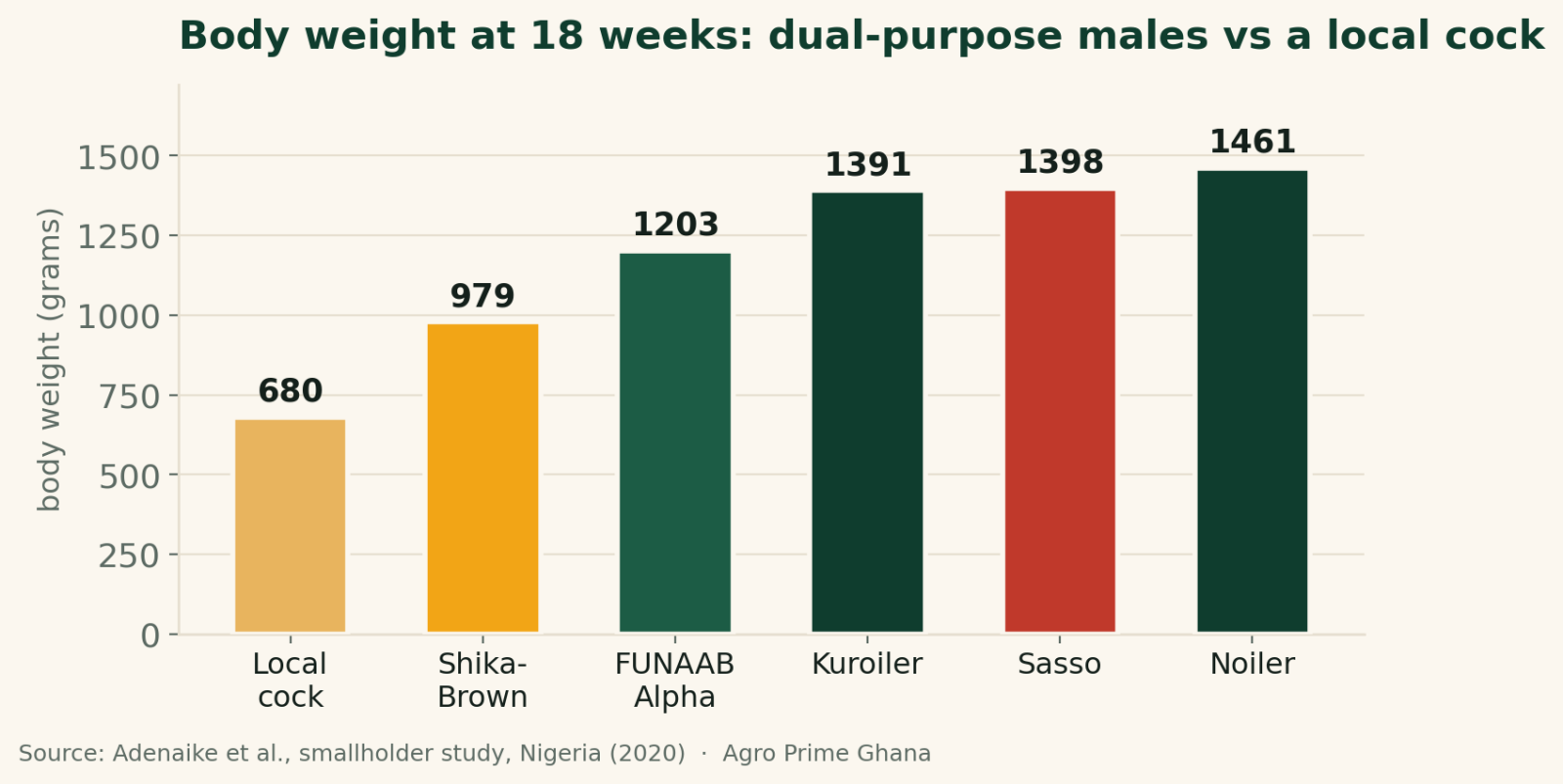
Dual-purpose birds (Sasso, Noiler, Kuroiler types) are a middle path between broilers and layers: hardier and more foraging than either, but not as fast-growing as a broiler nor as productive as a specialised layer. In a Nigerian smallholder study, improved dual-purpose males reached about 1.4–1.5 kg by 18 weeks — over 200% the weight of local cocks — while indigenous birds managed roughly 680 g. On the egg side, Kuroilers in East Africa laid on the order of 240–260 eggs per hen per year and started laying around 18–24 weeks, well above a village hen but below a top layer strain. They lay larger eggs than local hens (~54 g vs ~46 g). Buy them if you want resilient, foraging meat-and-egg birds for the household or local market; choose a specialised broiler or layer instead if maximum meat speed or peak egg output is your single goal. Expect a middle result, and buy from a hatchery that is honest about which strain you are actually getting.
What "dual-purpose" actually means for a day-old chick
A dual-purpose chick is bred to balance two traits that specialised birds push to extremes. A commercial broiler (Cobb, Ross) is engineered for one thing — rapid muscle growth to slaughter in five to seven weeks — and is a poor layer. A commercial layer (Lohmann, ISA, Hy-Line) is engineered to pour feed into eggs and stays small and lean. A dual-purpose bird sits deliberately in the middle: it grows to a respectable table size and lays a worthwhile number of eggs, while typically being hardier, better at foraging and more tolerant of low-input tropical conditions than either specialist. The improved breeds now common across Africa — Sasso (a French-origin coloured bird), Kuroiler (an Indian dual-purpose cross) and Noiler (a Nigerian improved bird) — were developed precisely to give smallholders far better output than an indigenous village chicken without demanding the intensive housing, feed and biosecurity commercial birds require. For a deeper breed-by-breed comparison, our guides to Noiler and Kuroiler chickens and the best chicken breeds for Ghana go further; this article focuses on the day-old-chick buying decision.
What growth can you realistically expect?
Expect a bird that comfortably outgrows a village chicken but grows far more slowly than a broiler. In a well-documented Nigerian study of six dual-purpose breeds under real smallholder management, improved males reached these body weights by 18 weeks: Noiler about 1,461 g, Sasso 1,398 g and Kuroiler 1,391 g, compared with indigenous local cocks at roughly 680 g — the improved birds carried "over 200% body weight at 18 weeks" relative to locals (Adenaike et al., 2020). Females were lighter, at around 1,217–1,330 g at the same age. In separate East African work, well-fed Kuroilers reached around 2.0 kg by 18 weeks and 2.3 kg by 20 weeks under better feeding, showing how much management lifts the ceiling (Msoffe et al., Tanzania). The honest headline: a dual-purpose bird takes roughly four to five months to reach a good table weight, versus five to seven weeks for a broiler. You are buying resilience and a dual output, not speed. That trade-off is the whole point of the breed — and the reason the buying decision must be made with clear eyes.
What egg production can you expect?
Dual-purpose hens lay far more than a village hen but well short of a specialised layer. Kuroilers studied across demonstration sites in northern Tanzania laid on the order of 240–260 eggs per hen per year, with most hens laying on roughly five days out of seven, and came into lay at around 18–20 weeks on the better sites (about 40% of flocks), the rest reaching first egg between 22 and 24 weeks (Research Square, 2022). Their eggs were also usefully bigger than a local hen's — averaging around 54 g against about 46 g for indigenous eggs. In the Nigerian multi-breed study, dual-purpose and improved layers reached hen-day production of roughly 45–46% under smallholder conditions (Adenaike et al., 2020). For context, a top commercial layer like a Lohmann Brown will lay well over 300 eggs in a laying year under good management. So a dual-purpose hen gives you a steady, worthwhile flow of larger-than-local eggs for the home and local sale — genuinely useful, but not the output you would build a dedicated egg business on. If eggs are your primary goal, a specialised layer and our layer feeding guide will serve you better.
Field note: expect a middle result, and you will be happy
Almost every disappointment we see with dual-purpose birds comes from a mismatch of expectations, not a fault in the bird. A keeper hears "meat and eggs from one flock" and quietly pictures broiler-speed growth and layer-level egg numbers — then feels cheated when the bird delivers neither extreme. The birds are doing exactly what they were bred to do: a good table weight in four to five months and a steady flow of decent eggs, all while shrugging off heat, foraging for part of their feed and tolerating conditions that would sink a commercial specialist. Go in expecting a solid all-rounder rather than a champion at either job, and dual-purpose birds rarely let you down. The keepers who love them are the ones who wanted a resilient, useful flock in the first place.
| What you're buying | Dual-purpose (Sasso/Noiler/Kuroiler) | Broiler (Cobb/Ross) | Layer (Lohmann/ISA) |
|---|---|---|---|
| Main output | Both meat and eggs | Meat only | Eggs only |
| Time to table weight | ~4–5 months | ~5–7 weeks | Not a meat bird |
| Eggs per hen / year | ~240–260 (Kuroiler) | Very few | 300+ |
| Hardiness / foraging | High | Low | Moderate |
| Best system | Semi-intensive, free-range, backyard | Intensive housing | Intensive / deep litter / cage |
| Best for | Household & local live/egg market | Fast meat turnover | Dedicated egg business |
Who dual-purpose chicks genuinely suit
Dual-purpose chicks are the right buy for a specific kind of keeper, and the wrong one for others. They suit you if you want hardy, foraging birds that give both meat and eggs for the household and the local market; if you keep birds semi-intensively or free-range rather than in a tightly controlled intensive house; if you value a resilient bird that tolerates heat, modest feed and less-than-perfect biosecurity better than a commercial specialist would; and if you are selling into a market that prizes a coloured, "local-looking" bird sold live. They are especially strong for backyard and peri-urban keepers around Kasoa and Accra who want eggs for the family and a saleable bird for festive occasions from the same flock. They are the wrong buy if your single goal is maximum meat speed — then buy a broiler — or peak egg output — then buy a layer. Trying to run a serious commercial egg operation on dual-purpose hens, or expecting broiler-speed growth, is the classic disappointment. Match the bird to the job. For free-range keepers specifically, dual-purpose birds pair naturally with the approach in our free-range layers guide.
Field note: know which "Sasso" or "Kuroiler" you're actually buying
The biggest buying risk with dual-purpose stock is not the breed — it is provenance. "Sasso", "Noiler" and "Kuroiler" have become popular names, and in the market you can be sold birds labelled with those names that are actually unimproved crosses or mixed local stock riding on the reputation. The performance figures that make these breeds attractive come from genuine improved stock, properly bred and hatched. Before you pay, ask the hatchery where the parent stock came from, insist on healthy, well-hatched, uniform day-old chicks, and be wary of anyone selling a "dual-purpose" bird with no clear line behind it. A cheap chick of unknown parentage that grows like a village hen is not a bargain. Buy from a hatchery that will tell you honestly what strain you are getting.
How dual-purpose birds compare on survival and management
Dual-purpose birds are famously hardy, but the research adds a useful nuance. In the Nigerian smallholder study, the fully improved fast-growers — Noiler, Sasso and Kuroiler — actually showed lower survivability than the more indigenous-leaning improved birds (Fulani ecotype, FUNAAB Alpha, Shika-Brown) under rough village conditions (Adenaike et al., 2020). The lesson is not that Sasso or Kuroiler are fragile — they are far tougher than a broiler — but that the more you push a bird toward productivity, the more it rewards decent management. In practice, dual-purpose chicks still need the fundamentals: a warm, dry brooding period; Newcastle and Gumboro vaccination; clean water; and good litter over their longer life. Because they live for months rather than weeks, they spend far longer exposed to coccidiosis, worms and Newcastle than a broiler does, so routine health management is not optional. Get brooding and vaccination right — see our guide to choosing healthy day-old chicks — and these birds reward you with genuine resilience.
Match the right dual-purpose chicks to your farm — ask us
Choosing between dual-purpose, broiler and layer stock is a decision worth getting right before you spend on a whole batch. Agro Prime Ghana supplies day-old chicks from our Kasoa hatchery — broilers, layers, and hardy cockerel/dual-purpose stock — and we will help you weigh honestly whether a dual-purpose bird fits your space, your market and your goals, or whether a specialised broiler or layer would serve you better. We would rather sell you the right bird than the dearest one. Tell us what you want the flock to do and we will match the stock and a feeding plan to it. Message us on WhatsApp at +233 24 915 1503 or book a visit to talk it through before you order.
Feeding and cost expectations before you commit
Budget for a longer feed cycle than a broiler but a bird that stretches feed better. Because dual-purpose birds grow slowly and forage well, they do not need — and cannot economically use — full broiler concentrate throughout. A sensible plan is a chick starter (~20–22% protein) early, a cheaper grower ration (~15–16% protein) through the long growth phase with genuine foraging where your system allows, and a layer ration once the hens you keep back come into lay. This foraging ability is a real advantage where maize has climbed from around GH₵120 to GH₵500–600 per 50 kg bag. But be clear-eyed: a bird fed for four to five months consumes more total feed than a broiler even though it eats less per day. The dual-purpose case rests on resilience, dual output, low-input suitability and market preference — not on beating a broiler on feed efficiency. Plan the full cycle, as you would for rearing cockerels, and the numbers make sense.
The bottom line on buying dual-purpose day-old chicks
Dual-purpose day-old chicks — Sasso, Noiler and Kuroiler types — are the right buy when you want one hardy, foraging flock to give you both meat and eggs for the household and the local live market, and you value resilience and a "local" product over the raw output of a specialist. Expect a bird that reaches a good table weight in about four to five months and lays a useful few hundred larger-than-local eggs a year — well above a village hen, well below a dedicated broiler or layer. Buy them for semi-intensive, free-range and backyard systems; skip them if your single goal is fast meat or peak eggs. Above all, buy genuine improved stock from a hatchery that is honest about the strain, brood and vaccinate the chicks properly, and plan the longer feed cycle. Get the buying decision right and dual-purpose birds are one of the most sensible, forgiving choices a Ghanaian smallholder can make.
Frequently asked questions
What are dual-purpose chickens?
How much do Sasso, Noiler and Kuroiler chickens weigh?
How many eggs do dual-purpose hens lay?
When do dual-purpose hens start laying?
Are dual-purpose chickens better than broilers or layers?
Are Sasso and Kuroiler chickens hardy?
How do I avoid buying fake dual-purpose chicks?
Do dual-purpose birds cost less to feed than broilers?
Sources & further reading
- Adenaike et al., in Archives Animal Breeding / PMC (2020) — Production performance and survivability of six dual-purpose chicken breeds under smallholder management in Nigeria (18-week body weights of Noiler, Sasso, Kuroiler vs local; hen-day egg production; survivability).
- Msoffe et al., Research Square (2022) — Growth performance, egg production and egg quality of Kuroiler chickens in Babati district, Tanzania (body weights to 20 weeks, age at first egg, 240–260 eggs/hen/year, egg weight vs local).
- Organic Agriculture / Springer — Dual-purpose production of eggs and meat (slow-growing Sasso/ISA breast yields and feed conversion context).
- Agro Prime Ghana guides: Noiler and Kuroiler chickens, best chicken breeds for Ghana, and rearing cockerels.
About Agro Prime Ghana
Agro Prime Ghana Limited runs a poultry hatchery and mixed agribusiness in Kasoa, supplying day-old chicks and supporting poultry keepers nationwide. These guides combine hands-on hatchery and farm experience with current industry and research references. We supply healthy day-old chicks (broilers, layers and hardy dual-purpose/cockerel stock), point-of-lay pullets, quality feed and practical farm advice. This article is general educational information, not a substitute for professional veterinary or agronomic advice. Deciding which chicks to buy? Book a visit or message us on WhatsApp (+233 24 915 1503) and we will help you match the right bird to your goals.