To brood chicks safely in hot weather, still give them a warm spot at about 35°C in week one but make it easy for them to escape the heat — provide a large, well-ventilated brooding area, plenty of cool fresh drinking water, and constant shade, and let the chicks' own behaviour tell you when to cut the added heat back. The mistake most Ghanaian keepers make in the hot season is the opposite of what they fear: they worry about chicks getting cold and pile on heat, then lose birds to overheating during the blazing afternoons. Chicks that pant, spread flat against the walls, go drowsy and stop eating in a hot brooder are in as much danger as chilled ones — and in our climate the heat threat is often the bigger one from mid-morning onward. This guide explains how to give newly hatched chicks the warmth they genuinely need while protecting them from the heat they cannot yet handle.
Written by the Agro Prime Ghana hatchery team and reviewed against current industry references (Cobb brooding guidance, University of Minnesota Extension and the MSD Veterinary Manual). Last updated September 2026.
Key takeaways
Even in hot weather, day-old chicks still need a warm zone of about 35°C (95°F) in week one because they cannot regulate their own temperature — but the priority shifts to preventing overheating. Give a large brooding area so chicks can move away from the heat, strong ventilation at bird level, deep shade, and cool, fresh water changed often. Chicks lose heat mainly by panting, and heat stress in poultry sets in as temperatures climb past about 29–30°C (85°F), with birds drinking two to four times their normal water. Read the flock: panting and birds spread to the cool edges means too hot; huddling under the heat means too cold. Cut supplemental heat back during hot afternoons, run the heat mainly at night, and never let drinkers run dry or warm.
Why chicks still need warmth even when the day is hot
It feels wrong to add heat to a brooder when the Kasoa afternoon is already sweltering, but a newly hatched chick's problem is not the same as an adult bird's. For the first two to three weeks a chick cannot regulate its body temperature, so it relies on the environment to stay warm — and it can still chill on a hot day if a breeze cuts across a bare concrete floor or the temperature drops after a rainstorm or overnight. The breed guides do not lower the week-one target for hot climates: Cobb still sets the brooder edge at about 35°C in week one, and the MSD Veterinary Manual still calls for a brooder floor of around 29–32°C. The difference in hot weather is not that chicks need less warmth — it is that you must provide a warm spot they can leave, because a brooder with nowhere cooler to go turns deadly when the ambient temperature climbs on top of your heat source. The goal is a temperature gradient: warm under the heat, cooler at the edges, so each chick can find its own comfort.
How overheating harms chicks — and why it is easy to miss
Overheating is dangerous precisely because a hot, drowsy chick can look peaceful. Unlike a mammal, a chicken cannot sweat; it sheds heat mainly by panting — rapid, open-mouth breathing that costs it water and energy — and by holding its wings away from the body. As the environment gets hotter, a chick's ability to cope runs out. University of Minnesota Extension notes that birds begin changing their behaviour and cutting feed intake as temperatures rise toward about 29°C (85°F), and that core body temperature reaches lethal levels as conditions approach a 100°F heat load. In a brooder that means chicks that stop eating, drink frantically or, when overwhelmed, go quiet and lethargic — the calm that precedes collapse. Because overheated chicks are silent and still, an inexperienced keeper may think all is well while birds are dying, whereas cold chicks at least protest loudly. This is why, in the hot season, you watch as hard for the too-hot signs as the too-cold ones.
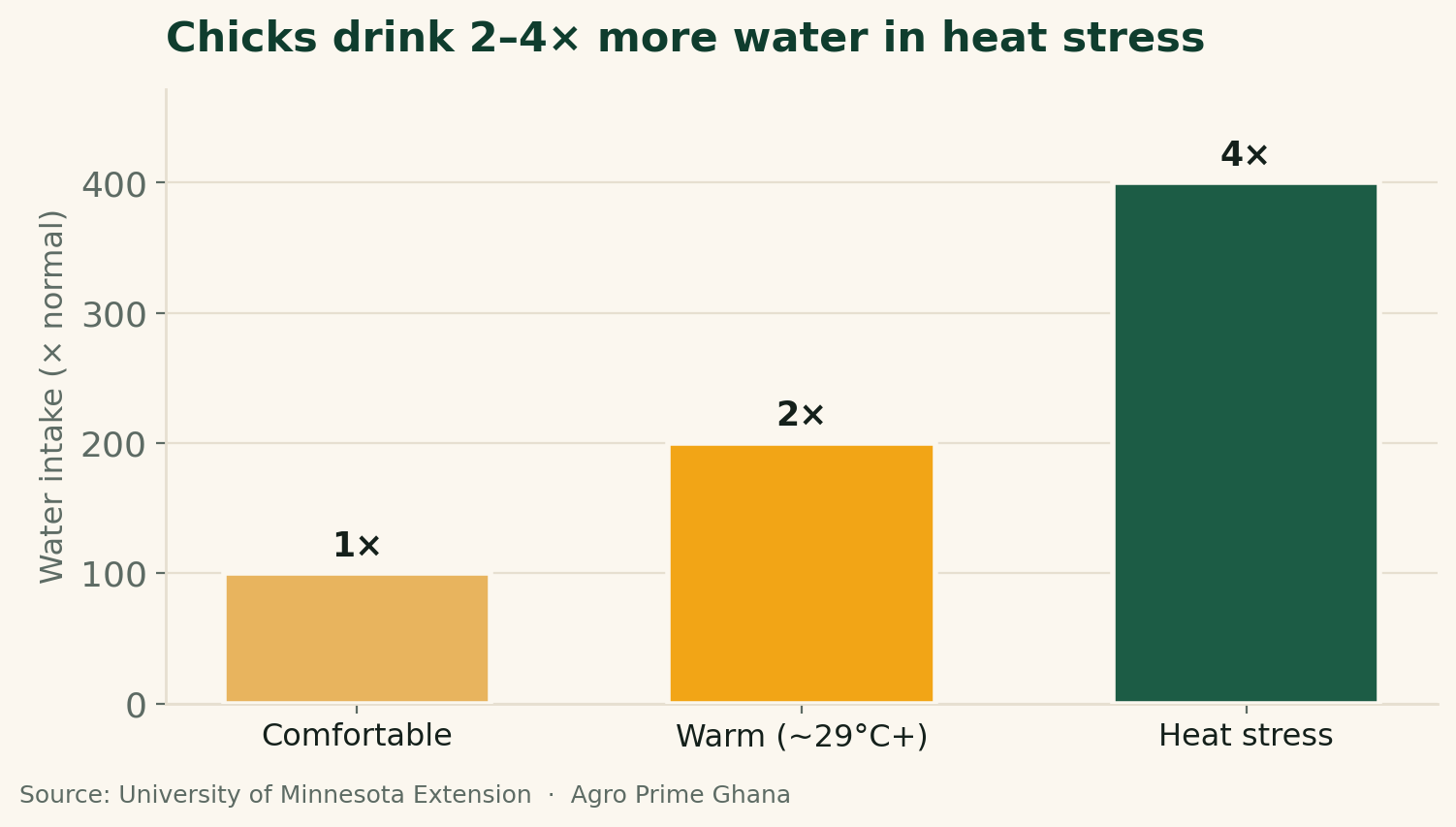
The water figures above are the clearest early-warning system you have: a sudden jump in how fast the drinkers empty is often the first sign a brooder is running too hot, well before you count any losses.
| What the chicks are doing | What it means | What to do |
|---|---|---|
| Panting, wings held open, spread flat at the cool edges, away from the heat | Too hot — the danger sign in hot weather | Reduce or raise the heat source, increase ventilation, add shade, refresh cool water |
| Drinking far more than usual, drinkers emptying fast | Early heat stress | Add drinker space, give cool fresh water, improve airflow before losses start |
| Quiet, drowsy, still, not feeding, beaks open | Severe overheating — birds at risk of collapse | Act immediately: cut heat, ventilate hard, cool the water, move air over the birds |
| Huddled in a tight pile under the heat, cheeping loudly | Too cold (can still happen at night or after rain) | Raise the heat, block draughts |
| Spread evenly, some feeding, some resting, soft murmur | Comfortable — the target | Hold the setup; keep monitoring as the day heats up |
Water is your first line of defence
In hot-weather brooding, water matters more than almost anything else, because panting is how a chick cools itself and water is what panting costs. Poultry drink far more in heat — University of Minnesota Extension puts it at two to four times the normal intake during heat stress — so drinkers that were adequate on a cool day run dry on a hot one, and a chick that cannot drink cannot cool. Give generous drinker space so every chick can reach water without a scramble, keep the water cool and fresh rather than letting it warm up (warm, stale water discourages drinking exactly when birds need it), and refill through the hottest part of the day. Position drinkers in the shaded, cooler parts of the brooder, not under the heat source. If a heatwave is forecast, adding an electrolyte and vitamin supplement to the water for a few days can help birds cope — the same guidance notes electrolytes and vitamins support birds through heat stress — but plain, cool, plentiful water is the foundation everything else sits on.
Field note: watch the drinkers, not just the birds
On a hot afternoon the fastest read on whether a brooder is too warm is not the thermometer and not even the chicks directly — it is how quickly the drinkers empty. When we notice water disappearing far faster than the morning rate, we treat it as an early alarm and improve airflow and shade before any chick looks distressed. Chicks that are panting are already stressed; drinkers emptying quickly is the warning that comes before that. Keep water cool and never let a drinker run dry in the heat of the day, because an empty drinker on a hot afternoon can cost you birds within hours.
Ventilation: move the heat and moisture out
Good airflow is what turns a hot brooder from a trap into a manageable space. Chicks give off heat and moisture, your heat source adds more, and the sun loads the building on top — unless fresh air moves through to carry that heat and humidity away, it builds up around the birds. University of Minnesota guidance is blunt that airflow should be prioritised at bird level, where it actually removes heat from the chicks, rather than high up where it does them no good. In a naturally ventilated Ghanaian brooder that means opening up in the heat of the day to let a through-breeze move across the pen at chick height, while preventing a hard draught blowing directly onto young chicks — gentle, steady air movement, not a wind tunnel. Ridge or high-level openings let the hottest air escape at the top while cooler air enters low. Ventilating well also keeps the litter dry, which matters for gut health. For more on getting airflow right, see our guide to poultry house ventilation.
Shade, stocking and layout for a hot-season brooder
How you house and space the chicks decides how hot their world gets before you touch a single control. Three things carry most of the benefit. First, shade: a brooding house under full sun bakes, so shade the roof and walls — trees, a second roof layer, or siting the brooder away from the worst afternoon exposure all cut the heat load. Second, space: crowding is the enemy in hot weather, because packed chicks pool their body heat and block airflow; a more generous stocking density lets heat dissipate and gives every chick room to reach a cooler patch. Third, a proper heat gradient: make the brooding area large enough that the zone away from the heat is genuinely cooler, so chicks can self-select their comfort — a small, uniformly hot brooder gives them nowhere to escape. Keep dry litter, put feed and water in the cooler shaded zones, and design the space so the mid-afternoon peak is something chicks can move away from rather than something that surrounds them.
Adjusting your heat source through the day
The single most practical hot-weather habit is to treat your brooder heat as something you turn down when the day heats up and back up at night — not a set-and-forget appliance. In the cool early morning and overnight, chicks still need their week-appropriate warmth, so run the heat then. As the sun climbs and the ambient temperature rises past your target, ease the heat back: raise a heat lamp, turn a gas or charcoal brooder down, or open the brooder so the added heat is diluted by cooler air. By the hottest part of a Ghanaian afternoon, week-old-plus chicks may need little or no supplemental heat at all — and by around week three to five, as they feather, you are mostly managing heat out rather than in. The rule stays the same as in any brooding: adjust to the chicks. If they crowd the heat in the cool morning and flee it in the hot afternoon, that is the gradient working — your job is to make sure both the warm refuge and the cool escape exist. Our brooder temperature chart sets out the week-by-week targets.
Start with strong chicks and a hot-season brooding plan
Chicks cope with heat far better when they start healthy, hydrated and unstressed — and when the brooder is set up for the season before they arrive. Agro Prime Ghana supplies vaccinated broiler and layer day-old chicks from our Kasoa hatchery and will help you plan a hot-weather setup: brooder size, ventilation, drinker space and a shade plan matched to your building. Message us on WhatsApp (+233 24 915 1503) or book a visit to plan your next batch, and see our full brooding guide.
When it goes wrong: acting on an overheating brooder
If you find chicks panting hard, spread to the walls, drowsy and off their feed, treat it as an emergency and act within minutes, because heat kills fast. Cut the supplemental heat immediately, since the ambient temperature is already doing the work. Open the brooder wide to get cool fresh air moving across the birds at their level; if you have a fan, direct gentle airflow over the flock. Replace warm water with cool, fresh water at once and add more drinking points, because rehydration is how a panting chick recovers. Spread birds out to reduce crowding, and get them into the coolest, shadiest part of the space. Those that recover will settle and return to feeding as the temperature drops; those pushed too far may not — which is exactly why prevention beats rescue every time. A flock lost to overheating is one of the most avoidable losses in poultry, coming down almost entirely to whether chicks had somewhere cooler to go and enough cool water. If unexplained chick losses recur, our guide on why chicks die works through the causes.
Field note: the afternoon is the danger window
Cold losses tend to happen before dawn; heat losses happen in the afternoon — and the two need opposite responses on the same day. What we have learned is to manage the brooder as two different environments: a warm one for the cool early hours and overnight, and a cool, airy, well-watered one for the heat of the day. The keepers who lose chicks in the hot season are usually the ones who set the heat once in the morning and leave it, so the same setting that was right at 6am is cooking the chicks by 2pm. Walk the brooder at the afternoon peak specifically, when the building is hottest, and be ready to pull heat, open up and refresh the water — that single habit prevents most hot-season brooder losses.
The bottom line on brooding chicks in hot weather
Hot-weather brooding is a balancing act, not a reason to abandon warmth. Chicks in their first weeks still cannot regulate their temperature, so they still need a warm zone of about 35°C in week one — but in Ghana's climate the greater daily danger is overheating, and the whole art is giving chicks a warm spot they can leave. That means a large, shaded, well-ventilated brooding area with a genuine temperature gradient, cool and plentiful water (chicks drink two to four times as much in heat), sensible stocking, and a heat source you turn down through the hot afternoon and up again overnight. Above all it means reading the birds: panting and fleeing the heat means cut it back, huddling means add it, evenly spread and murmuring means you have it right. Manage the afternoon peak as deliberately as the cold before dawn, keep the drinkers cool and full, and your chicks will come through the hottest Ghanaian days growing steadily instead of merely surviving.
Frequently asked questions
Do chicks still need heat in hot weather?
How do I know if my chicks are overheating?
How much more water do chicks drink in the heat?
At what temperature does heat stress start in chicks?
Should I turn off the brooder heat during hot afternoons?
How does ventilation help chicks in hot weather?
Can I give chicks electrolytes in the heat?
Is overheating or chilling the bigger risk in Ghana?
Sources & further reading
- University of Minnesota Extension — Preventing Heat Stress in Poultry (heat stress thresholds, panting, two-to-four-times water intake, ventilation at bird level, electrolytes).
- Cobb-Vantress — Brooding Fundamentals (week-one target temperature, tepid starter water, chick comfort indicators).
- MSD Veterinary Manual — Management of Growing Chickens (brooder floor temperature, weekly reduction).
- Agro Prime Ghana guides: how to brood day-old chicks, brooder temperature chart, poultry house ventilation, and why are my chicks dying.
About Agro Prime Ghana
Agro Prime Ghana Limited runs a poultry hatchery and mixed agribusiness in Kasoa, supplying day-old chicks and supporting poultry keepers across the country through every season, from the harmattan cold to the hottest months. These guides combine hands-on hatchery experience with current industry references. We supply healthy day-old chicks (broilers & layers), point-of-lay pullets, quality feed and practical farm support nationwide. This article is general educational information, not a substitute for professional veterinary or extension advice. Ready to start or expand? Book a visit or message us on WhatsApp (+233 24 915 1503) to order chicks, feed or brooding advice.