Backyard poultry keeping means running a small home flock — often just a handful of hens plus a cockerel, or a few dozen improved birds — that lives in your compound, is shut in at night, forages by day and gives the household eggs and meat. It is the easiest, cheapest way to start with chickens in Ghana, and it is how most Ghanaian keepers begin. You do not need land, money or a poultry-science background: you need a dry night shelter, a little balanced feed to top up what the birds scavenge, and one non-negotiable habit — vaccinating against Newcastle disease. Get those basics right and a few birds behind the house can put fresh eggs on the table every week, dress a bird for Sunday, and grow — at your own pace — into a real side income. This guide walks a first-timer through every step.
Written by the Agro Prime Ghana hatchery team and reviewed against current industry references (FAO small-scale and smallholder poultry guides). Last updated September 2026.
Key takeaways
A backyard flock in Africa typically runs anywhere from 5 to 100 birds, kept mainly by the household — often the women — for eggs, meat and small cash. Local hens left to scavenge lay very little: roughly 10–12 eggs, about three times a year (around 36 a year). Add a simple night shelter, a Newcastle vaccine and a handful of balanced feed morning and evening and you push a hen toward 40–60 eggs, and semi-intensive housing lifts it toward 100. The biggest killer is Newcastle disease, which can wipe out up to 100% of an unvaccinated flock; the second is chick loss, with about 70% of scavenging chicks dying before six weeks from disease, predators and hunger. Start small with strong, vaccinated stock, keep the birds dry and safe at night, feed to top up scavenging, and scale only when you are comfortable.
What is backyard poultry keeping?
Backyard poultry keeping is small-scale, low-input chicken production carried out around the home rather than on a dedicated commercial farm. In the classic Ghanaian version the birds are housed at night but allowed to range freely during the day, scavenging the compound for insects, seeds, greens and household leftovers, and getting only a handful of grain in the morning and evening to supplement what they find. The flock is small — the FAO puts typical African backyard flocks at 5 to 100 birds, and smallholder flocks often at just five to ten — and it is usually looked after by the family itself, very often the women of the household, who both own and manage the birds. This is the entry point almost every Ghanaian poultry business grows out of, and it remains hugely important: across sub-Saharan Africa, an estimated 85% of rural households keep chickens or other poultry, and family poultry supplies something like 20–30% of the total animal protein people eat in low-income countries.
The appeal is that it asks so little to begin. You are not building a broiler house or buying a thousand chicks; you are keeping a few birds in a corner of the compound, using space and food that would otherwise go to waste, and learning the craft on a scale where mistakes are cheap. That is exactly why it is the right place for a first-timer to start — and why we tell nervous beginners not to over-invest on day one.
Why keep a backyard flock in Ghana?
A backyard flock earns its keep in four ways at once: food, income, security and manure. Eggs give a small but steady supply — the FAO notes that eggs provide "a regular, albeit small, income" while live birds are "a more flexible source of cash" you can sell whenever money is needed, for school fees, a funeral, or the festive season when chicken prices climb. For a family, a home flock turns kitchen scraps and free-range foraging into protein you would otherwise have to buy, which matters for children's nutrition. The droppings enrich a backyard garden. And because the birds cost so little to keep, almost any household can start — which is why poultry keeping is such a well-documented tool for lifting rural and women-headed households, who are often the main beneficiaries.
The honest picture is that a traditional scavenging flock produces modestly. Left entirely to itself, a local hen lays only around 10–12 eggs a clutch about three times a year, and losses are heavy. But this is also the encouraging part: very simple, low-cost improvements multiply output. Giving the same local hen a safe night shelter and a Newcastle vaccine lifts her toward 40–60 eggs a year; housing her properly with supplementary feed pushes her toward 100. In other words, a beginner is not stuck at the bottom — small management steps, each within reach, steadily raise what the flock returns.
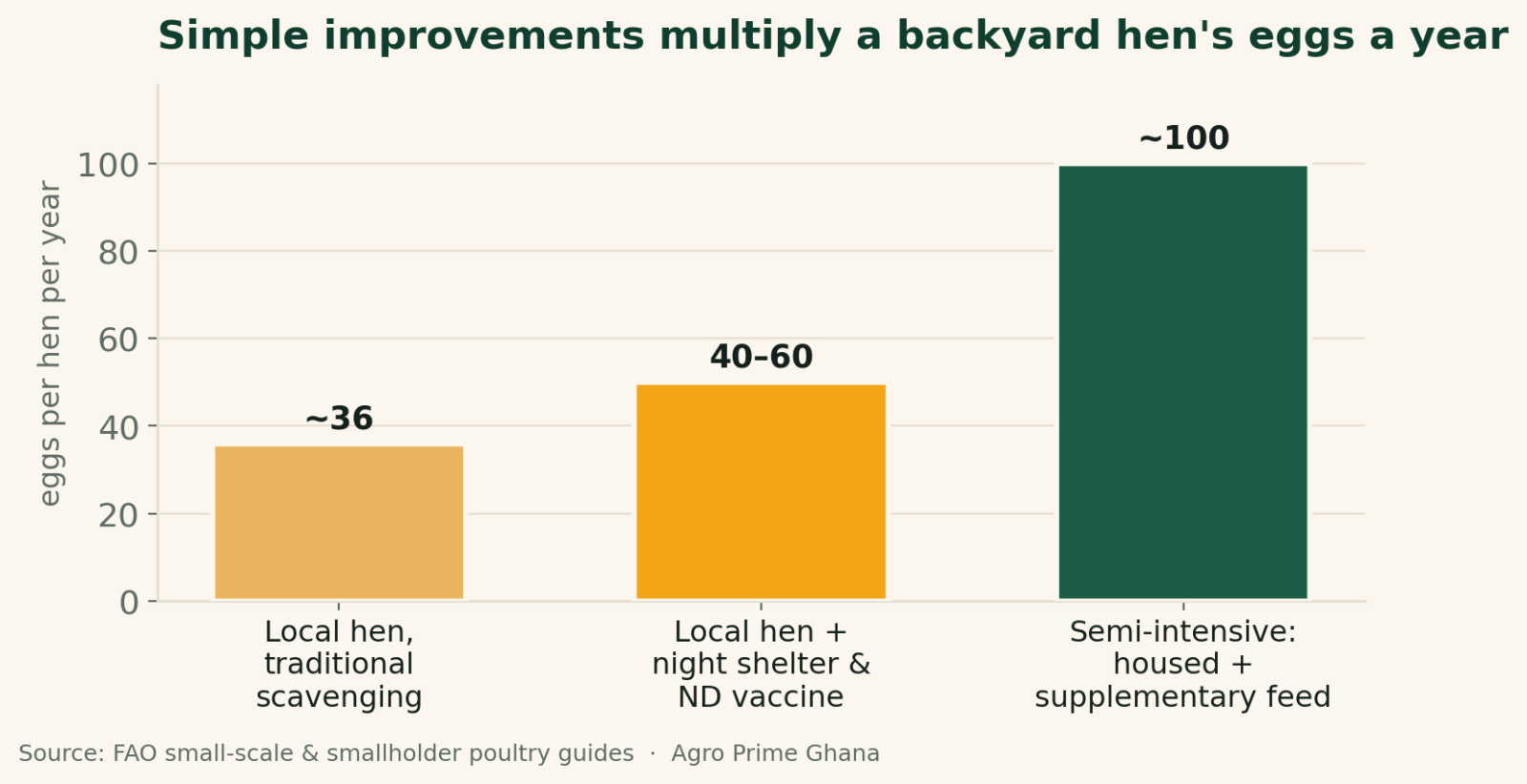
Reading the chart, the lesson for a first-timer is that management, not luck, decides how much a hen gives. The jump from a bird that fends for itself to one that is sheltered, vaccinated and topped up with feed is dramatic — and none of those steps is expensive. Below is a quick way to decide what kind of starter flock suits your goal, since the "right" bird depends on whether you mainly want eggs, meat or a bit of both.
| Starter flock option | Best for | What to expect |
|---|---|---|
| A few local/indigenous hens + cockerel | Absolute beginners, lowest cost, natural breeding | Hardy and self-reliant, but low output (~30–60 eggs/hen/yr) and slow-growing chicks; they will brood and hatch their own |
| Dual-purpose birds (Noiler, Kuroiler, Sasso-type) | Families wanting eggs and meat from one flock | Bigger and faster than local birds, lay far better, tolerate backyard conditions well — a popular middle path |
| A few point-of-lay (POL) pullets | Households mainly after a steady egg supply | Improved layers already close to laying; a reliable daily egg habit if fed a proper layer ration |
| Cockerels for meat | Meat on a budget, festive-season sales | Cheap to buy, grow slowly on scavenging + feed, sold live; a common Ghanaian starter enterprise |
How many birds should a beginner start with?
Start smaller than you think you should. For a true first-timer, somewhere between 5 and 15 birds is plenty — enough to learn feeding, watering, housing and vaccination on, and to supply a household with eggs, but few enough that an early mistake does not cost much or overwhelm you. It is far better to keep ten birds well than fifty badly. Learn to read your birds, get one production cycle under your belt, and let the flock and your confidence grow together. We walk through this decision in more detail in our guide on how many chicks to start with.
Whatever number you choose, the quality of the starting stock matters more than the quantity. Weak, unvaccinated chicks from an unknown source are the commonest reason a beginner's first attempt ends in disappointment. Buy from a reputable hatchery or supplier, insist that day-old chicks have been vaccinated at the hatchery where appropriate, and check that they are bright, active, dry and standing well before you take them home. If you would rather skip the fragile brooding stage entirely, starting with a few older point-of-lay pullets — birds already close to laying — is a lower-risk way in for someone who mainly wants eggs.
Simple housing for a backyard flock
A backyard flock does not need an expensive house — it needs a dry, secure place to spend the night. The single job of the shelter is to keep birds safe from predators (dogs, hawks, snakes, thieves) after dark and dry when the rain comes, because the two things that quietly destroy backyard flocks are night-time predation and damp. A simple raised coop of wood and wire, an old block outbuilding, or even a sturdy converted crate will do, provided it is:
- Predator-proof and lockable at night — the birds go in at dusk and are shut in until morning. This one habit prevents a large share of typical backyard losses.
- Dry and rain-proof, with a roof that does not leak and a floor that does not flood; damp bedding breeds disease.
- Well-ventilated but not draughty — Ghana's heat means air must move, especially in the hot afternoons and during harmattan dust, so open, wire-covered sides are better than a sealed box.
- Fitted with a simple perch for roosting and, for layers, a quiet, shaded nest box (a lined basket or wooden box) so eggs are laid in one clean place rather than lost around the compound.
Keep the litter or floor dry, clean out droppings regularly, and give the birds shade and constant clean water during the day — heat stress is a real risk in our climate, and a shaded compound with trees or a lean-to helps birds cope.
Field note: the night lock-up is the cheapest insurance you own
On our own hatchery floor we see the same pattern again and again: the beginners who lose birds are almost never beaten by exotic diseases first — they are beaten by a dog, a hawk or a snake getting into an open coop at night, or by chicks chilling in a leaky shelter after a downpour. Building the habit of counting the flock in at dusk and shutting the door costs nothing and saves more birds than any medicine. If you do just two things well in your first months, make them a locked, dry night house and Newcastle vaccination.
Feeding: kitchen scraps plus a balanced ration
The clever economics of backyard poultry come from feed the birds find themselves. A ranging flock scavenges insects, worms, seeds, green leaves and household leftovers, and this free foraging can cover a good part of its needs. But scavenging alone does not give a balanced diet, and it is why traditional flocks produce so little — the birds simply cannot find enough protein and energy to lay well or grow fast. The proven approach is to let them scavenge, then top up: offer a handful of grain or balanced feed in the morning and again in the evening, which is exactly the supplementary-feeding pattern the FAO describes for productive backyard systems.
Kitchen and garden waste is genuinely useful — rice, kenkey and banku leftovers, vegetable trimmings, cassava and yam peels (cooked), spoiled grain, termites and greens all help. Just keep a few rules: never feed mouldy or rotten material (mould toxins quietly harm birds), avoid heavily salted or spiced leftovers, and do not rely on scraps for everything. For birds you actually want to be productive, a proper balanced feed for their stage does the heavy lifting — a chick/starter ration for young birds, a layer ration for hens in lay (which supplies the extra calcium they need for strong shells), and a grower or finisher ration for meat birds. Clean water must be available at all times; in the heat, birds drink far more than beginners expect, and a flock that runs out of water in the afternoon suffers fast.
Start your backyard flock the right way with Agro Prime
The easiest way to succeed with your first flock is to begin with strong, healthy stock and the right feed — and a little advice from people who hatch and rear birds every week. Agro Prime Ghana supplies vaccinated day-old chicks (broilers, layers and dual-purpose), point-of-lay pullets, and quality feed for every stage, and we are happy to help a first-timer choose a small starter flock that fits their space, budget and goal — whether that is eggs for the family, meat for the festive season, or a bit of both. Tell us what you have in mind and we will put together a simple starter package and a plain-language plan for feeding and Newcastle vaccination. Message us on WhatsApp (+233 24 915 1503) or book a visit to get started.
Health and vaccination: Newcastle disease comes first
If you remember only one thing about keeping chickens in Ghana, remember this: you must vaccinate against Newcastle disease. Newcastle is a viral disease that the FAO calls "the single greatest constraint on the production of village poultry," and for good reason — in a susceptible, unvaccinated flock it can cause up to 100% mortality, sweeping through a compound and killing every bird in days. Almost every Ghanaian keeper has a story of losing an entire flock overnight, and Newcastle is usually the culprit. The tragedy is that it is preventable with a cheap vaccine.
The practical routine for a backyard flock is straightforward. Thermostable Newcastle vaccines such as the I-2 strain were developed specifically for village and backyard conditions because they tolerate the breaks in refrigeration that are common in rural Ghana. Given by eye-drop, the FAO's field guidance is to vaccinate and then re-vaccinate every 3–4 months, and trials show this can give around 80% protection even in the face of an outbreak. Ask your veterinary or agricultural extension officer, or your chick supplier, about the vaccination schedule for your area, and mark the re-vaccination dates on a calendar so they are not forgotten. Our guide to poultry vaccination technique covers how to give it correctly.
Beyond Newcastle, good backyard health is mostly good management: keep the shelter clean and dry, provide clean water, do not overcrowd, quarantine any new or sick-looking bird before adding it to the flock, and control internal parasites and external pests (lice, mites). Watch the flock daily — a bird that sits hunched, stops eating, has ruffled feathers or unusual droppings is telling you something early, when you can still act.
Field note: protect the chicks, not just the hens
Beginners often pour all their attention into the grown birds and lose the very chicks that were meant to grow the flock. In scavenging systems the FAO estimates roughly 70% of chicks die before six weeks — a brutal combination of disease, predators and simply not finding enough to eat. On our farm the fix is the same three things every time: keep young chicks warm and dry and shut safely away from cats, hawks and snakes; give them a proper chick feed rather than expecting them to scavenge a living; and vaccinate on schedule. Getting chicks through those first weeks is where a backyard flock is really won or lost.
Eggs and meat for the family — and beyond
A well-managed backyard flock quietly pays for itself in the kitchen before it ever earns a cedi. A handful of laying hens gives a household fresh eggs most days — protein for the children that you are not buying at the market — and the flexibility to slaughter a bird for a special meal or sell one live when cash is short. Because live birds can be sold at any time, the flock doubles as a small, feathered savings account: it grows on food that would otherwise be wasted, and you draw on it when you need to. Collect eggs at least once a day, store them clean and cool (pointed end down), and keep the nest boxes tidy so eggs stay fit to eat or to sell.
As the birds multiply — especially if you keep local hens or dual-purpose types that will go broody and hatch their own — you will soon have more eggs and birds than the family needs, and that surplus is your first taste of poultry as a business. Many of Ghana's commercial poultry keepers started exactly here.
How to scale up when you are ready
The right time to grow is when you have mastered the small flock — when your birds are surviving, laying and staying healthy, and the daily routine feels second nature. Scale in steps rather than leaps. A natural progression is: prove you can keep 10–15 birds alive and productive; add a few improved point-of-lay pullets for a steadier egg supply, or a batch of cockerels or broilers for meat; build a slightly bigger, better house; and only then think about a proper enterprise. Each step teaches the next, and each is affordable on the returns from the last.
When you do decide to turn the hobby into an income, treat it like a business: keep simple records of what you spend and earn, plan your batches around demand (the festive season is prime selling time for meat birds), and cost your feed carefully, since feed is the largest expense in any poultry venture. Our guides on increasing egg production, rearing cockerels and starting a poultry farm pick up the story from here. The beauty of the backyard route is that you never have to gamble a large sum — you grow the flock and your skill together, at a pace you can afford.
The bottom line on backyard poultry keeping
Backyard poultry keeping is the simplest, lowest-risk way to start with chickens in Ghana, and it rewards the basics rather than big money. Keep a small flock — 5 to 15 birds to begin — in a dry, predator-proof night shelter; let them scavenge but top them up with a handful of balanced feed morning and evening and always give clean water; and above all vaccinate against Newcastle disease, the one thing most likely to wipe out an unprotected flock. Do that, and even modest local hens will lift from a few dozen eggs a year toward fifty or more, put meat and eggs on the family table, and hand you a small, flexible income. Start small, get the basics right, protect the chicks through their first weeks, and let the flock grow as your confidence does — that is how most of Ghana's poultry keepers, ourselves included, began.
Frequently asked questions
How many chickens should I start with as a beginner in Ghana?
What is the best chicken to keep in a backyard flock?
Do I need to vaccinate a small backyard flock?
What should I feed backyard chickens?
How much housing do backyard chickens need?
How many eggs will a backyard hen lay?
Why do so many backyard chicks die?
Can I turn backyard poultry into a business?
Sources & further reading
- FAO — Small-scale poultry production (technical guide): backyard flock sizes, scavenging plus supplementary feeding, egg output under different systems, and poultry's share of animal protein.
- FAO — Smallholder Poultry Production: Livelihoods, Food Security and Sociocultural Significance: household flock sizes, local-hen egg output, chick mortality in scavenging systems, and the effect of vaccination.
- FAO — Newcastle Disease in Village Chickens: Newcastle as the greatest constraint on village poultry, up-to-100% mortality, and thermostable I-2 vaccine use and re-vaccination.
- Agro Prime Ghana guides: how many chicks to start with, point-of-lay pullets, poultry vaccination technique, starting a poultry farm.
About Agro Prime Ghana
Agro Prime Ghana Limited runs a poultry hatchery and mixed agribusiness in Kasoa, supplying poultry keepers across the country — from families with a few birds in the compound to growing commercial farms. We supply healthy, vaccinated day-old chicks (broilers, layers and dual-purpose), point-of-lay pullets, quality feed and hands-on farm support, and we love helping first-timers get started right. This article is general educational information, not a substitute for professional veterinary or extension advice — if your flock is sick, get it seen. Ready to start or expand your backyard flock? Book a visit or message us on WhatsApp (+233 24 915 1503) to order chicks, feed or advice.