
A point-of-lay (POL) pullet is a young hen roughly 16 to 18 weeks old that has finished the long, risky rearing stage and is within a few weeks of her first egg. Buying POL means someone else has already carried your birds through brooding, vaccinations and the delicate grower phase — you take delivery of near-adult pullets that should start laying within about two to four weeks and reach peak production soon after. For a Ghanaian farmer who wants eggs in the crate quickly and would rather not gamble on brooding day-old chicks, POL pullets are one of the smartest ways into layer farming. But "point of lay" is also one of the most abused terms in the local trade: birds are sold as POL when they are underweight, wrongly vaccinated, or months from an egg. This guide explains what POL really means, why it can save you money and heartache, what to inspect before you pay, and how to settle new pullets so they lay well.
Written by the Agro Prime Ghana poultry team and reviewed against current layer-breeder management guides (Hy-Line Brown, Lohmann Brown and ISA Brown). Last updated September 2026.
Key takeaways
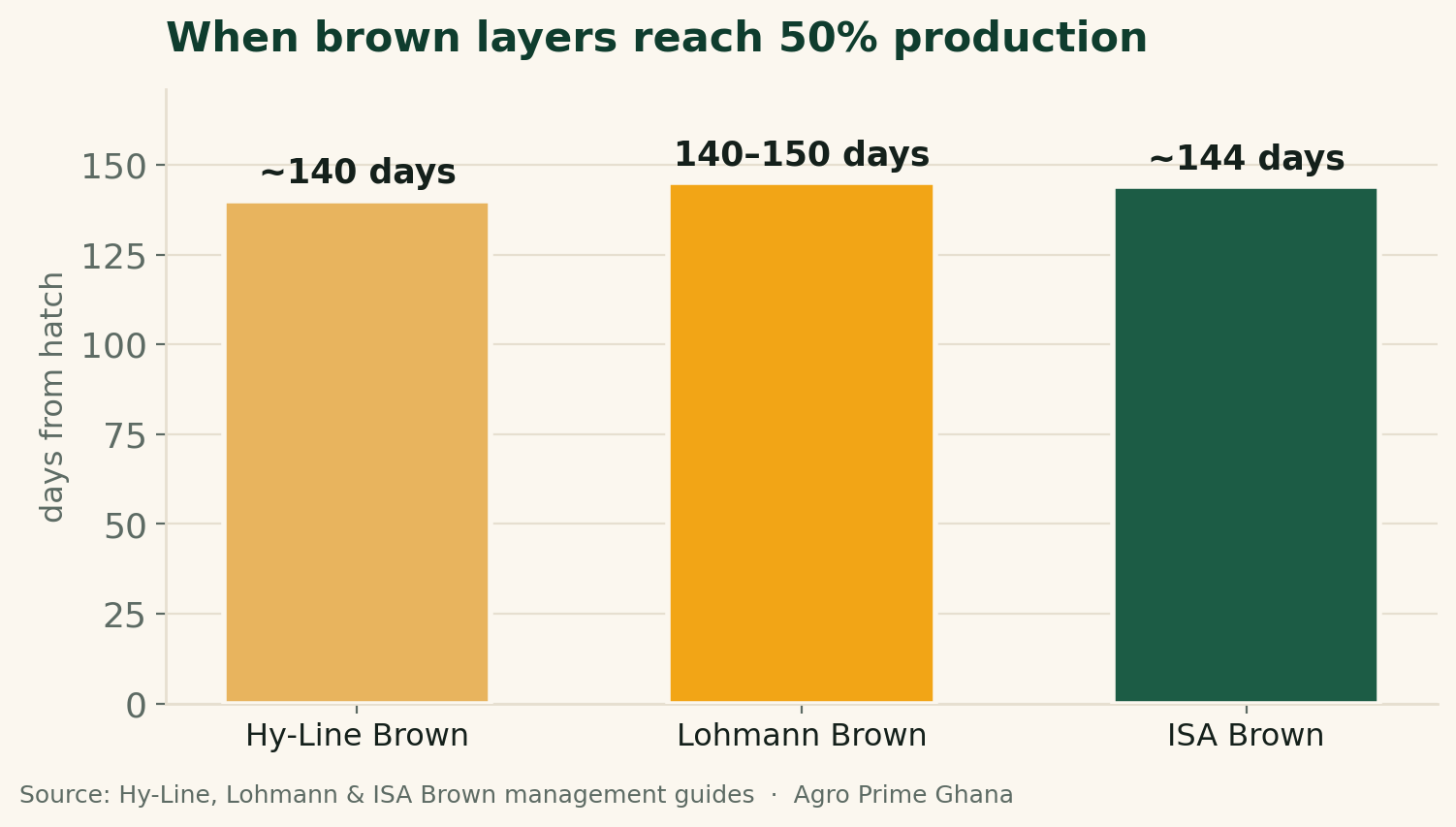
A point-of-lay pullet is a hen near sexual maturity, typically 16–18 weeks old, close to her first egg. Brown layers such as Hy-Line Brown, Lohmann Brown and ISA Brown reach 50% production at about 140–150 days and peak at 92–96%, so a genuine POL bird should be laying strongly within roughly a month, and at point of lay she should weigh around 1.4–1.55 kg. Buying POL lets you skip the 0–18 week rearing period — where most day-old-chick losses and vaccine failures happen — but it costs several times more per bird and you inherit the rearer's mistakes if you don't inspect carefully. Check age, body weight, uniformity, a written vaccination record (especially Newcastle and fowl pox), feathering, and freedom from disease before you pay. Settle new pullets on layer-phase feed, clean water, calm handling and the right lighting.
What does "point of lay" actually mean?
Point of lay describes the short window at the end of pullet rearing when a hen is sexually mature and about to start producing eggs. In commercial terms it lines up with the 16 to 18 week stretch, the same age at which breeder companies recommend transferring pullets from the rearing house into the layer house. According to the Hy-Line Brown management guidance, light stimulation to switch birds "on" is started when a flock reaches an average body weight of about 1.35 kg with at least 85% uniformity, usually around 16 weeks of age — that moment is, in practice, the point of lay.
It is worth being precise, because the local market is loose with the term. A true POL pullet is a bird of a known laying breed, of the right age, that has hit her body-weight target, carries her rearing vaccinations, and is ready to lay within a short, predictable window. The breed guides put first egg at roughly 18–19 weeks and 50% of the flock in lay at about 140–150 days, after which production climbs to a peak of 92–96%. If a seller's "POL" birds are 12 weeks old, or nondescript cockerel-type birds, or spent hens being offloaded, you are not buying point of lay — you are buying someone else's problem.
Why buying POL skips the riskiest part of layer farming
The strongest argument for POL is risk transfer. The first weeks of a chick's life are where most losses, disease exposure and costly mistakes occur. Brooding demands precise heat — brown-layer guides start chicks at around 33–36°C and step it down week by week — and a single cold night, a wet brooder, a missed vaccination or a coccidiosis outbreak can wipe out a young flock or quietly stunt it. By buying at point of lay, you let an experienced rearer absorb all of that: you collect near-adult birds that have already cleared brooding, the grower phase, beak treatment and the full rearing vaccination programme, and you see eggs in weeks rather than months.
That head start is real money and real time. A day-old chick will not lay a saleable egg until around five months old, and for those months you feed, heat, medicate and house it while earning nothing. A POL pullet shortens that "cash gap" dramatically: you buy, settle her for a few weeks, and income begins. For a first-time farmer, or anyone without the equipment or confidence to brood, POL removes the steepest part of the learning curve, and it is the fastest way to restock after a cycle ends. If you would like to learn the rearing craft yourself, our guide to rearing pullets from brooding to lay walks through the full 0–18 week job.
Point-of-lay versus day-old: the real trade-off
POL is not automatically "better" than day-old chicks — it is a different trade. You pay a premium because the rearer has carried the cost and risk of 16–18 weeks of feed, heat, labour and vaccination. Day-old chicks are far cheaper per bird but commit you to five months of expense and exposure before the first egg. The table below lays out the honest comparison.
| Factor | Day-old layer chick | Point-of-lay pullet (16–18 wk) |
|---|---|---|
| Price per bird | Lowest | Several times higher (pays for ~4 months of rearing) |
| Time to first egg | ~18–20 weeks of rearing ahead of you | Roughly 2–4 weeks after purchase |
| Cash locked up before income | ~5 months of feed, heat, labour | Minimal — income starts soon |
| Main risk you carry | Brooding losses, vaccine failure, coccidiosis, stunting | Buying badly reared or wrong-age birds |
| Equipment needed | Brooder, heat source, brooder guard | Layer house, feeders, drinkers, nests |
| Control over rearing quality | Full — it is yours | None — you inherit the rearer's work |
| Best for | Experienced keepers rearing their own | New farmers, fast restocking, no brooder |
The single biggest danger with POL is captured in that last risk line: you inherit whatever the rearer did or did not do. A badly reared pullet that is underweight or under-vaccinated at 17 weeks will never lay to her genetic potential, no matter how well you feed her afterwards. That is why the inspection below matters more than the price.
What to check before you pay for POL pullets
Treat buying POL like buying a used vehicle: the price tells you little; the condition tells you everything. Go through this checklist on the birds, and insist on records.
- Age and breed. Confirm the exact hatch date and the layer breed (Lohmann Brown, ISA Brown and Hy-Line Brown are the common brown layers in Ghana). Genuine POL is 16–18 weeks; ask to see the day-old chick invoice or hatchery paperwork.
- Body weight and size. A brown-layer pullet at point of lay should weigh around 1.4–1.55 kg. Pick birds up — they should feel solid and well-fleshed over the breast, not light and bony. Thin, small "POL" birds will lay late, small or poorly.
- Uniformity. Read the whole batch, not one good bird. A well-reared flock is even — most birds the same size; a mix of big and small means poor uniformity and a ragged start to lay. Breed guides target over 85–90% uniformity at transfer.
- A written vaccination record. Non-negotiable. Ask for a dated list of vaccines given — for Ghana the essentials are Newcastle disease (repeated), Gumboro, fowl pox and, ideally, fowl typhoid and infectious bronchitis. No record, or a vague verbal "they are vaccinated," is a red flag.
- Health signs. Bright eyes, clean nostrils, no gasping or swollen faces, reddening combs, clean vents, glossy feathers and good feathering (not bare, pecked backs). Sneezing, hunched ruffled birds, or a smelly, wet flock mean walk away.
- Combs and readiness. As pullets near lay, combs and wattles enlarge and redden and the pubic bones widen; a batch with pale, tiny combs is further from lay than the label implies.
Field note: the batch tells the truth, not the sales bird
A seller will always hand you the best-looking hen in the pen. The habit that protects buyers is to ignore that bird and read the group: stand back and watch the whole batch move. Are they even in size, alert, feathered and active — or a mixed bag of a few good ones and many small, quiet, pecked birds? Then catch three or four at random yourself and feel their weight. Three random birds that are all solid and the same size tell you far more about the rearing than the one prize hen the seller is holding. And always ask for the vaccination record in writing before money changes hands — a rearer who did the job properly will be proud to show it.
Agro Prime supplies vetted point-of-lay pullets and the feed to settle them
We rear and supply healthy, correctly vaccinated point-of-lay pullets of proven brown-layer breeds — at true 16–18 week age and body-weight target, with a written vaccination record — plus the layer feed and settling advice to get them laying fast. If you would rather start younger, we also supply day-old layer chicks and grower feed with a rearing plan. Message us on WhatsApp (+233 24 915 1503) or book a visit to see the birds and reserve a batch.
How much do POL pullets cost — and is the premium worth it?
A point-of-lay pullet costs several times what a day-old layer chick costs, because the price bundles in roughly four months of feed, heat, labour, medication and vaccination the rearer has already spent — the premium is real work you are buying, not markup. Local prices move with the maize and feed markets and the festive calendar, so ask suppliers for a current quote rather than rely on a fixed cedi figure. To judge whether it is worth it, compare the POL price against what it would truly cost to rear a chick to 18 weeks yourself — feed, your time and the risk of losses. For many small and first-time farmers, once brooding losses and the five-month cash gap are counted honestly, POL is competitive and far less stressful; for those with brooding skill and cheap feed, rearing day-olds can be cheaper per laying hen. Our notes on layer economics and starting a poultry farm help you run the numbers.
Settling new POL pullets so they lay well
The move to a new farm is stressful, and stress at point of lay can delay laying or trigger a dip. Handle the transition gently and the flock rewards you.
- Have the house ready before they arrive. Clean, disinfected, rested layer house; feeders and drinkers filled; clean nest boxes installed; dry litter or cage. Birds should walk into a finished home, not a building site.
- Move them cool and calm. Transport in the cool of morning or evening, in ventilated crates without overcrowding — rough handling and heat during transfer are a common cause of early losses.
- Water first, then feed. On arrival give clean, cool water immediately, often with a vitamin–electrolyte supplement for the first days, and let birds drink and rest before they crowd the feeders.
- Get the feed right. Move pullets onto a layer or pre-layer ration with adequate calcium for shells — but do not flood very young pullets with full layer calcium weeks too early. Our layer feeding guide and note on calcium for laying hens explain the timing.
- Light them correctly. Once birds are on target weight, a steady or gradually increasing light programme stimulates lay; never cut light hours on a laying flock. See our poultry lighting programme guide.
- Nests early, disturbance low. Provide enough clean nest boxes before the first eggs so hens learn to lay in them, collect eggs often, and keep predators, dogs and sudden noise away in the settling weeks.
Field note: quarantine before you mix new pullets with an old flock
A quiet way farmers import disease is dropping newly bought POL pullets straight in with an existing older flock. Even healthy-looking new birds can carry organisms your resident flock has never met — and your birds can do the same to them. Where you already keep layers, hold new pullets in a separate pen for a couple of weeks and only mix once you are confident both groups are healthy. Best of all is all-in, all-out: one age group per house, cleaned and rested between batches.
The bottom line on POL pullets in Ghana
Point-of-lay pullets are the fast, lower-risk route into egg farming: you buy near-adult hens of a known laying breed at 16–18 weeks, skip the brooding and grower stages where most losses happen, and start earning within weeks. The catch is that "POL" is often mislabelled, and a badly reared or under-vaccinated pullet can never be fixed after purchase. So the whole decision comes down to sourcing: buy from a rearer who can prove age, show a written vaccination record, and offer even, well-fleshed, healthy birds at true body-weight target — then settle them gently on the right feed, water, light and nests. Do that, and your flock climbs to a 90%-plus peak and lays reliably for the whole cycle.
Frequently asked questions
What age is a point-of-lay pullet?
How soon will point-of-lay pullets start laying after I buy them?
Are point-of-lay pullets better than day-old chicks?
What should I check before buying POL pullets?
How much do POL pullets cost in Ghana?
What weight should a point-of-lay pullet be?
Do I need a vaccination record when buying POL pullets?
How do I settle new POL pullets so they lay well?
Sources & further reading
- Hy-Line International — Managing Hy-Line Brown Varieties: Top 10 Considerations (body-weight and uniformity targets for light stimulation).
- Hy-Line Brown Commercial Management Guide — performance standards (18-week body weight, age at 50% production).
- Lohmann Brown-Classic Layer Management Guide — production standards (body-weight targets, 50% production age, peak lay).
- ISA Brown Product Guide — performance standards (body-weight targets, age at 50% lay, peak).
- Agro Prime Ghana guides: rearing pullets from brooding to lay, layer body-weight and uniformity targets, layer feeding and poultry lighting programmes.
About Agro Prime Ghana
Agro Prime Ghana Limited runs a poultry hatchery and mixed agribusiness in Kasoa, supplying poultry keepers across the country. We supply healthy day-old chicks (broilers and layers), correctly vaccinated point-of-lay pullets, quality feed and hands-on farm support. This article is general educational information, not a substitute for professional veterinary or agronomic advice. Ready to start or expand your layer flock? Book a visit or message us on WhatsApp (+233 24 915 1503) to order POL pullets, day-old chicks, feed or advice.