Wheat bran is a bulky, high-fibre poultry feed that is valued more for what it does to a ration than for the energy it supplies. It carries decent protein (around 16–17%) and useful phosphorus, but very little usable energy for poultry — a Ghana study measured just 5.8 MJ/kg against maize's 13.1 — so its job is to lighten dense feed, add fibre and bulk, and gently keep the gut moving, not to fuel growth. Used at sensible levels of roughly 5–10% in most rations (more in special diets like layer moulting), it is a handy, affordable ingredient; overdone, it dilutes energy, loosens droppings and holds birds back. This guide explains what wheat bran is, its real feeding value in Ghana, its mild laxative effect and gut role, where its limits lie, and how to use it well in broiler, layer and pullet feeds.
Written by the Agro Prime Ghana poultry team and reviewed against current feed-science references (Feedipedia and a Ghana feedstuffs study published in Livestock Research for Rural Development). Last updated September 2026.
Key takeaways
Wheat bran is the fibrous outer coat of the wheat grain, a by-product of flour milling. It is a high-fibre, low-energy feed: about 17% crude protein and 10% crude fibre with a high phosphorus content (around 11 g/kg), but a poultry metabolisable energy of only about 5.8–7.8 MJ/kg — roughly half that of maize. Its bulk and fibre give it a mild laxative, gut-conditioning effect, useful for lightening dense mash and for special uses like layer moulting diets. It contains pentosans (non-starch polysaccharides) that can depress nutrient use in young birds, so inclusion above about 13% tends to cut broiler feed intake. Practical inclusion is around 5–10% for most rations. Because it is bought by weight but low in energy, it rarely earns a big place in a least-cost broiler mix.
What is wheat bran, and what is in it?
Wheat bran is the hard, fibrous outer layers of the wheat grain, separated from the white flour during milling. Ghana imports and mills large volumes of wheat for bread and flour — through mills in Tema and Takoradi — so wheat bran (sometimes sold as "wheat offal" or "wheat pollard," though these vary slightly) is a widely available milling by-product. Nutritionally it is defined by contrast with the flour it comes from: the starch stays in the flour, while the bran keeps the fibre, much of the protein, the B-vitamins and most of the grain's minerals. According to Feedipedia, wheat bran contains about 17.3% crude protein, 10.4% crude fibre, a high 45% NDF (a measure of total fibre), and around 11 g/kg phosphorus — a genuinely useful phosphorus level, though much of it is bound as phytate. What it lacks is concentrated energy: with the starch removed, there is little left to fuel a fast-growing bird. That single fact — protein-and-fibre rich, energy poor — shapes everything about how wheat bran should be used, and it is why it behaves so differently from an energy feed like maize in our overview of poultry feed ingredients.
How much feeding value does wheat bran give in Ghana?
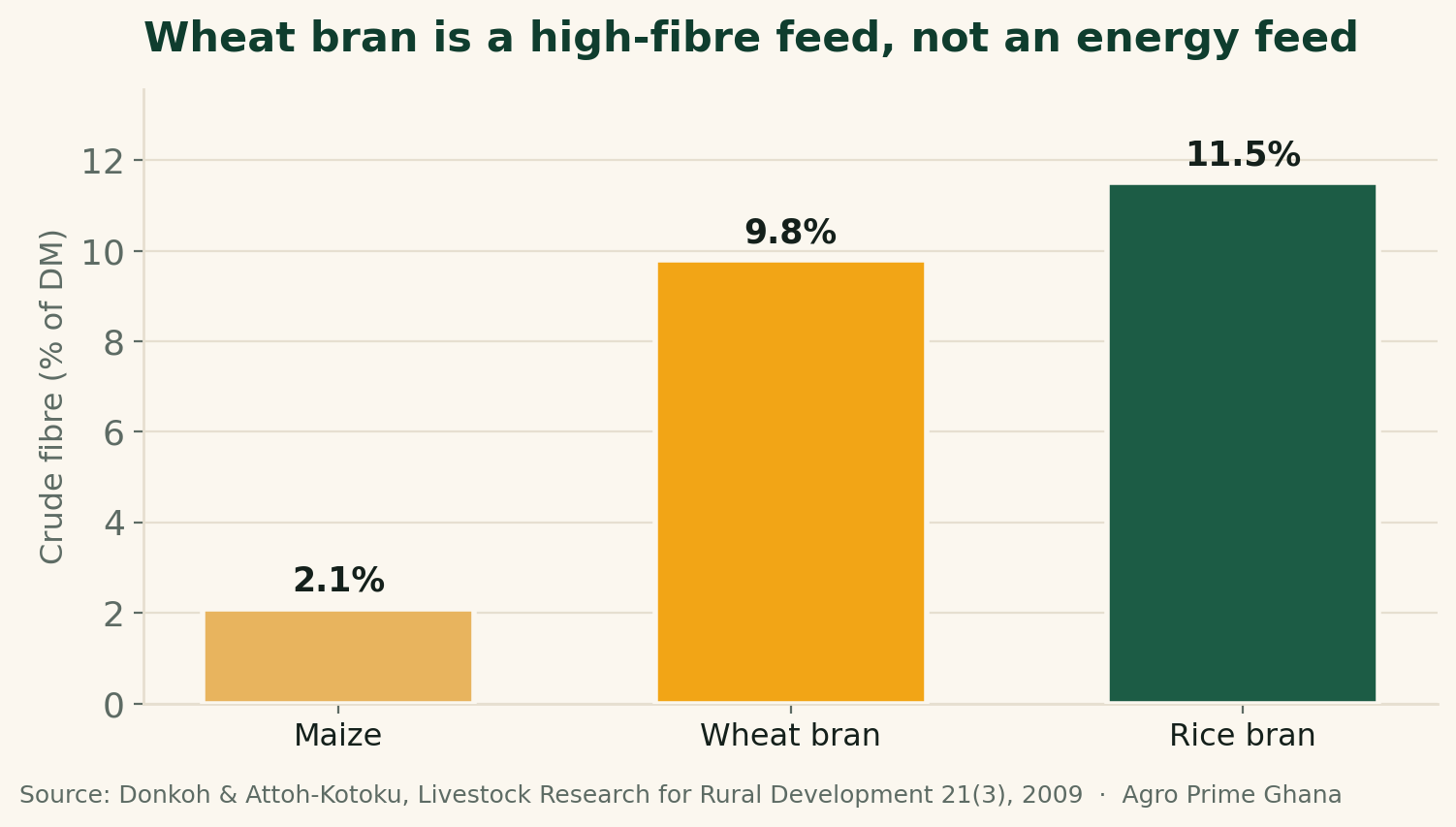
Wheat bran's feeding value for poultry is modest and centres on protein, phosphorus and bulk rather than energy. The Ghana study by Donkoh and Attoh-Kotoku in Livestock Research for Rural Development measured local wheat bran at about 16.5% crude protein and 9.8% crude fibre, but an apparent metabolisable energy of only 5.8 MJ/kg of dry matter — the lowest of all the energy-type feeds they tested, and less than half of maize's 13.1 MJ/kg. Feedipedia's broiler figure is a little higher at around 7.4 MJ/kg, but the message is the same: this is not an energy feed. Its protein is reasonable in quantity but only moderately digestible — the Ghana study found lysine digestibility of about 70%, below maize's 87% — so wheat bran cannot be leaned on for high-quality amino acids either; those still need to come from a proper protein source, as explained in our guide to amino acids in poultry feed. Where wheat bran earns its keep is as an affordable protein-and-fibre filler that adds bulk, supplies phosphorus, and improves the physical texture and gut behaviour of a ration — valuable, but strictly in a supporting role.
| Property (dry matter basis) | Maize | Wheat bran | Rice bran |
|---|---|---|---|
| Metabolisable energy (MJ/kg) | 13.1 | 5.8 | 8.8 |
| Crude protein | ~8% | ~16–17% | ~12% |
| Crude fibre | ~2% | ~10% | ~11–12% |
| Main role in the ration | Energy base | Protein, phosphorus, bulk & fibre | Energy extender |
| Typical poultry inclusion | Up to ~55–60% | ~5–10% | ~10–15% |
Energy, protein and fibre figures from Donkoh & Attoh-Kotoku (LRRD 2009), Ghana.
The laxative effect: why wheat bran keeps the gut moving
Wheat bran has a well-known mild laxative and gut-conditioning action, and understanding it explains both its uses and its risks. The fibre in bran — especially its insoluble fibre and pentosans — holds water and adds bulk to the digesta, which speeds the passage of feed through the gut and produces softer, bulkier droppings. Feedipedia describes wheat bran plainly as "a bulky feed that can be used to lighten dense, heavy feed mixtures," and that bulking action is exactly what makes it useful in some situations and troublesome in others. In moderation, this gentle laxative effect can help prevent feed from packing too densely and can keep the digestive tract active. But push the level too high and the same effect produces genuinely loose, wet droppings, wetter litter, and faster gut transit that leaves less time to absorb nutrients — so birds pass more of what they eat. In young broilers the pentosans can also raise the viscosity of the gut contents, interfering with digestion and depressing growth. The practical takeaway: a little wheat bran conditions the gut and lightens the feed; too much simply flushes nutrients and soaks your litter.
Field note: watch the litter when you change the bran level
Litter is the honest report card for how much wheat bran a ration can take. When we adjust a feed and the droppings turn noticeably wetter and the litter starts caking and smelling of ammonia within a day or two, that is usually the bran talking — too much fibre pulling water through the gut. The fix is to pull the bran back a few points and let things settle. Wet litter is not a small thing: it drives up ammonia, invites coccidiosis and footpad problems, and undoes any saving the extra bran was meant to deliver. We would rather run a slightly dearer, drier ration and keep the house healthy — good litter management starts in the feed trough.
Where wheat bran actually shines: moulting and gut health
Wheat bran has two roles where its high-fibre, low-energy character is a genuine advantage rather than a limitation. The first is in layer moulting or feed-restriction diets. Feedipedia notes that large amounts of wheat bran can be used in moult diets for layers — precisely because you want a bulky, low-energy feed that fills the bird while deliberately lowering energy intake to rest the hen and reset her laying cycle. Its second strength is as a gentle gut conditioner: a modest amount of insoluble fibre supports normal gut development and gizzard function and helps prevent the sluggish, overly dense digesta that fine-ground energy feeds can cause. There is growing recognition in poultry nutrition that a controlled level of "structural" fibre is not merely filler but actually benefits gut health and feed passage, and wheat bran is one of the cheapest ways to supply it in Ghana. The skill is dosing it: enough to condition the gut and lighten the mix, not so much that it dilutes energy or loosens the droppings.
The limits: pentosans, energy dilution and feed intake
Three factors set the ceiling on how much wheat bran you can use. The first is energy dilution. Because bran carries so little energy, every extra percentage point pulls down the ration's energy density; birds try to eat more to compensate, but there is a limit to how much a bird can consume, so beyond a point growth or egg production simply falls. The second is pentosans — the non-starch polysaccharides (NSPs) in wheat bran that Feedipedia notes "are thought to have antinutritional activities in poultry and result in depressed nutrient utilization and poor growth," particularly in young birds whose guts handle viscous fibre poorly. The third is feed intake: Feedipedia reports that high wheat-bran inclusion — more than about 13% — tends to reduce feed intake in broilers, especially when the feed is offered as a dusty mash rather than pellets. All three limits point the same way: keep wheat bran modest, keep it lower for young broilers than for adult layers, and lean on it more where fibre is an asset (moult, pullet growing) than where dense energy is the priority (broiler finishing).
How much wheat bran to feed, by bird type
Match the level to the bird's stage and to whether you want energy or bulk:
- Broiler starter: keep wheat bran very low or out. Chicks need dense energy and clean amino acids, and bran's fibre and pentosans work directly against fast early growth — see our broiler feeding guide.
- Broiler grower/finisher: a modest 5% or so can help texture and cost without badly diluting energy; stay well under the ~13% intake-depressing threshold.
- Layers: around 5–10% is common and useful — laying hens tolerate more fibre, and the phosphorus and bulk suit them, provided energy stays high enough to sustain lay.
- Growing pullets: a good home for wheat bran, since you often want a higher-fibre, moderate-energy diet to grow frame without fattening the pullet.
- Moulting layers: high levels are appropriate here, using bran's bulk to lower energy intake deliberately during a controlled moult.
Whatever level you choose, formulate the whole ration to its targets rather than just adding bran — a tool like the Pearson square keeps energy and protein on track once the bran goes in.
Balance the bulk with feed that still performs — let us help
Wheat bran is a useful, affordable filler, but a ration built on cheap bulk alone grows slow birds and wet litter. At Agro Prime Ghana we supply quality feed and help farmers formulate rations that use local by-products like wheat bran in the right proportion — enough to condition the gut and trim cost, not so much that energy and growth suffer. Whether you are raising broilers, layers or pullets, message us on WhatsApp (+233 24 915 1503) or book a visit, and we will help you set the bran level right for your birds' stage and your budget.
Sourcing and storing wheat bran in Ghana
Wheat bran is one of the more consistent by-products on the Ghanaian market, because it comes largely from a handful of established flour mills rather than countless small operations, so its quality tends to be steadier than roadside rice bran. It is still worth checking: good wheat bran is dry, flaky, light and mild-smelling, free of mould, caking and weevils. Because it is bulky and holds moisture readily, it must be stored dry — damp bran cakes and moulds quickly in our humid climate, and mouldy bran risks the same mycotoxin problems as any spoiled feed. Store it off the floor in a cool, ventilated, rodent-proof store, and use it in good time. On price, wheat bran is usually affordable per kilo, but the true cost is per unit of energy or nutrient delivered — because it is so low in energy, a heap of cheap bran can cost more per unit of growth than a smaller amount of maize. This is exactly why, in a properly costed least-cost formulation, wheat bran earns only a modest place: it is valued for its protein, phosphorus and bulk, not as an energy bargain.
Field note: bran is a tool, not a way to cut corners
The temptation, when feed prices bite, is to keep pushing more wheat bran in because it is cheap and bulks out the bag. We have watched that go wrong many times: the feed looks like plenty, the birds fill their crops, but they are quietly short of energy, the droppings go loose, and growth or egg numbers drift down. Bran is best thought of as a seasoning, not the main dish — a few points to lighten and condition the ration, sitting on top of a proper energy base and a real protein source. When farmers ask us why cheap, bran-heavy feed is not delivering, the answer is almost always to rebalance rather than to keep economising in the same direction.
The bottom line on wheat bran
Wheat bran is a dependable, widely available Ghanaian feed ingredient whose value lies in protein, phosphorus, bulk and gut-conditioning fibre — not in energy, of which it has little. That makes it a supporting player: excellent for lightening dense mash, growing pullets, and layer moulting diets, and fine as a modest slice of layer and broiler-finisher rations, but a poor choice to lean on for growth or to stretch into an energy substitute. Keep it to roughly 5–10% in most feeds, well under the level where it loosens droppings and cuts feed intake, lower it for young broilers, and always formulate the whole ration to hit its energy and protein targets. Watch your litter as the truth-teller, buy dry clean bran and store it dry, and treat bran as the seasoning rather than the meal. Do that, and wheat bran does a quiet, useful job in your feed store — cheap bulk that helps the ration behave without dragging your birds down.
Frequently asked questions
Can chickens eat wheat bran?
How much wheat bran can I add to poultry feed?
Does wheat bran cause diarrhoea in chickens?
Is wheat bran good for laying hens?
What is the difference between wheat bran and rice bran?
Why is wheat bran low in energy for poultry?
Can wheat bran replace maize in poultry feed?
How should I store wheat bran?
Sources & further reading
- Feedipedia (INRAE, CIRAD, AFZ, FAO) — Wheat bran (composition, energy, phosphorus, pentosans/antinutritional factors, laxative bulking effect, moult-diet use, inclusion limits).
- Donkoh A. & Attoh-Kotoku V. — Nutritive value of feedstuffs for poultry in Ghana, Livestock Research for Rural Development 21(3), 2009 (Ghana AME, crude protein, crude fibre and amino-acid digestibility of wheat bran, maize and other feeds).
- Agro Prime Ghana guides: poultry feed ingredients, amino acids in poultry feed, and poultry litter management.
About Agro Prime Ghana
Agro Prime Ghana Limited runs a poultry hatchery and mixed agribusiness in Kasoa, supplying day-old chicks and supporting poultry keepers across the country. These guides combine hands-on hatchery and farm experience with current feed-science references. We supply healthy day-old chicks (broilers and layers), point-of-lay pullets, quality feed and hands-on farm support across Ghana. This article is general educational information, not a substitute for professional nutritional or veterinary advice. Ready to feed your flock better? Book a visit or message us on WhatsApp (+233 24 915 1503) to order chicks, feed or ration advice.