A smoked or grilled chicken business in Ghana turns cheap parts of a familiar bird into a high-margin, ready-to-eat product — but it only works if you get three things right: a reliable supply of birds, genuinely safe food handling, and a location where hungry people already pass. The single non-negotiable rule is temperature. Poultry must reach a safe minimum internal temperature of 165°F (74°C), and it must not linger in the "danger zone" of 40–140°F where bacteria multiply fast. Get that discipline into your bones and the rest — smoker, seasoning, packaging, price — is ordinary business. This guide walks through the methods, the food-safety numbers, packaging, the Ghanaian market and where the money actually is.
Written by the Agro Prime Ghana poultry team and reviewed against current food-safety references (USDA Food Safety and Inspection Service and the Ghana Food and Drugs Authority). Last updated September 2026.
Key takeaways
Smoked and grilled chicken is one of the easiest ways for a Ghanaian poultry keeper to capture more value from each bird, because you sell a finished meal rather than a live animal. Cook every piece to an internal 165°F (74°C) checked with a thermometer, keep raw and cooked apart, and never let ready food sit in the open for more than 2 hours — or 1 hour when it is above 32°C, which is most Ghanaian afternoons. Hold cooked chicken hot at 140°F (60°C) or chilled at 40°F (4°C) or below. Margins come from buying birds well (spent layers and local broilers are cheapest), controlling charcoal and seasoning costs, and selling where foot traffic is high. Ghana imports roughly 180,000 tonnes of poultry a year against a demand near 400,000 tonnes, so appetite for chicken is not the problem — consistency and safety are.
What a smoked or grilled chicken business really is
At its core this is a value-addition business: you buy a live or dressed bird for one price and sell it, cooked and seasoned, for two to three times as much. The customer is not paying for the chicken alone — they are paying for the fire, the spice, the convenience and the fact that it is ready to eat now. In Ghana it shows up as the roadside grilled-chicken stand, the "hot chicken" seller outside a lorry station, the smoked-chicken supplier to chop bars, restaurants and caterers, and the weekend operator who grills to order for parties and funerals. Grilling and smoking differ as techniques, but the logic is identical: cheap raw bird in, finished product out, sold fast before it spoils. What separates a stall people queue at from one that makes customers sick is not the recipe — it is the discipline around heat, time and hygiene.
Why the Ghanaian market rewards it
Ghana simply does not produce enough chicken to meet its own appetite, and that gap is your opportunity. According to Ghana's Ministry of Food and Agriculture, national demand for poultry meat is around 400,000 metric tonnes, while local production sits near 57,871 tonnes and imports fill roughly 180,000 tonnes — a shortfall of about 162,000 tonnes, with broiler meat making up over 80% of the country's meat imports (MoFA, Revamping the Poultry Sector in Ghana). On the ground, demand is deep and reliable, especially around Accra, Kasoa, Kumasi and Tema. A cooked, ready-to-eat bird sidesteps the imported-versus-local debate entirely, because nobody buying hot grilled chicken at 7pm is comparing your bird to a carton of frozen imports — they are buying dinner. That is why value-added chicken is one of the more resilient corners of the trade covered in our guide to poultry marketing in Ghana.
The temperatures that keep customers safe
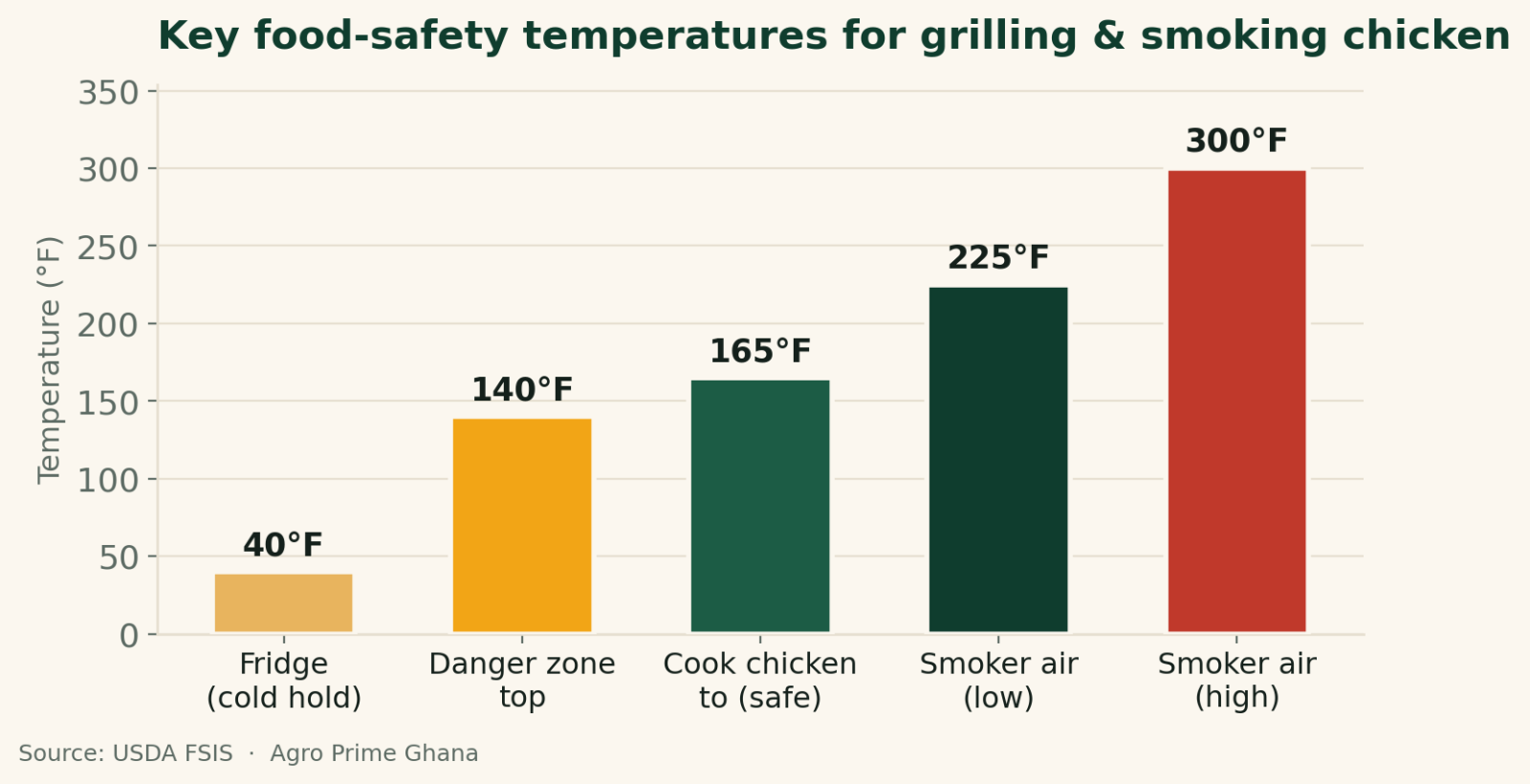
Food safety here comes down to a handful of numbers, all from the same source, and you should treat them as sacred. The USDA Food Safety and Inspection Service sets the safe minimum internal temperature for all poultry at 165°F (74°C), measured with a thermometer in the thickest part away from bone — the temperature that kills Salmonella and Campylobacter. When smoking, FSIS recommends keeping the smoker between 225 and 300°F throughout, hot enough to move the meat through the danger zone at a reasonable pace. The "danger zone" is the band between 40 and 140°F (4–60°C) in which bacteria multiply rapidly. The whole craft of safe grilling and smoking is getting chicken up through that zone and out the top to 165°F, then serving it hot or chilling it fast — never letting it drift back down and sit.
| Temperature / rule | Value | Why it matters for your stand |
|---|---|---|
| Refrigerator (cold hold) | ≤ 40°F (4°C) | Keep raw and cooked chicken here until the last moment |
| Danger zone | 40–140°F (4–60°C) | Bacteria multiply fast; minimise time spent here |
| Hot hold (holding cooked) | ≥ 140°F (60°C) | Keep grilled birds this hot until sold |
| Safe internal (cook to) | 165°F (74°C) | The kill step — check with a thermometer |
| Smoker air temperature | 225–300°F | Keeps meat moving through the danger zone |
| Time out in the open | 2 hrs (1 hr if > 32°C) | Discard cooked chicken left out longer |
Source: USDA FSIS — Smoking Meat and Poultry; Grilling Food Safely.
Choosing your method: grill, smoke or both
Both methods sell well; the right one depends on your setting, fuel and customer. Grilling over charcoal is fast and cheap to start and gives the char and smoke Ghanaians associate with good roadside chicken, so it suits high-turnover spots where birds are cooked and sold within the hour. Smoking is slower and needs a proper smoker or a converted drum, but gives deeper flavour, a longer-keeping product, and the smoked bird that chop bars, caterers and light-soup cooks buy in bulk. Many operators run both. Whatever the method, the meat is not "done" because it looks charred or the juices run clear — it is done when a thermometer reads 165°F. A cheap probe thermometer is the most important tool you will buy.
Field note: what we tell first-time grillers about "looking done"
The most common and most dangerous mistake we see is judging chicken by its outside. A bird can be beautifully browned and smoky on the surface while the meat next to the bone is still pink and under-cooked — especially with the bigger local cocks and spent layers, which have denser meat. Others burn the outside to be "safe" and end up with dry, bitter birds nobody buys twice. The fix is the same either way: buy a food thermometer, push it into the thickest part of the thigh and breast, and cook to 165°F. It removes the guesswork and stops you wasting money on scorched meat.
Field note: in our heat, the clock is stricter than the book
The single rule we drill into anyone new to the trade is time. The standard guidance allows cooked food to sit out two hours, but that drops to one hour once the temperature passes 32°C — and near a charcoal grill on a Kasoa afternoon the air is well past that. So we treat one hour as the ceiling and aim to sell within minutes of cooking: grill in batches you can actually move, keep the next lot raw and cold, and never let unsold birds sit warm "just in case." Fast turnover is not only better business; in our climate it is the safety margin.
Sourcing birds: where your margin is won
Because the customer pays for a finished meal, your profit is set largely by what you pay for the raw bird — so buy well. The cheapest carcasses to grill or smoke are usually spent layers (end-of-lay hens sold cheap once egg production drops) and locally raised broilers such as Cobb or Ross birds bought at farm gate. Spent hens are lean and firm, ideal for smoking and light soup; young broilers are tender and grill quickly. Buying live or freshly dressed birds directly from farms rather than through several middlemen is where the real margin sits, which is why some grillers eventually raise their own broilers — see our guides to raising Cobb 500 broilers and broiler versus layer profit. Whatever you buy, insist on healthy, well-handled birds kept cold from farm to fire.
Food safety from raw bird to sold plate
Safe handling is a chain. Keep raw chicken cold at 40°F (4°C) or below until it goes on the fire, and thaw frozen birds in the fridge or under cold running water, never on the counter. Keep raw and cooked strictly apart: never return grilled chicken to the tray, board or cooler that held it raw, and never brush cooked meat with raw marinade. Once cooked to 165°F, hold birds hot at 140°F (60°C) or above, or chill them fast if they are for later. And respect the clock: FSIS advises discarding perishable food left out more than 2 hours — or just 1 hour above 90°F (32°C) (USDA FSIS, Grilling Food Safely).
Order strong, farm-fresh broilers to feed your grill
The grillers who make the best margins control their bird supply instead of buying at retail through several hands. Agro Prime Ghana supplies healthy day-old broiler chicks and can advise on a simple grow-out so you have a steady flow of the right-sized birds for grilling or smoking. To build your business on a reliable, traceable supply, message us on WhatsApp at +233 24 915 1503 or book a visit to the Kasoa hatchery.
Seasoning, marinades and keeping them safe
Flavour is where you build a following, and Ghana gives you plenty to work with: ginger, garlic, onion, scotch bonnet, suya spice (yaji), curry, thyme, stock cubes, dried pepper and a little oil. A signature marinade or dry rub customers come back for is a genuine competitive advantage — but marinating is also a food-safety step, because raw chicken sitting in seasoning is still raw chicken. Always marinate in the refrigerator, never at room temperature; FSIS notes chicken can be marinated safely in the fridge for up to 2 days. Keep it cold in a covered container, and treat used marinade as contaminated — throw it away, or boil it hard before using it as a baste. Whichever you choose, keep the recipe consistent: customers buy the taste they remember, and a stall that tastes different every week struggles to build repeat trade.
Packaging and selling on
How you present and pack the bird shapes both your price and your safety. For walk-up sales, hot food handed over promptly in food-grade paper or a clean takeaway pack is fine — the key is that it stays hot until it reaches the customer. For smoked chicken sold to chop bars, caterers or households to cook later, cool the birds properly, pack them in clean food-grade material, and keep them chilled through delivery. If you sell packaged, branded, labelled smoked chicken through shops or to institutions, note that pre-packaged processed food is regulated: the Food and Drugs Authority requires such products to be registered before sale, advises on labelling and packaging, and runs a Progressive Licensing Scheme for small and cottage producers. Good record-keeping makes that transition easier, as we cover in record keeping for poultry businesses.
The economics: where the money actually is
The appeal is a fat margin per bird, but your real profit is the finished price minus a stack of small costs that are easy to underestimate: the raw bird (your biggest line), charcoal or gas, seasoning and oil, packaging, transport, your stand or rent, and your own labour. The operators who make real money buy birds cheaply and reliably (often direct from farms), control fuel and portion waste tightly, and position where footfall is already heavy — near stations, offices, drinking spots, markets and events. Volume and consistency beat a high price on a slow corner. Because cash moves fast here, simple daily records — birds bought, birds sold, charcoal used, cash in — tell you whether you are actually profitable or just busy.
The bottom line on smoked and grilled chicken
A smoked or grilled chicken business is one of the most accessible ways for a Ghanaian poultry keeper to earn more from every bird, in a market where demand runs far ahead of local supply. But it lives or dies on discipline. Cook every bird to 165°F (74°C), keep raw and cooked apart, hold food either properly hot or properly cold, and respect the 2-hour (1-hour in the heat) rule without exception. Win your margin at the buying end and position where people already are. Do that consistently and a simple grill can grow from a roadside stand into a genuine agribusiness — one that pulls value all the way back to the farm gate.
Frequently asked questions
What temperature should chicken be cooked to be safe?
Is a smoked chicken business profitable in Ghana?
How long can cooked chicken sit out before it becomes unsafe?
What is the best chicken to use for grilling or smoking?
How should I marinate chicken safely?
What temperature should I run my smoker at?
Do I need FDA registration to sell grilled chicken in Ghana?
How do I keep smoked chicken fresh for delivery to chop bars?
Sources & further reading
- USDA Food Safety and Inspection Service — Smoking Meat and Poultry (safe 165°F internal temperature, 225–300°F smoker range, danger zone, marinating and thawing).
- USDA Food Safety and Inspection Service — Grilling Food Safely (165°F/74°C poultry, 140°F/60°C hot hold, 2-hour and 1-hour rules).
- Ghana Ministry of Food and Agriculture — Revamping the Poultry Sector in Ghana (national demand, local production and import figures).
- Ghana Food and Drugs Authority — Food Registration (registration of processed and packaged foods, Progressive Licensing Scheme).
- Agro Prime Ghana guides: poultry marketing in Ghana, broiler vs layer profit, Cobb 500 broiler guide, and record keeping for poultry farms.
About Agro Prime Ghana
Agro Prime Ghana Limited runs a poultry hatchery and mixed agribusiness in Kasoa, supplying day-old chicks and supporting poultry keepers and food entrepreneurs across the country. We supply healthy day-old chicks (broilers and layers), point-of-lay pullets, quality feed and hands-on farm support, and we help people build value-added businesses on a reliable bird supply. This article is general educational information, not a substitute for professional food-safety or veterinary advice — follow FDA Ghana and food-safety guidance for any food you sell. Ready to start or expand a chicken business? Book a visit or message us on WhatsApp (+233 24 915 1503) to order chicks, feed or advice.


