Agribusiness investment in Ghana carries real risks, and several of them can wipe out a production batch. Animal disease, feed-price swings, bird mortality, falling sale prices, currency moves and weak management can each turn a profitable plan into a loss, and a loss can reduce or eliminate the capital you put in. The most useful protection is to understand them before you pay anything, to ask the operator how each one is handled, and to invest only money you could afford to lose entirely.
This guide is deliberately frank. Agribusiness is often presented as a stable, tangible way to grow money, and parts of that story are true: food is always needed, a farm is a physical asset, and a short production cycle gives fast feedback. But a living animal is not a bank deposit. Its survival, growth and sale price depend on biology, weather, markets and day-to-day management, and each of these can go wrong. Knowing the specific ways it can go wrong is the start of a sound decision.
Written by the Agro Prime Ghana team and reviewed against current market references (Bank of Ghana; Securities and Exchange Commission Ghana public notices). Last updated October 2026. General information, not financial advice.
Key takeaways
The main risks are disease and biosecurity, feed-price volatility, mortality, market price swings, currency movement, interest-rate competition and management or governance failure. Maize and soybean together make up most of poultry feed: maize 50 to 55% and soybean about 30%, according to the Association of Feed Millers of Ghana (reported February 2025). The cedi depreciated 9.5% against the US dollar by September 2026, per the Bank of Ghana. The Securities and Exchange Commission has issued public warnings about unlicensed investment schemes in February and July 2026. Before any investment, get written terms, check who is offering it and what happens to your capital in a loss.
Disease and biosecurity: the risk that moves fastest
Poultry disease is the risk most capable of destroying a batch in a few days. Avian influenza and Newcastle disease are both recognised threats to flocks in West Africa, and a single outbreak can kill birds quickly, force culling and disrupt sales. AllAfrica reported in December 2025 that more than 200,000 birds had been vaccinated across three northern regions, which shows how seriously the sector treats vaccination. Vaccination reduces risk but does not eliminate it, and an outbreak on a neighbouring farm can reach your site through people, vehicles, equipment or wild birds.
Biosecurity is the set of practices that keep disease out: controlled access, footbaths, clean and disinfected houses, rodent and wild-bird control, separate equipment, and a rest period between batches. These practices cost money and time, and they are the first thing a cost-cutting operation may neglect. An investor should ask what biosecurity protocol is in place, how it is audited, and what the operator did after the last disease event, if there was one.
Feed-price volatility: a cost you do not control
Feed is usually the largest running cost, and its price follows the cost of its ingredients. The Association of Feed Millers of Ghana said that maize makes up 50 to 55% of poultry feed and soybean about 30%. Those two ingredients therefore drive most of the feed price, and both are exposed to harvests, weather, transport and currency.
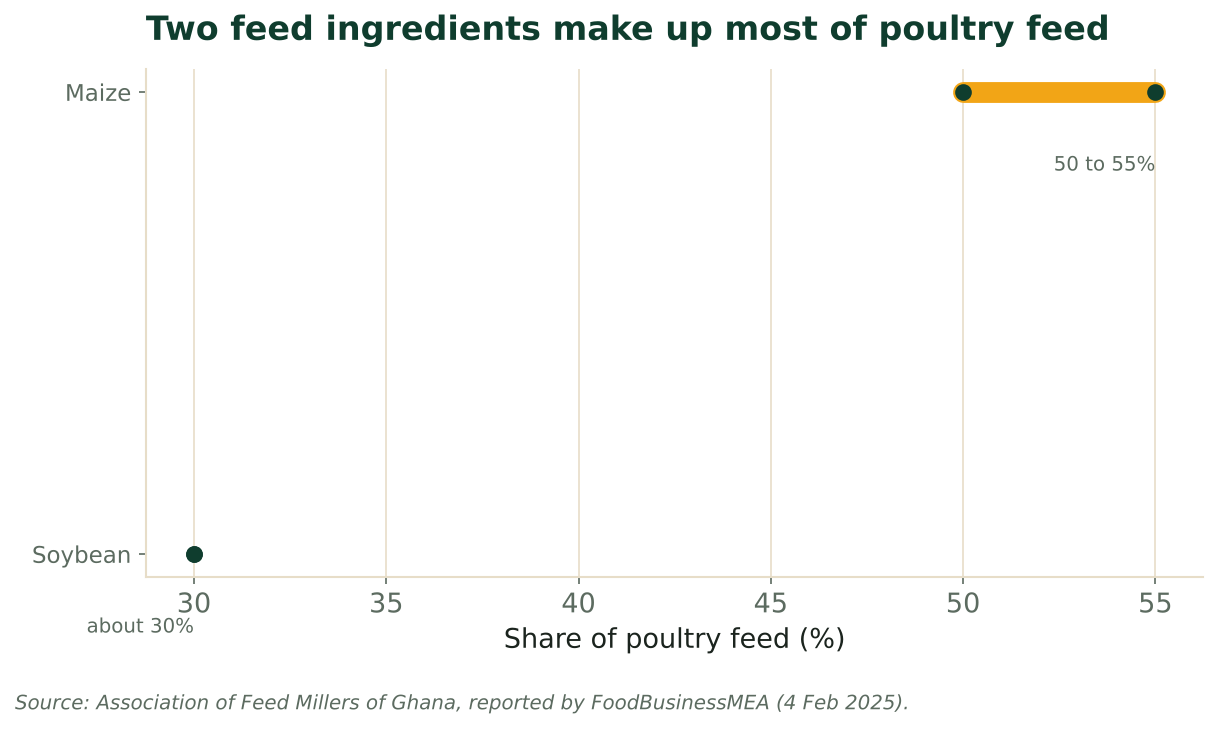
The recent past shows how quickly this can change. Reporting in February 2025 linked sharp feed price increases to drought in northern Ghana, which the Ghana Grains Council said cut maize production by 35%. The same reporting cited a 50-kilogram bag of maize rising from US$16 to US$29 at one point. A farm that locks in a price, buys ahead or passes costs on to buyers can protect its margin. A farm that has no such plan can see its margin disappear in one season. Ask the operator how feed is bought, whether it holds buffer stock and whether it can recover cost increases from its sales.
Mortality and performance: the gap between target and reality
Breeders publish performance targets, and they are useful benchmarks. The 2022 Cobb 500 performance supplement gives a mixed-sex day-42 target of about 3.28 kg live weight at a cumulative feed conversion of 1.555. Those figures assume good conditions and a well-managed flock. On a real farm, birds die, some grow slowly, and feed is wasted. Each of these reduces the sale weight per bird placed or raises the feed cost per kilogram sold.
Mortality is the cost that most first-time investors underestimate, because it looks like a small percentage until you multiply it through the batch. A bird that dies has already consumed feed and carries its share of the chick, housing and labour cost. Ask for mortality by batch, the causes recorded, and how losses are counted. A figure with no method behind it is not a useful figure.
Market price swings: selling is not guaranteed to be profitable
A farm can do everything right and still lose money if the price at sale falls. Many producers may sell into the same market at the same time, and buyers can push prices down when supply is heavy. Imported frozen chicken also sets a price benchmark, so local birds compete with a product whose cost depends on global supply and the exchange rate.
Ask who the buyers are, whether there is a written offtake arrangement, and what happens to the birds if the planned buyer does not take them. A farm that holds birds past their ideal weight pays for extra feed without earning more per kilogram. A farm that sells at a low price to clear its sheds may cover its feed bill but nothing else.
Currency risk: the cedi can move against your costs
Some inputs are imported or priced in line with import costs, including equipment, certain veterinary products and some feed ingredients. The Bank of Ghana reported that the cedi depreciated 7.9% against the US dollar on the interbank market in the first half of 2026. A Bank of Ghana summary cited by MyJoyOnline put the depreciation at 9.5% as of September 2026. A weaker cedi raises the cedi cost of anything priced in dollars, while the sale price of local birds may not rise at the same pace. That gap squeezes the margin.
Currency movements also matter to investors in a different way. If you are an overseas investor, or your capital is in another currency, the cedi value of your return can fall even if the farm performs well in cedi terms. Ask which currency the batch budget and the profit settlement are in.
Interest-rate competition: the opportunity cost of your money
Your capital has alternatives, and the most important is the government's own debt. The Bank of Ghana held its policy rate at 14% on 25 September 2026, and the 91-day and 364-day bills yielded 4.62% and 9.71% in the auction reported on 18 October 2026. A farm investment must offer enough extra return to compensate for its higher risk, lower liquidity and the chance of loss. If it does not, the safer asset is the better choice.
Management and governance: the risk you can most influence
Many agribusiness losses come from management and governance rather than from nature. Records may be incomplete or late. Costs may be charged to a batch without evidence. Money from different batches or activities may be mixed. Profit-share formulas may be unclear, or may depend on terms that change after you pay. A partner may have no clear right to see the accounts, or no clear route out.
These risks can be reduced by asking better questions before you invest. Who holds the money and where is it kept? What is the written formula for profit, and which costs are deducted before profit is calculated? What records will you receive, how often and in what form? Can you see the batch-level accounts? What happens if the operator changes its plans, becomes insolvent or stops trading? A reputable operator should answer these clearly and in writing.
Fraud and unlicensed schemes
Agriculture has been used as a cover for investment schemes that promise high returns with little explanation of how they work. The Securities and Exchange Commission Ghana issued a public notice on 16 February 2026 warning the public against an unlicensed investment scheme involving Mekanism Marketing Ltd. On 15 July 2026 it issued a further notice warning against the Yepbit Exchange and Bonchat platforms, which it described as suspected fraudulent investment schemes. A notice from the regulator is not proof of wrongdoing by every firm that uses similar language, but it is a clear signal to check before paying.
Before you invest, check whether the offering is registered and regulated for what it is, whether the people you deal with are identifiable, whether a written agreement exists, and whether the promised returns come with a clear explanation of the costs and risks. Promises of certain or very high returns are a warning sign in their own right.
| Risk | What it looks like | Questions to ask before you invest |
|---|---|---|
| Disease | Sudden mortality, culling, lost sales | What biosecurity and vaccination schedule is used, and what happened in the last disease event? |
| Feed price | Margin squeezed mid-cycle | How is feed bought and stored, and can cost increases be passed on? |
| Mortality | Fewer birds to sell than placed | What mortality per batch has been recorded, and how is it counted? |
| Sale price | Birds sold below cost | Who buys, on what terms, and is there a written offtake? |
| Currency | Imported inputs rise in cedi terms | What currency is the budget in, and are supplier prices fixed for the quote period? |
| Management | Unclear costs and missing records | Can I see batch-level accounts, and who holds the money? |
| Liquidity | Capital locked until sale or settlement | When is my capital returned, and what is the exit route? |
| Fraud | Guaranteed or very high returns, no written terms | Is the offering registered, and is there a signed agreement? |
Investor note: a profit share is only as clear as its formula
Ask for a worked example that includes a loss, not only a profitable batch. If the formula cannot show what happens when the batch loses money, you do not yet understand the risk you would be taking.
Where Agro Prime fits, and what it does not remove
Agro Prime Ghana runs a hatchery and poultry production in Kasoa, and its partner page invites people to back its farming production through a profit-share on a batch. Agro Prime does not remove the risks in this guide. Disease, feed prices, mortality and sale prices affect its batches as they affect anyone's. A serious partner should offer written terms, batch records, a clear account of costs and an honest explanation of a bad season. We would rather you ask hard questions now than after you have paid.
Next step
Before deciding, read how partnering with Agro Prime works and ask for the full terms in writing. You can message us on WhatsApp (+233 24 915 1503) with your questions, and book a visit to see the operation. Take your time, and do not commit money under pressure.
The bottom line
Agribusiness can be a legitimate way to back production people need, and a short cycle gives fast feedback. It is also a higher-risk option than a Treasury bill, and disease, feed, mortality, price, currency and management risks can each reduce or eliminate your return. Understand how each risk can fail, insist on written terms and clear records, and size any investment so that a total loss would be survivable.
Investor note: warning signs to walk away from
Be cautious of guaranteed returns, pressure to pay quickly, unwillingness to put terms in writing, no clear information about where your money is held, and promises that do not explain costs or losses. Any one of these is a reason to pause.
Related reading: poultry farm cash flow, break-even analysis and the broiler feeding guide.
Frequently asked questions
What is the biggest risk in agribusiness investment in Ghana?
There is no single answer, but disease can destroy a batch quickly, and feed-price swings can erase a margin. Management and governance failures, such as unclear records or unclear profit terms, are often the risks an investor can most influence before paying.
Can I lose all my money in a poultry partnership?
Yes, it is possible. Depending on the written terms, a loss on a batch can reduce or eliminate what you receive and may affect the capital you put in. Read the loss provisions carefully and invest only what you could afford to lose.
How much does feed affect poultry profit?
Feed is usually the largest running cost. Maize makes up 50 to 55% of poultry feed and soybean about 30%, according to the Association of Feed Millers of Ghana, so changes in those ingredient prices flow through to the farm's costs.
What is a realistic mortality rate to expect?
It depends on the chicks, the housing, the biosecurity and the management. Ask for the recorded mortality per batch and how it was counted. Breeder targets describe performance under good conditions, not guaranteed results.
How does the cedi affect agribusiness investment?
Imported equipment, some veterinary products and certain inputs can rise in cedi terms when the currency weakens. The Bank of Ghana reported a 9.5% depreciation against the US dollar by September 2026, which increases input costs in cedi terms.
Are Treasury bills a safer alternative?
They are government securities with a stated yield for a stated term, so they carry much lower risk than a poultry batch. The 91-day bill yielded 4.62% and the 364-day bill 9.71% in the auction reported on 18 October 2026. Yields change at every auction, so check the current rate before deciding.
How can I check whether an investment scheme is legitimate?
Check that it is registered and regulated for what it offers, get a signed agreement, and get costs and loss scenarios in writing. Check the Securities and Exchange Commission Ghana's public notices before paying.
What should I ask an agribusiness operator before paying?
Ask for the written terms, the profit formula, the batch records, the biosecurity protocol, the mortality and feed-conversion history, who holds the money, and how and when you get your capital back. You can message Agro Prime on WhatsApp (+233 24 915 1503) with these questions, or read how partnering works.
Sources & further reading
- FoodBusinessMEA, feed costs and maize and soybean shares in Ghana's poultry sector, 4 February 2025
- MyJoyOnline, cedi depreciation of 9.5% as of September 2026, 23 September 2026
- Ghana News Agency, cedi depreciation of 7.9% in the first half of 2026, 30 August 2026
- AllAfrica, over 200,000 birds vaccinated in three northern regions, December 2025
- Cobb-Vantress, 2022 Cobb 500 Broiler Performance and Nutrition Supplement
- Securities and Exchange Commission Ghana, public notice on an unlicensed investment scheme, 16 February 2026
- Securities and Exchange Commission Ghana, public notice on Yepbit Exchange and Bonchat platforms, 15 July 2026
- Ghana News Agency, Bank of Ghana holds policy rate at 14%, 25 September 2026
- MyJoyOnline, Treasury bill auction report, 18 October 2026
About Agro Prime Ghana & a note on risk
Agro Prime Ghana Limited runs a poultry hatchery and mixed agribusiness in Kasoa and invites partners to invest in its farming production through a profit-share on a production batch. This is general educational information, not financial advice, and investing carries risk including loss of capital. Figures quoted are dated and change; always do your own research or consult a licensed adviser. Explore it: see how it works, book a visit, or message WhatsApp (+233 24 915 1503).