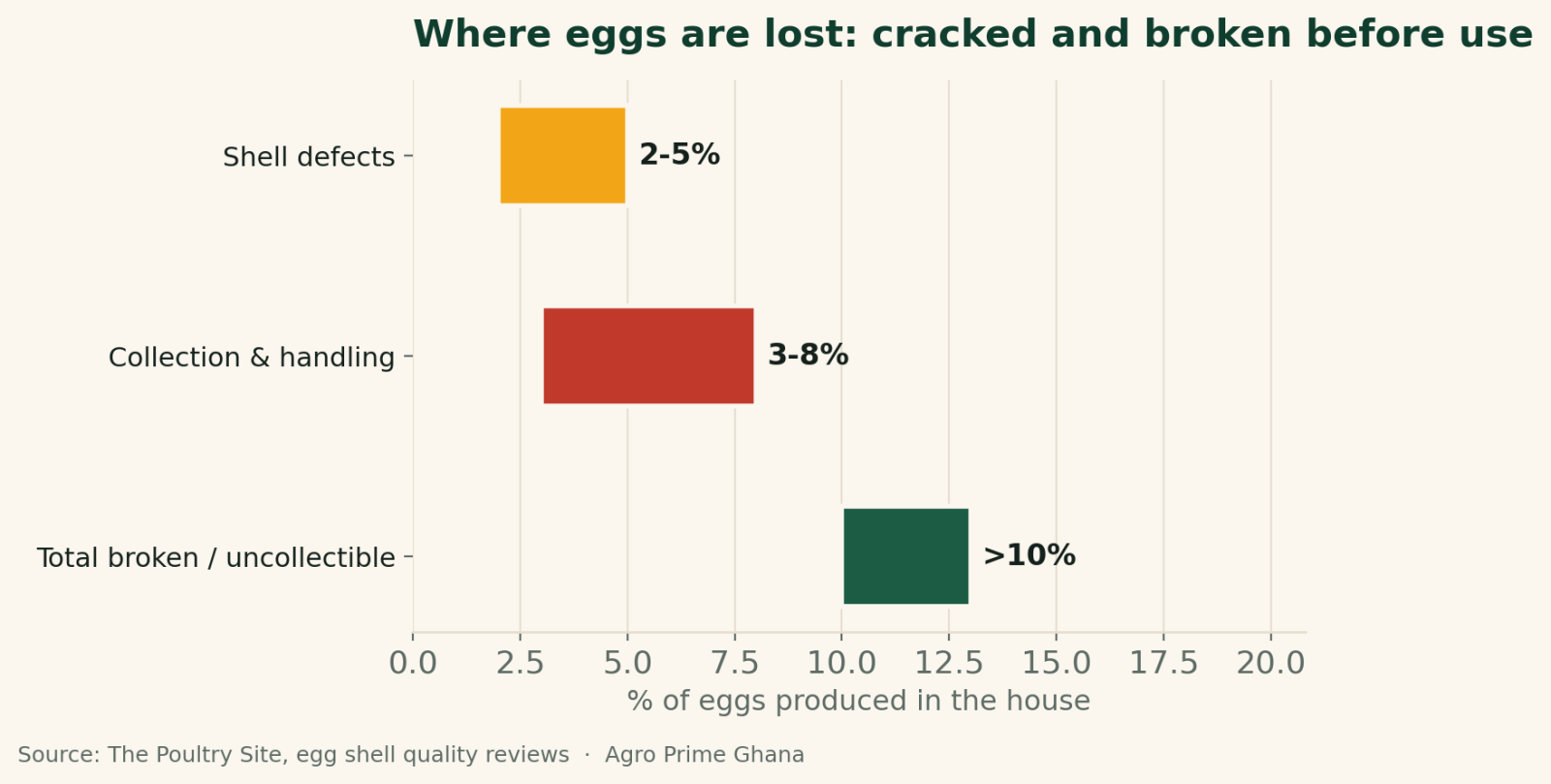
Cracked and broken eggs are cut by fixing two things: shell strength (built from enough calcium, vitamin D and the right feeding around ageing hens and hot weather) and handling (frequent collection, gentle equipment, and careful packing). It matters because breakage is a big, silent loss — industry figures suggest that more than 10% of eggs laid in the house are uncollectible or break before use, with roughly 2–5% lost to shell defects and another 3–8% lost during collection and handling. Every cracked egg is one you fed a hen for 24 hours to produce and now cannot sell at full price — and in Ghana, where late-cycle flocks lay through real heat, thin shells are a year-round battle. This guide explains what makes a shell strong, why cracks happen, and the practical steps that reliably bring your breakage rate down.
Written by the Agro Prime Ghana poultry team and reviewed against current references (The Poultry Site shell-quality reviews and university extension). Last updated September 2026.
Key takeaways
A hen builds each shell from about 2 g of calcium, laid down over roughly 19–20 hours in the shell gland, at up to 100–150 mg per hour. To supply that she needs about 4 g of calcium a day in a layer ration of 3.5–4.0% calcium, ideally with coarse (large-particle) limestone or oyster shell that dissolves slowly overnight when the shell is being formed. Shells weaken with hen age — calcium absorption and mobilisation fall to under half of normal after about 40 weeks — and with heat, because a panting hen develops respiratory alkalosis that starves the shell of carbonate. Breakage totals 10%+ of eggs (about 2–5% from defects, 3–8% from handling). Cut it with good calcium nutrition, cool calm birds, frequent gentle collection, sound equipment and careful packing.
How much of your egg income is cracking away?
The reason cracked eggs deserve real attention is that the losses are large and mostly invisible. Reviews summarised by The Poultry Site estimate that more than 10% of the eggs produced in a hen house are uncollectible or break before their intended use — roughly 2–5% lost to shell defects (thin, cracked or misshapen shells) and a further 3–8% lost during collection, packing and handling. Think about what a cracked egg represents: the hen has spent nearly a full day and about 2 g of her body calcium building it, you have paid for the feed, and then it is downgraded to a cheap "second" or thrown away entirely. On a flock of any size those percentages are a serious slice of gross income disappearing quietly at the nest and the packing table. The encouraging part is that both halves — the shell-quality losses and the handling losses — respond well to management, so a farm running at 10–12% breakage can usually pull it down substantially without buying anything exotic.
What makes an eggshell strong?
A strong shell is the product of a demanding daily manufacturing job, and understanding it shows you every place it can go wrong. The egg spends its final 19–20 hours in the hen's shell gland (the uterus), where calcium carbonate is deposited on it at up to 100–150 mg per hour. All told the shell is about 1.7–2.5 g of mineral — some 94–97% calcium carbonate — forming a layer only about 300–350 micrometres thick that must still resist more than 30 newtons of force. To build one shell the hen deposits roughly 2 g of calcium, and because she uses only about half to sixty per cent of the calcium she eats, she needs around 4 g of calcium in her feed each day to keep shells strong. That is why a layer ration is built to about 3.5–4.0% calcium (against 0.35–0.40% phosphorus) — far more calcium than a growing bird needs. Crucially, much of the shell is laid down overnight, in the dark, when the hen is not eating, so the form the calcium takes matters as much as the amount: coarse, slowly-dissolving limestone or oyster shell stays in the gizzard and releases calcium through the night, whereas fine, fast-dissolving calcium is gone before the shell is finished. This physiology is covered further in our guides to calcium for laying hens and grit and oyster shell.
The three big enemies of shell strength
Most thin-shell and cracking problems come down to three things — hen age, heat, and calcium nutrition — usually acting together.
| Factor | What it does to the shell | What it means on the farm |
|---|---|---|
| Hen age | Older hens lay bigger eggs but calcium absorption and mobilisation fall to under 50% of normal after ~40 weeks; the same calcium is spread over a larger shell | Shells get thinner and breakage climbs as the flock ages — plan extra calcium for late lay |
| Heat stress | Above ~25°C hens pant; panting lowers blood CO₂ (respiratory alkalosis), starving the shell gland of the carbonate it needs | More thin and soft shells in hot afternoons and the dry season — cooling and timing matter |
| Calcium/vitamin D nutrition | Too little calcium, the wrong particle size, or poor vitamin D₃ (needed to absorb calcium) all reduce shell mineral | The most controllable factor — get the ration and calcium source right first |
Hen age: why late-lay flocks crack more
Shell strength declines steadily as a flock gets older, and this is normal physiology rather than a disease. As a hen ages her eggs get larger, but her body puts down roughly the same amount of shell material — so the shell is stretched thinner over a bigger egg. On top of that, the reviews note that a hen's ability to absorb and mobilise calcium falls to less than half of normal after about 40 weeks of age. The result is that a flock which lays beautiful strong shells at 25–30 weeks will, without intervention, crack far more eggs at 60–70 weeks. The practical response is to lift and adjust calcium as the flock ages — many managers add extra oyster shell (on the order of an extra gram per bird) to older hens, and lean harder on coarse-particle calcium fed in the afternoon so there is calcium available all night. Knowing your flock's age and watching breakage climb tells you when to act; keeping simple records, as in our guide to record keeping, makes the trend obvious before it costs you badly.
Heat: the Ghanaian shell-thief
Heat is a particularly important cause of thin shells in Ghana because our layer houses spend much of the year above the comfort zone. When the air rises above roughly 25°C, hens cool themselves by panting — rapid breathing that blows off carbon dioxide. That lowers the level of dissolved CO₂ and carbonate in the blood (a state called respiratory alkalosis), and carbonate is exactly what the shell gland needs to build calcium carbonate. So a panting hen, even one eating plenty of calcium, cannot lay it down properly, and you see more thin, rough and soft-shelled eggs in hot afternoons and through the harmattan-into-hot-season stretch. The fixes are the same ones that protect laying rate in the heat: shade and roof insulation, good ventilation and airflow, plenty of cool clean drinking water, feeding in the cooler parts of the day so intake stays up, and avoiding midday disturbance. Because heat hits both shell quality and production together, it is worth tackling systematically — see heat stress in poultry.
Feeding for strong shells
Nutrition is the lever you control most directly, and getting it right prevents a large share of shell defects. The essentials:
- Enough calcium, in the right ration. A layer feed should carry about 3.5–4.0% calcium so a hen eating normally gets her ~4 g a day. Under-eating birds (in heat, or on poorly balanced feed) fall short even on a correct ration, so protect feed intake.
- Coarse particle size for overnight release. Include a good share of the calcium as large-particle limestone or oyster shell, which sits in the gizzard and dissolves slowly to feed the shell gland through the night when most of the shell is formed. Fine calcium alone is used up too early.
- Afternoon / evening calcium. Offering coarse calcium or oyster shell in the afternoon lines up the supply with the overnight calcification window — the hen absorbs calcium far more efficiently when the shell gland is active.
- Vitamin D₃ and phosphorus in balance. Vitamin D₃ is required to absorb calcium from the gut; a good premix and correct calcium-to-phosphorus balance make the calcium you feed actually usable.
- Don't over-feed calcium to young or growing birds. Excess calcium before point of lay harms the kidneys and does not help; the high-calcium ration is for laying hens, matched to the guides on layer feeding.
Field note: feed the coarse calcium in the afternoon, not just the morning
A change that costs almost nothing and pays quickly is when you offer coarse calcium. Because the shell is built mostly overnight while the hen is off feed, we make sure a portion of the oyster shell or large-particle limestone goes in during the afternoon, so there is slow-release calcium sitting in the gizzard to draw on all night. Farms that give all their calcium first thing in the morning often see thinner shells simply because the mineral is spent by evening. It is the same feed — just timed to match how the hen actually makes a shell.
Stronger shells start with the right feed and the right pullets
Thin shells and high breakage are usually a feed-and-management problem, and Agro Prime Ghana is set up to help you fix it. We supply quality layer feed with proper calcium and shell support (including coarse-particle calcium sources), point-of-lay (POL) pullets bred for good production, and hands-on advice on calcium timing, heat management and gentle handling to cut your cracked-egg rate. If breakage is eating into your crates, message us on WhatsApp (+233 24 915 1503) or book a visit and we will help you get the ration, the birds and the routine right.
Handling and equipment: stopping cracks after the egg is laid
Even a perfectly strong shell cracks if the egg is mishandled, and remember that 3–8% of eggs are lost during collection and handling — often more than are lost to shell quality itself. This half of the problem is pure management:
- Collect often and gently. Frequent collection means fewer eggs piling up in a nest where hens trample and crack them. Handle eggs calmly; rushing and rough tipping cause cracks.
- Keep nests well-bedded. Soft, clean nest material cushions eggs as they are laid and as hens settle. Bare or hard nest floors crack eggs on contact.
- Reduce floor and slat eggs. Eggs laid on hard floors or slats crack far more than nest eggs — train hens to nests and provide enough of them.
- Maintain your equipment. In cage or roll-out systems, check that egg belts, roll-out floors and collection channels are smooth, correctly angled and not jammed; worn or misaligned equipment cracks eggs by the tray. Cushion collection points.
- Pack carefully in good crates. Use clean, sound crates, do not overstack, set eggs pointed-end down, and avoid rough loading. Transport over Ghana's rough roads is a major crack point — cushion and secure loads, as covered in transporting eggs.
A useful discipline is to find out where your cracks happen: candle or inspect a sample of eggs at the nest, again after collection, and again after packing. If most cracks are already there at the nest, the problem is shell quality (feed, age, heat); if eggs are sound at the nest but cracked after collection or transport, the problem is handling and equipment. Fixing the right half is what brings the number down.
The bottom line on reducing cracked and broken eggs
Cracked eggs are two problems wearing one disguise: weak shells and rough handling. Build strong shells by feeding a proper layer ration of about 3.5–4.0% calcium, delivering a good share of that calcium as coarse limestone or oyster shell offered in the afternoon so it is available through the overnight shell-forming window, keeping vitamin D₃ and phosphorus in balance, and lifting calcium as the flock ages past its prime. Protect those shells from Ghana's heat with shade, ventilation, cool water and cooler-hour feeding so hens are not panting away the carbonate their shells need. Then stop cracking the good shells you have made: collect often and gently, keep nests soft, maintain smooth equipment, and pack and transport with care. Track where your cracks are actually happening so you fix the real cause. Get both halves right and you turn a 10%-plus loss into a manageable few per cent — recovering eggs, and income, that were quietly slipping away.
Frequently asked questions
What causes thin or weak eggshells?
How much calcium does a laying hen need?
Why do older hens lay more cracked eggs?
How does heat cause thin shells?
Does the type of calcium matter, or just the amount?
What percentage of eggs are normally cracked or broken?
How do I stop eggs cracking during collection and transport?
Can I improve shell quality quickly, or does it take time?
Sources & further reading
- The Poultry Site — Maintaining Egg Shell Quality (shell composition, breakage percentages, specific gravity, calcium content).
- The Poultry Site — Factors Influencing Shell Quality (shell-gland calcification time, daily calcium requirement, age decline, heat-stress alkalosis, calcium particle size and timing).
- Agro Prime Ghana guides: calcium for laying hens, grit and oyster shell, heat stress in poultry, and transporting eggs.
About Agro Prime Ghana
Agro Prime Ghana Limited runs a poultry hatchery and mixed agribusiness in Kasoa, supplying point-of-lay pullets, day-old chicks, quality layer feed with calcium and shell support, and hands-on farm advice across Ghana. These guides combine practical farm experience with current industry references. This article is general educational information, not a substitute for professional veterinary or nutritional advice. Struggling with cracked eggs? Book a visit or message us on WhatsApp (+233 24 915 1503) to sort out feed, calcium and handling.