Vent prolapse — sometimes called "blowout" — is when part of a laying hen's oviduct or cloaca pushes out through the vent and fails to slip back in after she lays an egg. It is one of the most preventable causes of layer death, and one of the most dangerous once it starts, because penmates will peck the exposed red tissue and can literally pull the bird's insides out. The classic Ghanaian scenario is a young flock lit and pushed into lay too early and too heavy: pullets start laying large eggs before their bodies are ready, one or two prolapse, the others peck, and within days you are pulling dead and dying birds out of the nest boxes. The good news is that prolapse is overwhelmingly a management problem — set body weight, lighting and calcium right, and it nearly disappears. This guide explains what causes it, what to do the moment you spot it, and how to design it out of your flock.
Written by the Agro Prime Ghana poultry team and reviewed against current veterinary references (MSD Veterinary Manual and breed management guides). Last updated September 2026.
Key takeaways
Prolapse happens when the oviduct or cloaca fails to retract after an egg is laid. The big risk factors, per the MSD Veterinary Manual, are coming into lay too early (birds too small/immature), excessive or premature lighting, obesity/excess body fat, oversized or double-yolked eggs, poor body-weight uniformity and overcrowding. The deadly complication is cannibalism: flockmates peck the protruding tissue, and in a "peckout" the whole oviduct and even intestine can be pulled out, killing the hen. First response: isolate the affected hen immediately, clean the tissue, and reduce her lighting/energy to slow laying. Prevention is the real cure — bring pullets into lay at the correct body weight (about 1.35–1.40 kg for a brown layer), never light immature birds, feed enough calcium (roughly 4.2–4.8 g/hen/day rising with age), avoid obesity, and stop overcrowding. Beak trimming limits the cannibalism that turns one prolapse into many deaths.
What vent prolapse actually is
When a hen lays, the lower oviduct and cloaca briefly turn outward at the vent to deliver the egg, then retract back inside — this is normal and happens with every egg. Prolapse is when that tissue fails to retract and stays exposed. The MSD Veterinary Manual describes it as slow retraction of prolapsed tissue, typically "due to obesity or to poor development (hens that come into lay too early)." Once the tissue is out and cannot pull back, it swells, which makes retraction even harder, and it becomes a vivid red target hanging at the back of the bird. That is the point at which prolapse turns from a recoverable problem into a killer, because the flock's instinct to peck at anything red and bloody takes over. Understanding the mechanism matters, because it tells you exactly what to fix: anything that makes a hen strain harder, lay eggs too big for her frame, or carry too much fat around the vent will push her toward prolapse.
Why prolapse is so common in young Ghanaian flocks
Prolapse concentrates at the start of lay, and that is precisely where many Ghanaian flocks are mismanaged. The single biggest driver is bringing pullets into production before their bodies are ready. Modern brown layers are bred to start laying on a light signal, and if you give that signal — by increasing day length, or simply by rearing under long natural light — while the birds are still underweight and immature, they begin laying before their frame, vent and muscle tone can cope. The MSD Veterinary Manual lists excessive or premature photostimulation, early laying, poor body-weight uniformity, large and double-yolked eggs and obesity as the core causes. Each of these is common here: pullets reared without a controlled lighting plan; flocks that are uneven in size so the small ones are pushed by the group's lighting; and birds carrying too much fat on unbalanced home-mixed rations. Overcrowding adds the final ingredient — it concentrates birds, raises stress and stocking density (an MSD-listed risk), and guarantees that when one hen prolapses, dozens of others are close enough to peck her. Get the lighting and body-weight programme right and you remove most of the problem at the source; our guides to poultry lighting programmes and layer body-weight targets go into the detail.
| Risk factor | Why it causes prolapse | What to do instead |
|---|---|---|
| Lighting immature pullets | Forces lay before the body can cope; the classic trigger | Only increase light once birds hit target body weight (~1.35–1.40 kg) |
| Underweight / uneven flock | Small hens lay eggs too big for their frame and strain | Grade for uniformity; hit weight-for-age targets before lay |
| Obesity / excess fat | Fat around the vent blocks the oviduct from retracting | Balanced ration; avoid over-rich home mixes; control body weight |
| Oversized / double-yolk eggs | Stretch and injure the vagina, preventing retraction | Avoid over-stimulating young flocks; correct energy/protein |
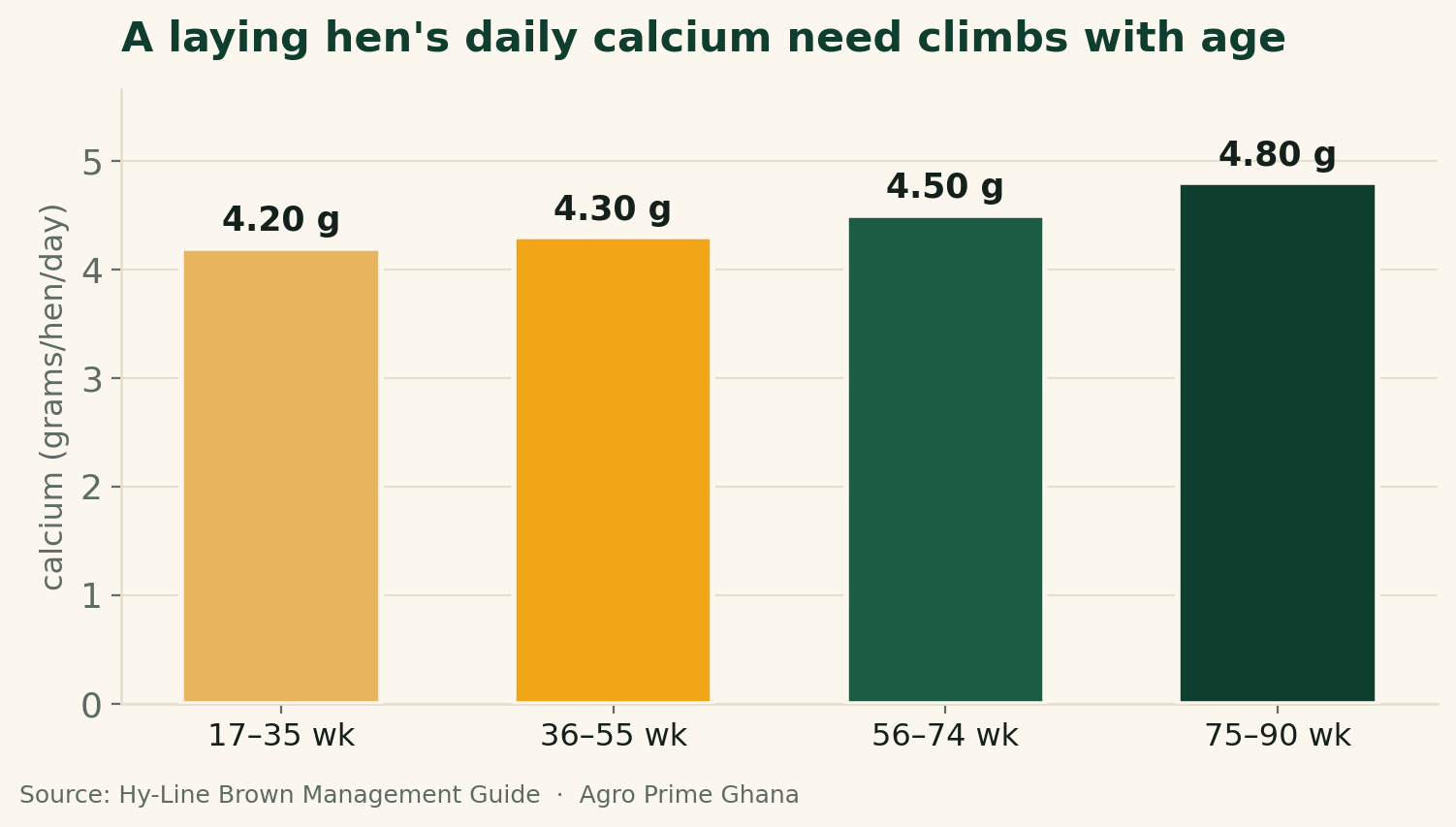
| Low calcium / poor muscle tone | Weakens the straining and retracting muscles around the vent | Feed adequate calcium (4.2–4.8 g/day), with coarse oyster shell |
| Overcrowding | Raises stress and puts peckers next to every prolapse | Correct stocking density; enough nest boxes and space |
How to recognise prolapse early
Caught early, a prolapsed hen can sometimes be saved; caught late, she is usually dead or destroyed by pecking. Look for a hen with a red, moist mass of tissue protruding from the vent, often with some blood discharge. Affected hens frequently hide in the nest boxes and sit apart from the flock. The most urgent early warning, though, is behavioural and social: a cluster of birds crowding and pecking at one hen's rear end almost always means a prolapse (or a fresh vent injury) underneath. Blood on eggs, on the vent feathers of several birds, or on your hands at collection is another red flag that pecking has started somewhere in the house. Because prolapse and vent pecking feed each other, the earlier you intervene the more birds you save — one untreated prolapse can teach a whole pen the habit of pecking at vents.
Field note: the first prolapse is a flock alarm, not a one-off
When we find a prolapsed or vent-pecked hen in a young flock, we treat it as a signal about the whole house, not just that one bird. It usually means the flock came into lay a little too early or too heavy, or that lighting outran body weight — and where there is one, more are coming. So alongside dealing with the affected hen, we check the recent lighting steps, weigh a sample of birds against target, and look hard at stocking density and nest-box access. Fixing the individual without fixing the cause just buys you a steady trickle of new cases.
First response: what to do the moment you find a prolapse
Speed and isolation are everything. The MSD Veterinary Manual's guidance for treatable cases centres on stopping the pecking and slowing the laying so the tissue can recover. In practical farm terms:
- Isolate the hen at once. Remove her from the flock immediately — this is the single most important step, because it stops cannibalism turning a recoverable prolapse into a fatal peckout.
- Clean and protect the tissue. Gently clean the exposed tissue, keep the vent area clean, and (where appropriate) apply a lubricant; handle calmly to reduce straining.
- Slow her down. Reduce laying stimulus by cutting her light and lowering dietary energy, giving the tissue a chance to retract and heal rather than being pushed to lay again immediately.
- Keep her quiet and separate until the tissue retracts and stays in. Some hens recover; badly damaged or repeatedly prolapsing birds are usually culled on welfare and economic grounds — the MSD manual notes commercial hens are typically culled.
Be realistic: a severe prolapse, especially one already pecked, has a poor outlook, and the kindest and most economic decision is often prompt culling. The bigger win is always upstream — the changes that stop the next hen prolapsing at all.
Prevention 1 — body weight and lighting: the master controls
The most powerful prevention is refusing to bring pullets into lay before they are physically ready, and this comes down to two linked levers: body weight and lighting. Modern brown layers should reach a target body weight of roughly 1.35–1.40 kg before you give the lighting signal to start laying, and breed guides such as the Hy-Line Brown management guide are explicit that light stimulation should begin only when the flock reaches its body-weight target — not at a fixed calendar age. Light a flock before it hits weight and you get exactly the early, straining, oversized-egg lay that causes prolapse. Two rules follow. First, never increase day length for immature or underweight pullets, and in open Ghanaian houses be aware that long natural daylight can itself over-stimulate a young flock — a proper lighting plan controls this. Second, chase uniformity: a flock where birds vary widely in size means the smallest are dragged into lay by the group's light while still far under target, and those are your prolapse cases. Weigh samples regularly and grade uneven flocks. For the underlying programme, see point-of-lay pullets and layer body-weight targets.
Prevention 2 — calcium and nutrition
Nutrition prevents prolapse from two directions: it stops obesity, and it keeps the muscles that expel and retract the egg working properly. On the fat side, over-rich or poorly balanced rations lay down excess body fat, and fat around the vent physically blocks the oviduct from retracting — a direct MSD-listed cause. On the muscle side, calcium matters, because a laying hen needs adequate calcium not only for shell but for the muscle tone and contractions involved in laying; a hen short of calcium strains harder and tires, raising prolapse risk. A modern brown layer's calcium requirement is high and rises with age, from about 4.2 g/hen/day in early lay to around 4.8 g/day in late lay (Hy-Line Brown guide), and much of it should be supplied as coarse-particle oyster shell or limestone so calcium is released slowly overnight when the shell is being formed. The practical prevention package: feed a properly balanced layer ration from point of lay, provide coarse calcium, avoid over-feeding energy that pushes obesity, and do not switch birds onto a full layer (high-calcium) diet long before they actually start laying. Our guides to calcium for laying hens and layer feeding cover the ration side in full.
Field note: don't let daylight do your lighting for you
In many open-sided Ghanaian layer houses there is no deliberate lighting programme at all — the birds simply follow whatever the sun does. That works against you at the start of lay, because long natural days can stimulate a young, underweight flock into production before it is ready, which is a straight route to prolapse. What we watch for is a flock hitting lay noticeably early, laying a run of oversized eggs, and then throwing up its first blowouts. The fix is to think about light deliberately from rearing onward — controlling stimulation until the birds reach weight — rather than discovering the problem in the nest boxes.
Stop prolapse before it starts — get the pullets right
Most prolapse traces back to pullets brought into lay too early, too light or too uneven — problems that are decided during rearing, long before the first egg. Agro Prime Ghana supplies well-reared point-of-lay pullets raised to breed body-weight targets, plus balanced layer feed with proper calcium and advice on lighting and the switch to lay. If your flock is prolapsing, we can help you check body weight, lighting and calcium against target and put it right. Message us on WhatsApp (+233 24 915 1503) or book a visit for pullets, feed or a flock check.
Prevention 3 — controlling cannibalism
Prolapse and cannibalism are two halves of the same disaster: the prolapse creates the wound, and the flock's pecking turns it fatal and then contagious. The MSD Veterinary Manual is blunt about the consequence — when birds peck the protruding organ, "the complete oviduct and parts of the adjacent intestinal tract may be pulled from" the body in a peckout, causing fatal bleeding and shock. Worse, vent pecking is a learned habit that spreads through a house once it starts. Controlling it protects both the individual prolapsed hen and the whole flock. The measures that work overlap heavily with general anti-cannibalism management: beak trimming (MSD lists it as a key prevention), correct stocking density so birds are not crowded, adequate feeder and drinker space, reducing light intensity where pecking is a problem, and removing any bleeding or prolapsed bird from the flock immediately so she cannot become a target and a teacher. Our full guide to cannibalism and pecking details the wider toolkit.
The bottom line on prolapse
Vent prolapse looks like a medical emergency, but it is really a management verdict delivered at the vent: it tells you a flock was brought into lay too early, too heavy, too uneven, or too crowded. The chain is predictable — premature lighting or underweight birds lead to early, straining, oversized-egg lay; the tissue fails to retract; and cannibalism finishes the job and spreads the habit. So while the emergency response is to isolate the affected hen fast, clean the tissue and slow her laying, the real cure sits upstream. Bring pullets into lay only at target body weight, never light immature birds, chase flock uniformity, feed a balanced ration with enough calcium as coarse oyster shell, avoid obesity and overcrowding, and control cannibalism with beak trimming and space. Do these things and prolapse stops being a recurring source of dead hens and becomes a rare, manageable event — which is exactly what it should be.
Frequently asked questions
What causes vent prolapse in laying hens?
What should I do first when I find a prolapsed hen?
How is prolapse linked to cannibalism?
At what body weight should pullets start laying to avoid prolapse?
Does calcium affect prolapse risk?
Can a prolapsed hen recover?
Why do young flocks prolapse more than older ones?
How do I prevent prolapse across the whole flock?
Sources & further reading
- MSD Veterinary Manual — Prolapse of the Oviduct in Poultry (causes, cannibalism/peckout, prevention).
- MSD Veterinary Manual — Common Management-Related Problems in Backyard Poultry (cloacal prolapse, obesity, early lay, treatment, cannibalism).
- Hy-Line Brown — Commercial Layer Management Guide (body-weight targets, light stimulation at weight, calcium requirements by age).
- Agro Prime Ghana guides: poultry lighting programmes, calcium for laying hens, and cannibalism and pecking.
About Agro Prime Ghana
Agro Prime Ghana Limited runs a poultry hatchery and mixed agribusiness in Kasoa, supplying day-old chicks and working alongside poultry keepers across the country. We supply healthy day-old chicks (broilers & layers), point-of-lay pullets, quality layer feed and hands-on farm support across Ghana. This article is general educational information, not a substitute for diagnosis and treatment by a qualified veterinary or extension officer — if your flock is prolapsing or being cannibalised, get it seen and act on the management causes. Need pullets, layer feed or a flock check? Book a visit or message us on WhatsApp (+233 24 915 1503).